
Oslo at Christmas
The best Christmas market in Oslo only runs for four days, and in my opinion it’s worth building the whole trip around them.
They fall on the first two weekends of December, when Norsk Folkemuseum out on Bygdøy fills its open-air village of turf-roofed farmhouses with more than 100 stalls, folk dancers and lefse baked on wood stoves.
The Oslo Christmas market in town, Jul i Vinterland, runs for two months and is a much smaller, simpler thing.
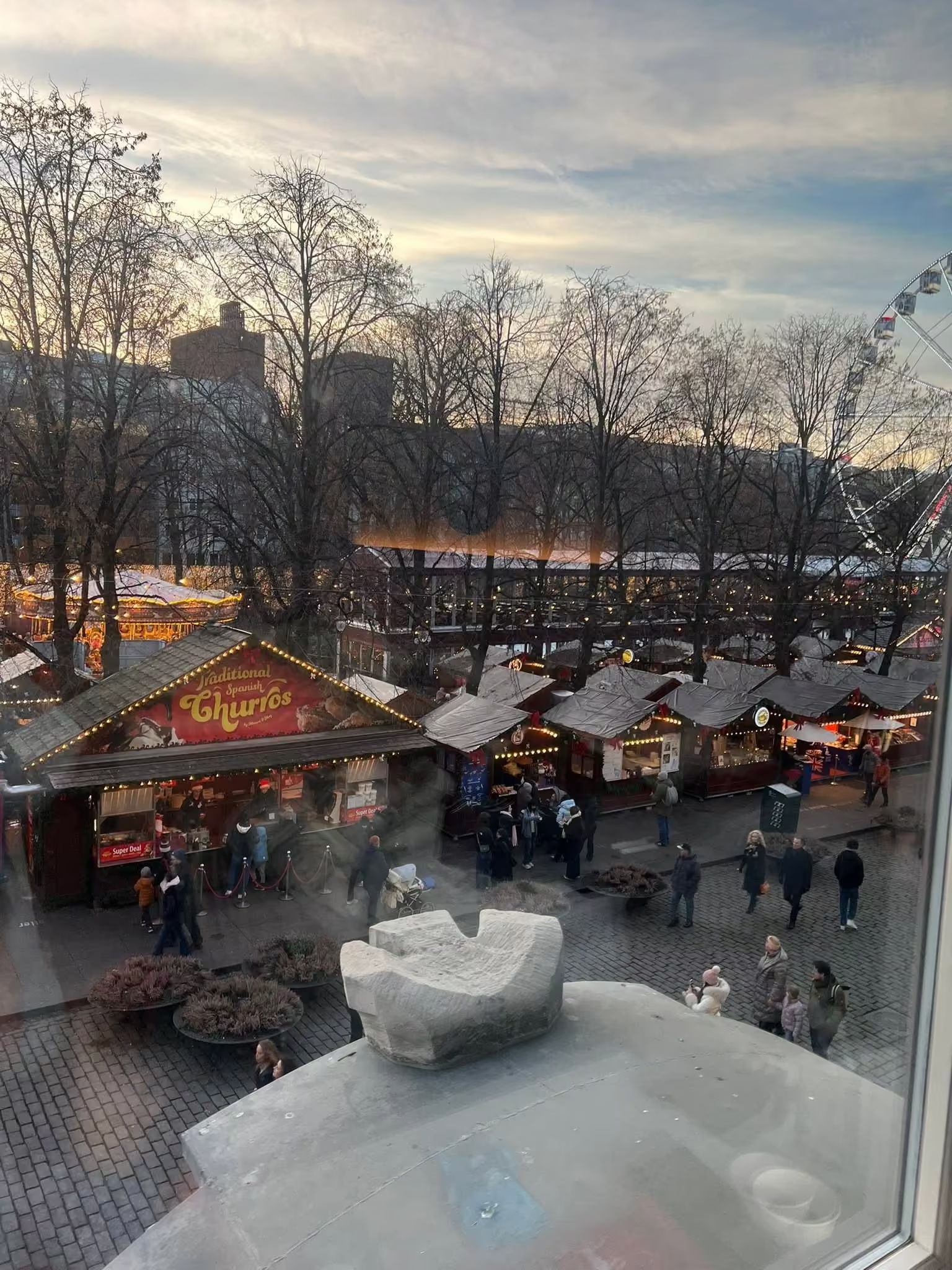
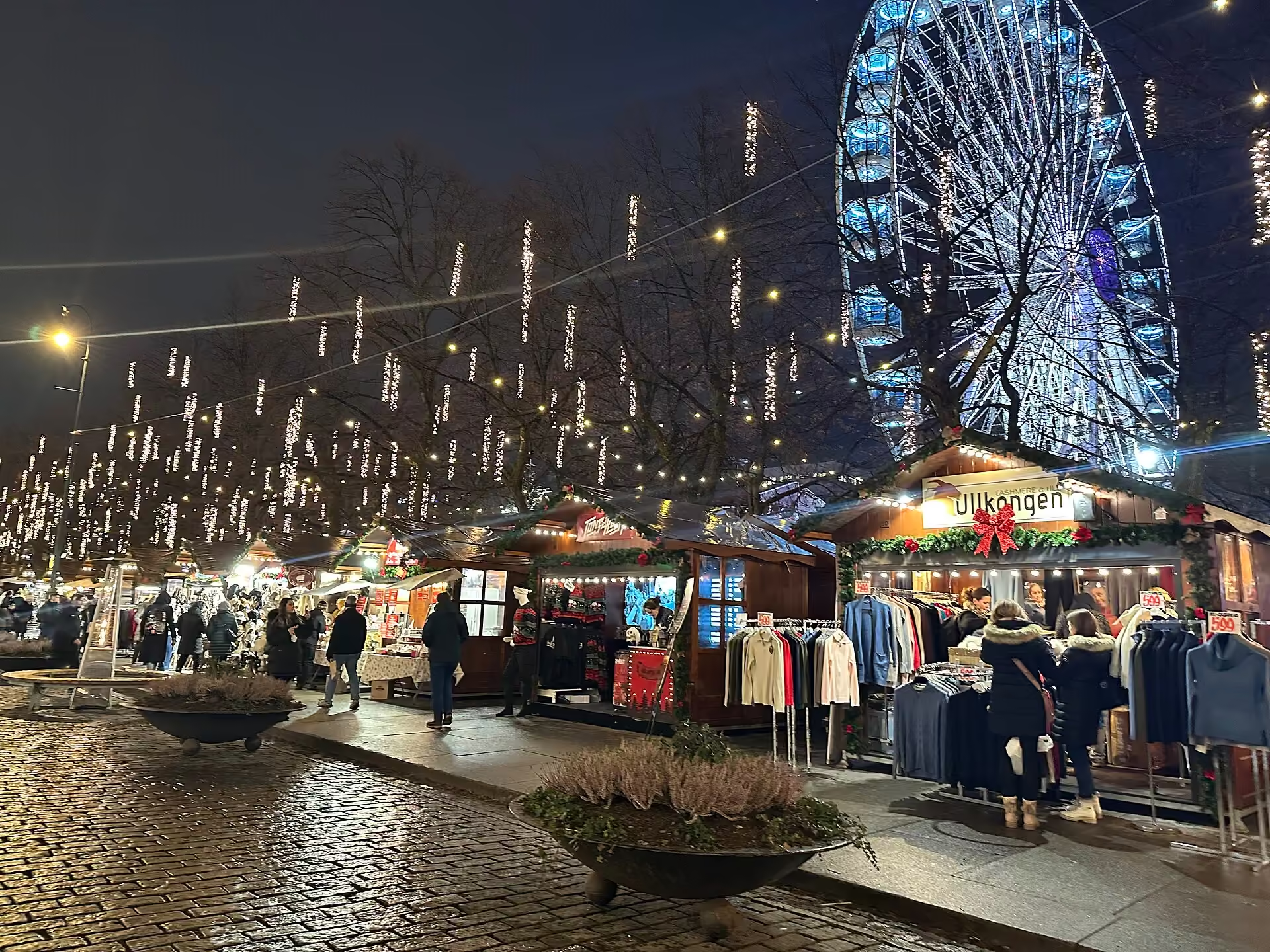
It’s two rows of wooden huts down the park strip on Karl Johans gate below the parliament, with a free ice rink, a Ferris wheel and a tunnel of lights, and an hour is plenty for all of it.
It’s commercial, like one of the big Vienna markets shrunk down to a single park strip, but it still makes for a good evening, and on the days the museum is closed, it’s the market you’ve got.
When Is the Oslo Christmas Market 2026?
The Oslo Christmas market at Spikersuppa runs from Saturday 7 November 2026 to Sunday 3 January 2027, and entry is free. It’s open every day of that run but one.
The Norsk Folkemuseum fair gets just four days, 5, 6, 12 and 13 December, from 10:00 to 16:00. Adults pay NOK 200 and under-18s go free, and those are the dates I’d fix first and fit everything else round.
Spikersuppa is easy to fit round them. It opens 12:00 to 20:00 Monday to Thursday, 12:00 to 21:00 on Fridays, 10:00 to 21:00 on Saturdays and 10:00 to 20:00 on Sundays, so don’t turn up before noon on a weekday, because you’ll find it shut.
The week before Christmas breaks that pattern, with 11:00 to 21:00 on 21 and 22 December and 11:00 to 18:00 on the 23rd.
Christmas Eve is the one day it shuts, and then it’s open on Christmas Day and Boxing Day, 11:00 to 20:00. That’s rare for a Nordic market, and it means you’ve still got a market to walk to if you’re in Oslo for Christmas itself.
It keeps those 11:00 to 20:00 hours up to 30 December and closes at 18:00 on New Year’s Eve. From 1 January it doesn’t open until 12:00, and on the last day, 3 January, it shuts at 18:00.
| Date | What’s on |
|---|---|
| Sat 7 Nov | Jul i Vinterland opens at Spikersuppa |
| Sat 28 Nov | The free rink opens at 17:00 |
| Sun 29 Nov | City Christmas tree lit at Universitetsplassen, 17:00 to 19:00 |
| Sat 5 to Sun 6 Dec | Norsk Folkemuseum Christmas fair, first weekend |
| Sat 5 Dec | Christmas day at Frogner Manor, 11:00 to 16:00 |
| Sat 12 to Sun 13 Dec | Norsk Folkemuseum Christmas fair, second weekend |
| Sun 13 Dec | Lucia morning concert at Grønland Church, 08:30 |
| Wed 23 Dec | Spikersuppa closes at 18:00 |
| Thu 24 Dec | Spikersuppa closed |
| Fri 25 to Wed 30 Dec | Spikersuppa open 11:00 to 20:00 |
| Thu 31 Dec | Spikersuppa open 11:00 to 18:00 |
| Fri 1 to Sat 2 Jan | Spikersuppa open 12:00 to 20:00 |
| Sun 3 Jan | Last day at Spikersuppa, 12:00 to 18:00 |
| From Mon 4 Jan | Closed until next season |
The Christmas Fair at Norsk Folkemuseum (Four Days Only)
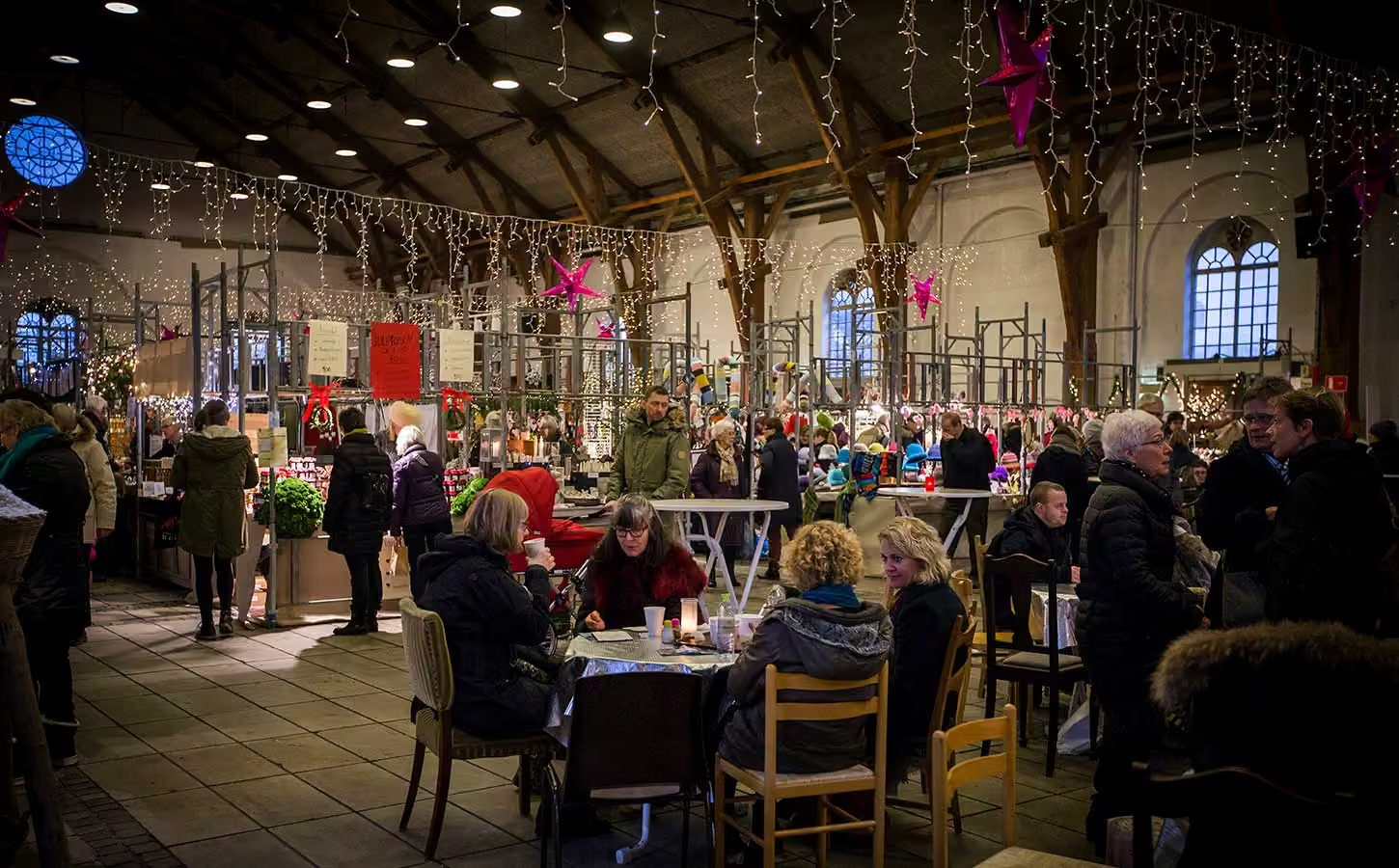
Oslo’s open-air museum is a village of old houses brought here from all over Norway. For two December weekends they’re dressed for the Christmas of their own era, anywhere from 1769 to 1959, with hosts in period costume, candle dipping and Christmas ale brewing in Hardangertunet.
I love that you can walk from an eighteenth-century Christmas to a 1950s one in a single morning.
The first thing I’d go for is a lefse, the soft Norwegian flatbread, baked on wood stoves in the old fire houses from Numedal and Telemark, and I’d want one warm in my hand before I’d looked at a single stall.
The fair has more than 100 of them, and in the Old Town streets a potter, a weaver, a silversmith and a candle-maker are at work, so that’s where I’d do my present shopping. The handmade stalls are a big part of why this feels like Oslo’s real Christmas market.
Out at Santa’s farmstead the children get Christmas porridge, folk dancers take over the open-air stage and a horse and carriage does the rounds for NOK 50, so no wonder the fair is packed with families.
It’s at its busiest from 12:00 to 14:00, which is why you should plan on the 10:00 opening and have your lefse before the midday rush.
Getting there for 10:00 means the bus, because there’s no parking. Bus 30 from Jernbanetorget runs every five minutes on fair days, and there’s a free shuttle from Skøyen station too.
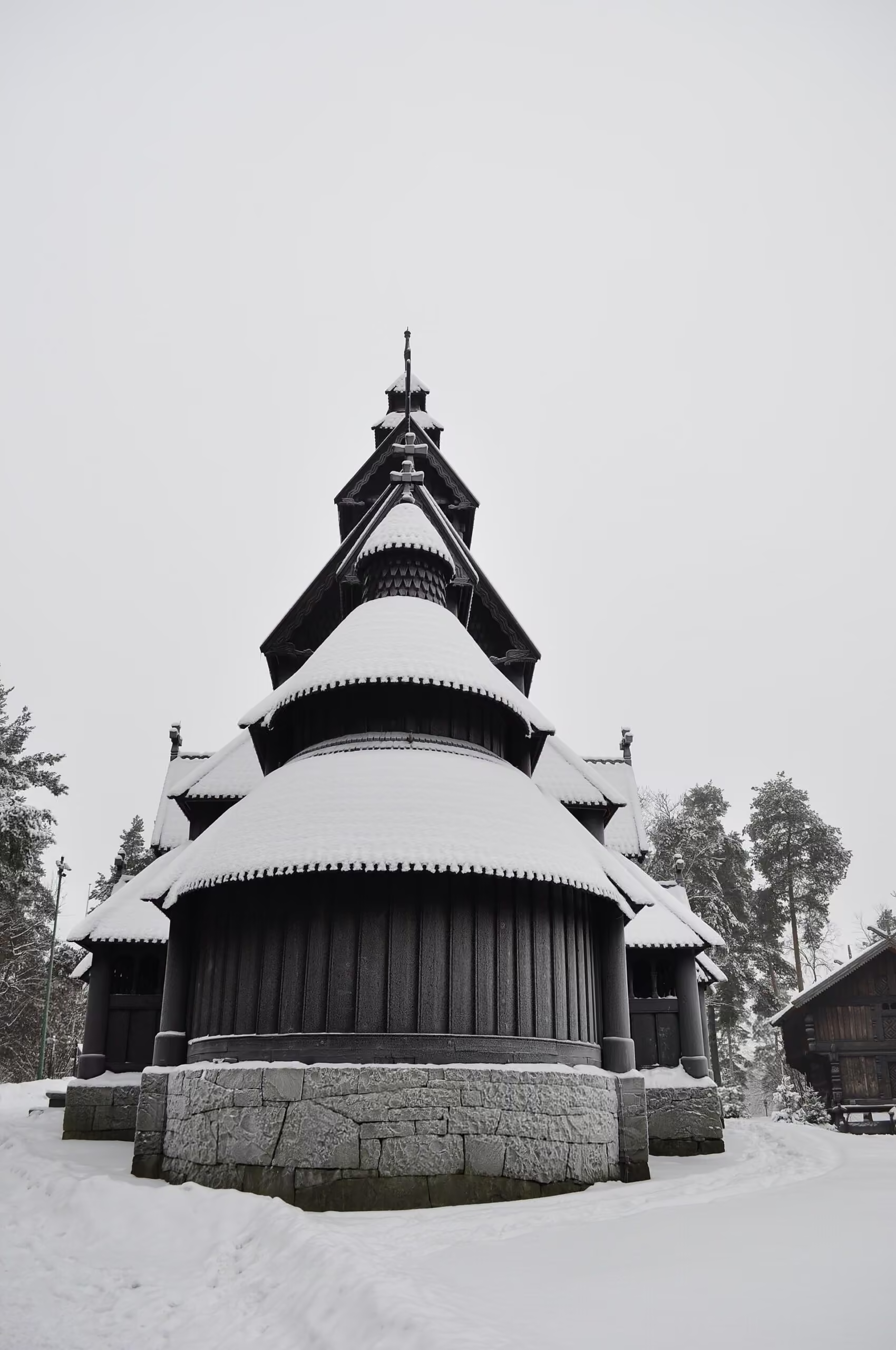
Getting back is harder, because the return bus can be packed at closing. The sun’s down by about 15:15 on the fair weekends, so stay to see Gol stave church lit up in the first of the dark, and then try to leave a little before 16:00.
Jul i Vinterland on Karl Johans gate
Spikersuppa is the park strip between the parliament and the National Theatre, and Jul i Vinterland fills it with 42 exhibitors in two rows, a Ferris wheel at the western end and a free rink in the old pond.
The stalls are the weak part, very touristy and light on anything local. The one I’d stop at anyway is the giant chocolate wheel, where you spin for a two-kilo slab of chocolate.
I’ve no idea who eats the prize, but it’s the most cheerfully ridiculous thing on Karl Johans gate.
The market gets better after dark, which in mid-December means from about 15:30. That’s when I’d climb to the top floor of the Gløgghus, where the balcony looks straight down over the rink and the wheel, because the upstairs seats are the best spot in the market.
They’re hard to get on a busy evening, so weekday evenings and the days between Christmas and New Year give you the best chance of one. If the balcony’s full, there’s a fireplace downstairs.
Evening is the wrong time for the rink, though, because the ice is cut up by then, so try to skate in the afternoon while it’s still smooth. It’s free if you bring your own skates, and it opens on 28 November.
What to Eat and Drink at the Oslo Christmas Market
The best Christmas market food in Oslo is out at the Folkemuseum, if your dates line up, so save your appetite for Bygdøy.
Norway is expensive, and there’s no getting round it, so in town I’d treat Spikersuppa as a place for a mug of gløgg rather than dinner.
If you do get hungry, head for the handful of Norwegian stalls, Spekestua for cured meats, Lakseboden for salmon and Viggos for smultringer, the local doughnuts. Most of the rest is international street food, from churros and caramel apples to Korean corndogs and bao.
These were the most recent prices, from 2024, and almost every stall takes cards and phone payments.
- Smultringer were NOK 49 for four, cheaper than one cup of gløgg, so they’re the first thing to buy.
- Gløgg was NOK 59, and the alcoholic version has to stay in the Gløgghus. The non-alcoholic one is sold all over the market.
- A moose kebab was NOK 219, and it comes wrapped in lefse, so it’s the nearest thing in town to the Folkemuseum, though you’ll feel the price.
- A sausage was NOK 99, which is Oslo prices for you.
- A waffle was NOK 55, one of the cheaper warm snacks on the strip.
- Brente mandler, sugar-roasted almonds, were NOK 60.
Things to Do in Oslo in December
A floating sauna on the fjord tops my list for Oslo in December.
- Oslo Badstuforening runs floating saunas along the harbour from 07:00 to 23:00 in all weathers, and Langkaia, opposite the Opera House, is five minutes from Oslo S. Bring a towel and sandals for the icy decks.
- Korketrekkeren is a two-kilometre toboggan run down from Frognerseteren at the end of metro line 1, free to ride, with sleds to hire at the top, and you take the metro back up. It only opens when there’s enough snow.
- The Opera House roof is free to walk up, and at blue hour, around 15:10 to 16:10 in mid-December, you get the fjord on one side and the city lights on the other.
- Fram and Kon-Tiki, two more Bygdøy museums, sit close to the Folkemuseum, so you can add one on the same trip.
- Christmas concerts fill Oslo’s churches through December, including the Lucia morning concert at Grønland Church on 13 December.
If your dates miss the Folkemuseum’s four days, Hadeland Glassverk, a glassworks village with a daily Christmas market from 26 October to 23 December, is about an hour away. The express bus doesn’t run in winter, though, so you’ll be changing on the way.
Closer in, Drøbak, half an hour south, has a Christmas house that’s open all year round.
With more than a day to spare, the train to Bergen is the trip I’d take, 6 hours 35 minutes direct on the Bergen Railway, with another Christmas market at the end of it.
Or head the other way, to Gothenburg, 3 hours 32 minutes by direct train, where Liseberg’s Christmas park runs until 30 December, so you can string Norway and Sweden together in one trip.
Weather in Oslo in December and What to Wear
Oslo in December is colder than Bergen or Copenhagen and far drier than Bergen, and that dry cold is easier to dress for than the numbers suggest.
Days average about 1°C and nights −3°C, and once the sun sets at 15:11 in mid-December, after a 09:13 sunrise, the feels-like figure drops to about −7°C. A decent coat, hat and gloves will handle it.
The hazard is underfoot. Karl Johans gate and the Bygdøy paths ice over, so wear boots with grip or slip-on ice grippers, which Norwegian supermarkets sell.
Snow is roughly a one-in-three chance, with snow on the ground on 32% of December days in our snow odds study. A proper snowfall is my cue for Korketrekkeren, while rain or slush can shut the Spikersuppa rink without notice.
Is the Oslo Christmas Market Worth It?
If your dates include 5, 6, 12 or 13 December, it’s an easy yes. Those four days give Oslo a Christmas market I’d cross the North Sea for, and it doesn’t happen in any other week of the year.
Outside those days, Karl Johans gate isn’t enough to fly in for. If you’re in Oslo anyway, though, an evening upstairs in the Gløgghus with the skaters going round below you is a good one.