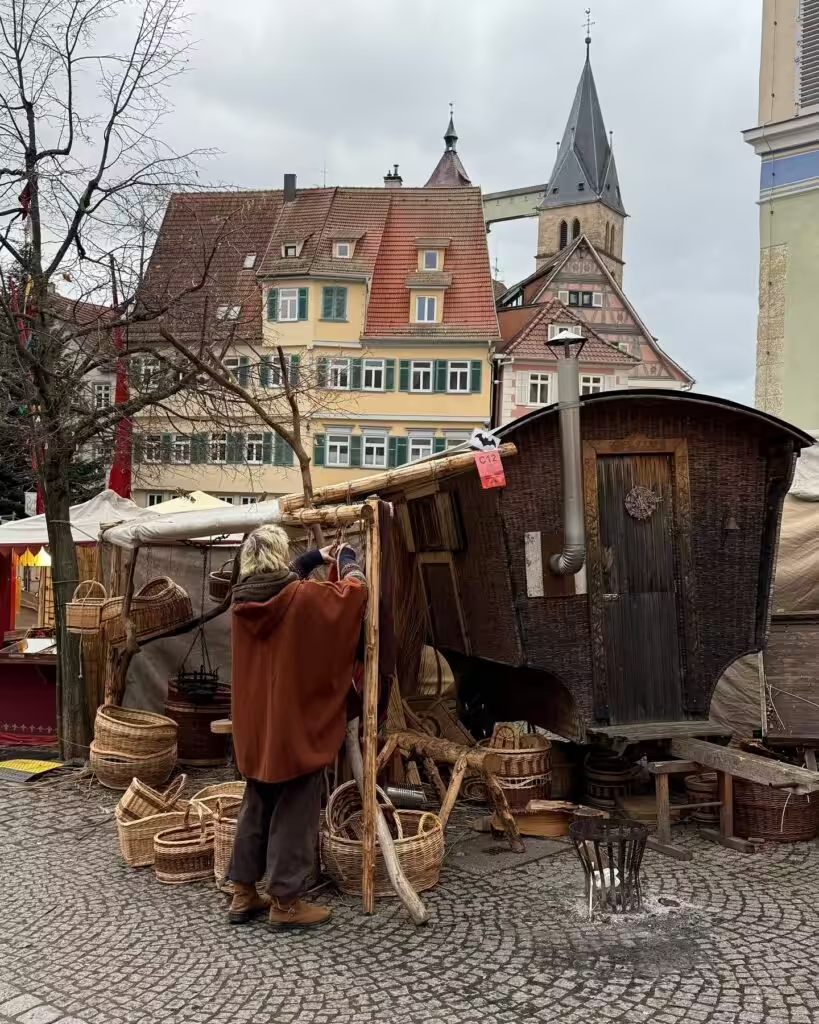
You'll spend your evenings standing still on cold cobbles with a hot mug in one hand, so pack for after dark, not for noon. Layers beat one giant coat, boots beat trainers, and a pocket full of coins beats a fancy wallet.
❄ After dark most markets feel below freezing, and Graz feels like −6°C (21°F) ❄
What to wear
What to wear to a Christmas market, head to toe
Dress for standing still, not walking. Take Vienna. At noon you're strolling between sights and the average December high is 6°C (43°F). By the evening you're rooted to the spot at a Glühwein stall, the sun went down at 16:00, and once it's dark the wind makes it feel like −4°C (25°F). That second number is the one to dress for, and layers handle both.
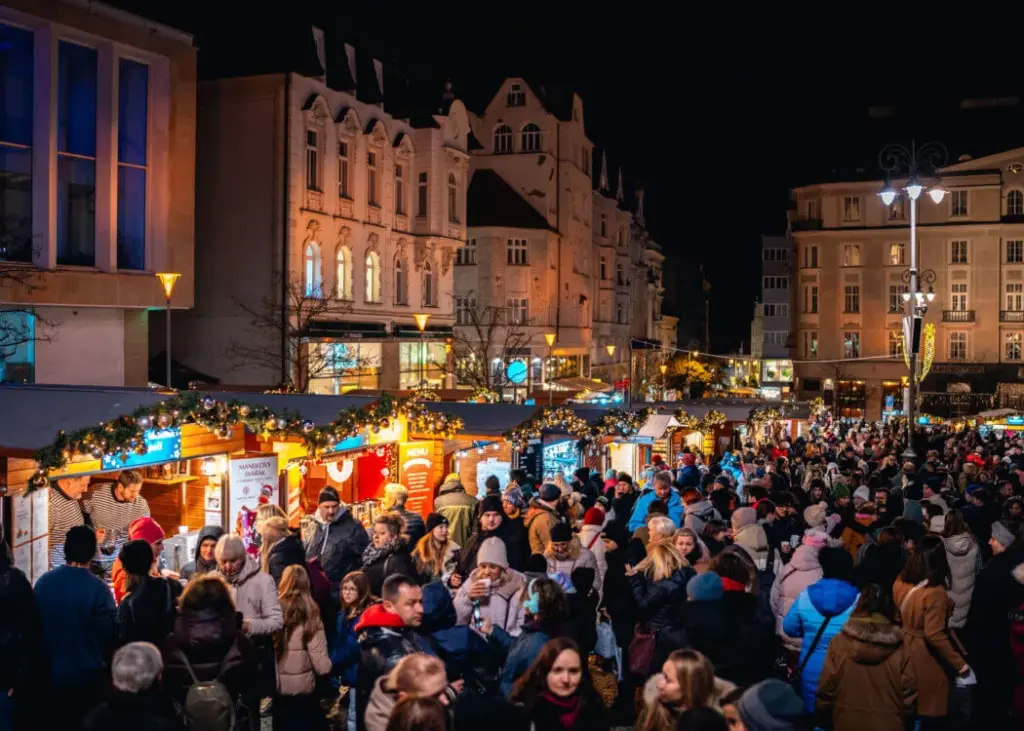
An evening at Zelný trh in Brno. Dark coats, hats and scarves, and not an umbrella in sight.
01Head
A hat that covers your ears
Wool or fleece, pulled right down over your ears.
02Neck
A scarf or gaiter up to your chin
Tuck it in and the wind has nowhere to sneak in.
03Hands
Touchscreen gloves
So you can check the map without taking them off. Add thin liners if you feel the cold.
04Base
A thermal top
Merino or Heattech, thin enough that you don't boil in a heated shop.
05Middle
A fleece or thin down jacket
The layer that comes off indoors and goes back on at sunset.
06Coat
A warm coat to your hips, with a hood
Sleeves rather than a sleeveless puffer, and a hood rather than an umbrella.
07Legs
Thermals or fleece-lined leggings under jeans
Jeans on their own let the cold through after an hour of standing.
08Feet
Waterproof boots and wool socks
Grippy soles for frosty cobbles, and room inside for thick socks.
Noon, walking
6°C
43°F
The average December high. A coat and a scarf are fine, and you'll be unzipping in every shop.
Base layer
Mid layer
Coat
Hat and gloves
Feet
How much of each layer you need
After dark, standing at the stalls
−4°C
25°F
How it feels after dark with the wind. Your feet go first, then your hands, so this is where thermals, wool socks and gloves earn their space.
Base layer
Mid layer
Coat
Hat and gloves
Feet
Dress like the locals
Dark, practical winter clothes are what you'll see on everyone around you. Nobody dresses up for the market itself, and a festive jumper under the coat is always welcome.
Going somewhere nice after?
A long dark wool coat over a thermal top works at the stalls and at dinner. Swap trainers for ankle boots with a grippy sole and let a big scarf do the dressing up.
Leave the trainers
Canvas and mesh soak through on wet cobbles, and the cold comes straight up through thin soles while you stand. Boots win every time.
The checklist
The full Christmas market packing list
Essential means you'll miss it, worth it means you'll be glad of it, and optional means nice to have. Pick your market below and the list sizes itself to how cold it gets there after dark.
A pocket knifeIf you're going to Germany, leave it at home. Germany has banned knives at Christmas markets since 2024, pocket knives included, and police can check bags.
×
An umbrellaA hood keeps a hand free for the mug and won't poke anyone in the crush.
×
The giant suitcaseSmall wheels and cobbles are a miserable pair. A case with big wheels, or a backpack, makes station days easy.
×
Too many thermalsTrams, shops and restaurants are heated. One set to wear and one to wash is enough for most trips.
December weather
How cold your market gets after dark
Ten Decembers of weather, 2015 to 2024, for 35 markets, coldest first. Graz, Salzburg and Kraków need proper winter kit. Paris is the mildest on the list and still feels like freezing once the sun goes.
Average December highs and night lows, the night-time wind chill and mid-December sunset, from the Copernicus ERA5 reanalysis via Open-Meteo, 2015 to 2024. Snow is the share of market-season days with snow lying, from our snow odds data.
Money
What to carry for the stalls
Getting into almost every market is free. The drinks aren't, and the mug comes with a deposit of anything from €1 to €5 that you get back in coins when you hand it in.
So plan on €20 to €40 a day each in coins and small notes, for deposits, toilets and the stalls that don't take cards. More stalls take cards every year, and Edinburgh's official market sites have gone card only.
Outside the euro you'll want a few local notes, koruna in Prague and Brno, złoty in Poland and forint in Budapest. And when a card machine offers to charge you in your home currency, say no, because paying in the local currency is almost always cheaper.
A typical German marketYour money pouch
Mulled wine
€4.50German average, 2025
Mug deposit
€4 or €5at most German markets
Currency
Euros
Toilets
Usually 50 cents to €2 in town halls and stations
Bags
Main-station lockers cost about €3 to €7 a day
Nuremberg€5Glühwein €4.50Mug deposit
Dresden€5Glühwein €4.50 to €5Mug deposit
Vienna€5Glühwein from €4.90Mug deposit
Munich€5At most stallsMug deposit
Salzburg€4At some stalls, each sets its ownMug deposit
Cologne€4Glühwein €5Mug deposit
Bratislava€2Mulled wine €3Mug deposit
Strasbourg€1A reusable cupMug deposit
Prices and deposits are from the 2025 season, or 2024 where that is the latest published.
Phone and data
Stay online without the roaming bill
Verizon and AT&T charge by the day abroad, and TravelPass and the International Day Pass are both $12 a day, so a week runs to $84. A Europe eSIM with 5 GB covers the same week for $12 to $19. From the UK, O2, giffgaff, BT, Tesco, iD, Lebara, SMARTY and ASDA include Europe, and inside the EU your plan roams at home prices.
Crowded squares can make signal patchy, so save your tickets and maps offline before you go.
Best value
Yesim
$11.52 · 5 GB for 30 days, Europe and the UK
Covers the UK as well as the rest of Europe, and the data lasts a month if your trip runs long.
Lebkuchen, Stollen and chocolate fly home happily. Cured meat is where trips end in a confiscation bin, cheese too if you're flying to the UK, and glass baubles need a sock or two around them to survive the case.
Flying home to the UK
No meat or dairy
Since April 2025 you can't bring meat or dairy from the EU into Great Britain. Sausages, ham and cheese get taken off you, with fines of up to £5,000 in England.
OK to bring
Lebkuchen, Stollen, chocolate, biscuits and sweets.
Flying home to the US
No cured ham or salami
Cured ham and salami from Germany and France aren't allowed in. Declare every food item and nothing you declare gets you fined, even if it's taken.
Usually fine
Lebkuchen, Stollen and chocolate. Declare them anyway.
Bottles and batteries
Check your airport
A bottle of Glühwein goes in your checked bag unless your departure airport's new scanners allow 2 litres in hand luggage, and any US connection puts you back on 100 ml.
Hand luggage only
Power banks and rechargeable hand warmers. On Lufthansa, Swiss and Austrian flights you can't charge or use power banks on board.
Questions
Packing questions
What should I wear to a Christmas market?Answer
A warm coat with sleeves and a hood, thermals or leggings under your jeans, waterproof boots with grip, wool socks, and a hat, scarf and gloves. You'll stand still for hours after dark, which feels a lot colder than the daytime temperature suggests.
Dark, practical clothes are what locals wear. Nobody minds a festive jumper, though.
How cold are Christmas markets in Europe?Answer
Colder than the forecast suggests. Across our 35 markets the average December high runs from 4°C to 9°C, but after dark with the wind it feels like 0°C in Paris and −6°C in Graz. Austria, southern Germany, Poland and the Czech Republic are the coldest, and Paris, Lille and the Rhineland the mildest.
What shoes should I wear to Christmas markets?Answer
Waterproof boots with a grippy sole, broken in before the trip, with room for thick socks. Cobbles get slick with frost and spilled Glühwein, and the cold comes up through your soles while you stand. A thin thermal insole fixes cold feet for a couple of euros.
Do I need snow boots?Answer
Usually not. Warm, waterproof boots with a grippy sole are enough at most markets. Snow lies on the ground on about one market day in ten at a typical market, closer to a quarter in Munich, Salzburg and Kraków, and well over a third in Hallstatt and the Ravenna Gorge. That's where slip-on ice grips are worth packing.
Do I need cash at Christmas markets?Answer
Bring some. More stalls take cards every year, but mug deposits of €1 to €5 come back in coins and small stalls still prefer cash. Edinburgh's official markets are the exception, and they're card only.
Can I bring a pocket knife to a German Christmas market?Answer
No. Germany has banned knives at Christmas markets since 2024, pocket knives included, and police can check bags. Leave it at home.
What plug adapter do I need for Christmas markets?Answer
A Type C Europlug adapter works in every market country on this page except Scotland, which uses the British Type G. Everywhere runs on 230 volts, which phone and laptop chargers handle without a converter.
Can I keep the Glühwein mug?Answer
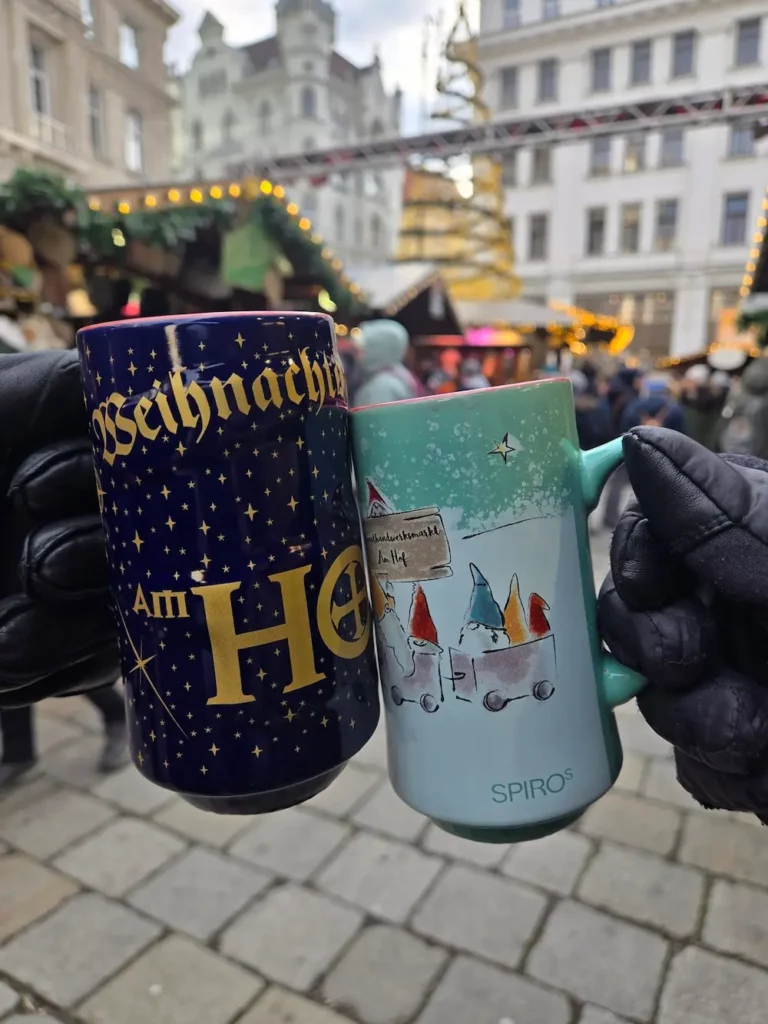
In Germany the deposit doesn't buy the mug, so ask at the stall or offer a few euros on top. Munich tolerates you keeping it, and Strasbourg's €1 cups are fine to take home.