Disclosure: This website is reader-supported, and some posts contain affiliate links. If you make a booking, I may earn a small commission, at no extra cost to you. Thank you for keeping me writing and doing what I love!
If you think “Christmas market in a pretty square” when you picture an Austrian Christkindlmarkt, Innsbruck is the one that breaks that mold.
Innsbruck is the capital of Tyrol and the fifth-largest city in Austria (population 132,188 in 2024), straddling the River Inn at the junction with the Wipp Valley, the natural corridor to the Brenner Pass, 30 km to the south.
It sits in a high-Alpine valley where the Nordkette, the North Chain of the Karwendel Alps, rises straight out of the rooftops above the Old Town, peaking at Hafelekarspitze, 2,334 m (7,657 ft).
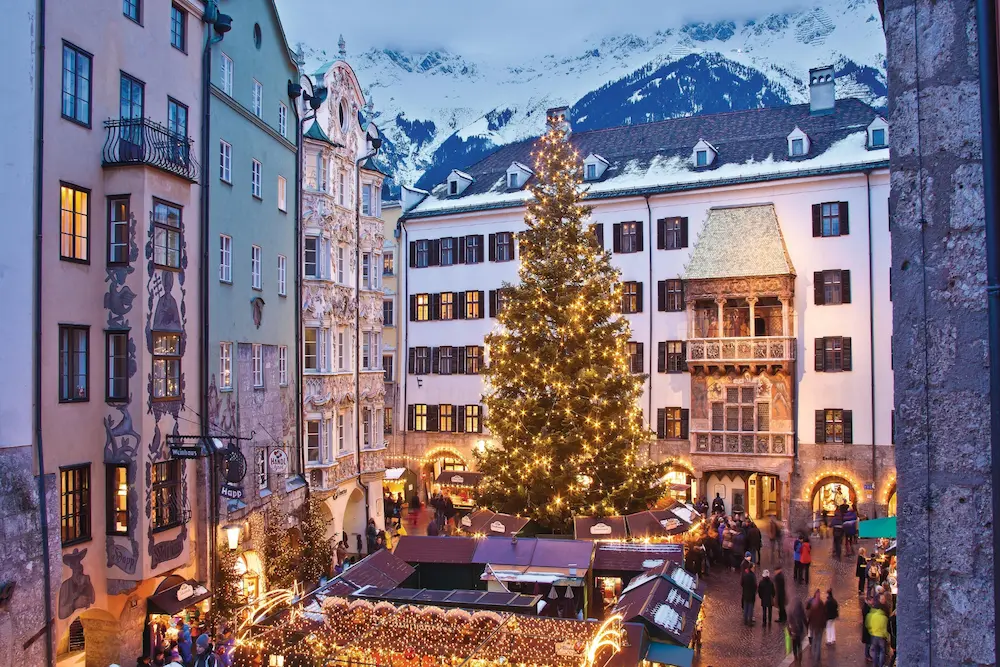
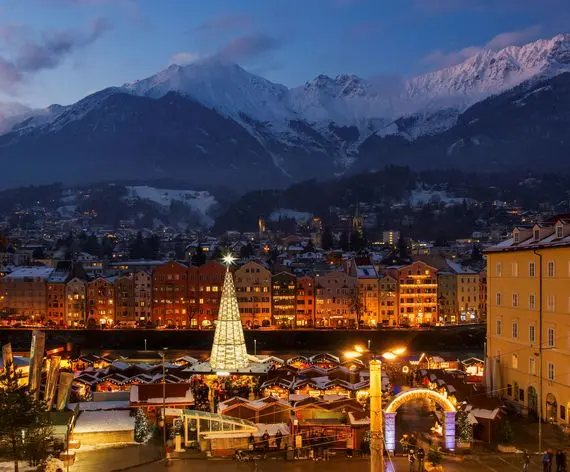
So when you’re standing at a glühwein stall, there are snowcapped peaks right there, not in some distant postcard background. And Innsbruck is different than most other cities because most European Christmas markets sit on a flat city square. Innsbruck’s sit in a bowl of mountains.
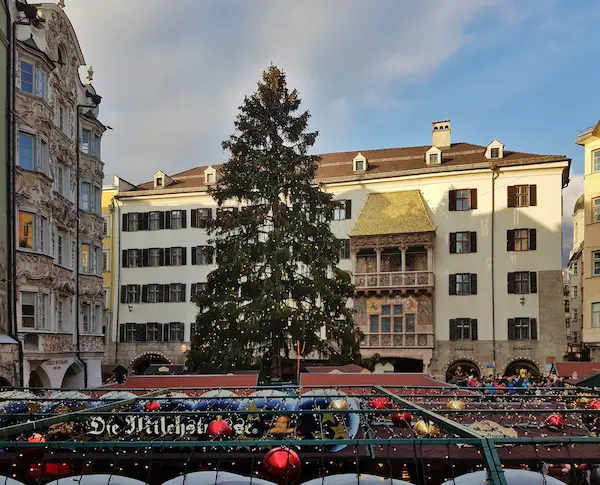
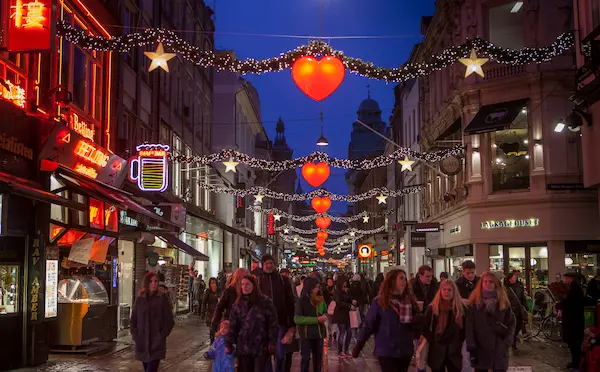
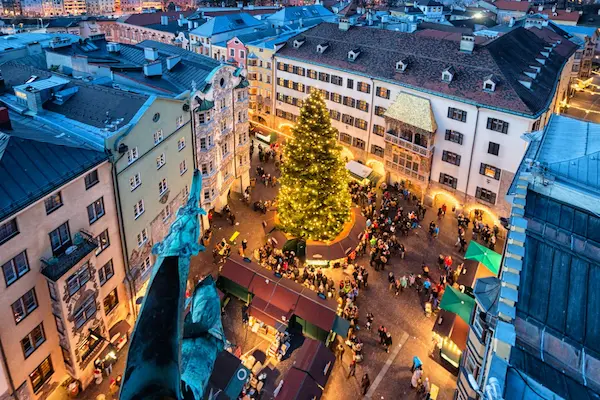
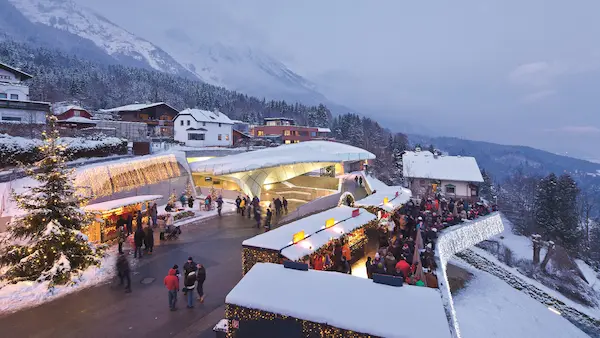
And of course, it’s not just one market. It’s seven Christmas markets, each with its own character. You’ll find traditional stalls beneath the Golden Roof, a family market crowned by a 17.5-metre Swarovski crystal tree, a modern glass-and-light market on the main shopping street, and a panoramic village market reached by a Zaha Hadid-designed funicular that lifts you above the city in eight minutes.
There’s also the Olympic identity. Innsbruck hosted the Winter Olympics twice, in1964 and 1976, plus the Winter Paralympics in 1984 and 1988 and the first-ever Winter Youth Olympics in 2012.
So when the Christmas lights go up, they’re going up in one of the definitive winter-sports cities on earth. The whole place leans into winter rather than just decorating for it.
I’ll try and walk you through everything you need to plan an Innsbruck Christmas market trip, including which markets to prioritize, what to eat and drink, where to stay, and how to make the most of the Alpine setting that makes this market unlike any other in Europe.
Keep reading for the scoop on Innsbruck in December!
When to Visit the Innsbruck Christmas Market
The Innsbruck markets are run by a single operator, and the official season dates for 2026/27 are:
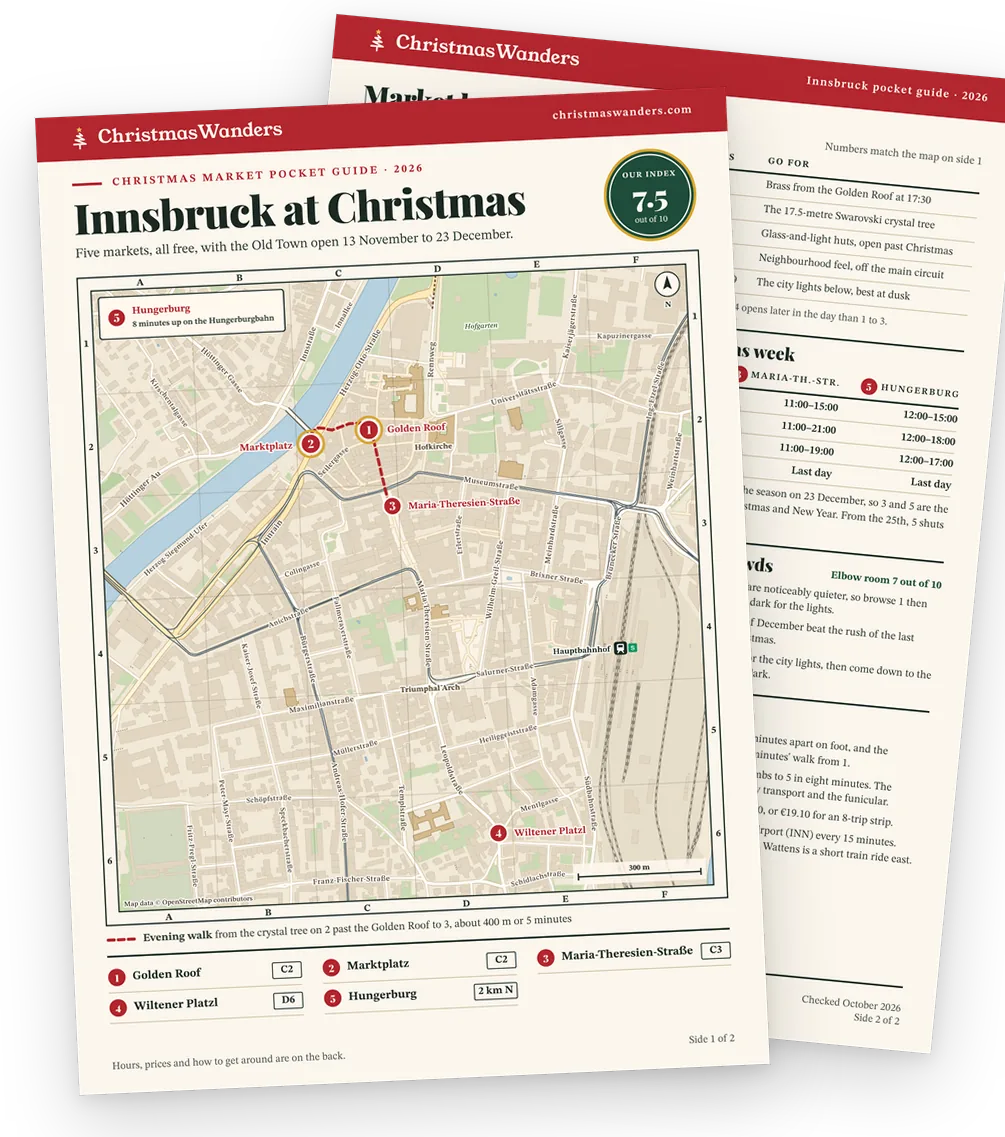
- Old Town & Marktplatz: November 13 – December 23, 2026. Daily 11:00–21:00
- Maria-Theresien-Strasse: November 25, 2026 – January 6, 2027. Daily 11:00–21:00, except 24 December (11:00–15:00) and 31 December (11:00–19:00)
- Hungerburg: November 20, 2026 – January 6, 2027. Weekdays 13:00–19:00, weekends and public holidays 12:00–19:00. On 24 December it’s 12:00–15:00, on 31 December 12:00–17:00, and from 25 December it closes at 18:00
If you have flexibility, I’d aim for the first or second week of December. The markets are fully running but not yet at peak tourist crunch, weekday mornings are noticeably quieter, and you sidestep the last-weekend-before-Christmas rush when Austrian and Italian domestic travelers descend (Innsbruck is an easy hop from both Munich and northern Italy).
December in Innsbruck is proper winter (it’s pretty goddamn cold!). Daily highs hover around 4°C/39°F, lows around 3°C/27°F, and the city averages roughly 21 cm of snow in December.
The odds of a white Christmas are good, but not guaranteed because the foehn wind sometimes brings sudden thaws, though less dramatically than in Salzburg. In any case, you need to pack warm layers for this one!
How to Get to Innsbruck
Innsbruck is dead easy to reach, which is part of why it gets busy.
- Fly into Innsbruck Airport (INN, Kranebitten) – the largest airport in Tyrol, with seasonal flights from Austrian Airlines, Lufthansa, easyJet, British Airways, and Transavia (Vienna, Frankfurt, London, Berlin, Amsterdam). Bus line F runs to the city centre every 15 minutes (30 min on Sundays). A single ticket is €3.10.
- By train – Innsbruck Hauptbahnhof sits at Südtiroler Platz, on the east edge of the centre, with direct trains from Venice, Bolzano, Zürich, Munich, Graz, and Vienna (via Linz and Salzburg). There’s even an ÖBB Nightjet sleeper to Brussels and Amsterdam. The train is my pick if you’re coming from anywhere in Europe and the station drops you a 10–15 minute walk from the Golden Roof.
- By car – the Inntalautobahn (A12) and Brennerautobahn (A13) meet just south of the city. Easy, but expect heavy traffic over the Brenner Pass on winter weekends. Tune to Radio Tyrol 96.4 MHz for updates.
What to Eat & Drink at the Innsbruck Christmas Market
Tyrolean Christmas-market food is a proper winter food tradition, and Innsbruck does it really well with a couple of local specialties that aren’t just generic German-market fare.
Here’s what to eat and drink at the Innsbruck Christmas market:
- Kiachln (Bauernkrapfen) – The Tyrolean one to seek out. A round of fried yeast dough, stretched thin in the middle and thicker at the edges, fried in lard, dusted with powdered sugar, and traditionally eaten with apricot marmalade, lingonberry jam, or sauerkraut. Sweet-or-savory is your call. This is the thing to try that you won’t find quite the same way in Germany.
- Glühwein (mulled wine) – The Christmas-market mandatory starter. You’ll pay a few euros for the drink plus a Pfand (deposit) on the mug, which you get back when you return it. The Old Town market serves a spiced glühwein up on the viewing platform by the Golden Roof. Pro move: don’t return the mug and you’ve basically bought a souvenir.
- Jagertee – A Tyrolean après-ski classic. A warm Inländer-Rum (Stroh is the famous brand) mixed with spiced black tea. The name is actually a Protected Designation of Origin: if it’s called Jagertee, it was made in Austria. Warmer and less sweet than glühwein, and it hits different at altitude.
- Maroni – Roasted chestnuts. Less sweet than candied almonds, very warming, and the smell is something you can’t miss.
- Bratwurst – The classic, right? You’ll find these at almost every Christmas market in Austria.
- Lebkuchen & Stollen – Gingerbread and Christmas bread. Lebkuchen often comes as decorated hearts on ribbons, which is cheesy, but makes for a great photo.
- Kartoffelpuffer – Potato pancakes, crispy and greasy in the best way.
- Baumstriezel – Spit cake, roasted over coals and rolled in sugar and nuts.
- Kinderpunsch – The non-alcoholic hot spiced fruit punch, for drivers and kids.
Things to Do Beyond the Stalls
You’ll want to break up the market-hopping with some actual Innsbruck. Here’s what to prioritize:
- Ride the Hungerburgbahn up the Nordkette – Even if you don’t care about the Hungerburg market, the ride is worth it. Zaha Hadid’s stations are striking, the Alpine Zoo is a worthwhile stop on the way up, and the Seegrube plateau serves that Sunday Advent brunch (10:00–13:00) with a view over the city. The cable car continues higher still if you want to touch actual snow.
- See the Swarovski Crystal Tree at Marktplatz after dark – 17.5 metres, 112,400+ crystals. It’s the most photographed single object in Innsbruck at Christmas. Go after sunset.
- Catch the daily music program in the Old Town – Brass from the Golden Roof at 17:30, the Innsbruck Music School on the Fairy Tale Stage at 18:00. Free, and surprisingly moving in the cold air.
- Spot the Christmas Angels – Costumed, gold-clad “angels” roam the markets spreading festive spirit, with an info stand beside the Ottoburg. A little cheesy but still very charming.
- Ride the Christmas Tram – The operator runs a festive tram through the city. Touristy, yes, but nonetheless, a nice way to warm up between markets.
- Watch for the Perchten & Krampusse – Tyrol’s darker midwinter tradition. Costumed Krampus and Perchten runs are programmed through Advent. Not for small kids, in my opinion, but a genuine piece of Alpine folklore you won’t get in Germany.
- Wander the Altstadt – The Golden Roof, the Hofkirche (with Maximilian’s cenotaph and the bronze Habsburg statues), and the Imperial Palace are all within a few minutes’ walk of the markets. Free to look at from outside and definitely worth paying into one or two.
- Day trip: Swarovski Crystal Worlds in Wattens – A short train ride east, just down the Inn valley. Opened in 1995 for Swarovski’s centenary and designed by André Heller, it’s a park-and-museum complex with a grass-covered Giant head, 18 “Chambers of Wonder” (installations by Brian Eno, Andy Warhol, Salvador Dalí, Yayoi Kusama, Keith Haring), and a Crystal Cloud of roughly 800,000 hand-mounted crystals. By 2019 it had welcomed 15 million cumulative visitors. The Innsbruck-Card gets you 10% off.
Where to Stay in Innsbruck for the Christmas Markets
The Old Town is compact and walkable, but December cold is real, and being able to drop shopping bags or thaw out between markets makes a difference.
Best neighborhoods for Innsbruck Christmas market visitors:
- Old Town (Altstadt) / around Maria-Theresien-Strasse – The most convenient option, by far. You can walk to every central market in under 10 minutes. Definitely pricier, but worth it for a short trip.
- Near Hauptbahnhof – A 10–15 minute walk to the markets, but easier on arrival and departure (and often better value). My pick if you’re coming in by train and want to keep costs down without sacrificing access.
- Hungerburg / Hötting side – Up on the north side, best for the panoramic market and mountain mornings. Ideal if you are aiming for a slower, quieter stay and you’ll take the funicular down to the Old Town markets in the evening.
Getting Around Innsbruck
Innsbruck’s Old Town is very walkable and it takes you 10–15 minutes from the Hauptbahnhof to the Golden Roof, and the 4 main markets all sit within easy walking distance of each other.
That’s the main reason it works so well as a Christmas-market destination because you don’t need a car, and you barely need transit.
When you do need it, the IVB (Innsbrucker Verkehrsbetriebe) runs 6 tram lines plus buses, integrated into the regional Verkehrsverbund Tirol (VVT) network.
A single ticket is €3.30. An 8-trip strip is €19.10 (prices as of April 2026).
The Hungerburgbahn funicular and the Nordkette cable cars are the ones you’ll use to reach the mountain markets and they’re a category of their own.
Is the Innsbruck Christmas Market Worth It?
Yes, and especially if you’ve already done Vienna or Salzburg and want something that feels different.
What Innsbruck does better than anywhere else in Austria is an Alpine Christmas in a walkable footprint.
You can do seven properly distinct markets in two or three days without ever getting in a car, all beneath peaks that are carrying actual snow, all watched over by a 500-year-old golden rooftop. That combination is hard to beat anywhere in Europe.
If you only have time for one Austrian Christmas market city, Vienna probably wins on sheer scale and Salzburg on storybook romance. But if the Alpine setting is what’s pulling you, I’d send you to Innsbruck over either of them.