Salzburg in December is the kind of place that makes you understand why people write Christmas songs.
Baroque domes dusted with snow, a fortress glowing on the hillside, the smell of roasted chestnuts and glühwein drifting through cobblestone alleys, and at the center of it all, one of the oldest Christmas markets in Europe, set against the backdrop of a UNESCO World Heritage old town.
The Salzburg Christkindlmarkt traces its roots all the way back to 1491, when it began as a “Tandlmarkt” on the square in front of the Cathedral.
By the 17th century, it had grown into the “Nikolaimarkt” or the St. Nicholas’ Market, and the Salzburg tourism board, which has every reason to pump up its own heritage, ranks it among history’s finest Advent markets, second only to Vienna, Paris, Amsterdam, and Nuremberg.
I’ll only add this: the setting backs the claim up.
The modern version of the market, as it’s known around the world today, has existed since 1974, which means it celebrated its 50th anniversary in 2024. These days, it draws close to a million visitors each season across multiple locations.
And there’s something about Salzburg’s old town that just works in winter. The city is compact, walkable, and framed by the Salzach River on one side and the Mönchsberg ridge on the other.
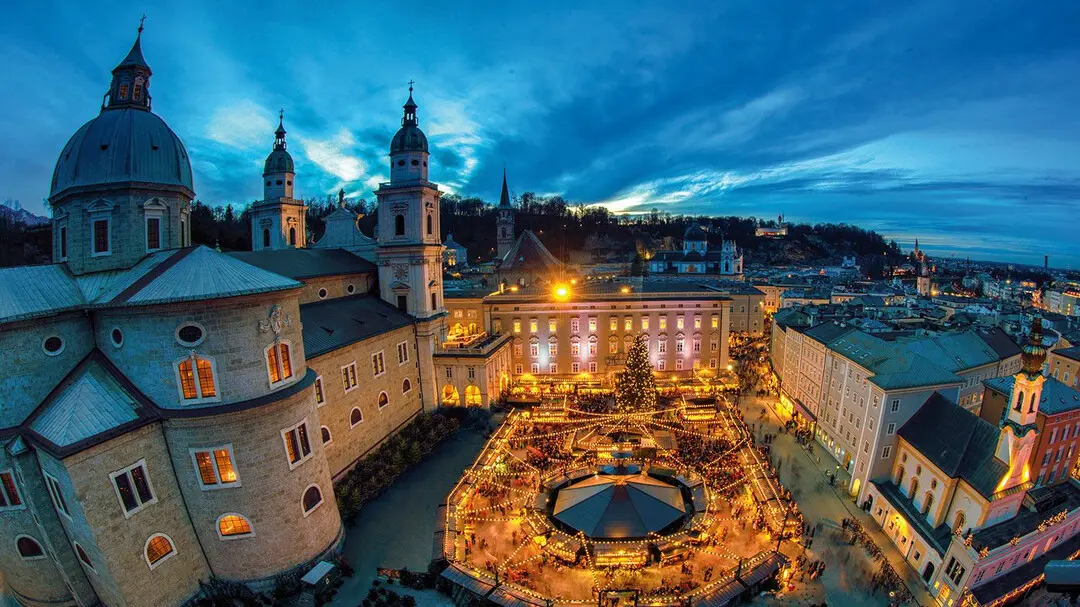
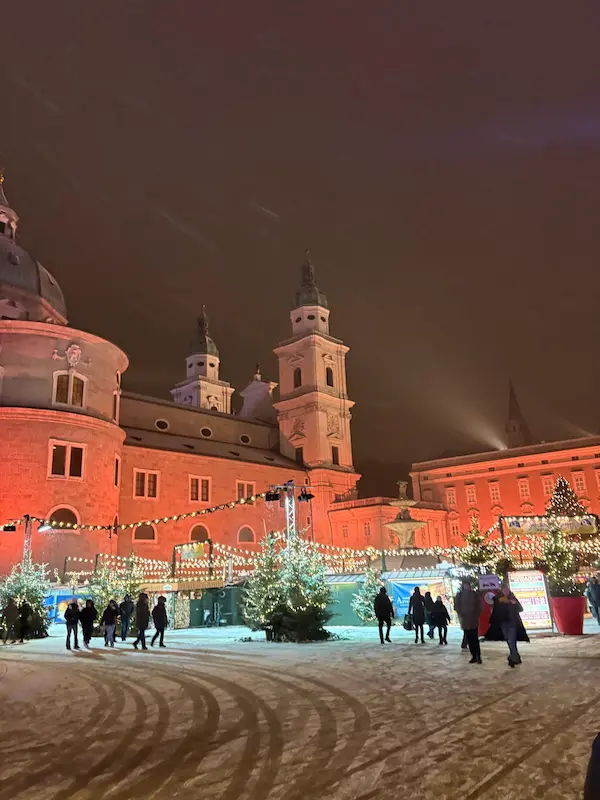
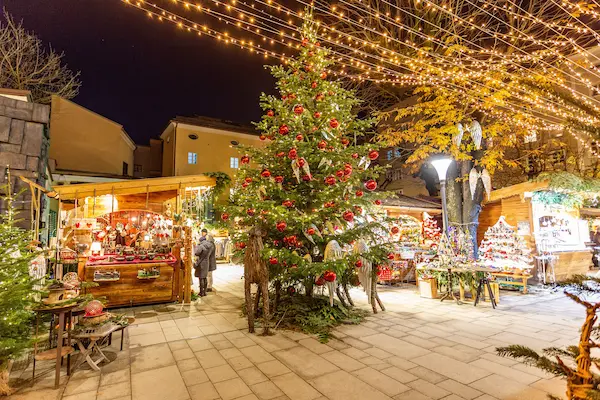
At night, the Domplatz (the Cathedral Square) lights up under a canopy of stars (literally: the market installs a “Sternenhimmel” light installation overhead), and the baroque cathedral facade becomes the most dramatic backdrop of any Christmas market I’ve seen.
But same as most European Christmas markets, Salzburg doesn’t have just one Christmas market. It has several, each with a completely different vibe. And knowing which ones to visit, and when, makes all the difference.
Salzburg’s Christmas Markets – Which Ones to Visit
Every day during Advent, the market comes alive with a cultural program unique to Salzburg. A traditional Turmblasen, a brass ensemble, plays from the towers high above the square, filling the cathedral quarter with music that echoes off the stone.
It’s not a staged tourist show though. It’s a true tradition that goes back centuries, and standing in the square with a mug of glühwein while the horns play down from above is one of those travel moments that sticks with you.
What I love most about the Salzburg Christmas market is that it doesn’t feel manufactured. Yes, it’s popular, of course (a million visitors a year popular), but the setting is so unshakably historic, and the daily program so rooted in actual local tradition, that it doesn’t have that soulless “Christmas theme park” feeling some markets fall into (I am looking at you Prague).
Salzburger Christkindlmarkt (Domplatz & Residenzplatz)
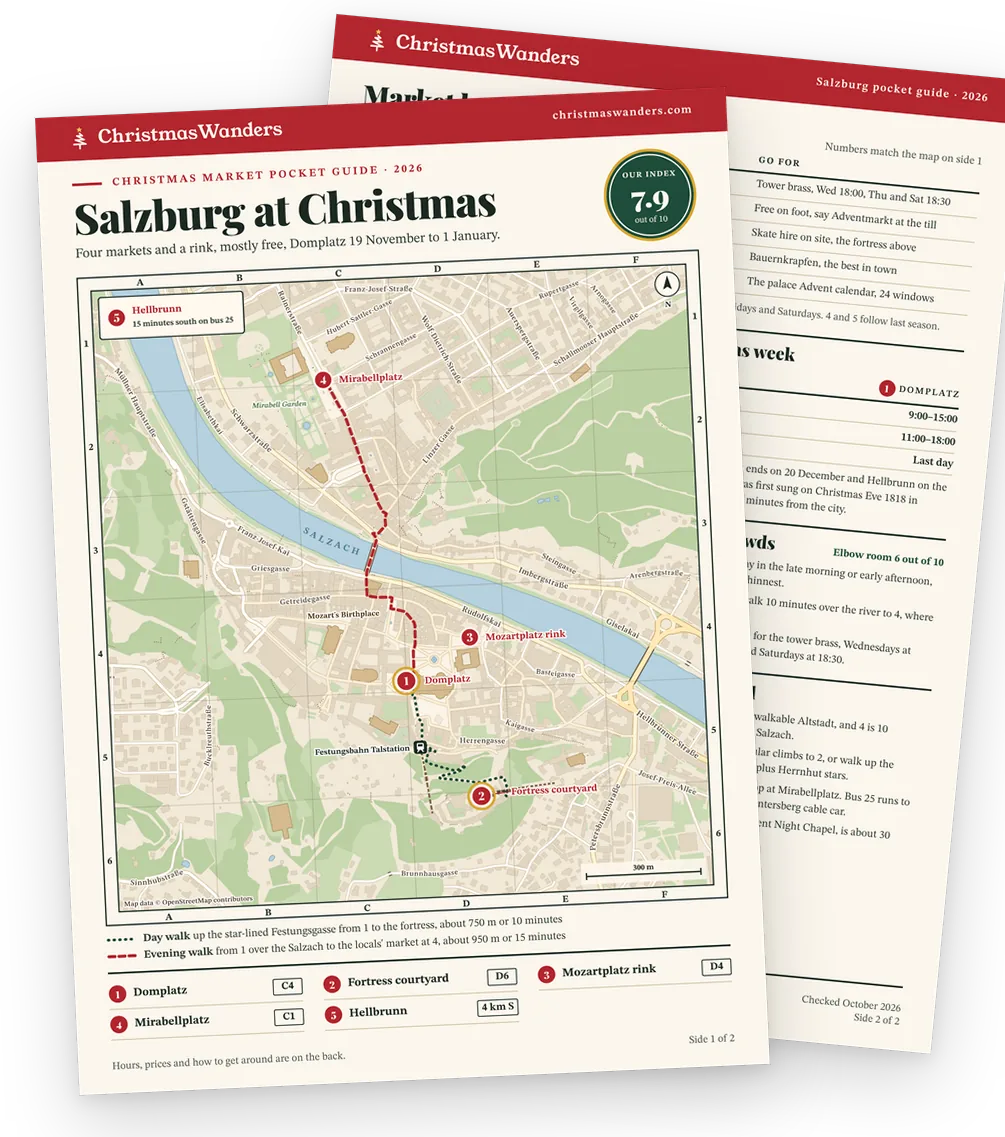
The main Salzburger Christkindlmarkt takes over Domplatz and Residenzplatz, with around 100 market stalls spilling across both squares and onto the adjacent Kapitelplatz. Admission is completely free, the market is barrier-free, and dogs are welcome too.
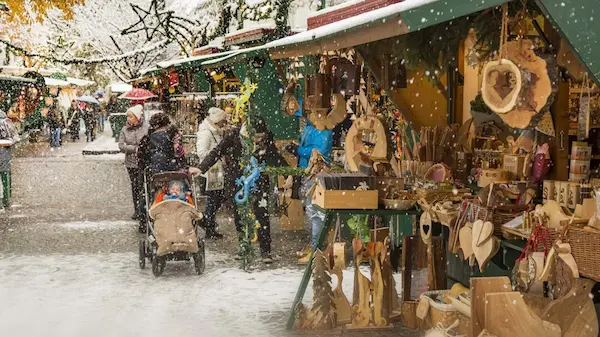
This is the main event: the historic market that most people are referring to when they say “Salzburg Christmas market.” It’s set across the Cathedral Square and Residenzplatz in the heart of the UNESCO old town, with around 100 stalls selling everything from hand-carved wooden ornaments to roasted almonds to the inevitable glühwein.
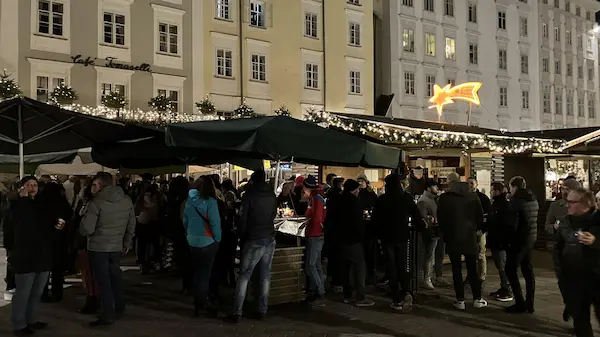
The vibe here is grand and atmospheric. The cathedral facade, the star canopy overhead, the traditional brass music from the towers: it’s the full Christmas-postcard experience. It’s also the busiest of the markets, especially on weekends after dark when the crowds get thick.
Hellbrunner Adventzauber (Schloss Hellbrunn)
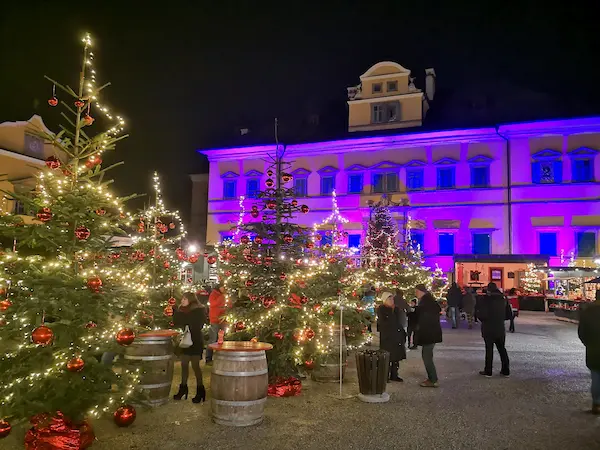
If the Domplatz market is the postcard, Hellbrunn is the winter wonderland. Located about 15 minutes south of the center by bus 25, this market sits in the grounds of Schloss Hellbrunn, the same palace famous for its trick fountains in summer.
What makes Hellbrunn special is that it’s built for families and for lingering.
The palace facade becomes a giant Advent calendar with 24 windows that open day by day throughout December.
There’s a fairy-tale forest (“Märchenwald”) of around 700 conifers decorated with 10,000 red baubles, a Christmas train for kids, a post office where children can write to the Christkind, and a campfire where the Mülln scouts help kids grill sausages on sticks.
The trick fountains, Hellbrunn’s signature attraction, even run in winter as the “Winter-Wasserspiele.” And there’s a Krampuswelt (Krampus world), which is… an experience. More on Krampus below.
Hellbrunn is closed on Mondays (with the exception of Dec 21) and runs through Dec 24. It’s been going since 2001 and celebrated its 25th anniversary in 2025.
Adventmarkt am Mirabellplatz
This is the locals’ favorite. It’s a smaller, quieter market set up in front of Mirabell Palace, just across the river from the old town. It’s described as being “abseits des Trubels”, away from the hustle, and that’s exactly what it is.
If you want to escape the Domplatz crowds, walk 10 minutes to Mirabellplatz. The market is smaller, the stalls are more artisanal, and the vibe is properly relaxed. It’s also the best market for Bauernkrapfen which is a crescent-shaped, fried yeast dough served warm with powdered sugar and sweet jam or savory Sauerkraut. More on that in the food section.
The Mirabellplatz market runs the same dates as the main Christkindlmarkt (Nov 20 – Dec 31, 2025), with slightly shorter hours, generally 10:00–20:00 on weekdays and until 21:00 on weekends.
Salzburger Festungsadvent (Hohensalzburg Fortress)
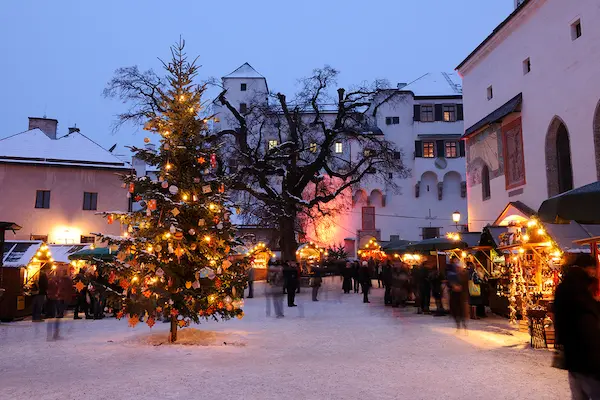
This one is my personal favorite. The Festungsadvent takes place in the courtyard of Hohensalzburg Fortress, the enormous medieval fortress that looms over the city from the Festungsberg hill.
It’s only open on weekends (Friday through Sunday, plus Dec 8), which makes it feel a bit more special. The path up to the fortress, the Festungsgasse, is lined with over 100 Herrnhut stars, and the courtyard market sells local crafts rather than the mass-produced stuff you find at some markets.
There’s a family program with cookie-baking and crafts, and the fortress bells ring out between 15:30 and 18:30.
The real draw is standing in the fortress courtyard with a mug of glühwein, looking down over the lit-up old town below. It’s one of the best views in Salzburg, period.
Admission to the market itself is free and you only pay if you want to go inside the fortress rooms or take the funicular. .
Eiszauber am Mozartplatz
Not technically a market, but worth mentioning is the Eiszauber, which is an ice-skating rink set up at Mozartplatz, right in the heart of the old town.
It’s run by the same Christkindlmarkt association and runs even longer than the markets themselves, typically from mid-November through the end of January.
It’s a fun thing to do with kids or if you need a break from eating and drinking your way through the stalls. You can rent skates on-site.
What to Eat and Drink at the Salzburg Christmas Market
Okay, this is the fun part (for me, because… well I enjoy food probably the most).
One of the best things about visiting Christmas markets in Austria is that the food is actually good and it’s not the lazy carnival food you tolerate at some markets. Instead, you get all of the regional specialties made well.
Glühwein
The anchor of any Christmas market experience. At the Salzburg Christkindlmarkt, glühwein costs €4.50–€5.50 depending on the stand, plus a €4 Pfand (deposit) for the ceramic mug.
You get the deposit back when you return the cup, or you can keep the mug as a souvenir, which is what I always do. They’re proper ceramic mugs with the year’s design stamped on them. Worth the forfeited deposit.
There are 12 drink stands total at the main market, and quality varies, if I am being honest.
Beyond standard glühwein, you’ll also find Punsch (fruit punch), Feuerzangenbowle (flaming punch with a rum-soaked sugar cone), Beerenpunsch (berry punch), and Kinderpunsch (non-alcoholic children’s punch).
Bauernkrapfen
If you only try one thing at the Salzburg Christmas markets, make it a Bauernkrapfen. This is a yeast-dough, crescent-shaped pastry that’s fried golden and served warm with powdered sugar and either sweet jam or savory Sauerkraut.
The best ones are at the Mirabellplatz market, where they’re something of a signature. It’s the kind of simple, perfect comfort food that tastes infinitely better when you’re standing outside in the cold.
Bosna
This is a Salzburg street-food classic that you’ll find at the main Christkindlmarkt: a grilled sausage in a roll with onions, curry powder, and mustard. The “Bosnastand” at the market has been running for over 30 years and uses original Bosna sausages from Metzgerei Walter, a local butcher. It’s cheap, filling, and exactly what you need after a few glühweins.
Roasted Chestnuts (Maroni) & Candied Almonds
The smell of Maroni (roasted chestnuts) and gebrannte Mandeln (candied almonds) is what defines the old-town alleys during Advent. You’ll find them at multiple stalls across the main market. The chestnuts are warm, slightly sweet, and perfect for cupping in your hands when your gloves aren’t cutting it.
Other Treats to Look For
- Lebkuchen: German/Austrian gingerbread, often heart-shaped and elaborately decorated
- Apple strudel: because you’re in Austria, and it would be wrong not to
- Kaiserschmarrn: shredded pancake with plum compote, a proper Austrian dessert
- Germknödel: yeast dumpling filled with plum jam, served with vanilla sauce and poppy seed
- Goulash: hearty, warming, and ideal for a cold evening
- Spiced sausage: grilled and served with mustard
Things to Do and See at the Salzburg Christmas Market
The Salzburg Christmas market isn’t just about eating and shopping (though both are excellent). There’s a daily cultural program that’s deeply rooted in local tradition, not invented for tourists.
Turmblasen – The Tower Brass
This is the one that got me. The Turmblasen is a traditional brass and wind ensemble that plays from the towers surrounding the Domplatz, high above the market. The sound drifts down from multiple directions, echoing off the cathedral walls, and it’s quietly transporting.
It happens on Wednesdays at 18:00 and Thursdays and Saturdays at 18:30. If you’re planning which evening to visit the main market, plan around this.
The Christ Child Visit
Every Sunday at 16:00, the Salzburg “Christ Child”, a local girl dressed in white and gold with angel wings, walks through the market with a procession of angels. It’s a sweet, old-world tradition that kids especially love. On Wednesdays at 16:00, there’s also a children’s reading with the Christ Child.
Open Choir Sing-Along
Every Tuesday from 18:00–20:00, there’s an open choir sing-along at the market. Anyone can join in. It’s the kind of thing that sounds cheesy until you’re standing there in the cold, singing along with a hundred strangers, and then it’s just… lovely.
Krampus and Perchten Runs
Okay, here’s where I need to give you a heads-up. If you’re visiting Salzburg in early December, you might encounter Krampus, the half-goat, half-demon figure, from Central European folklore who punishes naughty children while St. Nicholas rewards the good ones.
On December 5, there’s a Lauf der Krampusse (Krampus run) at the Domplatz starting around 13:00.
On December 6, St. Nicholas himself appears at 15:30. And on December 21, the first “Rauhnacht” (rough night), there’s a Perchtenlauf (Perchten run) at around 19:00, featuring the Perchten, wild pagan figures with terrifying carved masks and clanking bells.
If you’re traveling with kids, the Stefani-Perchten run at Hohensalzburg (Nov 30, 15:00) is described by the fortress itself as “perhaps the most family-friendly Krampus run in Salzburg.” The big Gnigl Krampuslauf (the city’s largest) is more intense.
I think it’s one of the most unique cultural experiences you can have at a European Christmas market. But if you have small children or are easily startled, just be aware that grown adults in demon masks will be running at you with switches. That’s normal here.
The Hellbrunn Advent Calendar
If you make it to Hellbrunner Adventzauber, the daily opening of a new window on the palace facade’s giant Advent calendar is a quietly delightful little ceremony.
Each day in December, another window lights up. It’s simple, it’s charming, and it’s the kind of thing that makes Hellbrunn worth the bus ride.
Ice Skating at Mozartplatz
The Eiszauber rink at Mozartplatz is open from mid-November through January, and it’s a fun way to spend an hour between market visits. Skate rental is available on-site. It’s nothing fancy, but gliding around under the lights with the fortress on the hill above you is pretty magical.
Best Time to Visit the Salzburg Christmas Market
If you can manage it, go on a weekday. The main Domplatz market is busiest on weekends, especially Saturday evenings, when it gets properly crowded. A weekday late morning or early afternoon is the sweet spot: stalls are open, the crowds are thinner, and you can actually see what you’re buying.
Locals tend to gravitate toward Mirabellplatz when the old town gets too packed. And if you want the full atmosphere (the lights, the music, the energy), go in the evening. Just be prepared for company.
Weather in December
Salzburg in December is cold and damp, with frequent overcast skies. Based on 1991–2020 climate data, the average high is around 4°C (39°F) and the average low is around −2°C (28°F). There are roughly 21 freezing nights in the month, about 13 days with measurable precipitation, and the sky is cloudy about 70% of the time.
Snow is possible but not guaranteed. Precipitation can fall as rain or snow, so check the snow odds before you bank on a white Christmas.
What to Pack
- Warm layers: a good base layer (thermals), a sweater, and a proper winter coat
- Waterproof footwear: the cobblestones get slick, and you’ll be standing around a lot
- Hat, gloves, and scarf: non-negotiable for evening market visits
- An umbrella: Salzburg sees plenty of winter drizzle
- A small bag: for your glühwein mug, if you decide to keep it (and you should)
Tips for Visiting the Salzburg Christmas Market
A few last things I’ve learned that will make your visit smoother:
Keep the glühwein mug. When you buy your first glühwein, you’ll pay a €4 Pfand (deposit) for the ceramic mug. You can return it for your money back, or keep it as a souvenir. They design a new mug every year, and they’re the real deal: actual ceramic, not flimsy plastic. Worth forfeiting the deposit for.
Go to Mirabellplatz to escape the crowds. If the Domplatz market is packed, walk 10 minutes to Mirabellplatz. It’s quieter, more local, and the Bauernkrapfen is better.
Buy a snow globe. Salzburg is actually credited as the birthplace of the snow globe (invented here in 1900 by Erwin Perzy). There are year-round Christmas shops in Judengasse and a lovely one called Candela in a passage off Getreidegasse. They make sharp, non-tacky souvenirs, a cut above the mass-produced ornaments at the market stalls.
Combine Hellbrunn with the Untersberg cable car. Both are on bus line 25, so you can visit the Hellbrunn Advent market and then continue to the Untersberg cable car in the same trip. The cable car gives you panoramic views over the Salzburg basin, spectacular when there’s snow on the mountains.
Consider the Salzburg Card. If you’re planning to visit Hohensalzburg Fortress, ride the Untersberg cable car, and visit museums, the Salzburg Card (from €35) covers public transport and free or discounted entry to major attractions. It pays for itself quickly if you’re doing more than the markets.
Take photos from the fortress. The best panoramic shot of the Christmas market-lit old town is from the Hohensalzburg Fortress courtyard, ideally with a mug of glühwein in hand. The view from the cathedral bell tower is also excellent if you can access it.
Don’t overpack your schedule. Salzburg is a city best savored slowly. The markets aren’t going anywhere. Give yourself time to just stand in the square, listen to the brass from the towers, and let the atmosphere do its thing.
Other Things to Do in Salzburg in Winter
If you’re spending more than a day or two in Salzburg (and I’d recommend at least 2–3 days), there’s plenty to do beyond the Christmas markets.
Hohensalzburg Fortress is one of the largest medieval fortresses in Europe and dominates the city skyline. The funicular up was installed way back in 1892, and the panoramic views over the snowy city from the top are worth the trip alone, even if you don’t visit the Festungsadvent market.
Mozart’s Birthplace (Getreidegasse 9) is where Wolfgang Amadeus Mozart was born in 1756. The yellow house on Salzburg’s most famous shopping street is now a museum. The Getreidegasse itself is worth a stroll for its beautiful wrought-iron guild signs alone. Each shop has a unique metal sign hanging above its door.
Sound of Music locations are scattered across the city. The Mirabell Palace gardens are where Maria and the children sang “Do-Re-Mi,” and the Hellbrunn palace grounds (where the Advent market is!) have the famous gazebo. You can take a Sound of Music tour if you want to see them all.
The Silent Night connection: Joseph Mohr, the man who wrote the lyrics to “Silent Night,” was from Salzburg. The song was first performed on Christmas Eve 1818 in Oberndorf, about 30 minutes from the city, where there’s now a small Silent Night Chapel with its own tiny Advent market and a special Silent Night postmark post office. It’s a lovely half-day trip if you want to get away from the city.
The Salzach River walk is beautiful in winter, especially at dusk when the old town’s lights reflect on the water and the fortress glows on the hill above. Walk along the Makartsteg pedestrian bridge for the classic postcard view.
Is the Salzburg Christmas Market Worth It?
Salzburg’s Christmas markets have something that most others don’t: a setting so historically genuine that the atmosphere feels earned, not manufactured. When you’re standing in the Domplatz at dusk, the cathedral facade lit up above you, brass music drifting down from the towers, and the smell of roasted chestnuts in the cold air… it’s hard to imagine a better Christmas market experience anywhere.
And the fact that Salzburg has multiple markets with properly different vibes means you can curate your own experience. Want the grand postcard moment? Domplatz. Want to escape the crowds? Mirabellplatz. Want panoramic views with your glühwein? The fortress. Want a winter wonderland for kids? Hellbrunn.
That variety, plus a UNESCO old town, a fortress, Mozart’s birthplace, and the birthplace of “Silent Night”, makes Salzburg one of the best Christmas market destinations in Europe, full stop. Not because it’s the biggest or the cheapest. Because it’s the most earned.
I hope this guide helps you plan your Salzburg Christmas market trip! If you have any questions, feel free to reach out!