Disclosure: This blog is reader-supported, and some posts contain affiliate links. If you make a booking, I may earn a small commission, at no extra cost to you. Thank you for keeping me writing and doing what I love!
The Nuremberg Christkindlesmarkt (German: Nürnberger Christkindlesmarkt – literally “Christ Child Market”) is the annual Christmas market held in the heart of Nuremberg’s Old Town.
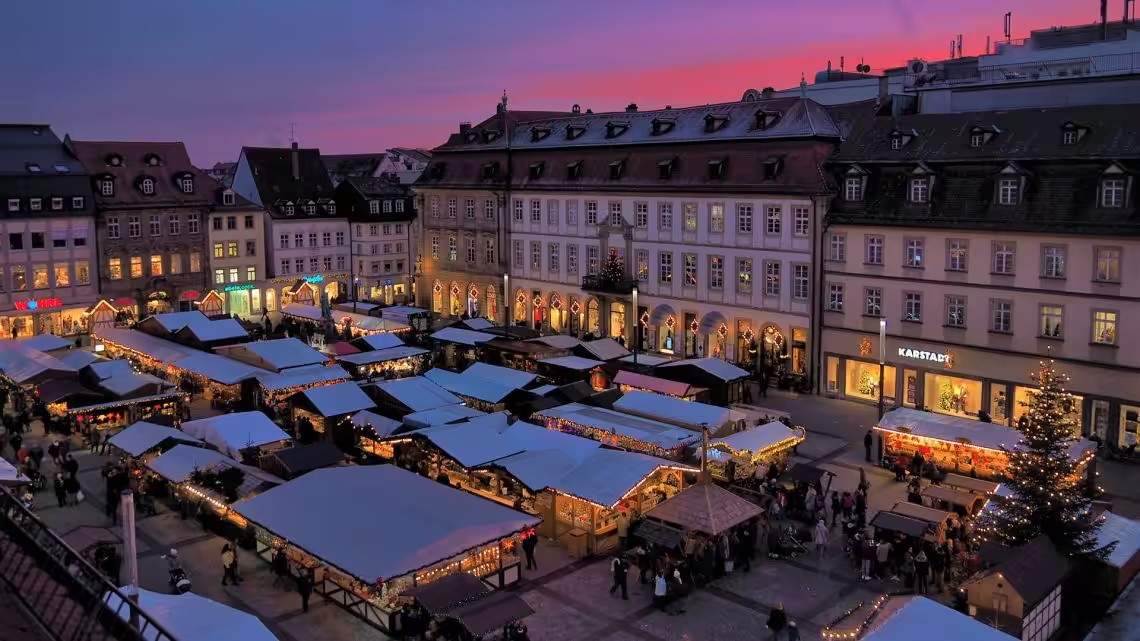
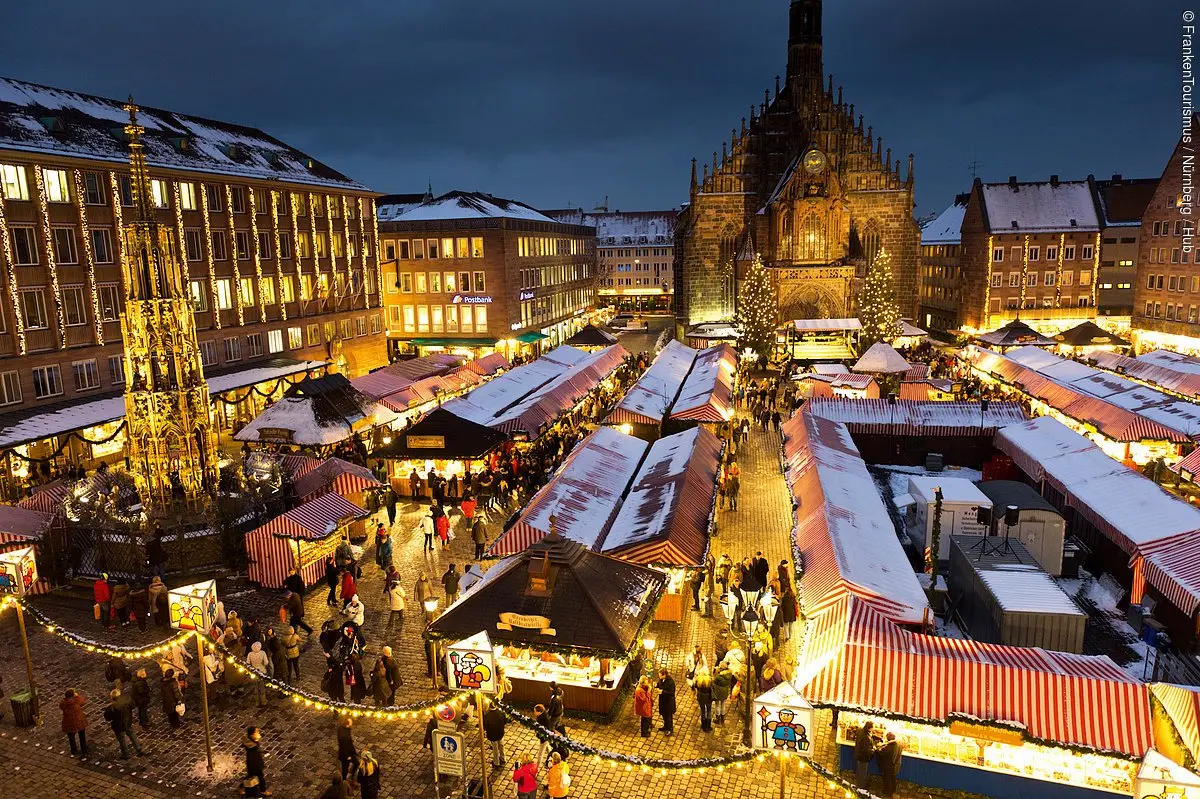
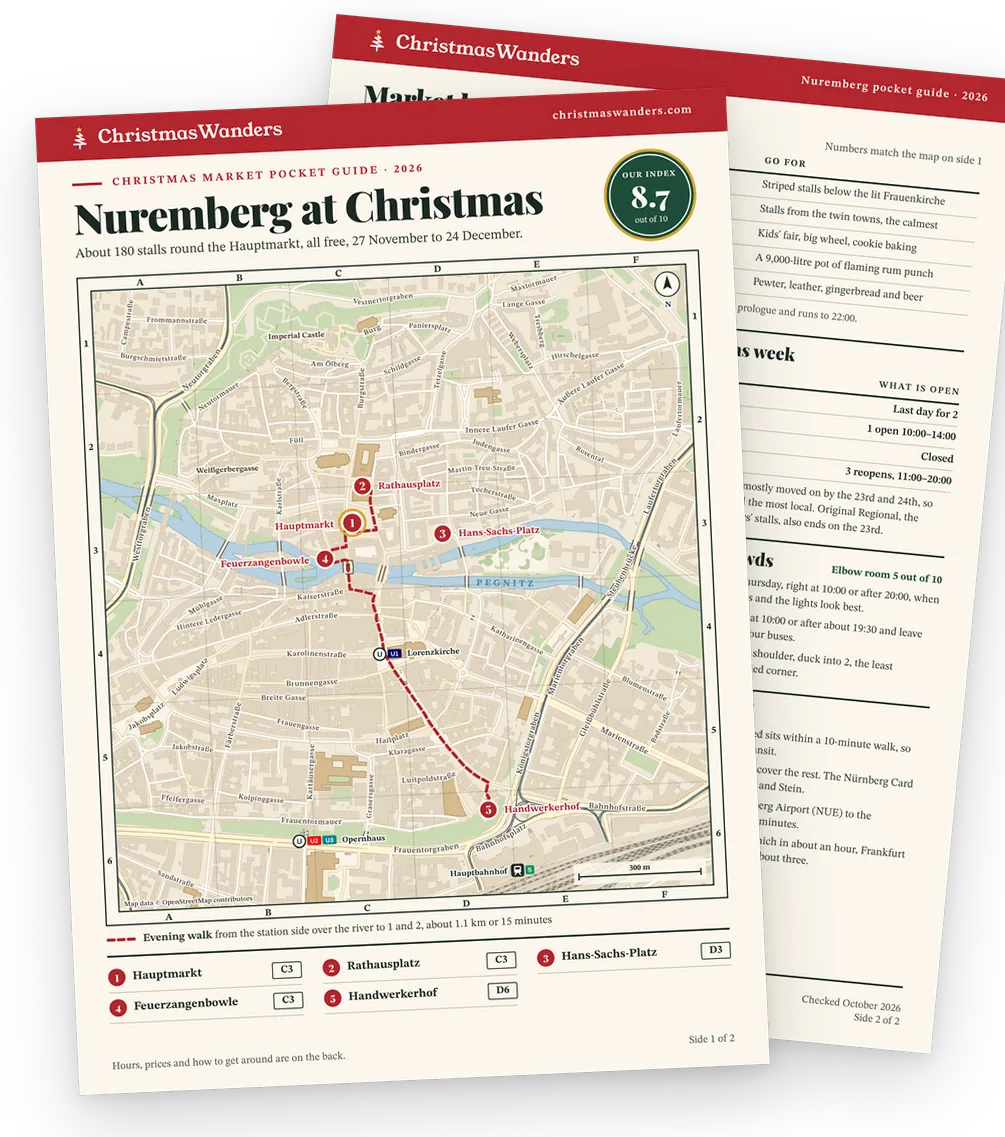
It sets up on the Hauptmarkt, the central main square, right in front of the Gothic Frauenkirche (Church of Our Lady), and spills into the adjoining squares and lanes. Picture around 180 wooden stalls under those iconic red-and-white striped canvas roofs, all within a few minutes’ walk of each other.
And If I had to pick just one of Germany’s markets (just one) the Nuremberg Christkindlesmarkt is the one I’d send you to.
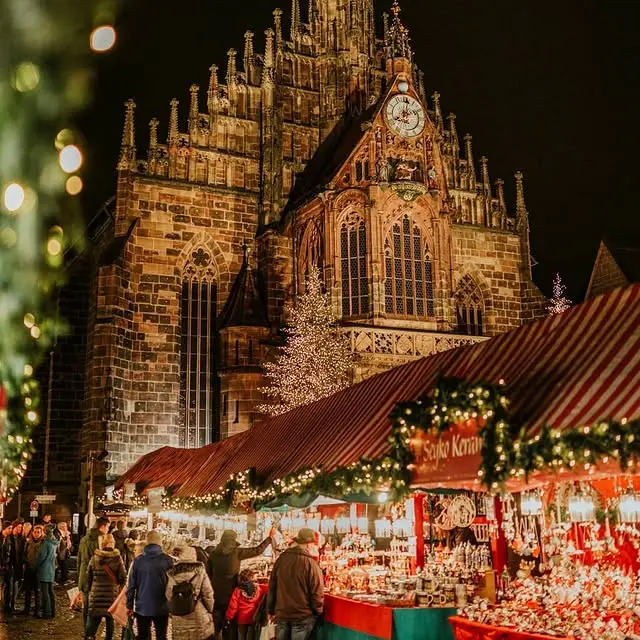
It’s not the biggest or the flashiest. But Nuremberg does Christmas the way Germany thinks it does Christmas: red-and-white striped stalls spilling across a medieval square, the spires of the Frauenkirche lit up behind them, and the smell of mulled wine and grilled sausage hanging in the cold air from about 4pm onward.
This is one of the oldest and most famous Christmas markets in the world and roughly two million people visit each year. Nuremberg literally brands itself as the Christmas City.
A Quick History of the Christkindlesmarkt
Nobody really knows when it started!
Despite “intense investigations” by local historians, the origins are unclear. The oldest hard evidence is a small wooden box held by the Germanic National Museum, inscribed on the bottom with a note about a gift sent to the “Kindles-Marck” in 1628. Official documents use terms like Kindleinbescheren (handing out Christmas presents to children) from 1610 onward, though historians aren’t sure those refer to this specific market.
The best guess is that it grew out of ordinary weekly-market sales sometime between 1610 and 1639, then slowly became its own thing. For a long time it opened on the Feast of Saint Barbara (December 4), but the crowds got big enough that in 1973 the opening was shifted to the Friday before the first Sunday of Advent, where it’s stayed.
There was no market at all between 1939 and 1948 because of wartime, obviously. When it returned in 1948, it came back with the solemn opening prologue that’s now part of the ritual.
The Christkind (The Star of the Show)
If you only remember one weird, wonderful detail about the Nuremberg Christmas Market, make it this: the market is opened by a teenage angel.
The Christkind (“Christ Child,” despite the name) is a young woman dressed in white and gold, with curly blond hair, a tall golden crown, and long golden sleeves that look like angel wings. The outfit is modeled on the Rauschgold angel which is the traditional foil angel that sits on top of Nuremberg Christmas trees.
She opens the market by reciting a prologue from the balcony of the Frauenkirche, secured with a rope, often in proper winter weather.
The speech was written by Friedrich Bröger for that first post-war market in 1948 and has been tweaked since. It opens and closes with an invitation to “the ladies and gentlemen who have been children once” and “the little ones at the beginning of the journey of life,” and calls the market a “little city made of wood and cloth.” It’s lovely, and if you can swing opening night, go.
Since 1969, the Christkind has been elected every two years from local girls aged 16 to 19. She has to be at least 1.60m tall (the balcony is high) and (my favorite requirement btw) free from giddiness. The citizens vote. A jury picks the winner from finalists.
It’s a quirky, deeply local ritual, and it’s the thing that makes this market feel like Nuremberg’s market rather than a generic German one.
When to Go (And How to Beat the Crowds)
Two million visitors in four weeks is a lot of people in a small Old Town. Here’s how I’d play it.
- Go on a weekday. Tuesday through Thursday is noticeably calmer than the weekend. The difference is huge.
- Go early or go late. The market opens at 10am and stays loud until 9pm. The sweet spots are right after opening (stalls are quiet, you can actually see the ornaments) and after 8pm on a weeknight (the dinner rush thins out and the lights are at their best).
- Avoid Saturday afternoons like the plague. This is when tour buses unload and you’ll shuffle shoulder-to-shoulder past the sausage stalls. If Saturday is your only option, go at 10am or after about 7:30pm.
- Opening weekend is magical but packed. Worth it for the prologue, not worth it if you hate crowds.
- The last two days are quieter. By December 23–24, a lot of the tourist traffic has moved on and it feels more local.
My pick is a Thursday in early-to-mid December, arrive mid-afternoon, stay through the evening switch-on. That’s the Christkindlesmarkt at its best.
What to Eat & Drink at the Christkindlesmarkt
This is the part I’d build your whole visit around. Nuremberg takes its market food seriously with two of its signature foods legally protected.
Drei im Weckla (Three in a Bun)
The Nürnberger Rostbratwurst is a tiny sausage, about 7–9 cm long, roughly 20 grams, flavored with marjoram, in a sheep casing. It’s been made to basically the same recipe since around 1300 (Goethe supposedly loved them enough to have them mailed to Weimar).
Because they’re small, the move is “Drei im Weckla” which is three of them tucked into a bread roll with mustard. It’s the market’s default snack, it costs a few euros, and you’ll eat roughly four of them over a visit, guaranteed. Don’t fight it.
Bonus fact: the name Nürnberger Rostbratwurst is a protected geographical indication in the EU, meaning anything sold under that name actually has to be made in Nuremberg. So the bratwurst at the market is the real, legally-protected thing.
Nürnberger Lebkuchen (Gingerbread)
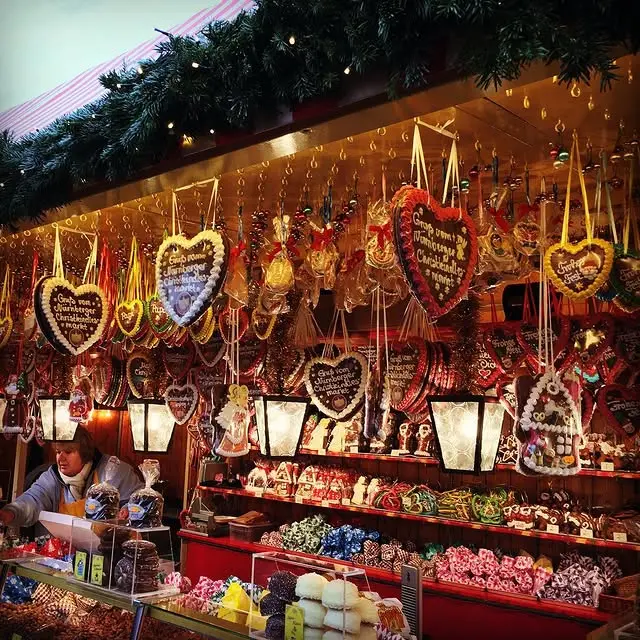
Nuremberg gingerbread is world-famous, and it’s also protected! Nürnberger Lebkuchen has been a protected designation of origin since 1996, so it can only be called that if it’s actually baked within the city limits.
The premium variety is the Elisenlebkuchen, a flourless recipe dating back to 1808 that must contain at least 25% nuts (the best artisan bakeries push closer to 40%). It’s spiced with aniseed, cinnamon, cloves, ginger, and cardamom, set on a thin wafer base, and glazed or chocolate-tipped.
The most photographed stand in the whole market is Lebkuchen-Schmidt’s “Hexenhäuschen” (witches’ house) and trust me, you’ll smell it before you see it. Grab a tin to take home because the tins themselves become collectibles you’ll cherish for years.
Glühwein & Feuerzangenbowle
Glühwein (mulled wine) is the fuel of every German Christmas market, and you’ll pay a small deposit on the ceramic mug. You can return it to get your money back, or keep it as a souvenir (I’d keep it).
The headline drink here, though, is Feuerzangenbowle which is literally “fire tongs punch.” A rum-soaked sugar cone is set alight and drips caramel into the mulled wine below. Nuremberg serves up what it bills as the biggest Feuerzangenbowle in the world, and the spectacle alone is worth the queue.
What to Buy (Souvenirs & Ornaments)
The Christkindlesmarkt is genuinely good for shopping, and it includes actual German craft, not junky tourist tat.
- Zwetschgenmännla (prune men) and Zwetschgenweibla (prune women): little figurines made from dried plums, figs, and nuts. They’re Nuremberg-specific, slightly odd, and make a far better souvenir than another fridge magnet.
- Rauschgold angels: the gold-foil angels that top Nuremberg Christmas trees, the same one the Christkind is dressed as.
- Gold-foil angels, glass baubles, nativity figurines, and wooden nutcrackers from the proper craft stalls.
- Lebkuchen tins from Lebkuchen-Schmidt: decorated, collectible, and a genuinely useful gift.
If you’re buying fragile ornaments, bring a small hard container in your bag or ask the vendor for a sturdy box. The walk back to the hotel through market crowds is not kind to glass.
The Other Markets Around the Hauptmarkt
Once you’ve done the main square, wander into the side markets:
- The Sister Cities Market (Markt der Partnerstädte) on Rathausplatz, running since 1998. Nuremberg is twinned with 14 cities, from Atlanta to Vienna to Kraków to Shenzhen, and each runs a stall selling local crafts and treats. Proceeds go to charity in the sister cities, which is a lovely detail. Ends December 23.
- Original Regional: stalls from the Nuremberg Metropolitan Region selling Franconian specialties. Also ends December 23.
- The Children’s Christmas (Kinderweihnacht) on Hans-Sachs-Platz: a nostalgic little fairground with a big wheel and roundabouts, plus stations where kids can bake cookies, paint glasses, and write a wish list to the Christkind.
- The Sternenhaus (House of Stars) in the Heilig-Geist-Saal: a program of storytelling, culture, and performances aimed at kids, running alongside the market.
If you’re traveling with children, the Kinderweihnacht alone justifies the trip. If you’re not, the Sister Cities Market is the most interesting corner for adults and it’s the least crowded and the most genuinely varied.
Things to Do in Nuremberg Beyond the Market
Nuremberg’s Old Town is small enough that you can see a lot between mulled-wine refills. A few non-negotiables include:
- The Imperial Castle (Kaiserburg) looms over the city and is the reason Nuremberg was ever important. Climb up for the view.
- The Frauenkirche, on the Hauptmarkt itself, where the Christkind gives her balcony prologue.
- The Beautiful Fountain (Schöner Brunnen), a 19-meter Gothic spire on the square. Legend says turning the golden ring grants a wish.
- St. Sebaldus Church and St. Lawrence Church, two of the city’s great medieval churches, one either side of the river.
- The Craftsmen’s Courtyard (Handwerkerhof) near the main station: half-timbered workshops selling pewter, leather, gingerbread, and beer. A mini-medieval-vibe shopping street.
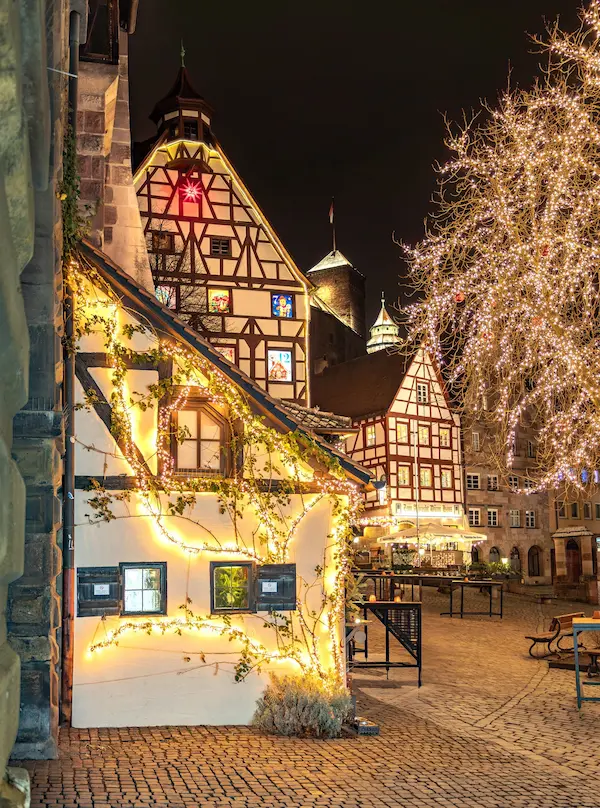
- Weißgerbergasse (Tanners’ Lane): a row of brightly painted half-timbered houses, the most photogenic street in the city.
- The Historic Rock-Cut Cellars (Felsengänge): a labyrinth of sandstone tunnels under the city, tied to Nuremberg’s beer-brewing history. A great rainy-day or “I need to warm up” option.
There’s also the heavier side of the city’s history. The Documentation Center at the Nazi Party Rally Grounds is the responsible thing to visit if you have a spare half-day. Nuremberg doesn’t hide from its 20th-century past, and it’s worth engaging with.
Market extras worth catching include the stagecoach (Postkutsche) rides through the Old Town, the children’s lantern procession, and the living nativity staged at the foot of the Castle.
How to Get to Nuremberg
Nuremberg is easier to reach than its size suggests, and arriving by train is the move. You step out of the Hauptbahnhof almost into the Old Town.
- By train: Nuremberg is a major ICE high-speed rail hub. Direct ICE connections run from Munich (about an hour), Frankfurt (around two hours), and Berlin (around three hours), plus regional links across Bavaria. The Hauptbahnhof is a 5-minute walk from the Hauptmarkt.
- By air: Nuremberg Airport (NUE) is close to the city and connects via the U-Bahn (U2 line) straight to the main station in about 12 minutes.
- By car: possible, but honestly unnecessary given the trains and Old Town parking is a hassle in December. Park outside and take transit in.
Getting Around Nuremberg
You barely need transit once you’re in the Old Town because everything market-related is within a 10-minute walk.
- U-Bahn, trams, and buses cover the rest of the city if you’re staying further out.
- VAG Rad, the city’s bike-share, works well in the (mostly flat) center, though December weather makes this a fair-weather choice.
- Walking is how you’ll actually experience the market. Don’t over-plan transit.
The one thing genuinely worth buying is the NÜRNBERG CARD: a two-day pass giving you free entry to all included museums and sights, 50% off partner activities, and free public transport across Nuremberg, Fürth, and Stein.
It’s €38 for adults, €12 for kids 6–11, and free under 6. If you’re going to do the castle, the Rock-Cut Cellars, and a museum or two alongside the market, it pays for itself fast.
Where to Stay for the Christmas Market
Location matters more than luxury here because you want to be able to walk back to your room after the market without a long cold transit ride.
- St. Sebald side (north of the river): the most central, right by the Hauptmarkt, the castle, and the best shopping streets. Expect higher prices in December.
- St. Lawrence side (south of the river): still walkable, slightly cheaper, with a great food-and-bar scene around the Lorenzkirche.
- Near the Hauptbahnhof / Handwerkerhof: convenient for train arrivals and often better value. The Craftsmen’s Courtyard is right there and the walk to the market is short.
Keep in mind that you should book early. Old Town genuinely sells out for December weekends, and the good-value places go first. Compare options on Booking.com for Nuremberg’s Old Town, and if you want to bundle it, check flights on KAYAK so you can lock in the whole trip before prices climb closer to the holidays.
A Perfect Evening at the Christkindlesmarkt
If you only have one evening, here’s the flow I’d build your night around:
- Arrive around 4pm, before it’s fully dark, to actually see the stalls and ornaments while the crowds are still manageable.
- Grab a Drei im Weckla from the first good bratwurst stand you smell. It’ll keep you going.
- Do a slow loop of the Hauptmarkt, then duck into the Sister Cities Market on Rathausplatz for the quieter, more varied stalls.
- Warm up with a Feuerzangenbowle at the big stand as the lights really kick in after dark.
- Browse the ornament and Zwetschgenmännla stalls while you’re merry (careful with the glass).
- End at the Frauenkirche looking back across the square. The view of the lit-up church behind the red-and-white stalls is the postcard shot, and it’s better in person than online.
That’s a complete Christkindlesmarkt evening in about three hours.
Tips for Visiting + Being a Responsible Visitor
A few practical notes, plus the bit I’d actually stress most:
- Bring some cash. Most stalls take cards now, but the smaller craft and food stands still prefer cash, and you don’t want to miss a Zwetschgenmännla because the card reader’s down.
- Dress for the cold. You’re standing still outdoors for hours. Layers, a real coat, gloves, a hat. December in Nuremberg hovers around freezing at night and the wind funnels through the Old Town.
- Book accommodation and trains early. December weekends sell out. The closer to the market, the sooner.
- Time it for the opening prologue if you can. First Friday evening, balcony of the Frauenkirche. It’s the part most visitors miss and the part that makes the market feel like Nuremberg’s.
- Go on a weekday. I know I said it already, but it’s the single biggest lever on how much you enjoy the visit.
The Nuremberg Christkindlesmarkt is the kind of Christmas market that lives up to the hype, which is rare. It’s old, it’s specific to this city, the food is legally protected, and a teenage angel opens it from a church balcony. You can’t really get that anywhere else.