Opens in a new tab

Christmas Markets in Bavaria

Nuremberg gets the crowds, Regensburg gives you four markets in one walk, and one €34 train ticket links them.

Bavaria's season starts in mid-November, when Nuremberg's WinterDorf and Munich Airport's covered market open on 12 and 13 November, and doesn't finish until 6 January, when the Feuerzangenbowle at the Isartor drains its last kettle. In between, Nuremberg puts 168 wooden booths around the Hauptmarkt and pulls two million people through them, and Munich spreads roughly 140 stalls across Marienplatz and twenty-odd more markets across the rest of the city. Entry is free almost everywhere, and the best-known exception is a palace courtyard in Regensburg.

First to open19 NovRegensburg
Last to close24 DecNuremberg
Top score8.7Nuremberg

Checked October 2026. Nuremberg, Munich, Regensburg, Bamberg, Augsburg, Würzburg and Berchtesgaden 2026 dates are confirmed on official sites. Glühwein prices still follow last season, because no 2026 prices are published yet.

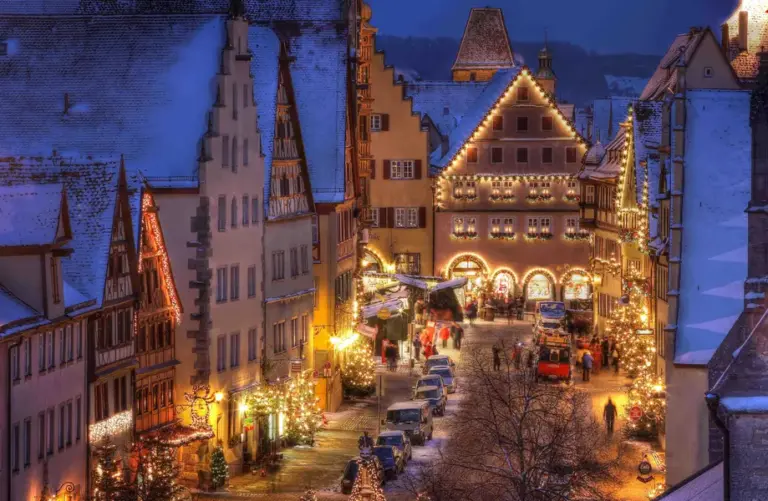
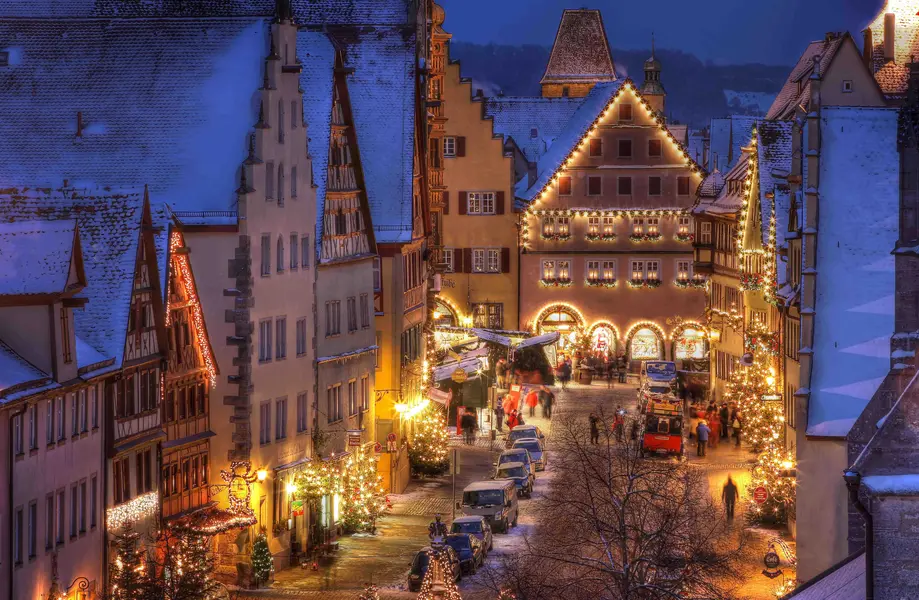
Rothenburg Christmas Market
Rothenburg ob der Tauber
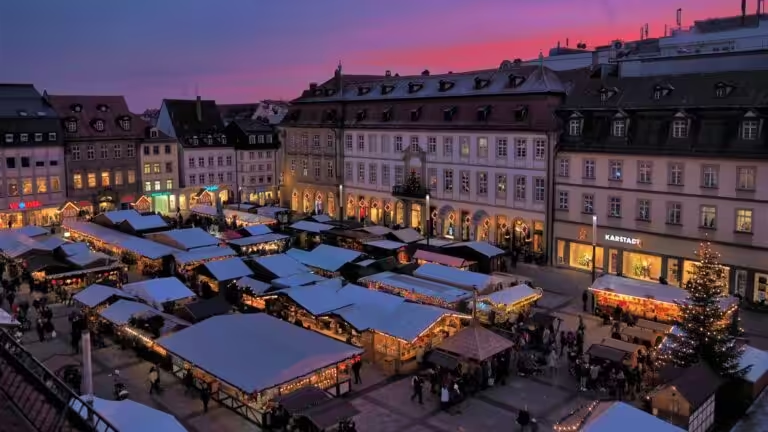
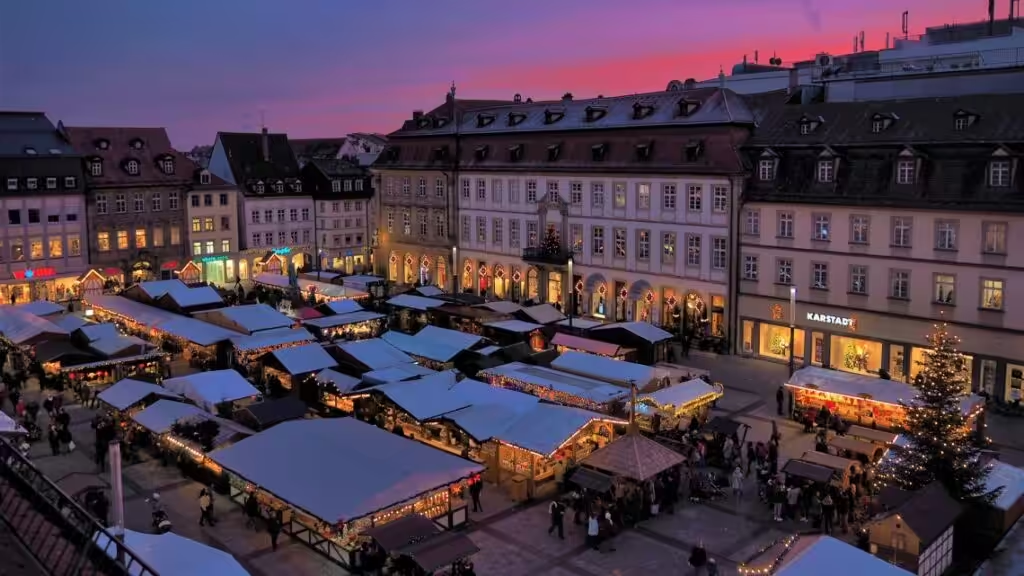
Bamberg Christmas market
Bamberg
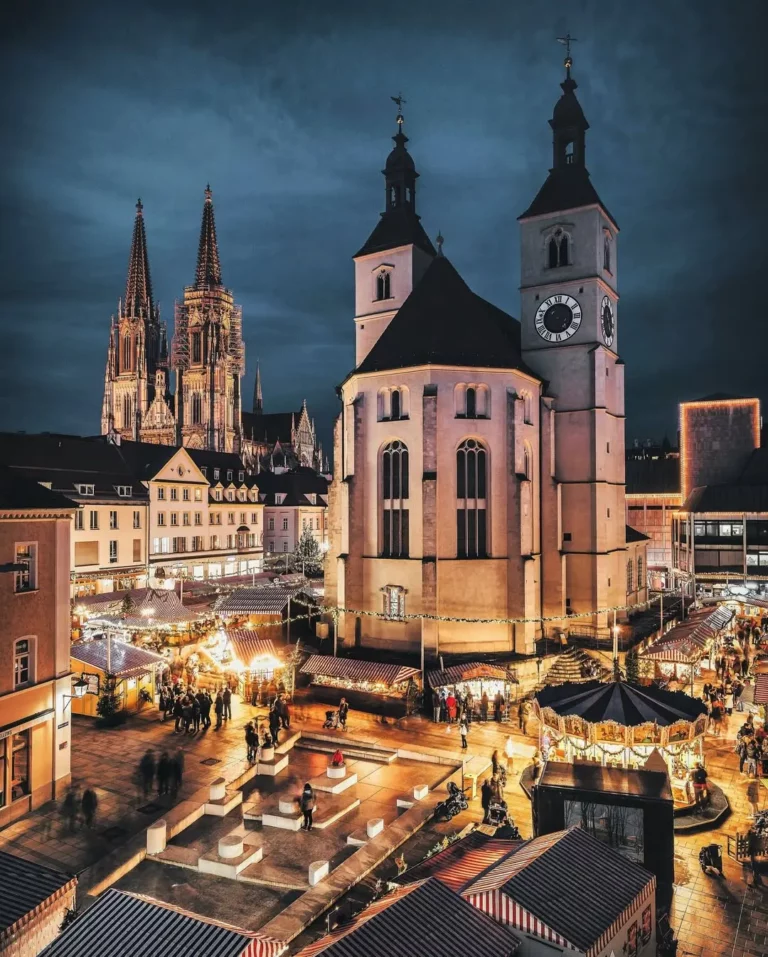
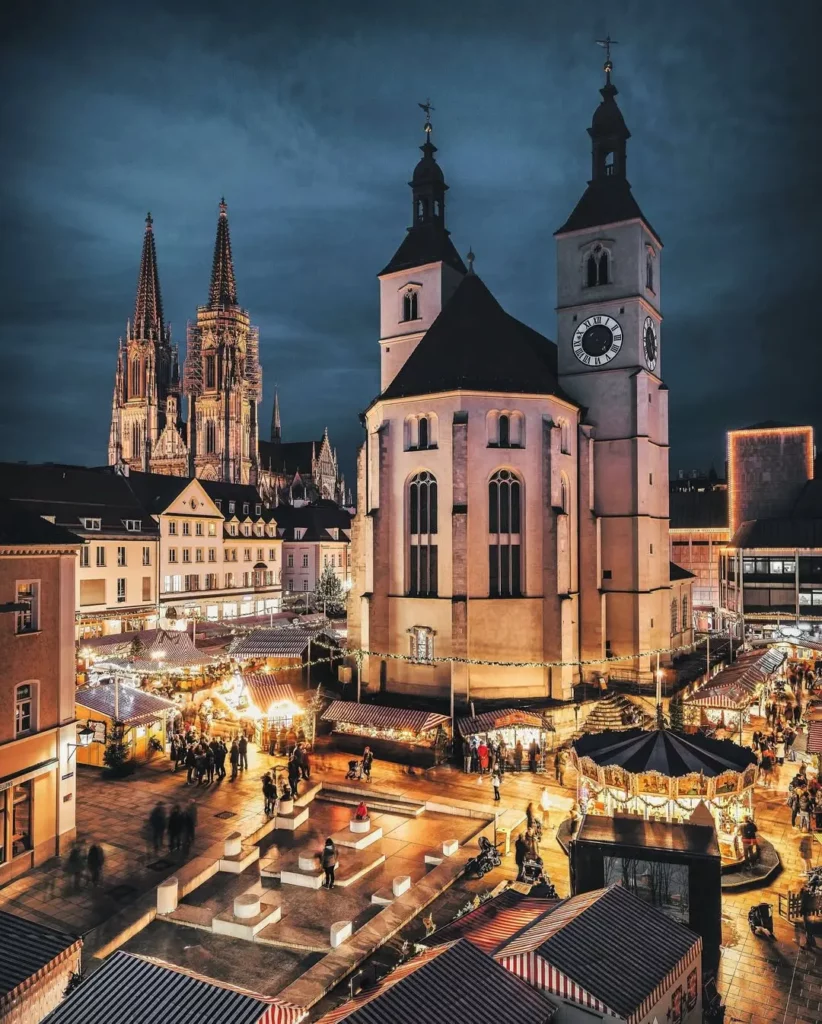
Regensburg Christmas market
Regensburg
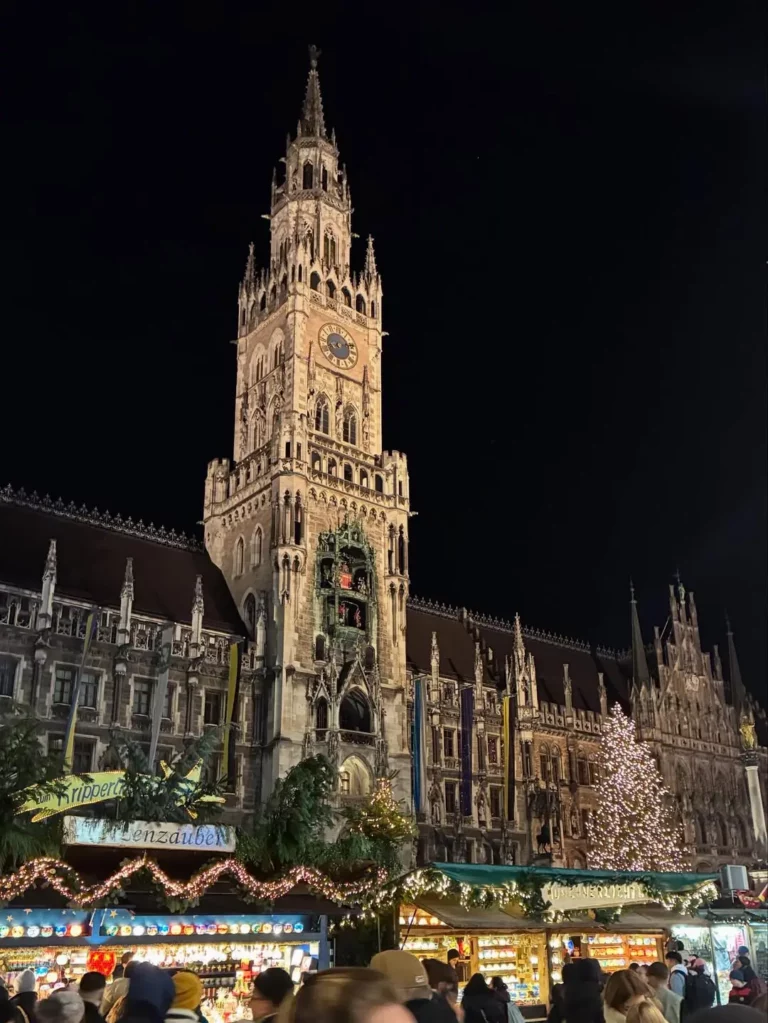
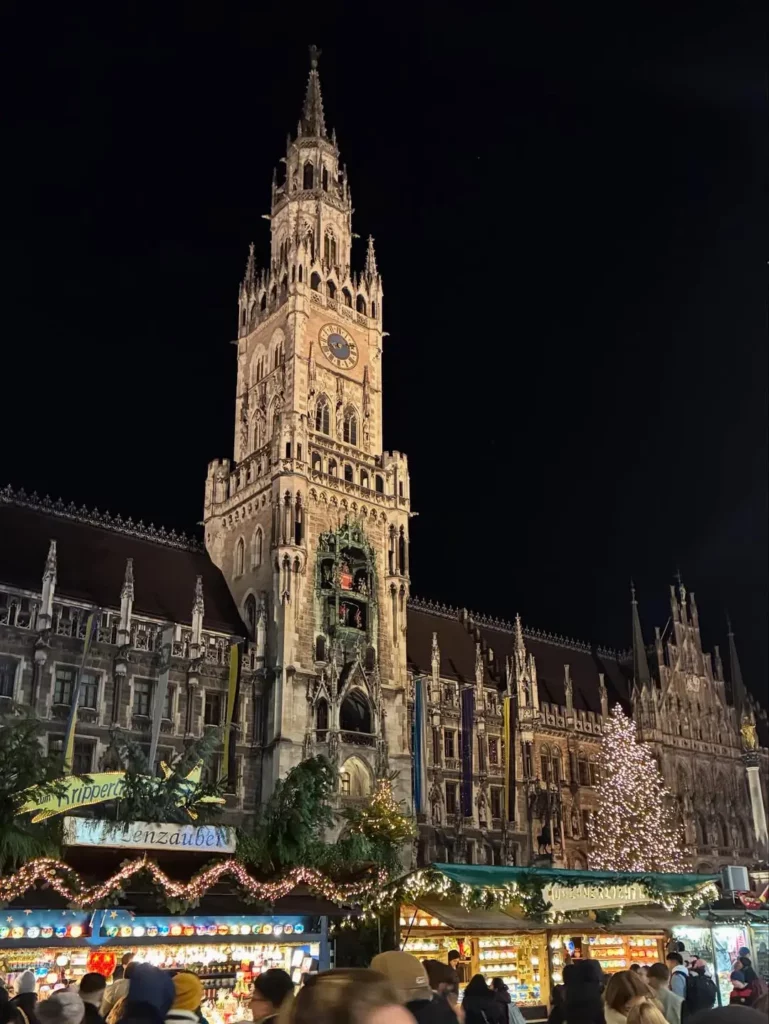
Munich Christmas market
Munich
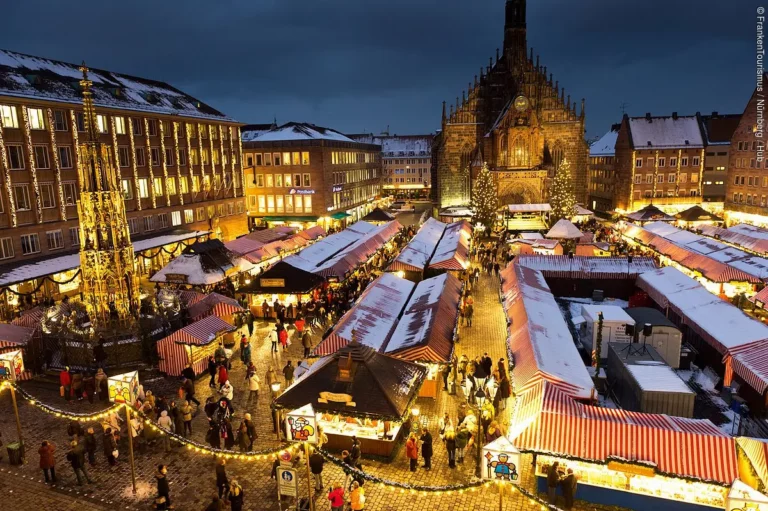
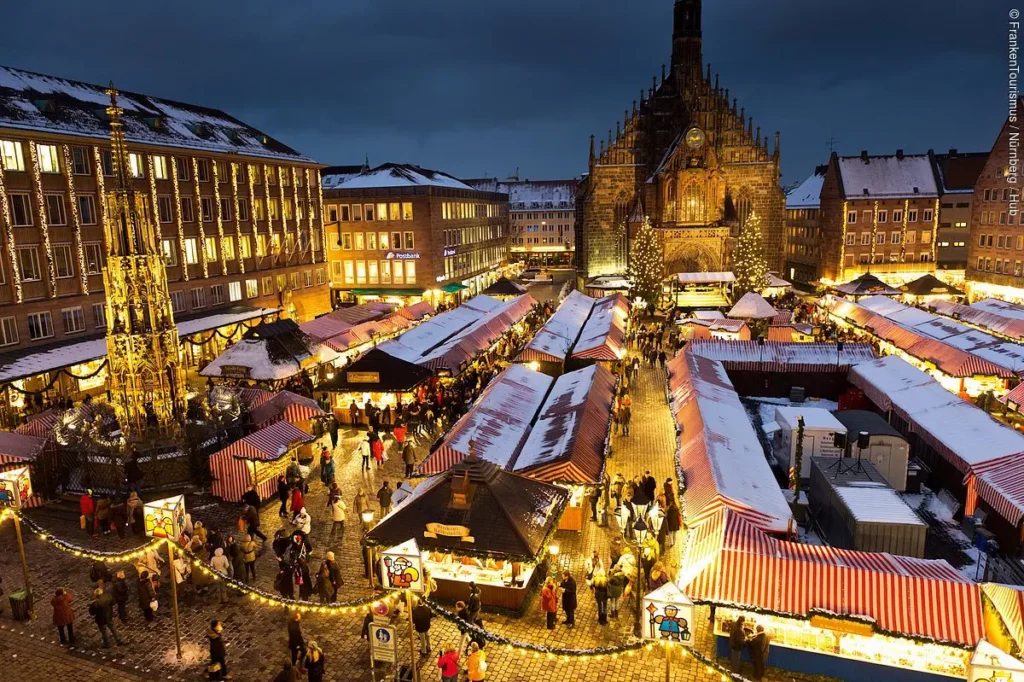
Nuremberg Christmas Market
Nuremberg
The short answer

If you only go to one Christmas market in Bavaria this year

Our pick, and the runner-up worth the detour.

Our pick beyond Nuremberg

Regensburg

Four markets · one evening's walk · 1h23 from Munich

Regensburg gives you four markets inside an easy walk of a UNESCO old town that came through the war largely intact. There's the Christkindlmarkt on Neupfarrplatz, the craftsmen's Lucrezia-Markt on Haidplatz, a beer-garden market in the Spitalgarten looking back across the Danube at the Steinerne Brücke, and the candle-and-torchlight courtyard at Schloss Thurn und Taxis. Go on a Monday and the palace charges €6.50 rather than the €13.50 it wants on a Saturday.

Bamberg runs it close as a town, with an old town that survived the war, around 35 nativity scenes and smoked beer from the barrel.

This is the shortlist

It's ranked on atmosphere, stall quality and how well the city works as a base.

The anchor · 168 booths · 27 Nov–24 Dec
Twenty markets, one U-Bahn · 20 Nov–24 Dec
Four markets in one evening · to 23 Dec
UNESCO old town · 24 Nov–23 Dec
Rothenburg ob der Tauber
Reiterlesmarkt · 61 stalls · 20 Nov–23 Dec
Augsburg
23 angels on the Rathaus · 23 Nov–24 Dec
Würzburg
Wine-country market · 51 min from Nuremberg
Berchtesgaden
Alpine · open 26 Dec–3 Jan
Passau
Organ concerts Wednesday to Saturday, €6 · to 22 Dec
Landshut
Good for kids · rink and free Bockerlbahn · 19 Nov–23 Dec
This season

When does every Bavaria Christmas market open and close?

This list is updated as official dates land

Bavaria · opening dates
MarketOpensClosesSizeEntrySince
Regensburger Weihnachtsmärkte
Thu 19 Nov
Wed 23 Dec
LargeMostly free1791
Münchner Christkindlmarkt
Fri 20 Nov
Thu 24 Dec
LargeFree1642
Alt-Rothenburger Reiterlesmarkt
Fri 20 Nov
Wed 23 Dec
SmallFreeOrigins in the 15th century
Bamberger Weihnachtsmarkt
Tue 24 Nov
Wed 23 Dec
SmallFree1911
Nürnberger Christkindlesmarkt
Fri 27 Nov
Thu 24 Dec
LargeFree1678
Runs into January Closes before the New YearDates change from year to year, so check the market’s own page before you book.
Browse by country

One Christmas season, country by country

Every market, ranked

All Christmas markets we visited in Bavaria

Rothenburg Christmas Market
Small

Rothenburg ob der Tauber

November 20, 2026 – December 23, 2026

Rothenburg's Reiterlesmarkt runs 20 November to 23 December 2026, with 61 stalls between the Rathaus, the Marktplatz and St. Jakob. It closes at 19:00 most nights, so sleep inside the walls and join the 20:00 English Night Watchman tour.

Hotels in Rothenburg ob der Tauber for your dates
Bamberg Christmas market
Small

Bamberg

November 24, 2026 – December 23, 2026

Bamberg’s market is modest and the town around it is the reason to come. Stalls run Maximiliansplatz through Grüner Markt from 24 November to 23 December, opening at 09:30. Around them sit about 35 nativity scenes and breweries pouring smoked beer from the barrel.

Hotels in Bamberg for your dates
Regensburg Christmas market
Large

Regensburg

November 19, 2026 – December 23, 2026

Four markets sit within an easy walk of a UNESCO old town that came through the war largely intact. Three are free. The fourth, in the torchlit palace courtyard of Schloss Thurn und Taxis, charges €6.50 on a Monday and €13.50 on a Saturday.

Hotels in Regensburg for your dates
Munich Christmas market
Large

Munich

November 20, 2026 – December 24, 2026

Twenty-odd markets share one U-Bahn map, and the famous one is the weakest. Marienplatz pulls three million people, then locals walk five minutes to Wittelsbacherplatz, the Residenz courtyard or the Rindermarkt salmon fires. From 2026 the season opens early, on 20 November.

Hotels in Munich for your dates
Nuremberg Christmas Market
Large

Nuremberg

November 27, 2026 – December 24, 2026

Nuremberg’s Christkindlesmarkt runs 27 November to 24 December 2026, with 168 red-and-white booths around the Hauptmarkt. The Kinderweihnacht adds a double-decker carousel and cookie baking, and from 1 December the Christkind appears Tuesday to Friday at about 14:30 and 15:00.

Hotels in Nuremberg for your dates
Side by side

How they compare

The Index is the overall score out of 10. Elbow room is a planning signal and sits outside it.

MarketAtmosphereValueFoodElbow roomAccessStallsIndex
Rothenburg ob der Tauber9774567.2
Bamberg8979767.4
Regensburg9777888.0
Munich8676977.4
Nuremberg9885998.7

Swipe the table sideways to see all six scores and the Index →

What makes Bavarian Christmas markets different?

Bavaria is really two Christmas regions sharing one state. Up north is Franconia, with Nuremberg, Bamberg, Würzburg and Rothenburg, where Christmas means Lebkuchen, little Nuremberg sausages, smoked beer and wine country. Down south is Old Bavaria and the Alps, with Munich, Berchtesgaden and the lakes, where it means mountain backdrops, brass bands and men in fur and carved wooden masks chasing people down the street.

Both sides share the Christkind, the angel-like Christ Child who brings the presents here instead of Santa. Martin Luther popularised the Christkind in the 1530s to push St Nicholas aside, and it only took over Catholic Bavaria in the early 1900s. So the most famous Christkind in the world lives in Nuremberg, a historically Protestant city, while Coburg hedges its bets and sends the Christkind and Father Christmas out together on Sundays.

The food is half the reason to come. Nürnberger Lebkuchen has protected status and has to be baked in Nuremberg to use the name, and the top grade, Elisenlebkuchen, is at least a quarter nuts with hardly any flour. Drei im Weggla means three finger-sized sausages in a bread roll, and the prune figures called Zwetschgenmännle are sold as lucky charms rather than snacks. In Bamberg, bock beer season runs to the end of December, and Schlenkerla taps its smoked Eiche bock on 29 November.

Is Nuremberg worth it?

Yes, but only if you choose your moment. The Christkindlesmarkt puts 168 red-and-white booths on the Hauptmarkt and the Rathausplatz next to it and pulls around two million people through them in four weeks, and at the wrong hour that's exactly how it feels. Opening night, every Saturday and the Sunday before Christmas are a crush, the kind where you see the stalls only above head height and keep losing whoever you came with.

Come on a weekday morning, though, and it's a different market. The stalls open at 10:00, the booths are some of the best kept in Germany, and you can actually stop and look. Thursday is noticeably calmer than the weekend, and the light at dusk around 16:30 is the moment to be there if you want the photos. If you want the opening itself, the Christkind reads her Prologue from the Frauenkirche balcony at 17:30 on 27 November, and you'll be sharing the square with half of Franconia.

The Christkind appears from 1 December, Tuesday to Friday, at about 14:30 at the Kinderweihnacht on Hans-Sachs-Platz and then on the main market around 15:00. The Markt der Partnerstädte by the Rathaus, where Nuremberg's twin towns run their own stalls, is roomier and more interesting than the main rows, and the four Original Regional booths tucked against St Sebald sell food from Franconian producers. Glühwein was €4.50 last season with a €5 mug deposit, and the same mug works at every stall because the traders share one deposit pool.

If the crowds get to you, Fürth is the escape. It's Nuremberg's next-door neighbour, a short U-Bahn ride away, and its medieval Christmas market is where plenty of locals go instead of their own.

Where else should you go in Bavaria?

Regensburg is my pick for the best all-round market trip in Bavaria. It's a UNESCO old town that came through the war largely intact, and it fits four or five markets into one evening's walk. There's the main market on Neupfarrplatz, the craftspeople's Lucrezia market on Haidplatz, a market in the Spitalgarten with mulled beer and a view of the Stone Bridge, and the candlelit courtyard of Schloss Thurn und Taxis. The palace one charges entry, and the price depends on the day. It's €6.50 on a Monday and €13.50 on a Saturday, children go free on Sundays, and women get in free on Sunday evenings after 19:00. Same market, half the price, so go on a Monday.

Bamberg is the opposite case. The market itself is small, and some people find it a let-down. The town is the draw, with a UNESCO old town of its own, a trail of around 35 nativity scenes in churches and squares, and breweries pouring smoked beer straight from the barrel. Come for Bamberg and treat the market as a bonus. And bring some cash, since not every stall takes cards.

Rothenburg ob der Tauber looks exactly like the Christmas card, which is why coach tours love it. Its Reiterlesmarkt has 61 stalls and closes early in the evening. Stay the night, walk the town wall before 09:00 and after the coaches leave, and you'll have the lanes nearly to yourself. If you'd rather skip the coaches altogether, Dinkelsbühl and Nördlingen give you the same walled-town feeling with a fraction of the people.

Munich has more markets than anywhere else in the state, twenty-odd, all on one U-Bahn map. The big one on Marienplatz has about 140 stalls and draws over three million visitors, and I find it the least interesting of the lot. The medieval market on Wittelsbacherplatz is louder and more fun, the artists' market in Schwabing labels where everything is made, and the little neighbourhood market in Haidhausen is the one locals keep recommending.

A few others are worth knowing. Augsburg turns its town hall into a living Advent calendar, with 23 angels appearing in its windows at 18:00 on Advent Friday, Saturday and Sunday evenings, plus 23 November and 23 December. Landshut is a good pick for families, with an ice rink and a free little Bockerlbahn train that shuttles visitors round on Friday to Sunday afternoons. Passau's market sits on the cathedral square, and from Wednesday to Saturday at noon there's a €6 concert on the cathedral organ, which is partly under restoration but still something to hear. And on the Chiemsee, the Fraueninsel market runs on just two long weekends, 26 to 29 November and 3 to 6 December, on an island you can only reach by boat.

How do you get around in 2026?

By train, but with one big warning for this year. The high-speed line between Munich and Nuremberg is being worked on from 30 October to 12 December. Until then there are at most two trains an hour and journeys take about 30 minutes longer than the usual 1 hour 2 minutes. Trains between Regensburg and Passau are replaced by buses until 12 December too.

So pick one rail spine and stay on it. From Nuremberg, Bamberg is 35 minutes away with about 60 direct trains a day, Würzburg is 51 minutes, and Rothenburg takes around 1 hour 10 to 1 hour 50 with two changes. From Munich, Augsburg is 26 minutes and Regensburg 1 hour 23. Salzburg is just under two hours on the regional train, the one the Bayern-Ticket covers.

The Bayern-Ticket costs €34 for one person and €10 for each extra traveller up to five, and covers every regional train in the state, plus almost all its city transport and buses, for a day, from 09:00 on weekdays. The Deutschlandticket is €63 for a calendar month and covers the same trains across the whole country. If you're travelling solo for two days or more, the Deutschlandticket wins. A couple needs three travel days for it to pay off, and a group of five is better off with Bayern-Tickets for up to four days. Neither covers ICE or IC trains, and the Deutschlandticket goes up to €66.80 in January 2027. It's a monthly subscription, so check the cancellation date or you may end up paying for January too.

For a base, I'd choose Nuremberg if the markets are the point. Bamberg, Würzburg, Rothenburg and Fürth are all easy day trips, and a typical December hotel night costs about the same as in Munich, around €127 against €131. Choose Munich if you want the Alps, Salzburg and the most places open after Christmas.

How many days do you need?

Five to seven days with two bases works best. Something like three nights in Nuremberg with day trips to Bamberg and Rothenburg, then three in Munich, gives you big markets, small towns and a bit of the Alps without living out of a suitcase.

Don't try to do a new market every evening. The big city markets sell a lot of the same ceramic houses, candles and paper stars, and after the third one they start to blur. Mix one or two of the famous markets with the towns themselves, a castle, a brewery, a thermal bath, and you'll come home wanting more instead of never wanting to see a wooden hut again. And don't believe anyone who tells you Christmas week is quieter. It isn't.

What does a Glühwein cost in Bavaria?

Bavaria has both the dearest and some of the cheapest Glühwein in Germany. Würzburg topped the whole country last season at €6 a cup, and Munich's Marienplatz charged €5 to €6. Head to Augsburg or Kempten and it drops to €3.50 to €4. Nuremberg sits in the middle at €4.50, and the Bavarian average came out at €4.27.

Berchtesgaden does it differently. There's no deposit at all, you buy the year's collector mug outright and bring last year's back for a refill if you have one.

Vienna's punsch costs about the same as Würzburg's Glühwein, €5.50 to €5.80, but you hand over a €5 mug deposit on top. Strasbourg, at €5 plus a €1 deposit, is about Munich money.

When can you see Krampus?

Early December is when the wild men come out. The biggest show is in Munich on Sunday 13 December, when 300-plus Krampus figures in carved masks run through the old town from 15:00 and up to 50,000 people turn out to watch. It's a spectacle, and maybe not one for toddlers.

In Berchtesgaden, the Buttnmandl, men wrapped in straw with cowbells round their waists, march through town on 5 December, and Bad Tölz has its Krampus run on the evening of the 12th. Then every afternoon at 15:00 from 17 to 24 December, Berchtesgaden's Christmas shooters fire their hand mortars, a racket that's been on Bavaria's cultural heritage list since 2018.

What's open after Christmas Eve?

More than you'd expect. Most Bavarian markets close on 23 December or at 14:00 on the 24th (and most also close for Totensonntag, Sunday 22 November, though Berchtesgaden stays open), and from the afternoon of Christmas Eve to the 26th even the supermarkets are shut, so book Christmas Day dinner well ahead. But a few keep going.

In Nuremberg, the giant Feuerzangenbowle at the Fleischbrücke, a kettle of rum-soaked flaming sugar over mulled wine, pours from 15:00 to 23:00 on 25 and 26 December. The Kinderweihnacht reopens on 26 December and runs to the 30th. Munich's Feuerzangenbowle is back at the Isartor this year and runs right through to 6 January. Bad Kissingen's market is open on Christmas Day itself, Berchtesgaden reopens on the 26th and runs to 3 January under the Watzmann, and Garmisch-Partenkirchen's Winter im Park keeps its lights on until 5 January.

Will there be snow?

Probably not in the towns. Munich's chance of a white Christmas has fallen from about one in three to about one in seven over the last few decades, and a mild spell around Christmas turns up in roughly seven years out of ten. December in Nuremberg and Regensburg is more likely to be grey and damp than snowy.

If snow is the dream, go south. Berchtesgaden, Garmisch and Mittenwald are your best bets, and the mountains around them usually have snow even when the lowlands don't. Wherever you end up, the sun sets at about 16:20 in December, so plan the towns for daylight and the markets for after dark.
On the map

How far apart are the Christmas markets in Bavaria?

Every line is a train between two markets, with the fastest journey time. Tap a market to see its dates, the trains from there and hotels nearby.

Planning the trip

Pairing cities, and what it costs

Christmas markets you can pair by train

The best trips pair two or three cities a short train ride apart. Times are the fastest regular train, station to station, and how often it runs.

Nuremberg → Bamberg35 min · ~60 direct trains a day
Nuremberg → Würzburg51 min · up to 62 direct a day
Munich → Augsburg26 min by ICE
Munich → Nuremberg1h02 by ICE normally · about +30 min until 12 Dec
Munich → Regensburg1h23
Munich → Garmisch-Partenkirchenregional train · Bayern-Ticket covers it
Nuremberg → Rothenburg o.d.T.two changes · 1h10–1h50
Regensburg → Passaureplacement bus until 12 Dec, rail from 13 Dec
Munich → Salzburg (cross-border bonus)1h30–1h45 by railjet or EC · just under 2h on the regional train the Bayern-Ticket covers

A weekend for two

Glühwein, Nuremberg (2025)€4.50, same as 2024
Glühwein, Munich (2025)€5.00–€6.00, among the dearest in Germany
Glühwein, Bamberg (2025, all 14 stands surveyed)€4.00–€4.50
Mug deposit, Nuremberg€5, the same at every stall
Glühwein, Augsburg and Kempten (2025)€3.50–€4
Mug deposit, Berchtesgadennone, you buy the collector mug
Deutschlandticket from January 2027€66.80 a month
Thurn und Taxis entry, Saturday vs Monday€13.50 vs €6.50
Bayern-Ticket, one day€34 for one, +€10 each to five (€74)
Deutschlandticket (from 1 Jan 2026)€63 a month, worth it from two solo travel days
Glühwein, Würzburg (2025)€6, the dearest in Germany
Nuremberg hotel, opening weekend vs January (2025, estimate)€210–€529 vs €65–€95
Before you book

Questions people actually ask

    When do Bavarian Christmas markets open and close in 2026?

The season runs from mid-November to 6 January. Nuremberg's WinterDorf opens on 12 November and Munich Airport's covered market on 13 November. Munich's Marienplatz market runs 20 November to 24 December and Nuremberg 27 November to 24 December, both closing at 14:00 on Christmas Eve. Most other Bavarian markets finish on 23 December, and most close for Totensonntag, Sunday 22 November, though Berchtesgaden stays open. One of the last is Munich's Feuerzangenbowle at the Isartor, which pours to 6 January 2027.

    Do any Bavarian Christmas markets charge admission?

A few do, and the best known is the Romantischer Weihnachtsmarkt in the courtyard of Schloss Thurn und Taxis in Regensburg. It charges €6.50 on Mondays, €9.50 on Sundays and Tuesday to Friday, and €13.50 on Saturdays. Children aged 6 to 16 pay €3.50 and go free on Sundays. A handful of small castle markets also charge a few euros at the gate.

    What's the cheapest way to get between Bavarian market towns?

The Bayern-Ticket. It's €34 for one person and €10 for each extra traveller up to five, so a group of five pays €74 for a full day on every regional train in the state and almost all its city transport and buses, and it reaches Salzburg Hbf on regional trains. On weekdays it starts at 09:00. From two solo travel days in one month, the €63 Deutschlandticket is better value. Neither covers ICE or IC trains.

    Which Bavarian markets are open on Christmas Day?

Nuremberg's Feuerzangenbowle at the Fleischbrücke pours from 15:00 to 23:00 on 25 and 26 December, and Bad Kissingen's market is open on Christmas Day too. Munich's Feuerzangenbowle at the Isartor opens from 12:00 and runs right through to 6 January. Berchtesgadener Advent closes on the 25th but reopens on the 26th and runs to 3 January, Nuremberg's Kinderweihnacht reopens on the 26th, and Garmisch-Partenkirchen's Winter im Park continues to 5 January. The day-by-day market calendar shows what else is open over Christmas.

    Should I base in Munich or Nuremberg?

Nuremberg, if the markets are the point. Bamberg is 35 minutes away, Würzburg 51, Rothenburg down a branch line and Regensburg over a freshly rebuilt main line, so that's four market towns without changing hotel. Munich wins if you want density rather than variety, with twenty-odd markets on a day ticket, the most places open over Christmas and the Alps on its doorstep. Munich to Nuremberg is normally 1h02 by ICE, about half an hour longer until 12 December while the line is rebuilt.

    Can I pay by card at Bavarian Christmas markets?

In Munich, mostly. About 80% of Christkindlmarkt traders take cards, though American Express is refused and minimum spends run €1 to €10. Outside Munich, carry cash, because card acceptance varies stall by stall, and keep small change and notes for the mug deposits.

    What is the Christkind, and where do I actually see one?

In southern Germany the Christ Child brings the presents rather than the Weihnachtsmann, and in Nuremberg she is a real person, a young Nuremberger chosen for a two-year term. She opens the market by reading the Prologue from the Frauenkirche balcony at 17:30 on 27 November, then from 1 December appears at the Kinderweihnacht around 14:30 and on the main market around 15:00, Tuesday to Friday. Augsburg does it differently, with 23 angels appearing on the Rathaus façade at 18:00 on Advent weekend evenings and on 23 November and 23 December.

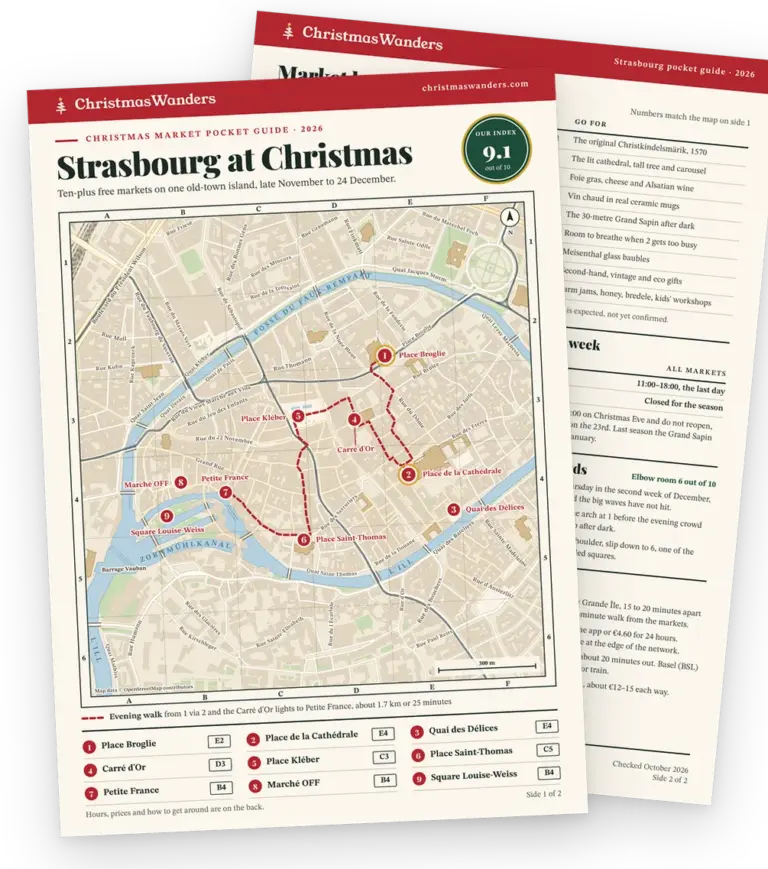
A ChristmasWanders pocket guide, a street map of every market on one side and hours, prices and transport tips on the other

A pocket guide, both sides

Free pocket guide

Every market in your city, on one sheet of paper

Tell us which city you’re going to and we’ll email you its pocket guide. It’s a real street map with every market on it, plus the opening hours, what things cost and how to get from one market to the next. Print it, fold it, and it still works when your phone dies in the cold.

Two A4 pages, made to print on both sides of one sheet. After that, a few emails a season, and you can unsubscribe in one click.

Quick picks