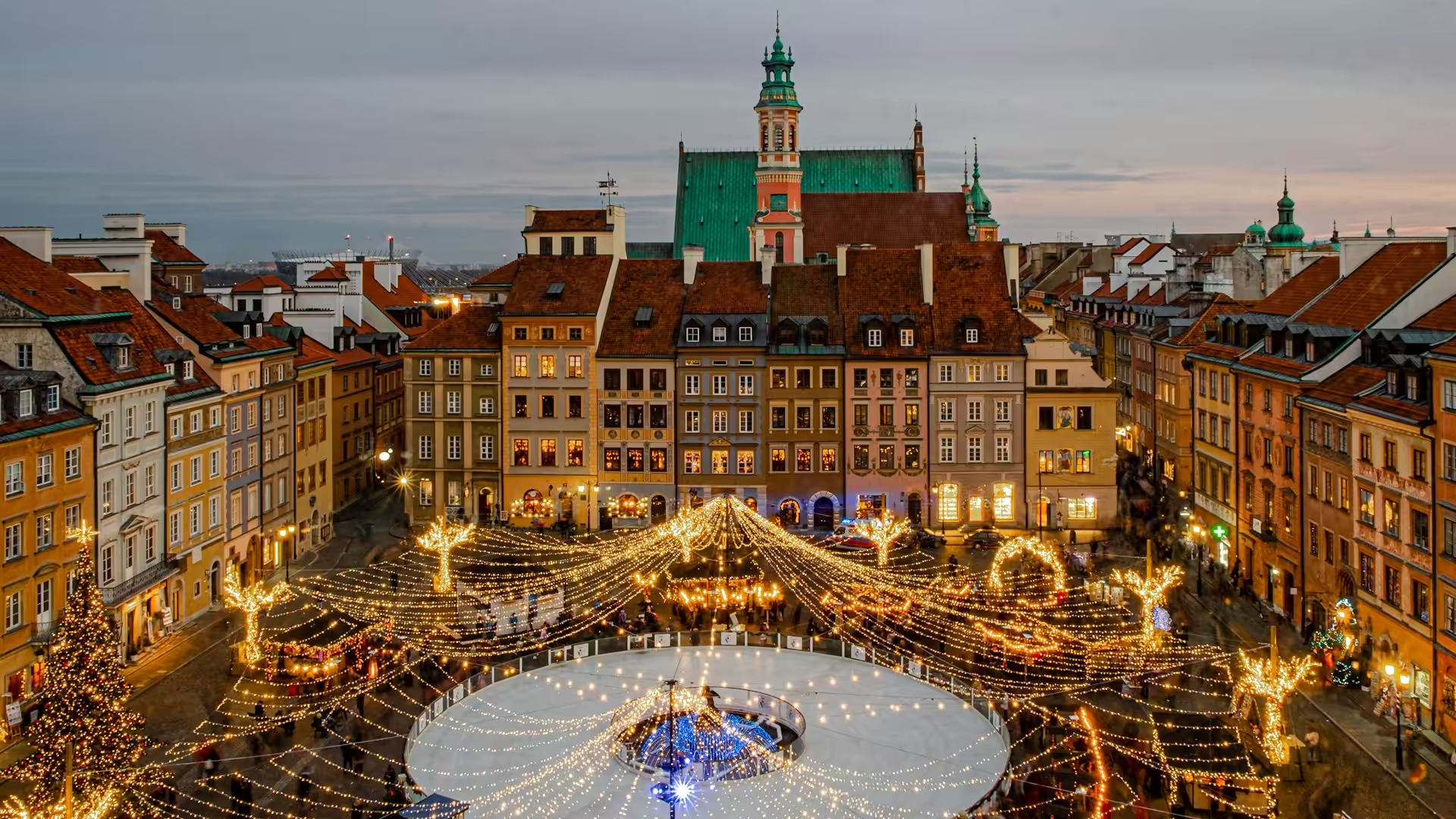
Here’s the deal. Warsaw’s Christmas market is good. Not legendary, not “cancel your plans and book a flight” good, just… good. Solid.
A seven out of ten that thinks it’s an eight. Nobody in the history of aviation has ever crossed an ocean specifically for Warsaw’s Christmas market, and if anyone ever claims they did, check their lanyard, because they work for the Warsaw tourism board.
It’s a market that exists to serve a great city, not a city that exists to serve a great market. Know what I mean?
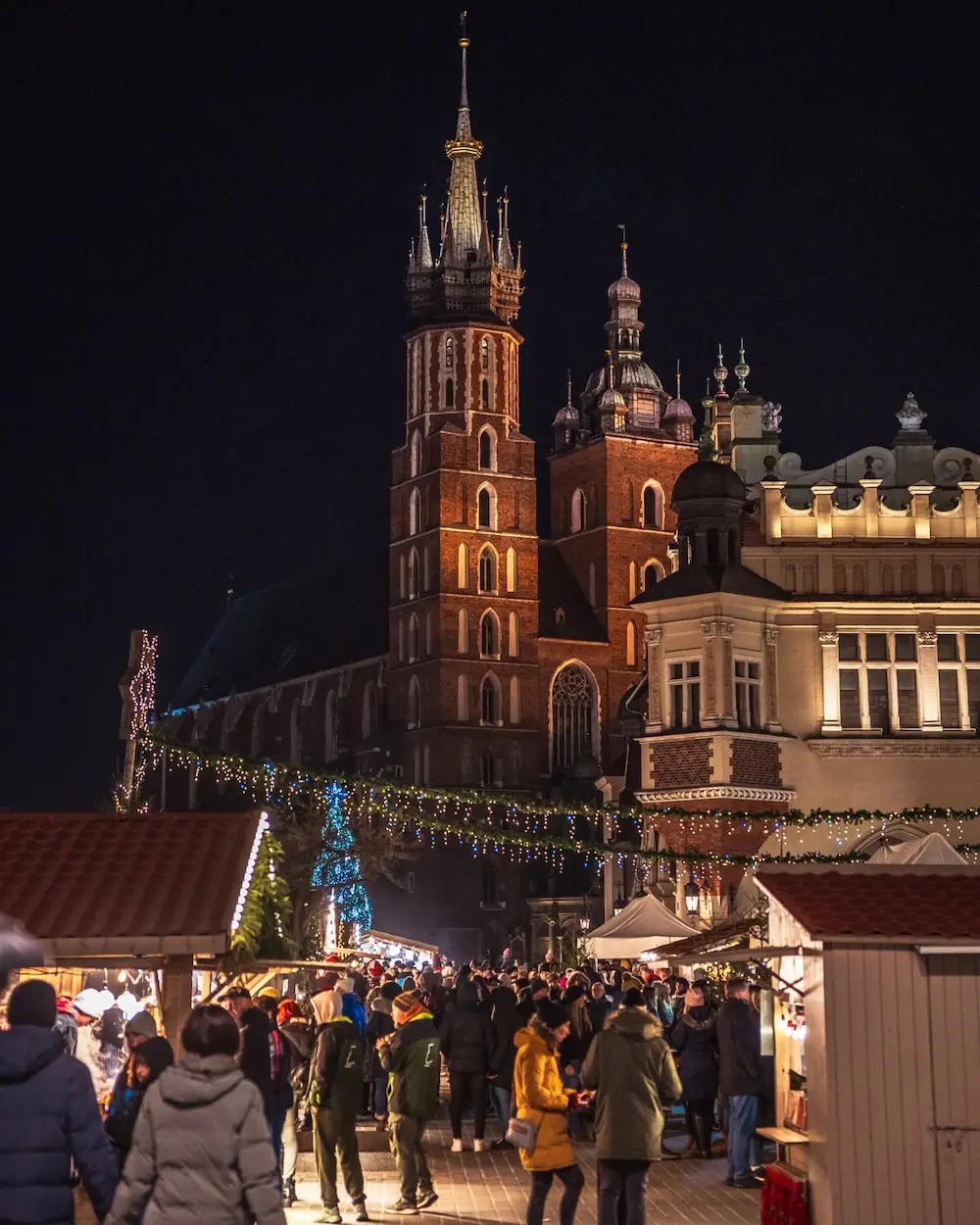
And this is where the Krakow comparison matters, because it’s the fastest way to explain it. Krakow is a Christmas market with a great city attached.
Warsaw is a great city with a Christmas market attached. Same words, just in a different way and that makes for a completely different trip.
In Krakow, the market is the star of the show and everything orbits that square.
In Warsaw, the market is more like… the nice scarf on an already well-dressed man. It’s a bonus. It’s festive. It does its job. But nobody’s writing poems about the scarf.
Now, and this is the part where I stop being sassy, that’s actually not the insult it sounds like.
Because here’s what it means in practice: you’re not going to Warsaw to chase some perfect fairytale Christmas market experience and then feel vaguely disappointed when the stalls repeat.
There’s no pressure on the market to carry the whole trip, so it doesn’t have to.
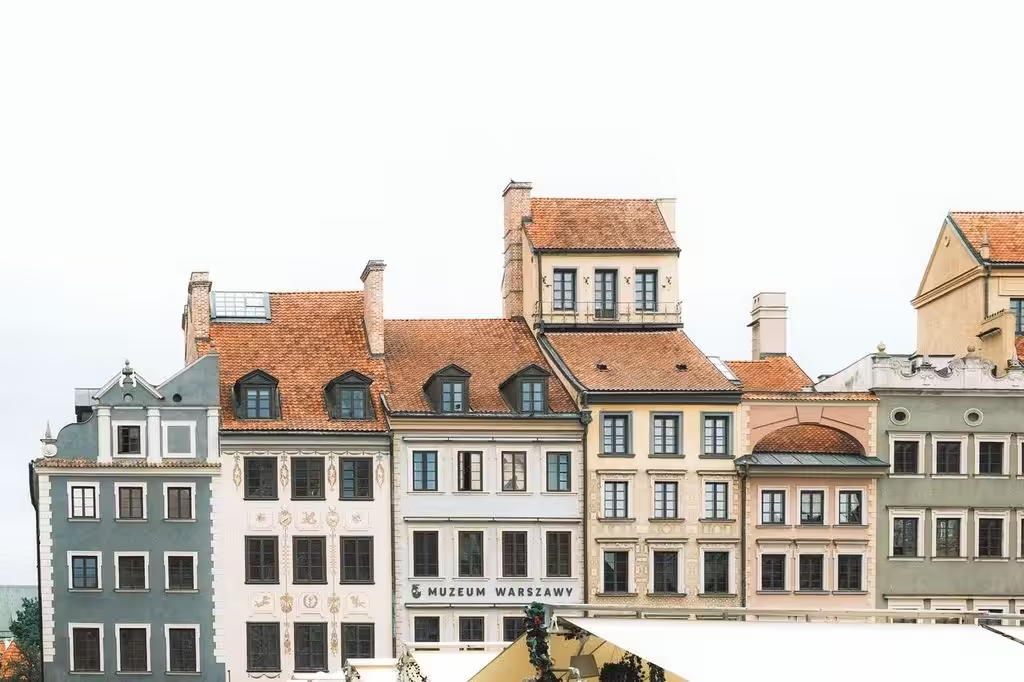
You wander through the Old Town market, you skate a few laps on the rink surrounded by those pastel facades, you get your pierogi and your mulled wine, you feel very Christmas-y, everyone’s happy.
And then you realize you’ve got two more days in one of the most interesting cities in Europe, and THAT’S the trip.
It’s also just… easier, somehow?
Krakow in December is a bit of a darling now… it knows it’s pretty, the crowds have found it. Warsaw doesn’t have that pressure and those crowds.
It’s a big, real, working capital that puts on some lovely lights and a nice market and gets on with its life.
You get the festive atmosphere without feeling like you’ve walked onto a film set where everyone’s competing for the same photo.
So if your dream is the single most magical Christmas market square in Europe, I’m sending you someplace else and we both know it.
But if you want a proper city break with real substance, where the Christmas market is a genuinely charming bonus rather than the whole personality, Warsaw might be your place.
So go for the city and let the market be the cherry on top. And whatever you do, don’t tell the Varsovians I called their market a scarf, okay??
What makes Warsaw special and worth visiting?
Warsaw is a place that didn’t get damaged in the war. Warsaw got erased.
And I mean that almost literally.
After the Warsaw Uprising in 1944, when the city rose up against the Germans and held out for two months, the retaliation wasn’t just military.
The Germans brought in special demolition squads, Verbrennungskommandos, whose entire job was to go street by street, building by building, burning and dynamiting the city on purpose.
This was just to delete Warsaw from the map, out of spite. Libraries, churches, palaces, apartment blocks, everything.
By the time it was over, around 85% of the city was rubble. There’s a famous photograph of the Old Town market square in 1945 and it’s just… a field of bricks with a couple of wall stumps.
So then the war ends, and Poland has to decide what to do with a dead capital. And there were serious people — serious people! — saying don’t rebuild it.
Leave the ruins as a memorial, move the capital to Łódź, let Warsaw be a graveyard. Instead, the Varsovians said no, we’re bringing it back, exactly as it was, brick by brick.
And then they started rebuilding the Old Town from paintings. In the 18th century, the Polish king’s court painter was a guy named Bernardo Bellotto, nephew of Canaletto, the Venice guy, and he painted these incredibly detailed cityscapes of Warsaw, so precise, so obsessively accurate, that two hundred years later architects could use them as blueprints.
They measured window proportions off his canvases. They combined his paintings with old photographs, postcards, architectural drawings, and people’s memories, where some elderly residents literally came in and described their streets from memory.
The whole country chipped in, schoolkids collected bricks, emigrants sent money from abroad. The slogan at the time was “the whole nation builds its capital,” and it wasn’t propaganda, it was literally what happened.
The result is the weirdest, most wonderful thing. An Old Town that looks 400 years old and opened in 1953.
It’s younger than my dad.
The Varsovians themselves call it “the newest old town in Europe,” and they’re very proud of the joke. And here’s my favorite part… it’s not even a perfect replica.
The rebuilders cheated a little. They straightened things that were crooked in the original. They touched up the past. Behind those baroque facades, the apartments are pure 1950s layouts.
And then the cherry on top: UNESCO looked at this obvious, admitted fake, and gave it World Heritage status anyway.
The only reconstructed old town on the entire list. Because they decided the reconstruction itself was the masterpiece. The fakeness WAS the achievement. That’s like a cover band getting inducted into the Rock and Roll Hall of Fame, and honestly, deserved.
So when you’re standing in that square with your grzaniec, looking at those pastel houses, remember that every single one of them is a resurrection.
Krakow is beautiful because it got lucky and the war passed it by. Warsaw is beautiful because it refused to die.
And a Christmas market surrounded by a city that willed itself back into existence? That hits different.
What the market does well
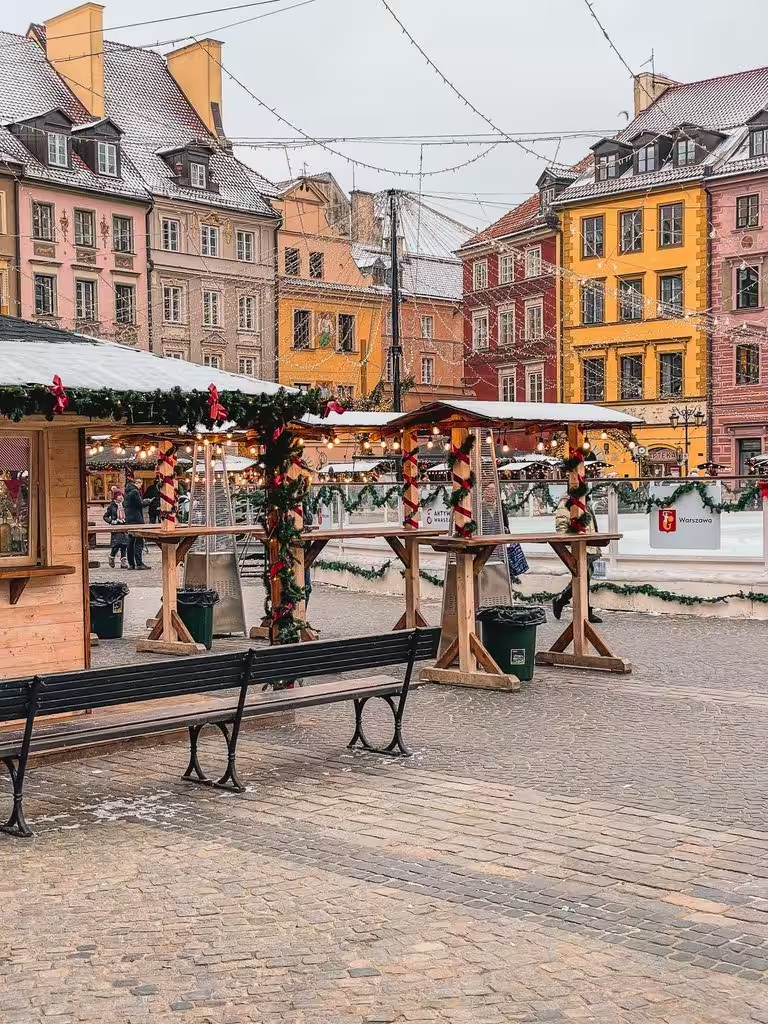
Okay, so what does Warsaw’s market actually do well, because I roasted it a bit, and now it deserves its fair defense. It’s got four genuine strengths, and one honest asterisk at the end.
First is the setting, and specifically what the setting does to you. Those pastel facades around the Old Town square, at night in December, lit up with market lights and the smell of grilled cheese in the air, something funny happens: you stop caring. Completely.
The knowledge that it’s a reconstruction actually makes it more charming, not less. You’re standing there going “this is fake” while also going “this is gorgeous,” and both things are true. It’s like finding out your favorite restaurant microwaves everything and deciding you simply don’t want to know more.
The second thing is the ice rink. Warsovians plop a rink right on the Old Town square itself, and this is, for many people, the money shot of the whole trip. Skating in a loop surrounded by those colorful townhouses, with the Christmas lights going, maybe snow falling if the weather gods are feeling generous… it’s the single most cinematic thing Warsaw’s market offers.
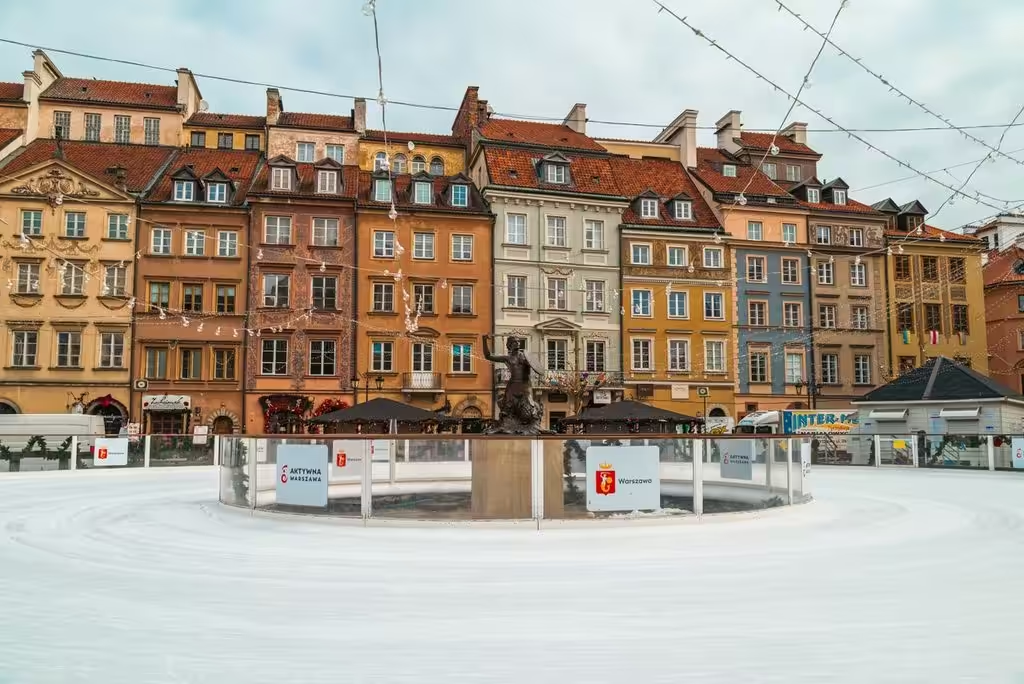
And even if you skate like a newborn giraffe, you should do one lap.
Third, and this is the sleeper strength nobody outside Poland talks about, the illuminations.
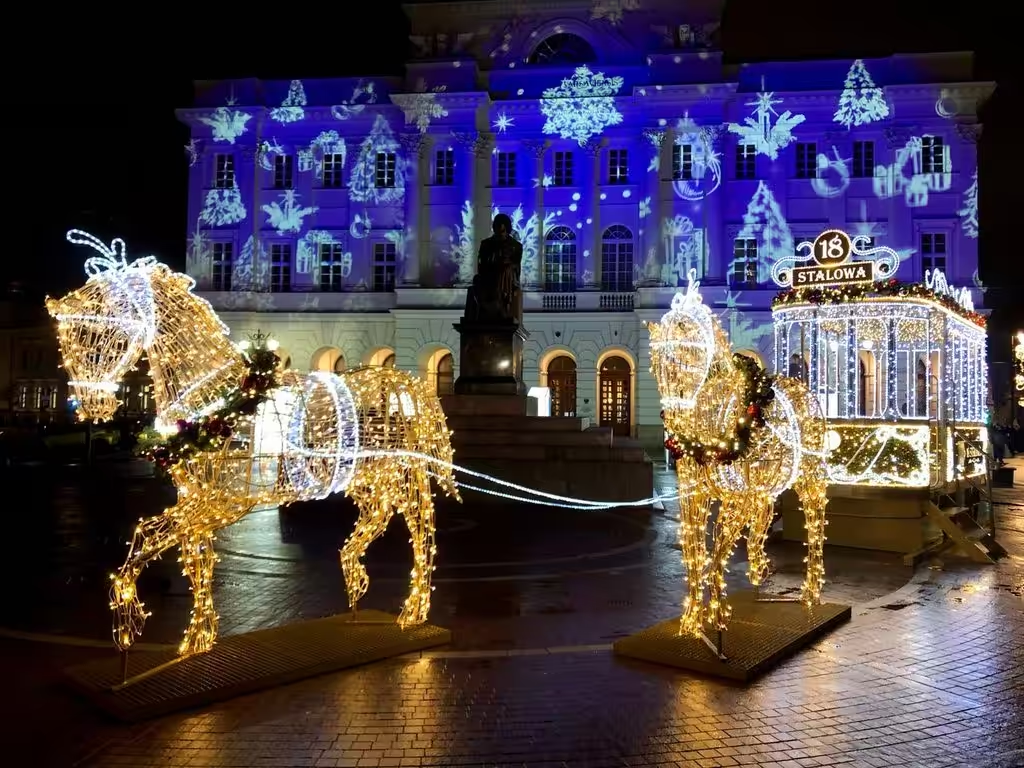
Warsaw goes HARD on Christmas lights. And that includes the entire Royal Route, which is this grand historic avenue running south from the Old Town through streets called Krakowskie Przedmieście and Nowy Świat (and yes, write those down, your friends will think you’re fluent) gets absolutely decked out.
Big light installations, glowing tunnels, the entire works. Varsovians are genuinely proud of it and they should be.
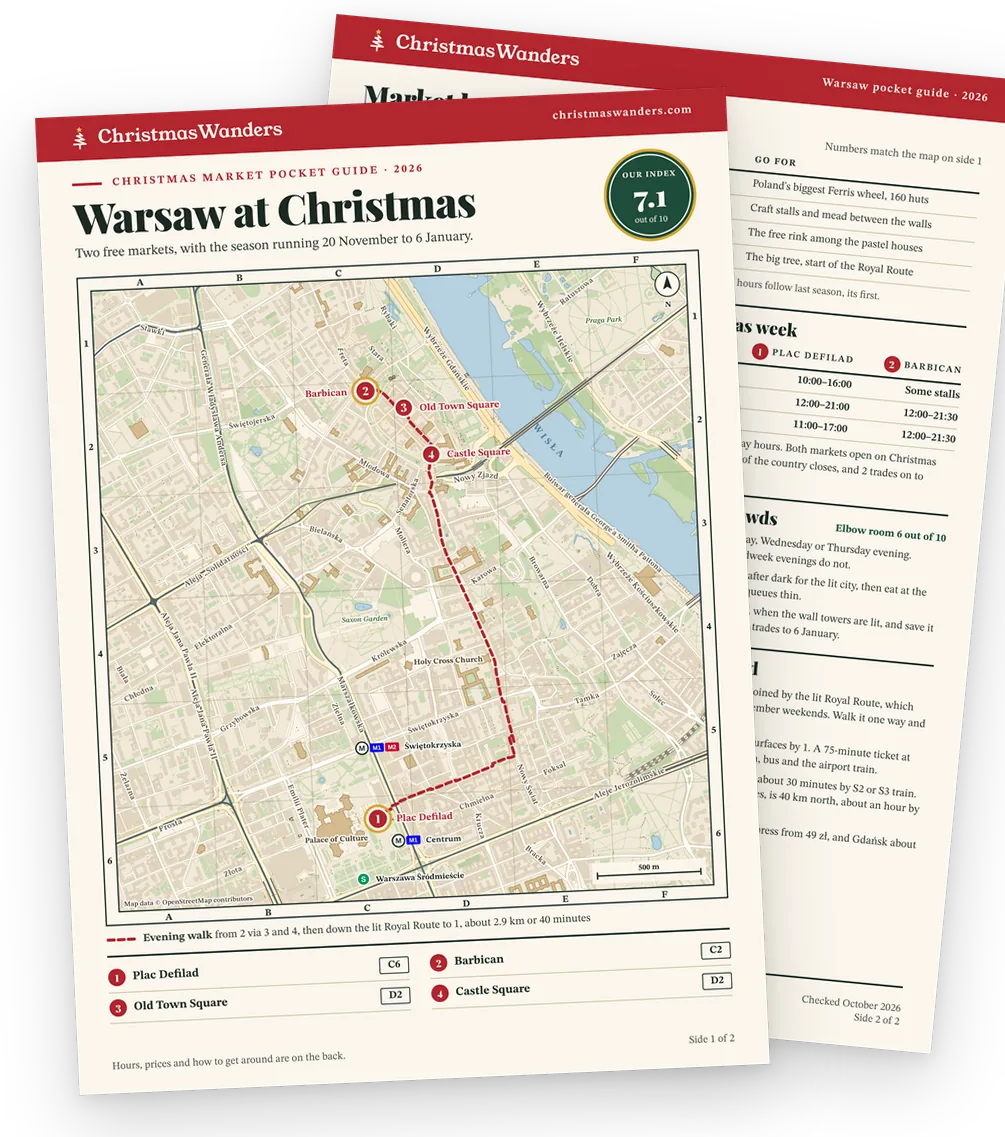
And it’s not just decoration, it’s sort of an activity. Start at the big tree on Castle Square, do the market, then walk the Royal Route through all the lights, and end in one of the bars along Nowy Świat.
That’s a full evening, that’s the Warsaw Christmas experience, and it costs exactly zero euros… until the bar.
Fourth is the food. Food is the classic full Polish arsenal, no compromises. Everything I told you about Krakow applies here as well. You got the fried pierogi with crispy onions, the immortal bigos that’s been simmering since Tuesday, the oscypek that squeaks against your teeth with the cranberry doing its sweet-salty magic, żurek in a bread bowl so you can eat the dishware, and hot Krupnik, the honey vodka that drinks like dessert and kicks like a mule.
Warsaw’s market serves the complete national menu, and the national menu is elite. No cap!
Now the asterisk, because we keep it honest in this house. Warsaw’s market has no signature move.
It has… everything, done well, from the shared Polish playbook. It’s a fantastic cover band, but it’s playing Poland’s greatest hits, not its own album. There’s no stall, no tradition, no object where you go “ah, THIS, you can only get THIS here.”
But does it need a signature move?
Beyond the market – what should you do?
Buckle up, because the beyond-the-market list is stacked.
First, the two museums that must be on your must-visit list. The Warsaw Uprising Museum tells the story of those 63 days in 1944 when the city rose up against the Germans, and it’s not a quiet-white-walls kind of museum.
It’s immersive, loud and EMOTIONAL: there’s a full-scale replica bomber hanging in the hall, sewers you can crawl through like the insurgents did, heartbeats coming out of the walls.
You walk out wrung out and weirdly grateful.
Then there’s POLIN, the Museum of the History of Polish Jews. This is a thousand years of Jewish life in Poland, built on the ground of the former ghetto, and it won European Museum of the Year basically the moment it opened, because it’s honestly really good.
You should also do these on separate days. Back-to-back you’ll need a nap and a very large drink.
Then the big one you can’t miss, literally, because you can see it from everywhere: the Palace of Culture and Science.
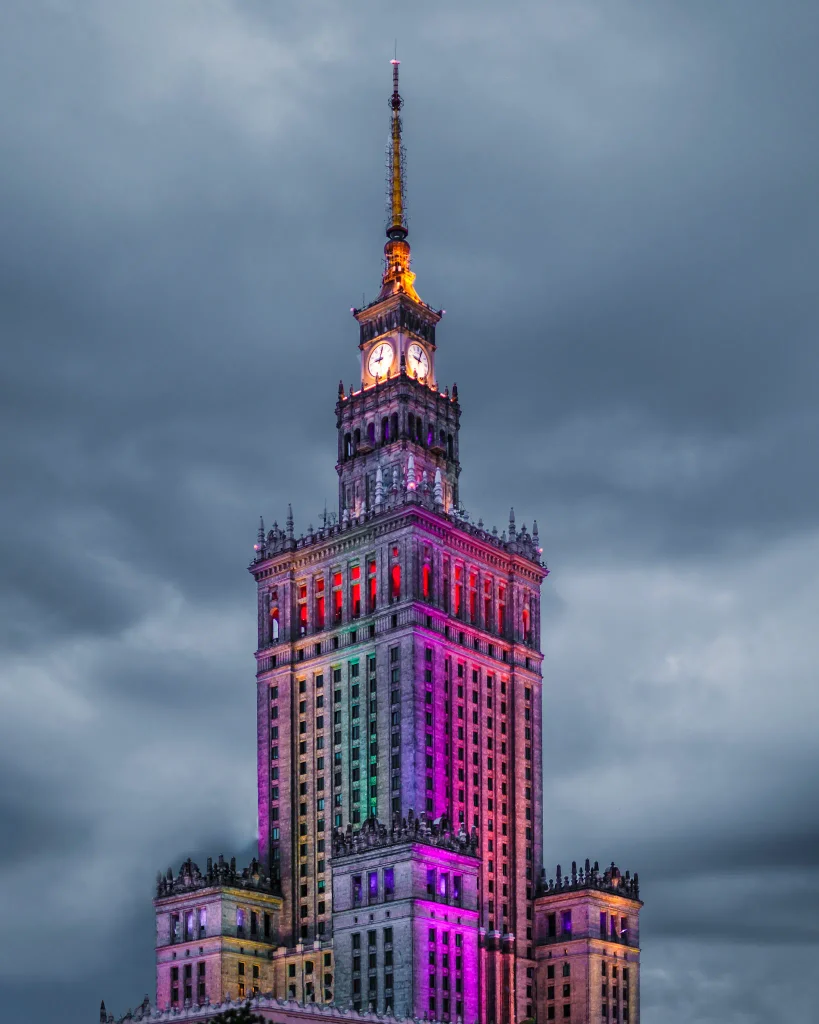
This is Stalin’s “gift” to Warsaw in 1955. And yes, “gift” in heavy quotes, the way your cat brings you a dead bird.
It’s this enormous Soviet wedding cake of a skyscraper, and Varsovians have spent seventy years hating it so affectionately that it’s now basically the city’s mascot.
Here’s the joke everyone makes, because it’s true: the PKiN viewing terrace has the best view in Warsaw, because it’s the only place in the city where you can’t see the PKiN. Go up to the 30th floor at sunset, watch the lights come on, thank me later.
The Royal Castle and Old Town you’ll wander anyway, but the castle has the same resurrection story as everything else, blown up in ’44, rebuilt decades later with money donated by ordinary Poles, because of course it was.
And save an hour for Łazienki Park, the royal summer residence, a palace sitting on an island in a lake, peacocks strutting around like they pay rent, and a famous Chopin monument.
Chopin, by the way, is a whole Warsaw subplot. He left Poland at twenty, never came back, was buried in Paris, but his heart, literally, in an urn, is sealed inside a pillar of the Holy Cross Church on the Royal Route.
The man gave his body to France and his heart to Poland, and if that doesn’t get a little gasp from you… well, leave this website right now.
Now the fun stuff. The Neon Museum, over in the Praga district, is a warehouse full of rescued Cold War neon signs, which are the glowing relics of communist-era shopfronts, bars, and cinemas, and it sounds niche and is absolutely fantastic.
It’s the most Instagrammable room in Poland in my opinion.
And Praga itself deserves an evening too. It’s the right-bank district that survived the war more intact, so it’s got the actual old pre-war tenements, a rough-around-the-edges reputation, and the coolest bars in the city tucked into former factories.
While you’re there, the Polish Vodka Museum sits in an old distillery and the ticket includes a tasting, which is the correct way to learn history, and I will not be taking questions.
And then, the milk bars. Bar mleczny, the surviving communist-era canteens, still subsidized, still serving pierogi and soups and pancakes for pocket change, still staffed by ladies who have seen everything.
The decor is “1974, unchanged,” the prices feel like a printing error, and the food is grandma-tier.
Getting to Warsaw Christmas Market
As for getting there, you should know that Warsaw has two airports. There’s Chopin Airport, the main one, which is basically in the city and fifteen minutes by train or a cheap Uber, civilized, lovely.
And then there’s Modlin airport, which is where Ryanair flies, and which is “Warsaw” the way a postcard of Warsaw is Warsaw.
It’s forty kilometers north, it’s fine, there’s a bus, it takes about an hour, and it’s how you get those absurd thirty-euro flights.
Just make sure you take a good look at WHICH Warsaw airport you’re booking, because “surprise, you’re in a field in Mazovia” is a bad way to start a Christmas trip.
Either way, Warsaw is usually the cheapest entry point into Poland from anywhere in Europe. London, Paris, Berlin, Rome… someone’s always running a sale.
Once you’re in, getting around is easy and cheap. Metro, trams, buses, all on one ticket system, contactless-friendly, and there’s an app called Jakdojade (yes, it’s a funny name, it means “how do I get there,” and it will plan every journey for you).
Keep in mind that Warsaw is very much spread out. This is not Krakow where everything is a ten-minute stroll. The Old Town, the museums, Praga, Łazienki are all in different parts of the city, so you will actually use the trams, which is fine, because the trams cost about a euro and come constantly.
As for doing some combinations of Christmas market trips in Poland, these are the info you should keep in mind.
Warsaw to Krakow is two and a half hours on the fast train. You can also fly into Warsaw, do your day or two of museums and neon and vodka homework, take the morning train to Krakow, do three days there for the better market, and fly home out of Krakow.
You can also do Gdańsk. It is two and a half hours north from Warsaw and it is doable as a second city if it’s early December, since its market wraps up around the 23rd.
Berlin is also five and a half hours west by train if you maybe want to do a two-country trip. And for the romantics out there… There are actual night trains.
You can board a sleeper in Warsaw, close your eyes in Poland, and wake up in Vienna or Budapest.
It’s not the fastest option, it’s not the cheapest option, but it IS the option where you get to say “I took a night train across Europe at Christmas,” and that’s worth at least three Instagram posts and one smug dinner-party story for the rest of your life.
Last practical bits, rapid fire. Poland uses the złoty, not the euro, but honestly it barely matters, because Poland is so card-and-contactless that you can go a whole trip without touching cash.
Just avoid the currency exchange kiosks at the airport, especially the ones with friendly blue branding; they’re a trap!
English is fine everywhere you go, but one “dziękuję”(jen-KOO-yeh), which is Polish for “thank you”, buys a lot of goodwill.
Who should visit Warsaw’s Christmas market?
Warsaw is not for everyone, and that’s fine because the best trips never are.
I think anybody who is a history person should have Warsaw high on the list. In every friend group, it’s the one who reads 800-page books about the war “for fun,” the one who annotates documentaries out loud.
For that person, this is the city where the entire 20th century happened at maximum volume, with the ghetto, the Uprising, the erasure, the reconstruction, Stalin’s wedding-cake skyscraper, Solidarity, the whole story of Europe in one postcode.
There’s nowhere on the continent where history feels this close to the surface. If you are that person, stop reading here, and go book this trip.
It’s also for anyone who finds Prague or Krakow a bit too… precious.
And I say this with love for both cities, but some people walk into a perfectly preserved fairy-tale old town and their skin crawls a little because it feels like a theme park, like the city is performing for tourists.
Warsaw is the antidote to that.
It’s big, it’s raw, it’s a real working capital where people live and commute and argue about politics, and the prettiness is just one neighborhood among many.
A very simple test: do you prefer Berlin or Prague? The Berlin people, the ones who liked the grit, the layers, the scars, will love Warsaw. The Prague people should get on the train to Krakow.
Also, shoutout for all the deal hunters.
If someone’s group chat is full of “look at this flight price I found” energy, Warsaw is their Christmas miracle. Cheapest flights into Poland, two-euro dinners, museum tickets that cost less than a London coffee, mulled wine you don’t have to budget for.
You can do this whole trip for what two nights in Vienna costs. It’s one of the best value Christmas trips in Europe, full stop.