What makes Polish Christmas markets different?
The calendar, mostly. Most German markets pack up on 23 or 24 December, and Poland is still going strong. Wrocław runs until 7 January, Warsaw and Poznań until 6 January, and Kraków until at least New Year's Day. If you can only travel in the week between Christmas and New Year, Poland is one of the best places in Europe to find the stalls still open and the lights still on.
Christmas here is also a family thing first and a shopping thing second, and you feel that on the 24th. Wigilia, the Christmas Eve supper, starts when the first star comes out. Families break an opłatek wafer and wish each other well, then traditionally work through twelve meatless dishes, carp included, with an empty place laid in case a stranger knocks. It's a lovely tradition and it's also the reason half the country disappears indoors that evening.
Kraków has its szopki, glittering nativity cribs built like miniature Kraków churches, and the tradition behind them is on UNESCO's intangible heritage list. The yearly competition is a proper event. On Thursday 3 December the makers set their cribs out around the Mickiewicz monument on the main square from 10:00, parade them round the square at noon, then carry them into Krzysztofory Palace, where they stay on show from 9 December to the end of February.
And the season doesn't end on New Year's Day. On 6 January, Three Kings Day, crowned parades fill the streets of hundreds of Polish towns (a record 941 of them last January), and in Wrocław, Warsaw and Poznań the markets are still trading on parade day.
Is Poland still cheap for Christmas markets?
For food, yes. For mulled wine on the main squares, not any more, so don't go expecting half-price everything.
A cup of grzaniec cost 20 zł on the main squares in Wrocław, Gdańsk, Warsaw and Katowice last season. That's about €4.57, roughly what a cup cost in Germany (around €4.50 on average), and a bit more than the 100 CZK you paid on Prague's Old Town Square. Kraków's Rynek is the dearest in the country, with most cups at 25 to 30 zł and a big 400 ml one at 40 zł.
The bargains are one step to the side. Grilled oscypek, the smoked sheep's cheese from the Tatras, costs 6 to 9 zł in Gdańsk with a spoon of cranberry on top, three pierogi go for 10 zł, and bars one street off Wrocław's Rynek pour grzaniec from 12 zł. Away from the big four the grzaniec gets cheaper, with Toruń at 15 to 20 zł and Łódź at 18 zł a cup.
Then there are the deposits. Wrocław charges 20 zł for its boot-shaped mug, Poznań 25 zł (refunded to your card), and Gdańsk 30 zł at the dozen huts that trialled a Kashubian porcelain mug last season, which is more than the drink inside it. Visitors kept more than 16,000 of those mugs, so think of the deposit as a souvenir price and you'll be happier.
Poland still comes out cheaper than Vienna, where punsch runs €5.50 to €5.80 plus a €5 mug deposit. Against Germany, though, the saving is in the food, the side-street bars and places like Toruń, because main-square grzaniec costs about the same.
Hotels are the one cost that can surprise you. Wrocław hotels often sell out on market weekends and prices jump with them, so stay Sunday to Thursday or sleep in Poznań, 77 minutes away on the fastest train.
What should you eat and drink?
Start with oscypek, grilled until it squeaks and served with cranberry. At 6 to 12 zł it's the best-value thing on any Polish market. Pierogi are everywhere, and bigos, the hunter's stew of sauerkraut and meat, is a proper meal for 20 to 25 zł.
Go easy on the big-ticket stalls. A grilled sausage in a roll was 45 zł on Kraków's Rynek last season and a pork knuckle up to 85 zł, which is what a sit-down meal costs in a restaurant two minutes away, with a chair and a radiator thrown in. Eat your main meal indoors and graze on the market.
For drinks, grzaniec is the mulled wine and grzane piwo the mulled beer, usually spiced with honey and cloves. Some of Kraków's stalls pour a sweet grzaniec galicyjski from wooden barrels, Warsaw's market sold mead at 15 zł a cup last year, and in Toruń you can follow the gingerbread with a gingerbread beer at the Jan Olbracht brewery. Bring a sweet tooth to Toruń in general. Its piernik gingerbread has been baked there for centuries and you'll leave with a bag of it whether you planned to or not.
Where should you go in Poland?
Wrocław for the market, Kraków for the city, Gdańsk for the design and Warsaw if you're coming over Christmas itself.
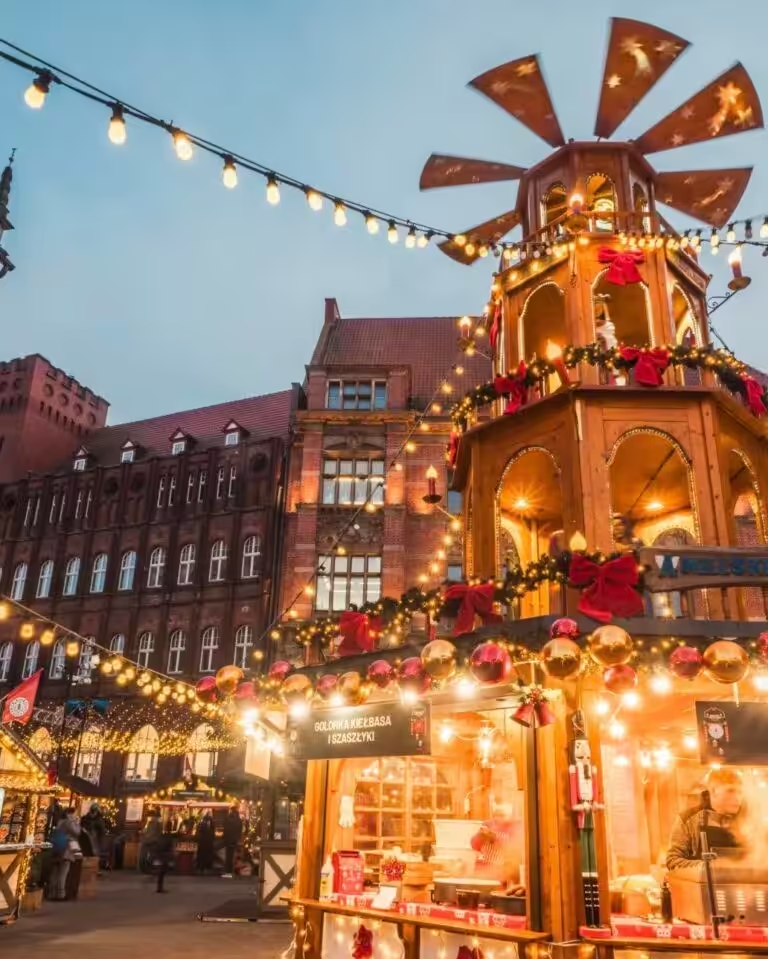
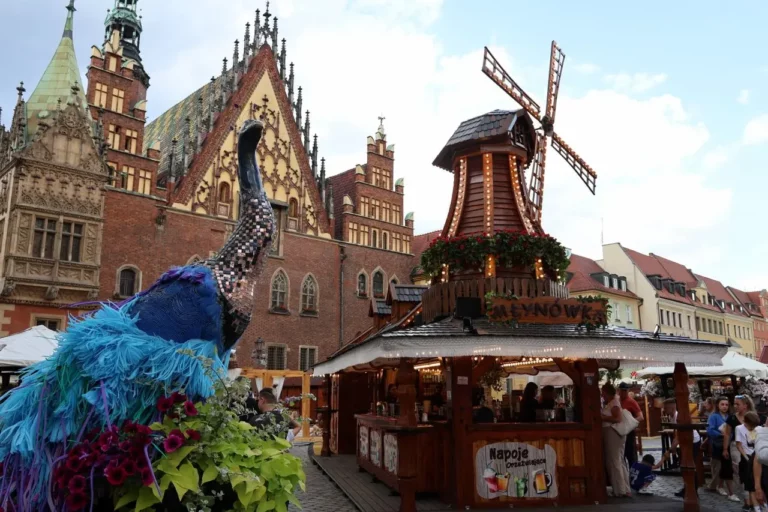
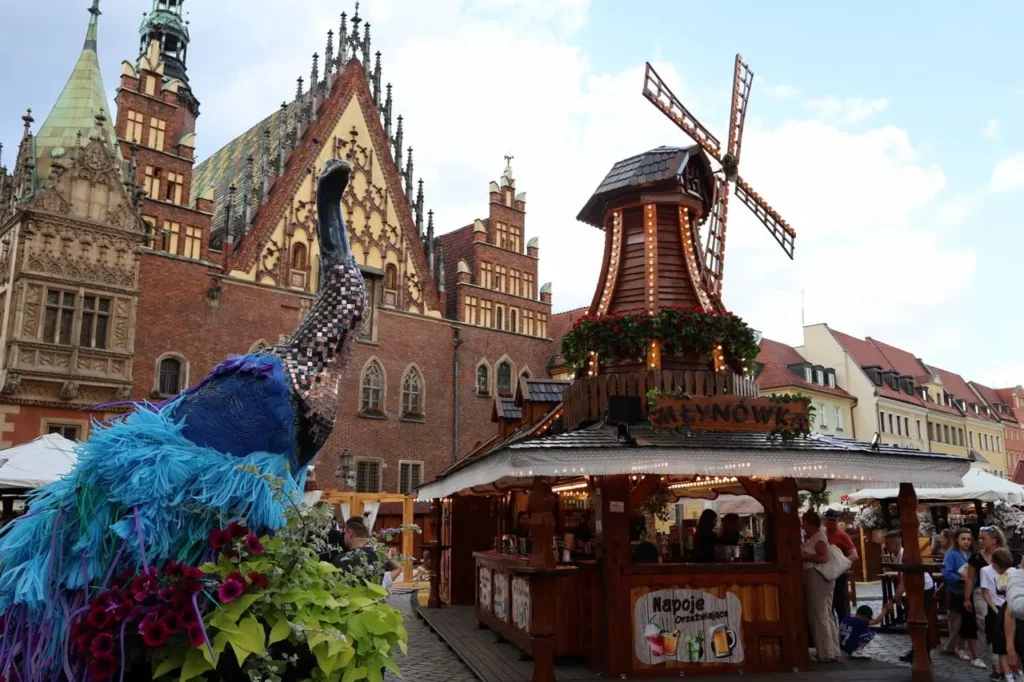
Wrocław is the one I'd pick if you could only do one market. It's the biggest in Poland, about 260 huts wrapping all four sides of the Rynek and spilling down Świdnicka, Oławska and onto Plac Solny. Just over a million visits were counted last season, but only about 30% of them were on the Rynek itself, so start on Oławska or Plac Solny and work inwards. The grzaniec comes in the famous boot mug, the official wine stalls only take cash, and there are hundreds of little bronze dwarfs hidden around the old town, which turns a walk with kids into a treasure hunt.
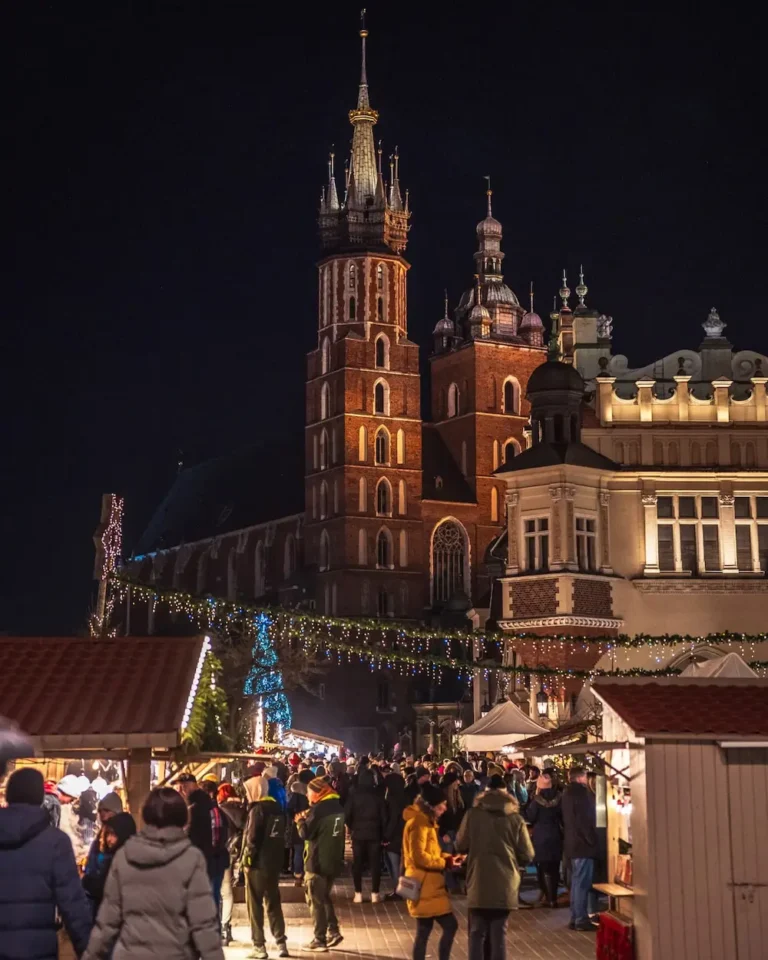
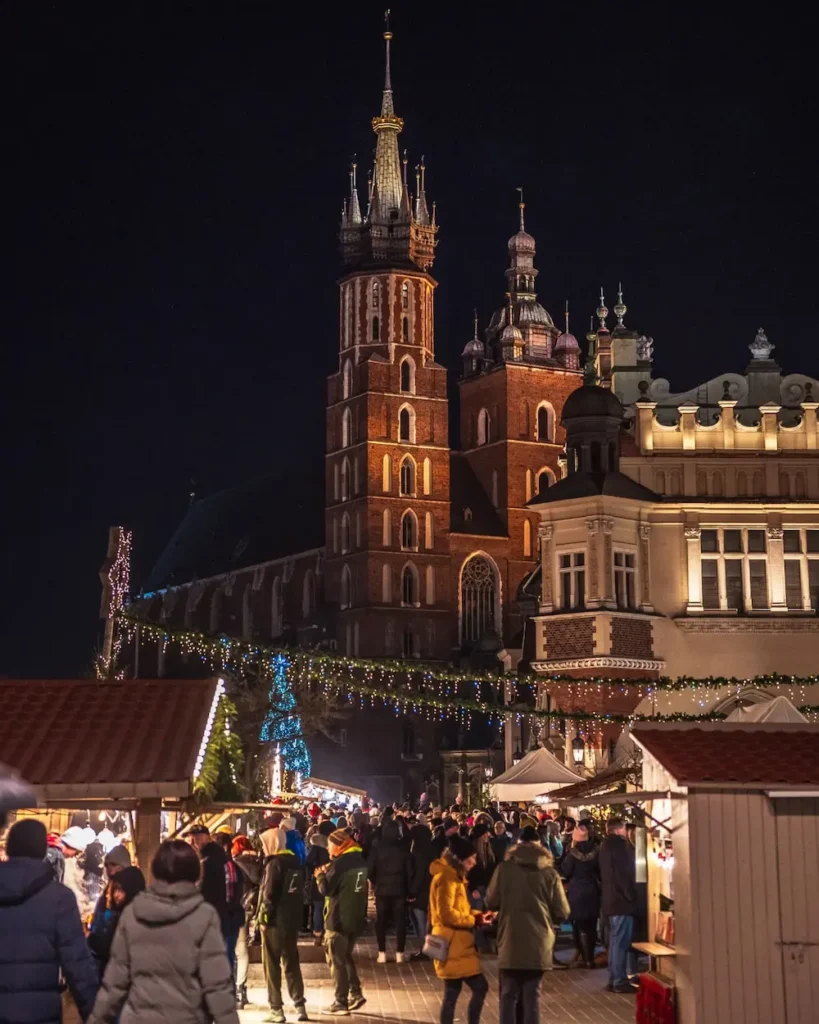
Kraków is the better city and the smaller market. Rynek Główny is one of the largest medieval squares in Europe, and the market's 105 stalls sit on the Town Hall Tower side of it. Plenty of locals skip it as crowded and pricey, and they have a point about the drinks. But at dusk, with the Cloth Hall lit up and the trumpeter playing the hejnał from St Mary's tower and stopping mid-note like he always does, it's hard to stay grumpy. Kraków also has more to do indoors when it's −3 °C outside. It opens on 27 November and runs to at least 1 January, and the organiser is hoping to stay open to 3 or 6 January, so check again in November if you're coming after New Year.
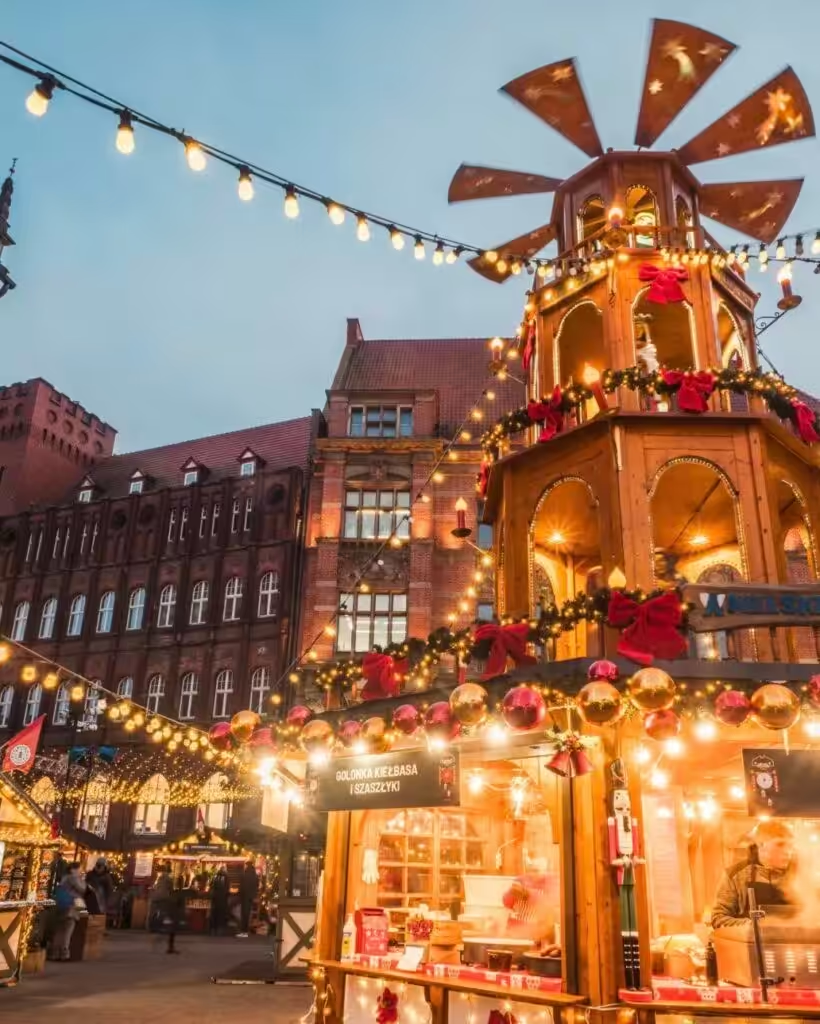
Gdańsk is the most designed market in the country. It runs from the Coal Market along the Royal Way, with an Advent-calendar gate, a joke-telling moose called Lucek and 62 craft stands inside the Great Armoury. It was voted Europe's best Christmas market in 2025, the food is the cheapest of the big four, and it closes on 23 December. It's lovely, but I wouldn't fly in just for the market. Pair it with Warsaw, 2 hours 33 minutes away at the fastest, or give it a day with Sopot.
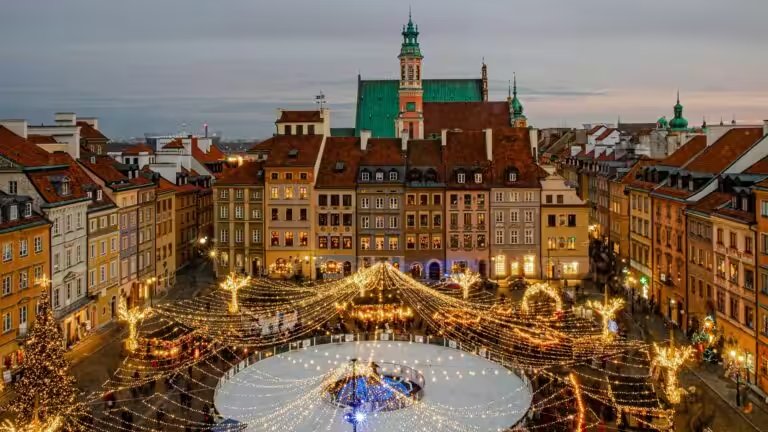
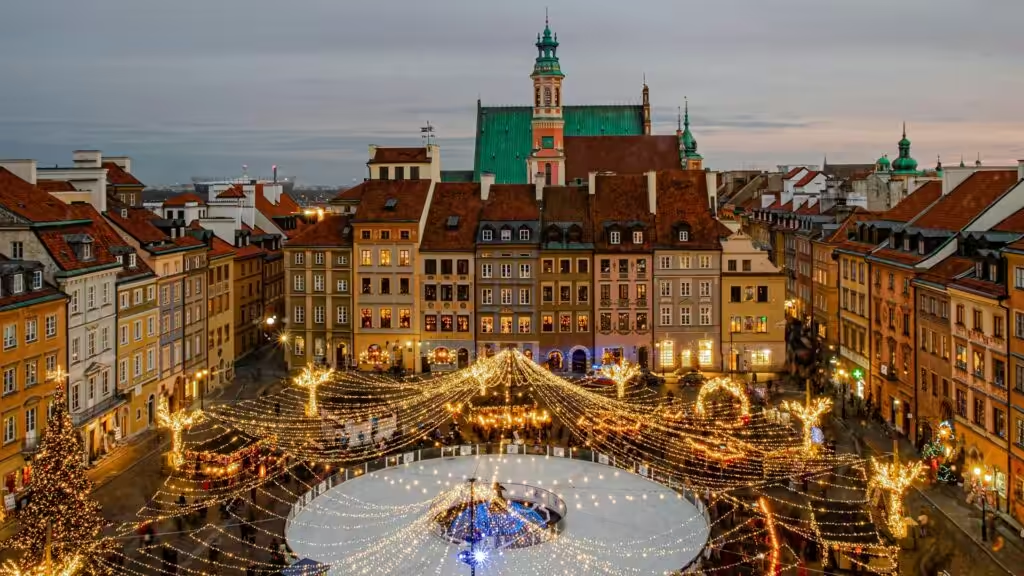
Warsaw has two markets and they feel nothing alike. The new Jarmark Warszawski on Plac Defilad opened in 2025 under the Palace of Culture, a few minutes' walk from Warszawa Centralna. It had more than 100 huts and the 55-metre Sky 55 wheel (45 zł a ride) last year and promises more space this time. The older one sits by the Barbican in the Old Town. Locals find the new one bigger than it is cosy, and the better evening is the walk from Nowy Świat up the lit Royal Route to the Old Town, where an ice rink went up on the market square last year. Warsaw's real strength is Christmas itself, because both markets opened on Christmas Day last year.
Poznań holds its 20th ice sculpture festival on 11 to 13 December, with carvers at work all weekend and ice workshops for kids on the Sunday. Toruń is the gingerbread city, with a living gingerbread museum (shows on the hour, in English at 14:00) and a market of more than 100 stalls that ends on 20 December. Katowice is 46 minutes from Kraków and last year put a rink on its market square, free if you bring your own skates.
Which two cities should you pair?
Two cities is the right number. Polish cities are far enough apart that three in a long weekend means half of it on trains, and two lets you see each one after dark. Four or five days covers two cities comfortably.
The classic pair is Kraków and Wrocław, 2 hours 53 minutes apart at the fastest, with 19 trains a day. It gives you the best city and the best market, and it's the one I'd hand a friend for a first trip. Warsaw to Kraków is quicker, 2 hours 12 at the fastest with 30 trains a day, and Warsaw to Gdańsk is 2 hours 33. If you want a short hop, Wrocław to Poznań takes 77 minutes, and Kraków to Katowice 46.
On the current timetable, Berlin to Wrocław is about four hours on three daily EuroCity trains, and Berlin to Warsaw five to five and a half. From Kraków you can carry on to Vienna on a daytime EuroCity in about five and a half hours or the Carpatia night train, which leaves at 20:57 and gets you there before breakfast.
Poland changes its national timetable on 13 December, and PKP Intercity has frozen sales of express and international tickets for travel from 10 December until the new timetable is approved. So if your dates sit in the middle of December, don't panic when the booking site shows nothing. Check again from mid-November. In Warsaw, the long-distance platforms at Warszawa Wschodnia also close for rebuilding from December, so look at which station your train actually uses.
What happens on Christmas Eve?
Since 2025, 24 December has been a public holiday in Poland, and the shops close for the whole day. In exchange, the three Sundays before it are shopping Sundays, which this year means 6, 13 and 20 December. After the 24th the shops stay shut on the 25th, the 26th and Sunday the 27th, and reopen on Monday 28 December.
Christmas markets are exempt from the law, so whether they open on the 24th is each organiser's call. Wrocław closes on 24 and 25 December and comes back at 13:00 on the 26th. Last year Warsaw's Plac Defilad market opened from 10:00 to 16:00 on Christmas Eve and from 12:00 to 21:00 on Christmas Day, and the Barbican market kept going too. Gdańsk, Toruń, Szczecin and Bydgoszcz are already finished by then. Kraków hasn't published its holiday hours yet.
So if you're here for Christmas, sort out your Christmas Eve dinner early. Restaurants are allowed to open, but plenty close so the staff can be home for Wigilia. The midnight mass, Pasterka, is open to everyone and is the most atmospheric hour of the whole season if you can stay awake for it.
Wrocław reopens at 13:00 on the 26th, when the square tends to be quiet, and New Year's Eve there runs late, with food and drink served until 02:00.
When should you go?
Go on a weekday if you can. Wrocław is at its best from Monday to Thursday between about 12:00 and 16:00, and a Saturday evening there is shoulder to shoulder. Kraków tends to be busiest from mid-December to the end of the year, and Gdańsk is packed enough on weekend evenings that the city puts on extra trams.
Don't plan around snow. In western Poland the number of days with snow on the ground has roughly halved since the 1960s, and you're more likely to get wet cobbles than a white Rynek. Bring proper shoes and a hat, and a few hundred złoty in cash for the stalls that don't take cards.