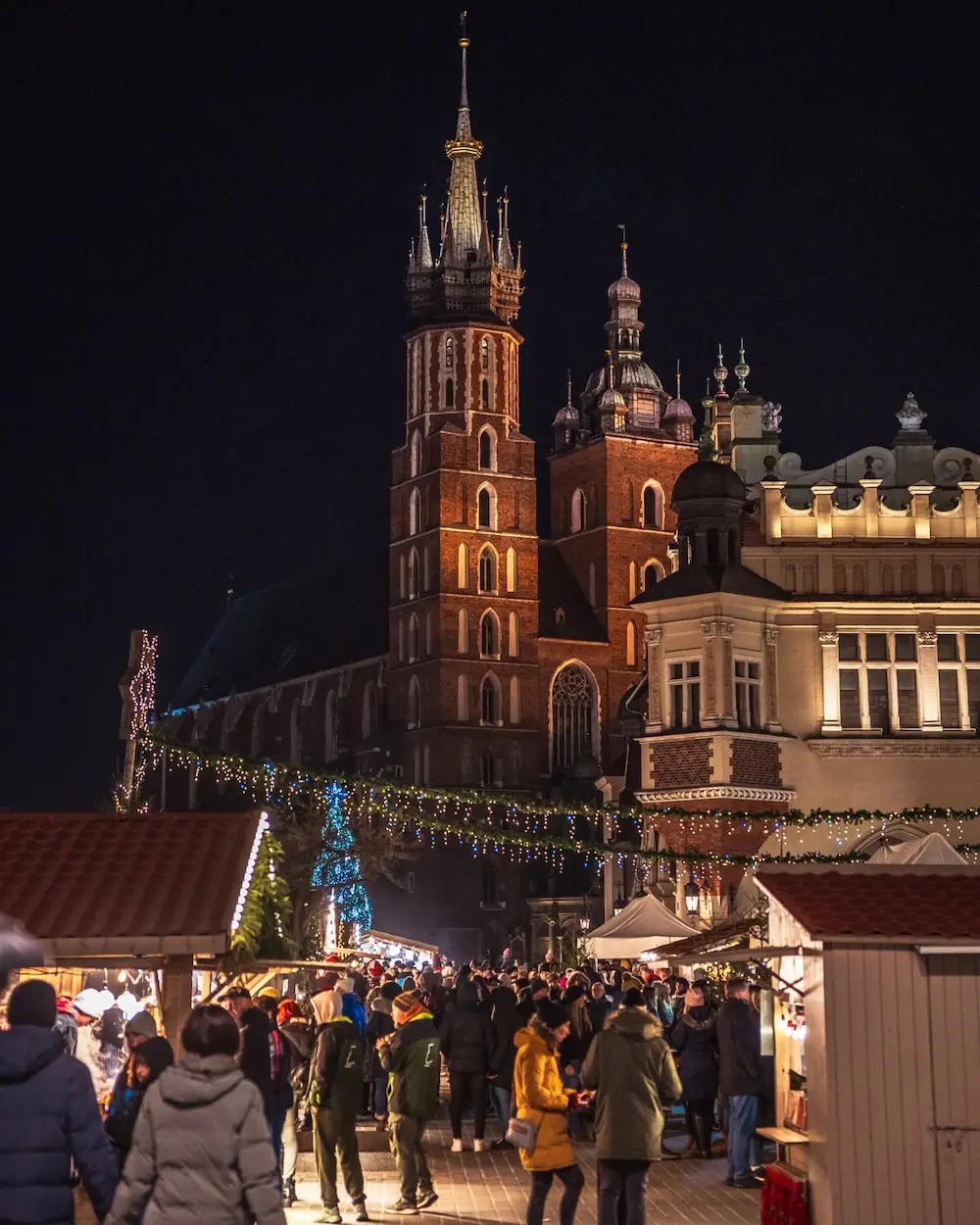
Honestly? Krakow might be the most underrated Christmas market trip in Europe, and it’s mostly because of where the market happens to be.
It’s set on the main square, which is this enormous medieval plaza, one of the biggest in Europe, with the old Cloth Hall sitting in the middle and St. Mary’s Basilica playing a trumpet call from its tower every hour.
You don’t need the market to be amazing when the setting looks like that, but the market’s good anyway.
What makes Krakow different, though, is the szopka. They’re these wild, elaborate nativity cribs. Forget anything you’re picturing, because they’re more like miniature theatrical castles covered in colored foil, mixing the nativity scene with Krakow’s own architecture.
It’s a folk art that exists nowhere else, UNESCO-recognized, and there’s a public competition on the square in early December where locals bring their creations.
It’s one of those things where you see it and think, okay, I’ve never seen anything like this before.
Food-wise it’s also got its own thing going on. The star, in my opinion, is oscypek, which is a smoked sheep’s cheese from the Tatra mountains, grilled and served with cranberry sauce.
Sounds weird maybe but it tastes incredible, and you won’t find it at any Austrian or German market.
The market also runs past Christmas, to at least 3 January. Almost everything in Austria and Germany shuts down around the 23rd or 26th, so if you’ve ever wanted to do a Christmas market trip between Christmas and New Year, Krakow is one of your best options in Europe.
Downsides is that it’s properly cold, the stalls do repeat once you’ve done a lap, and the winter smog is a real thing, unfortunately. Krakow’s air quality in December is genuinely bad some days.
But for a two or three day trip it’s fantastic value, and you’ve got the Wieliczka Salt Mine right there for when you need a break from the market, which is one of the stranger and cooler things you’ll ever walk through underground.
Let me tell you everything in more detail!
Food and drinks at Krakow Christmas Market
Pierogi first, obviously. These are the national treasure, and the thing you need to know is that every Polish grandmother, every babcia, makes the best pierogi in the world.
This is not disputed.
It is simply true for all of them simultaneously, don’t ask how, physics doesn’t apply to grandmothers.
At the market you’ll mostly find pierogi ruskie, which are potato and cheese, and yes, the name is confusing, they’re called “Ruthenian” and there’s nothing Russian about them, they’re as Polish as it gets.
You should also get them fried, not boiled, with crispy onions on top. The boiled ones are for home, the fried ones are for standing in the freezing cold making happy noises.
You’ll also see mushroom-and-sauerkraut ones. That’s the Christmas Eve filling, very traditional and occasionally sweet ones with blueberries, which split Poland into two warring camps. I take no sides… Okay, fine, savory wins.
The soups and stews, though… This is where Poland embarrasses the rest of Europe’s market food.
Żurek is my favorite one: a sour rye soup, made from fermented rye starter, with sausage and a boiled egg in it. Sounds like a science experiment, tastes like a hug.
Bigos is the other one I loved. That’s hunter’s stew, sauerkraut with basically every meat that was in the building, and it has this magical property where it gets better every day you reheat it, so market bigos has sometimes been alive for a while, in a good way.
Get either of them in a bread bowl and you’ve solved the whole evening meal. You eat the soup, then you eat the bowl, nothing wasted, very Polish, no plate to carry.
The cheese! Oh the cheese… Oscypek, like I mentioned earlier, your salty grilled sheep’s cheese, is the market’s signature.
It’s protected by the EU, has to be made by actual highlanders from Tatra sheep’s milk, and the Górale people who make it take it extremely seriously.
At the market they grill it till it’s golden and squeaky and it does literally squeak against your teeth. That’s how you know it’s real! You should slap cranberry sauce on it though. Salty, smoky, sweet. The combo shouldn’t work and absolutely does.
And pajda, the dark horse of Polish food list.
Let’s be honest about what it is: rustic bread with smalec, rendered lard with little cracklings in it, plus pickles and onion. Yes, lard. Spread like butter. It sounds like something you’d lose a bet over, and then you try it and immediately understand why an entire nation is emotionally attached to it.
The pickle is doing crucial work cutting the fat, and the whole thing is basically Poland’s answer to the butter board, except it predates TikTok by several centuries.
Pair it with a hot Krupnik and you’ve got the full Polish winter experience with bread, lard, honey vodka, freezing cold and… zero regrets.
As for the drinks, that’s where Krakow’s market really diverges from the Austrian one.
I recommend you start with grzane piwo. Yes, that’s mulled beer, which is essentially hot beer with honey and spices, sometimes even with egg yolk whipped in, and before you make a face… it works, it’s malty and warming and it’s about as Polish as it gets. And yes, Polish do make weird food and drinks, I know, but it all tastes amazing.
Then there’s miód pitny, warm mead, honey wine served hot, which Poles have been drinking since forever and which is dangerously easy to put away in the cold.
And the one that gets people in trouble is hot Krupnik, a honey vodka liqueur served steaming.
It goes down like sweet tea and then the cold air stands you back up and reminds you it was vodka.
Nalewki, the little homemade fruit and herb tinctures, show up at stalls too with cherry, honey, quince, that sort of thing.
Entertainment at Krakow’s Christmas market
Krakow’s market is not an amusement park, and if you’re expecting Vienna Rathausplatz with its ice trails and Ferris wheel and light shows, you need to recalibrate before you land.
There are no big rides, no skating through a fairy-lit park, nothing like that.
What Krakow offers instead is atmosphere and a handful of genuinely great events… and honestly, I think it comes out ahead on culture while losing on infrastructure.
Let me explain what I mean.
The best single entertainment event of the whole season is the szopka competition.
Remember those wild foil-covered nativity castles I told you about? Every year, traditionally the first Thursday of December, the makers parade them onto the main square and gather around the Mickiewicz statue, and there’s a proper ceremony with judging and crowds and brass-band energy.
It’s quirky and local and completely unserious in the best way, with grown adults carrying glittering three-foot spired masterpieces through the streets at 10am.
If you can time your trip to it, do. The winners then go on display in the Krzysztofory museum for the rest of winter, so even if you miss the day itself you can still see them.
Then there’s the stage. The market has a proper stage on the square and it runs a program through the season with carol concerts, children’s choirs, and crucially, Polish folk ensembles.
And I need to sell you on this, because “folk dancing” sounds like something you’d politely endure, but Polish regional dance is legitimately impressive. The costumes are spectacular, the energy is absurd, and the Krakowiak, the city’s own dance, is basically two minutes of pure cardio in a flower crown.
Carol culture generally is a big deal here; kolędy are the Polish Christmas carols and Poles actually know the words, all of them, and will sing. It’s disarming.
Beyond that, the entertainment is the square itself doing its thing. The horse-drawn carriages doing loops with their drivers in old-fashioned getup. The hejnał trumpet call from the basilica tower every hour, cutting off mid-note. Legend says because the original trumpeter took a Tatar arrow to the throat mid-warning in 1241, and they’ve been cutting the tune short ever since in his honor, which is the most Polish way imaginable to honor a guy.
And in the days right before Christmas there’s traditionally a public opłatek-sharing on the square, which is the Christmas wafer thing where strangers break bread with each other and wish each other well, plus free barszcz and pierogi. Wholesome. Very wholesome. Slightly suspicious how wholesome.
The ace up Krakow’s sleeve, though, is New Year’s Eve.
The market runs into January, and the Rynek hosts one of the biggest NYE parties in Poland with big stage, live acts, thousands of people, fireworks over the Cloth Hall, the whole schindig.
What Else Is There to Do in Kraków at Christmas?
In my opinion, Krakow is one of those cities where the Christmas market is genuinely the third best reason to go. Krakow got through World War II essentially intact and is the complete original. Five hundred years as Poland’s royal capital, and the stones are all still there. In Central Europe that makes it a unicorn.
So beyond the Christmas markets, you should start with Wawel, the castle hill above the river.
This is where Polish kings were crowned and buried for centuries and the cathedral is basically Poland’s Westminster Abbey, except the kings are right there in sarcophagi and you walk among them.
And then, because Krakow can’t help itself, there’s a dragon. The legend says a dragon lived in a cave under the castle, terrorizing everyone, until a cobbler’s apprentice fed it a sheep stuffed with sulphur and it drank half the Vistula and exploded.
There’s a fire-breathing dragon statue at the foot of the hill today. It breathes actual fire, every few minutes, forever. Krakow built a monument to a fictional creature it killed and it rules.
St. Mary’s Basilica, the one with the trumpeter, contains the Veit Stoss altarpiece which is the largest Gothic altarpiece in the world, carved over twelve years in the 1400s, and when it opens in the morning there’s an audible gasp from whoever’s inside.
It’s one of those artworks that photographs have never once done justice. Also hiding in town is Leonardo da Vinci. Lady with an Ermine, one of only four portraits of women he ever painted, just casually hangs in Krakow because a prince’s mum bought it in Italy in 1798.
Nobody expects a Leonardo in Poland, which is exactly why you should go smugly look at it.
Then do the Rynek Underground, because it’s directly under your feet while you’re at the market. This is an excavated medieval street level, the actual cobbles and trade stalls from the 1200s, turned into a genuinely excellent museum.
Book ahead though, it’s timed entry and it sells out.
Kazimierz, the old Jewish quarter, is two places in one. By day it’s the heavy history (pre-war Krakow was a quarter Jewish), the synagogues and the Remuh cemetery are still there, and this is the neighborhood Schindler’s List was filmed in.
Schindler’s actual factory, across the river, is now a superb museum of the occupation years so go in expecting Spielberg, come out having learned the city.
And by night Kazimierz flips personality completely and becomes the best bar district in Central Europe with candlelit cellar bars, no polish, all atmosphere, and at 2am you eat a zapiekanka at Plac Nowy, which is half a baguette buried under mushrooms and cheese, and it’s the finest drunk food on the continent, I will not be debating this!!
You could also take some day trips. As I mentioned earlier, Wieliczka Salt Mine is pure joy. It contains seven hundred years of mining history, and the miners carved entire chapels underground out of salt, including one with chandeliers made of salt crystals where everything, the floor, the altar, the Last Supper relief, is salt.
Auschwitz is the other one, an hour and a half out, and it’s not a fun day and it’s not supposed to be.
But it’s one of the most important places you’ll ever stand, and most people who go say exactly that afterward. Take it seriously, give it the day, don’t schedule anything fun after.
If you want the weird, do Nowa Huta. This is the communist planned district built after the war as the “ideal socialist worker’s city,” all monumental socialist-realist boulevards, with its central square on what’s now Ronald Reagan Avenue, because post-communist Poland has a sense of humor.
Tours run in rattling old Trabants and it’s the perfect yin to the old town’s yang.
And you should also eat at a milk bar at least once. Bar mleczny, the surviving communist-era subsidized canteens, where a plate of pierogi costs less than a coffee in Vienna and the aesthetic is “1974, but the food is made by grandmas.”
It’s a cultural experience disguised as lunch.
Krakow vs other Polish Christmas Markets
Krakow is the classic and still the safest bet. Best square, deepest food culture, the szopka, the dates running into January, and the strongest city content behind it, Wawel, Kazimierz, the salt mine. It’s really the complete package.
Wrocław is the one Poles will fight you over.
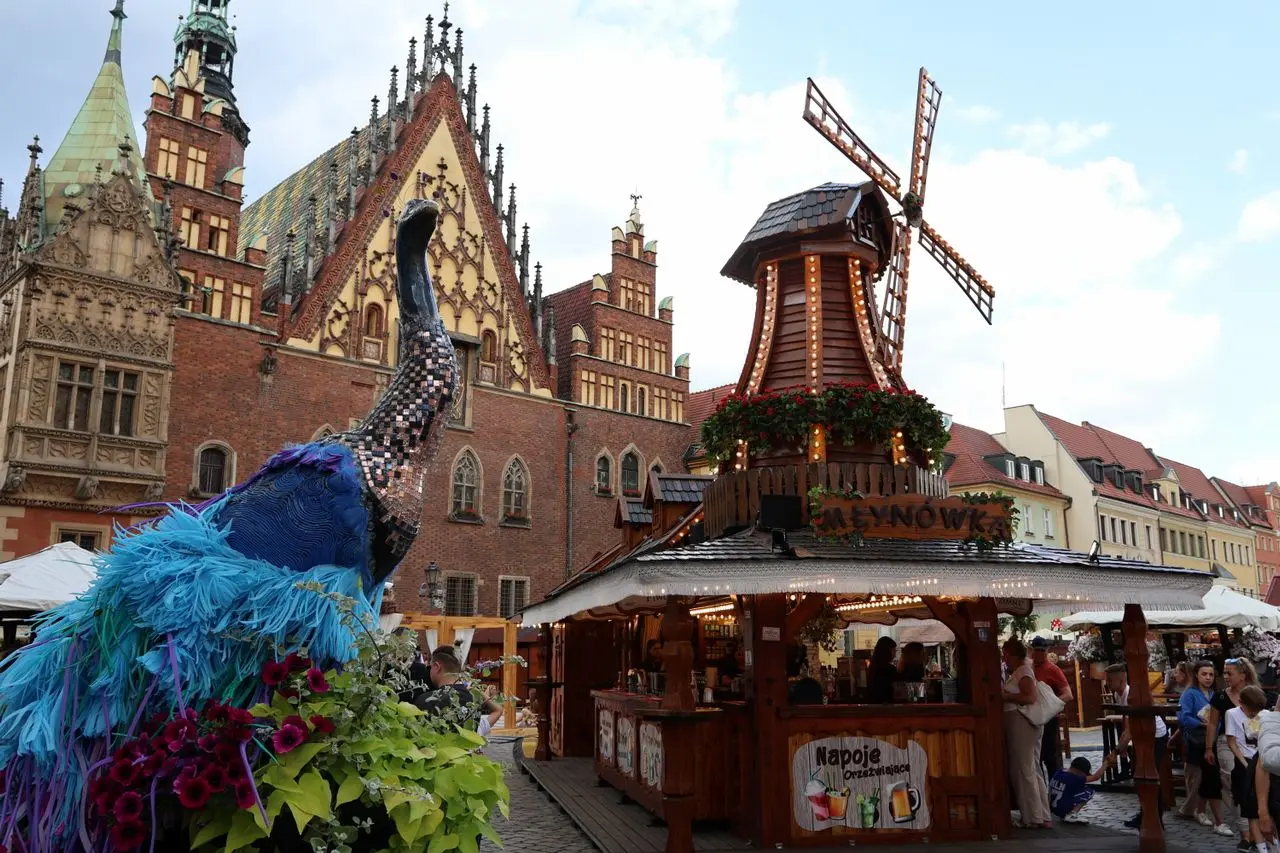
Its market is arguably the most beautiful in the country, set on a rynek that’s a riot of colorful burgher houses, plus it spills toward Cathedral Island across the river, which at night in December is almost criminally pretty.
Wrocław also commits to the bi with a fairy-tale forest installation, and the city’s famous gnome statues. Hundreds of little bronze gnomes scattered all over town and most tourists end up hunting them like Pokémon.
Many Poles will straight-up tell you Wrocław’s market is better than Krakow’s and that’s okay. Personally, I’d call it prettier; Krakow wins on food and city depth. It’s a genuine 50/50 argument, and the rest of Poland’s markets only make it harder.
Gdańsk is the rising star and the one that keeps placing absurdly high in those “best Christmas market in Europe” votes… like, beating Vienna high.
The setting is Hanseatic with tall, narrow, gabled merchant houses, Neptune’s Fountain, amber everywhere because Gdańsk is the amber capital of the world.
It feels more northern-European than Polish, really. The catch is the Baltic wind, which does not care about your coat, and the market usually wraps around the 23rd, so it’s an early-December play like most German or Austrian Christmas markets.
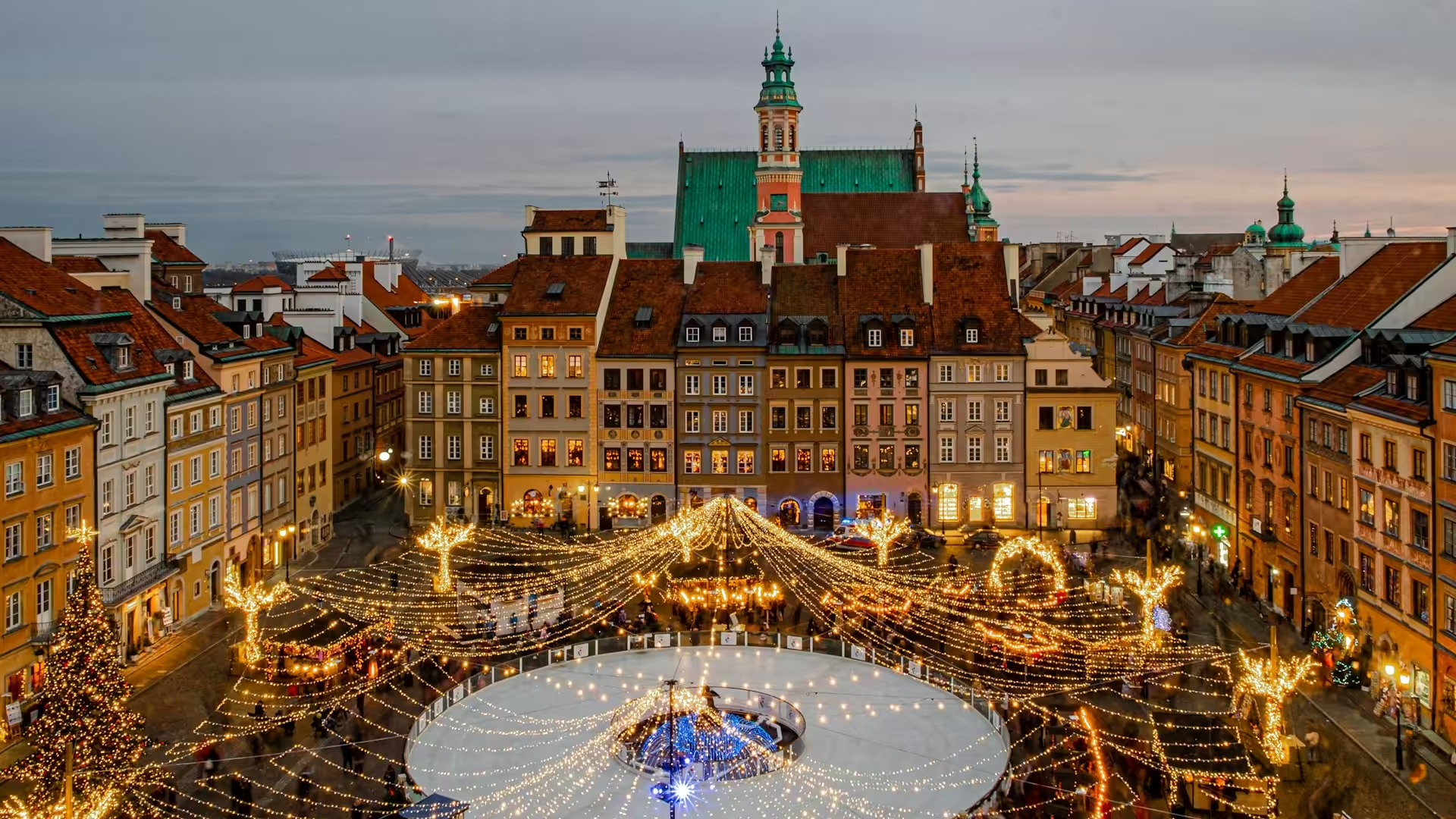
Warsaw, on the other hand, is a bit of a letdown. The markets on Plac Defilad and by the Barbican are fine, and there’s a pretty decent ice rink on the rebuilt Old Town square, but Warsaw is a city you visit for the city and not the Christmas market.
Nobody is crossing Europe for Warsaw’s Christmas market, and that includes Varsovians.
Now, should you combine Polish cities or just do Krakow? Polish markets share a food DNA, so combining Polish markets gives you less stall variety than, say, Austria-plus-Bavaria-plus-Budapest, where each border changes the menu.
The differentiator within Poland is the cities, not the markets.
Which leads to my actual advice. If it’s your first Polish Christmas trip, you must do Krakow, full stop, within three or four days and the best combo isn’t another city at all, it’s Zakopane.
Two hours south, the winter capital of Poland at the foot of the Tatras, where oscypek actually comes from, snow basically guaranteed, highlander culture with its own music and wooden architecture, and mountains you can ride a cable car up. Krakow for the square, Zakopane for the peaks, trust me.
If you’ve got five-plus days and want a second market city, take Wrocław. It’s three hours from Krakow, gorgeous, half as touristy, and it gives you the beauty-contest contrast while keeping everything else easy.
So is Krakow’s Christmas market worth it?
If you have been paying attention, then the answer is clear; Yes, goddamn yes!
The market itself is good, not the greatest spectacle in Europe, but good. The square is a stunner, the food is the best market food I’ve talked your ear off about, the szopka cribs are a one-of-a-kind thing you’ll see nowhere else on Earth, and everything costs about half what Vienna charges.
The asterisk is that the market alone doesn’t have Vienna’s toys and has no ice trails, no Ferris wheel, no light park.
However, nobody should go to Krakow just for the market.. The market is the excuse; the city is the prize.
You’re getting Europe’s largest medieval square, a royal castle, a Leonardo, a dragon that breathes fire, an entire medieval street level under the square, the best bar quarter in Central Europe, a salt mine with an underground cathedral, soup for two euros, and a city that survived the war with every original stone in place.