Disclosure: This blog is reader-supported, and some posts contain affiliate links. If you make a booking, I may earn a small commission, at no extra cost to you. Thank you for keeping me writing and doing what I love!
Budapest in winter is the kind of city that sneaks up on you.
You arrive expecting cold, grey, and communist-era concrete and instead you get bathed-in-gold grandeur, steaming bowls of goulash, and not one but a handful of Christmas markets that locals and travelers alike lose their minds over.
Of all the European Christmas markets we’ve daydreamed about (and trust me, the list is long), Budapest kept pulling at me the hardest. Maybe it’s the chimney cake or maybe it’s the fact that you can soak in a thermal bath and drink mulled wine in the same afternoon.
…It’s probably both.
Why the Budapest Christmas Market?
There’s a reason Budapest keeps topping lists of the best Christmas markets in Europe and it’s not just marketing hype.
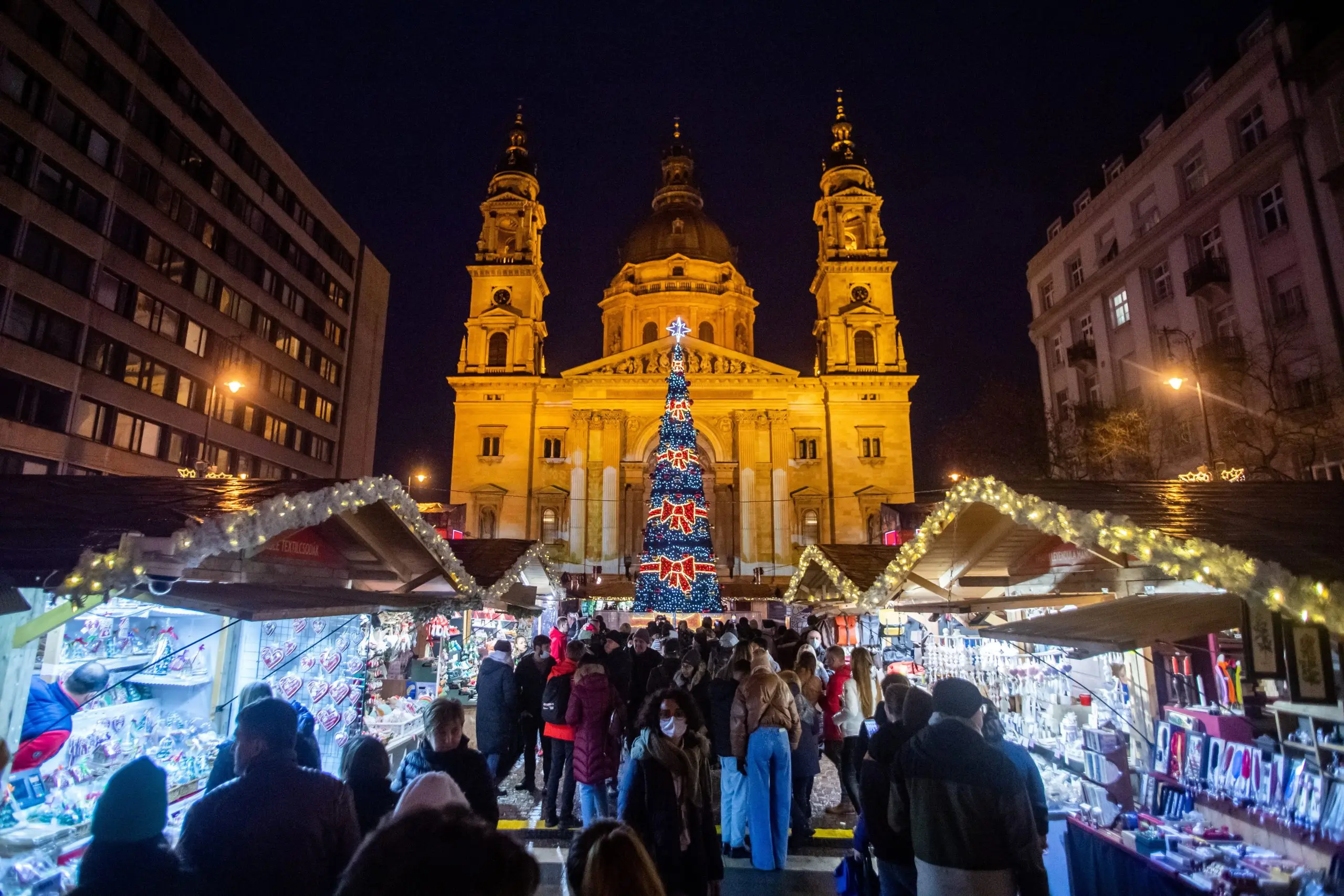
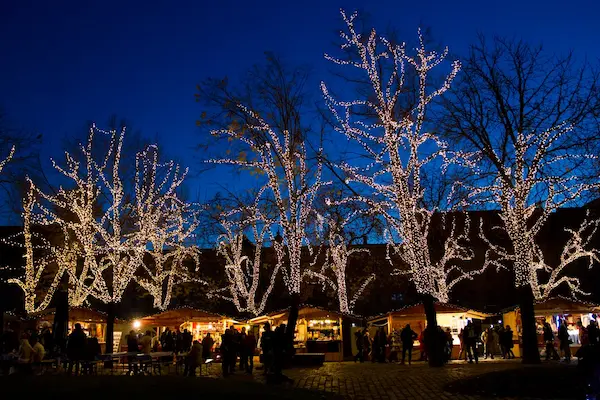
The Advent Bazilika market by St Stephen’s Basilica has been voted Europe’s most beautiful Christmas market four times, and the smaller ones scattered around the city each have their own personality. When you go to Budapest, you’re going to be hopping between several Christmas markets, each with its own vibe.
Most importantly, what sets Budapest apart from the Strasbourgs and Viennas of the world is the value. This isn’t a city where a cup of mulled wine sets you back €9. It’s still Eastern Europe-affordable (ish), the food is seriously good (like OH MY GOD good), and the whole thing feels grand without being precious.
Plus, and I find this the most interesting part, the markets here lean artisan over mass-produced.
The main market famously enforces a rule that stalls must sell genuine Hungarian handcrafted goods, not the same imported trinkets you’ll find at many markets from Bruges to Berlin.
It’s a small thing but one that changes the whole feel of it, honestly.
When to Go?
The Budapest Christmas markets typically open in mid-to-late November and run straight through to New Year’s Day (sometimes into the first week of January).
In recent years, the main markets have opened around November 15–18 and stayed open until December 31 or January 1.
The Basilica market usually follows a similar timeline.
As for when in the day to go:
- Weekday mornings are blissfully quiet so they are perfect for photos and actually browsing the stalls.
- Weekday late afternoons into evening are the sweet spot in my opinion. That’s when the lights come on, the crowds aren’t yet at fever pitch, and the food smells incredible (did I already say that the food at Budapest is next level??).
- Weekends are packed. Like, shoulder-to-shoulder packed. If you can only do a weekend, go early.
And make sure you don’t skip Budapest at night.
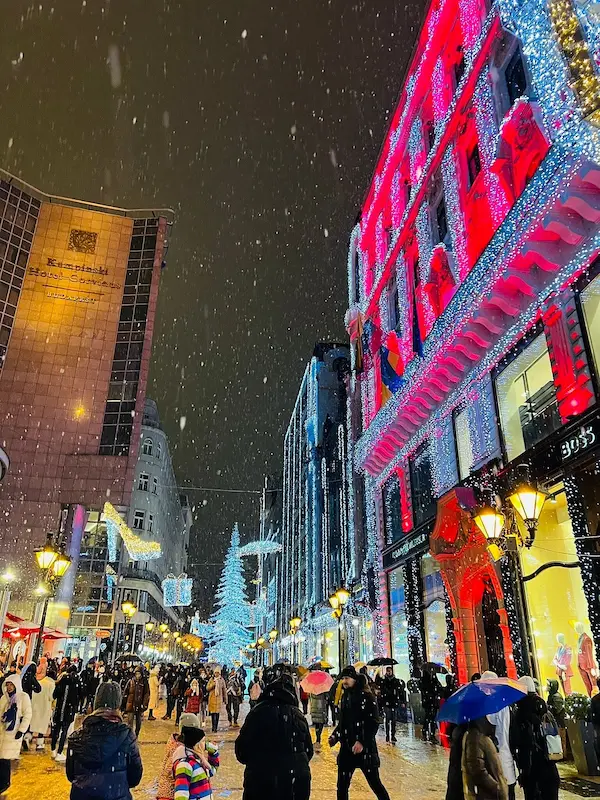
The whole city (not just the markets) does an incredible job with light installations.
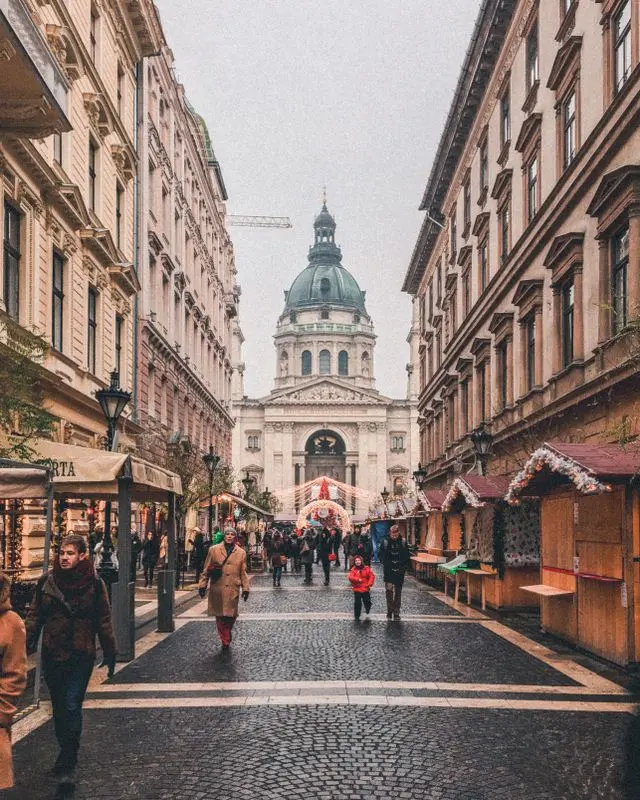
Fashion Street (Deák Ferenc utca) turns into a tunnel of glowing lights between Vörösmarty Square and Deák Ferenc tér.
It’s genuinely gorgeous.
Where to Find the Markets
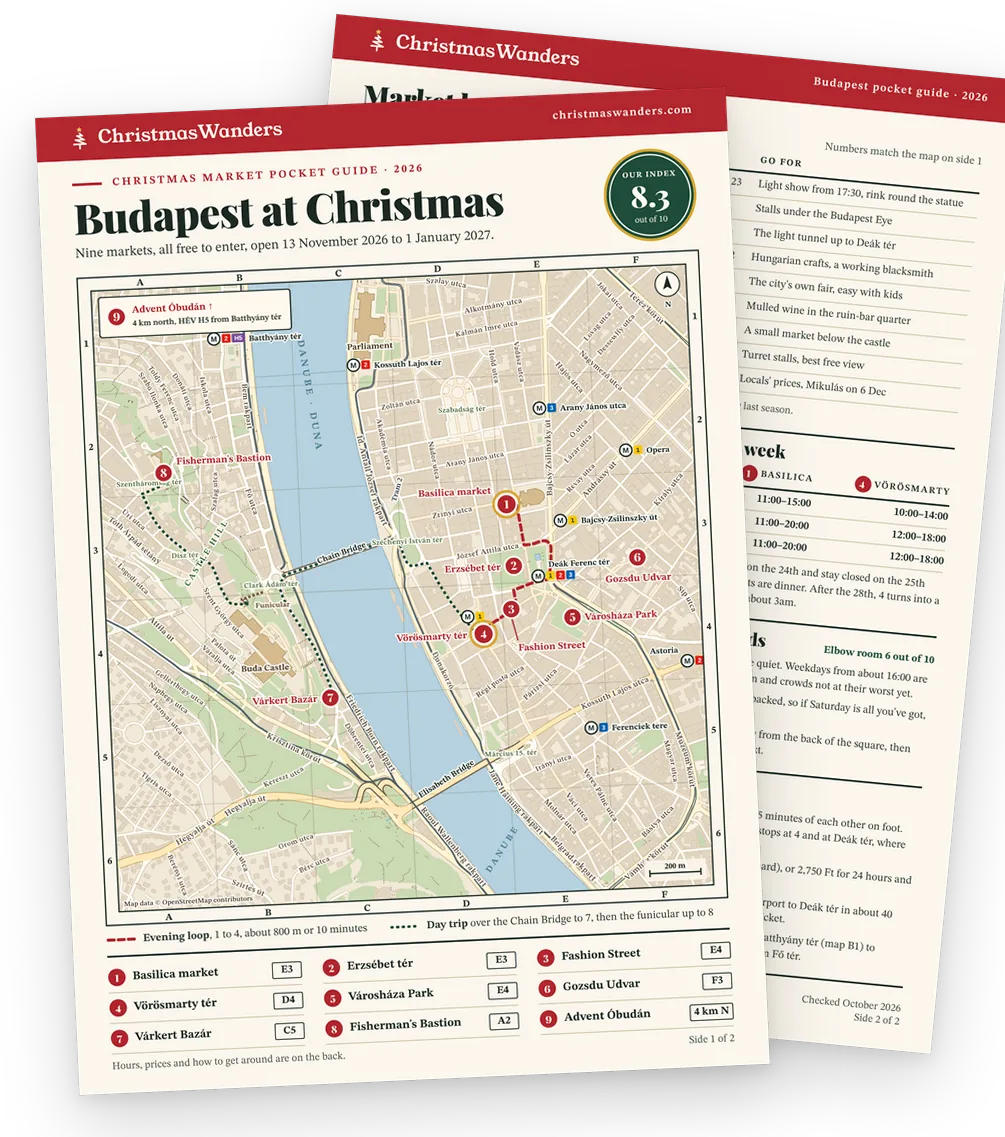
There are several, and they’re all walkable from each other. Here are the ones worth your time.
Vörösmarty Square Market (The Big One)
This is the Budapest Christmas market, and the one you’ve seen all over Instagram probably.
Set right in the heart of the city at Vörösmarty tér (the northern end of Váci utca), it’s the oldest and most famous of the bunch.
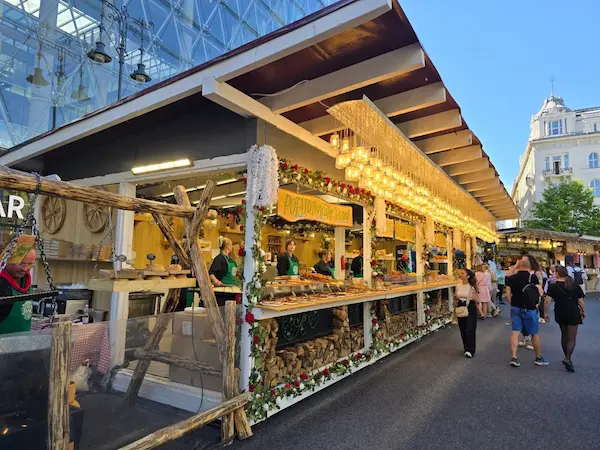
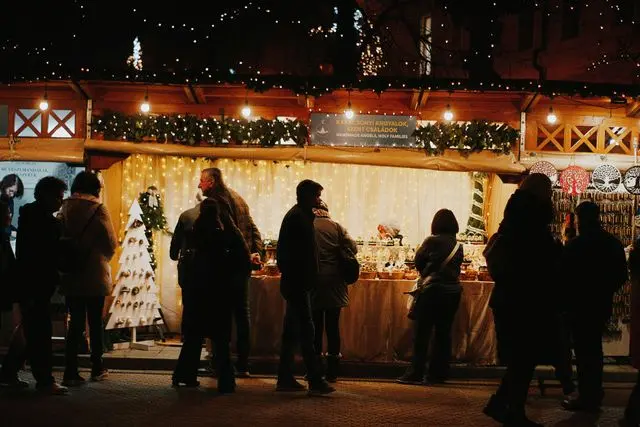
Rows of wooden stalls sell handcrafts, ceramics, leather goods, honey, paprika, and every Hungarian comfort food you can imagine.
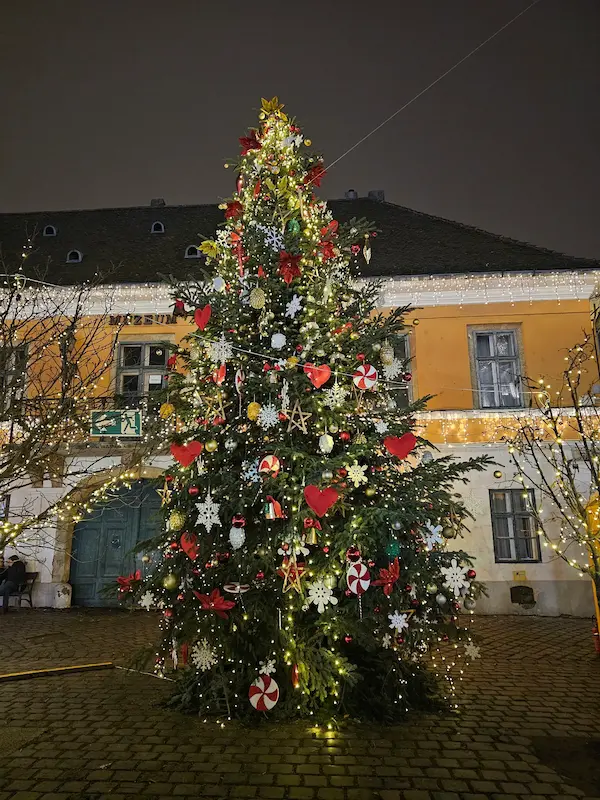
The centerpiece is a big Christmas tree and an Advent calendar that opens a new window each day leading up to Christmas. It’s touristy, yes but it’s touristy done right, if I may add.
St. Stephen’s Basilica Market (Advent Basilica)
If Vörösmarty is the classic, the Advent Basilica market is the show-off.
Set in the square in front of the stunning St. Stephen’s Basilica, this market has a small ice rink out front and a 3D light show projected onto the basilica’s facade every half hour after dark. It’s the kind of thing you have to stop and watch even if you’ve seen it twice already.
I’d say this one edges out Vörösmarty for atmosphere, even if it’s smaller. The backdrop is just that good.
Fashion Street & Erzsébet Square
Connecting Vörösmarty to Deák Ferenc tér, Fashion Street is less a market and more a corridor of light installations and food stalls. Great for strolling between the main markets and grabbing a chimney cake en route.
Nearby Erzsébet Square has a cluster of stalls and sits right under the Budapest Eye ferris wheel, which gives you a bird’s-eye view of the whole glowy scene. Worth the ride at night.
Óbuda Christmas Market (Fő tér)
If you want to escape the tourists, head up to Óbuda (district III) to the Fő tér (Main Square).
This is the locals’ market which means smaller, more artisan-focused, and far less crowded. It feels like a community Advent fair rather than a tourist attraction. If you have the time, it’s a lovely contrast to the buzz of the city center.
Other Spots Worth a Peek
- Gozsdu Courtyard – more about food, drinks, and party vibes than crafts.
- Fashion Street’s surrounding streets – pop-up stalls and light displays throughout the inner city.
But honestly, you should just wander. The markets bleed into one another across the city center, and half the fun is stumbling onto a stall you didn’t expect.
What to Eat & Drink (The Star of the Show)
Okay, here’s where Budapest really wins.
A lot of European Christmas markets phone in the food and offer the same old bratwurst, same old crepes, same old overpriced glühwein. Yeah, it’s fun, it’s Christmas food, and I am still going to eat and drink this stuff. But I love when a city does its own thing, offers some of its own culture, you know?
Well, Budapest does its own thing, and the food is genuinely Hungarian, genuinely hearty, and genuinely cheap-ish for a capital city.
Here’s what you absolutely cannot skip:
- Kürtőskalács (chimney cake) – The iconic spiral of sweet, caramelized dough baked over an open flame, then rolled in cinnamon, cocoa, or crushed nuts. You’ll smell it before you see it. It’s the must-eat of the Budapest markets.
- Goulash in a bread bowl – Rich, paprika-red, and soul-warming. Served inside a hollowed-out loaf of bread, because of course. Perfect when it’s freezing out.
- Lángos – Deep-fried flatbread smothered in sour cream, cheese, and garlic. It’s the Hungarian street food of champions. Not light. Not sorry.
- Roast goose leg – A traditional Hungarian Christmas staple. Crispy skin, juicy meat, served with red cabbage. Surprisingly affordable from market stalls.
- Roasted chestnuts – A Christmas market classic everywhere, but Budapest does them well, and they’re cheap.
- Forralt bor (mulled wine) – Spiced hot red wine. Every market sells it, and there’s a mug deposit system: you pay a small fee for a collectible themed mug (different each year), get it back if you return the mug, or keep it as a souvenir. We always keep ours.
- Hot apple cider – The non-wine alternative. Mulled, spiced, delicious.
- Palacsinta – Thin Hungarian pancakes stuffed with anything from chestnut cream to cocoa to jam. The dessert finisher.
A rough idea of prices (in Hungarian forint, HUF is roughly 390 HUF to €1):
- Mulled wine: 800–1,200 HUF (plus mug deposit)
- Chimney cake: 1,500–2,000 HUF
- Lángos: 1,500–2,500 HUF
- Goulash in bread: 2,500–3,500 HUF
- Roast goose leg: 3,000–4,500 HUF
Not dirt cheap, but noticeably less than Vienna or Strasbourg for the same or even a better experience. Remember to bring a mix of cash and card. Most stalls now take cards, but a few smaller/artisan ones don’t.
What to Buy (Skip the Souvenir Tat)
The main market enforces a “no mass-produced imports” rule for craft stalls.
That means what you’re buying is actually made by Hungarian artisans including all of the pottery, leather goods, carved wooden toys, hand-embroidered textiles, beeswax candles, honey, paprika, foie gras, and carved wooden chess sets.
Some favorite finds for myself were:
- Herendi or Hollóházi-style ceramics (the real stuff, not knockoffs – check the stamp).
- Hand-tooled leather goods – bags, wallets, journals. Beautiful quality.
- Hungarian paprika – the real thing, in cute tins. Far better than anything from home.
- Honey and beeswax – Hungary has a rich beekeeping tradition.
- Felted wool slippers – warm, quirky, perfect winter gift.
- Hand-blown glass ornaments – delicate, colorful, and genuinely lovely.
My advice is to buy one or two things you actually love rather than carting home a bag of “stuff.”
These are real makers, and your forints support real people!
Practical Tips for Visiting
A few things worth knowing before you go:
Dress for the cold
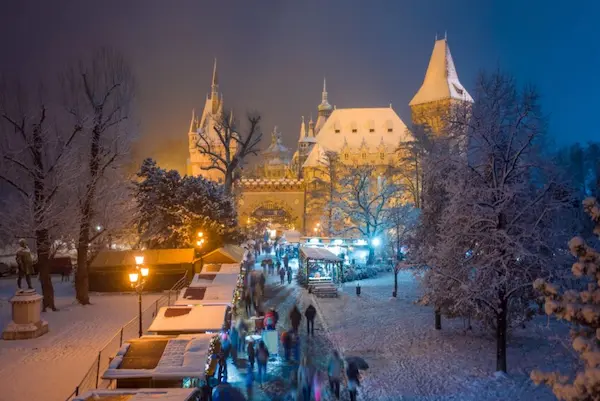
Budapest in December sits around 0–5°C (32–41°F), often with a biting wind off the Danube. Snow is possible, too (it was snowing when we were there last time). Layers, a warm coat, gloves, a scarf, and decent shoes with grip (those cobbled squares get slippery) are non-negotiable.
Don’t overpay for accommodation
Stay central if you can, so somewhere in District V (Belváros) puts you within walking distance from Vörösmarty and the Basilica. But like anywhere popular, prices jump in the center or close to it. The further you go from the heart, the cheaper it is, of course. District VII (the Jewish Quarter) and parts of District VI are great middle-ground options (still close, more character, lower prices).
Get around on foot (and tram)
The markets are all within a 15–20 minute walk of each other in the city center. For longer hops, tram 2 runs along the Danube and is scenic, and the M1 (yellow) metro line is a UNESCO-listed relic in itself. A Budapest Card can be worth it if you’re museum-hopping too.
Bring both cash and card
Most stalls take cards now, but some artisan and food stalls are cash-only. Hit an ATM for some HUF when you land, but don’t stress because cards are widely accepted.
Go twice if you can
Once by day, once at night. They feel like two completely different markets. Day is for browsing and photos and night is for the lights, the music, the mulled wine, and the magic.
Pair It With the Rest of Budapest
This is the thing I’d shout from the rooftops: do not treat Budapest as just a Christmas market trip.
The markets are wonderful, but they’re a few hours of each day at most. The rest of Budapest is what makes the whole trip sing.
- Soak in a thermal bath – Széchenyi or Gellért. Soaking in steaming 38°C water while it’s freezing outside is one of life’s great pleasures. Széchenyi’s outdoor pools in winter are unreal.
- Ride tram 2 along the Danube at night – the Parliament building lit up is jaw-dropping.
- Eat your weight in Hungarian food beyond the markets – ruin bars in District VII, a proper lunch of chicken paprikash, and definitely a chimney cake or three.
- Wander the Castle District above the river for views that don’t need a filter.
If you only do the markets and skip the baths, you’ve missed the point. Budapest is a two-for-one city in winter.
Is the Budapest Christmas Market Worth It?
Yes. Emphatically, yes, goddamnit!
Is it touristy? Of course it is. Every great Christmas market in Europe is. But Budapest manages to be touristy and authentic, grand and affordable, magical and genuine in a way a lot of its flashier competitors aren’t.
And one responsible travel note, because I can’t help myself: please support the local artisans and food stalls, not the cheapest trinkets.
Buy the handmade ceramics. Eat the goulash from the small stall. Tip the musician. Tourism can be a load-bearing factor in a city’s winter economy so make yours count for the people who actually live there.