Graz had around 1.9 million Advent visits in 2024, and 92% of them were Austrians.
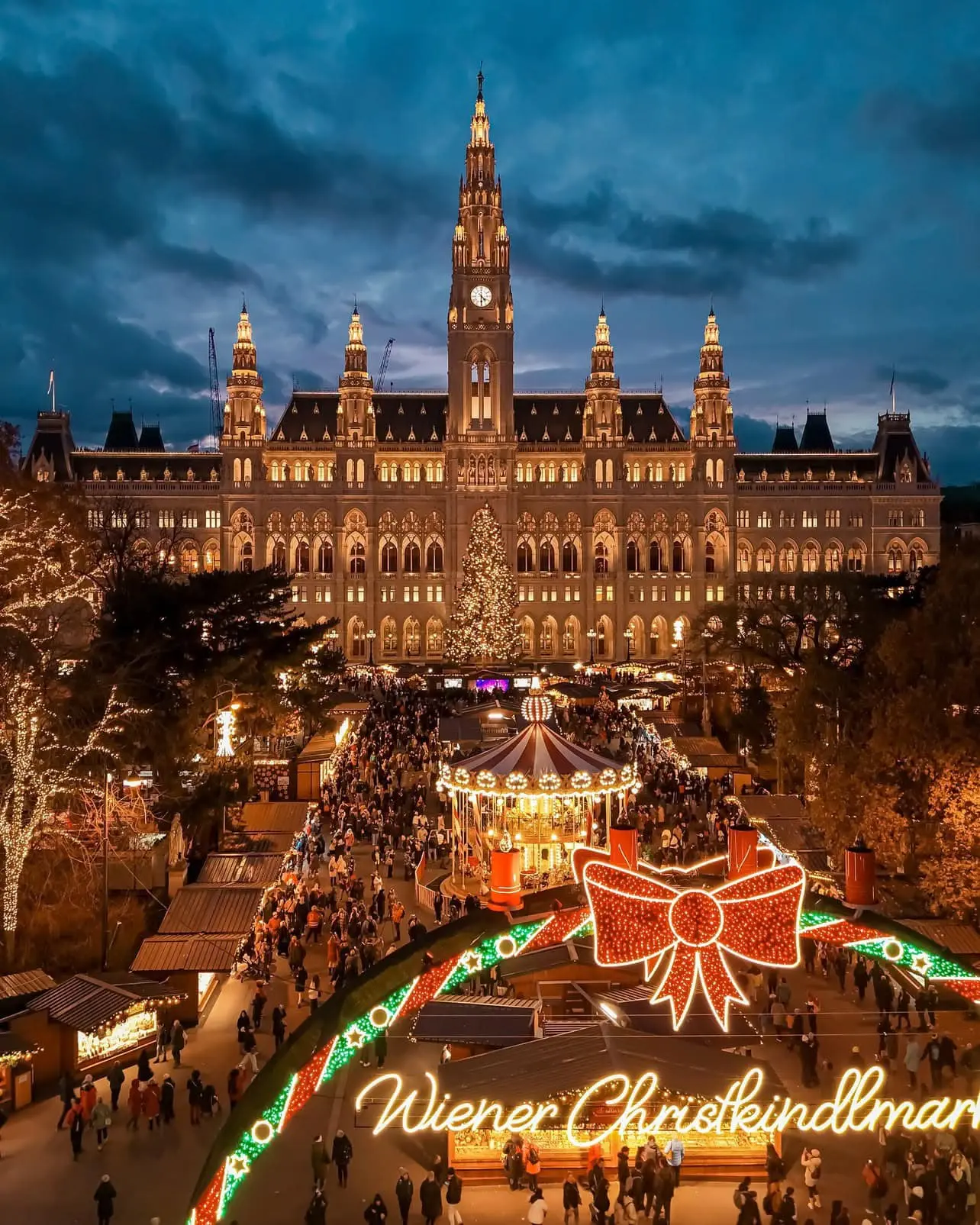
Compare that with Vienna, where the market on Rathausplatz alone had 3.3 million visits in 2023 and about one in four came from abroad.
Graz is the big Austrian Christmas market that Austrians mostly keep for themselves, and the foreigners who do find it are mostly neighbours coming up from Croatia, Slovenia and Hungary.
Graz also doesn’t do one giant market, which isn’t a surprise, because this is how most Austrian Christmas markets are.
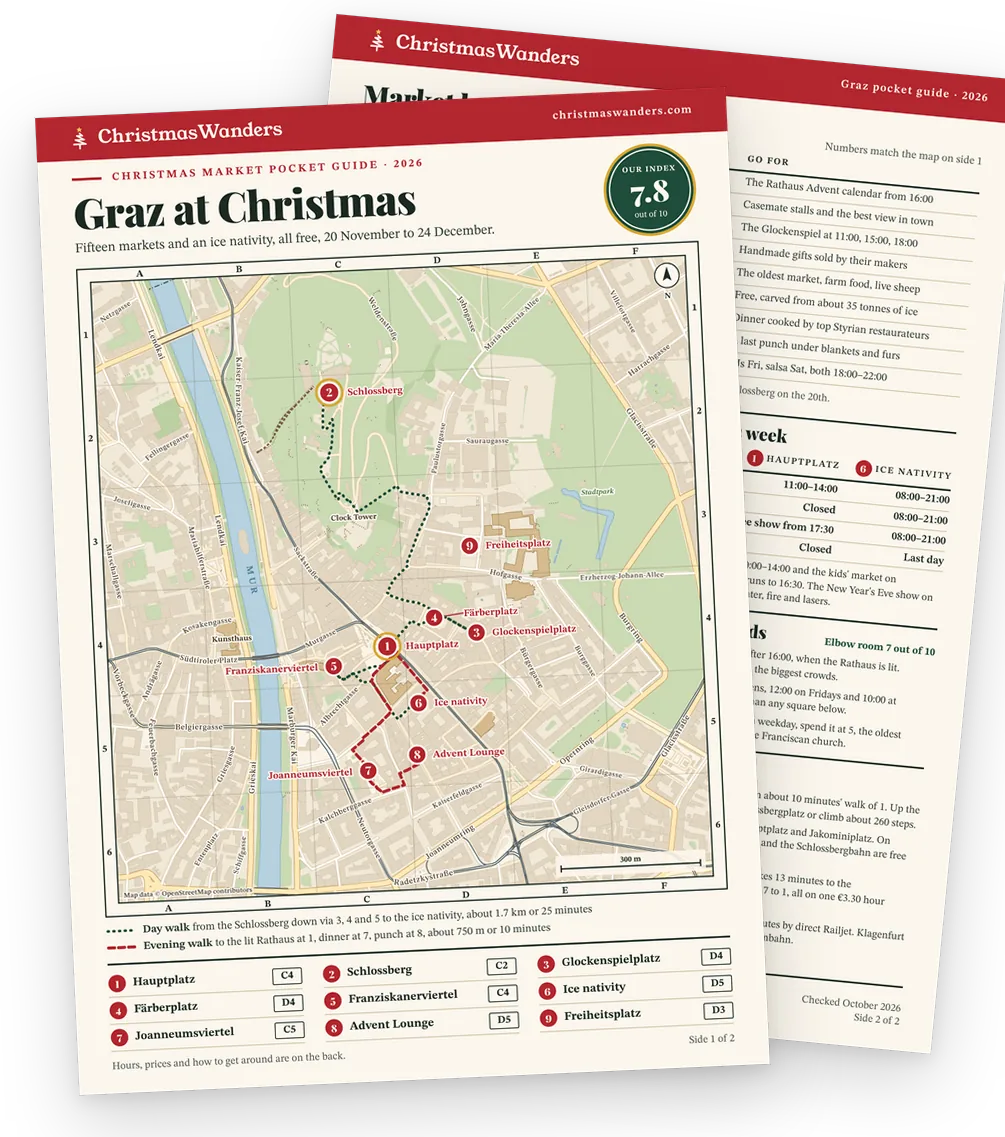
It spreads about fifteen small ones across its old town, almost all of them within ten minutes’ walk of the main square, so an evening here is a slow crawl from one little square to the next instead of a shuffle through one big crowd.
On top of that you get a nativity carved out of ice, a market inside the old fortress on top of the hill, and a pink Glühwein made from a wine that can legally only come from Styria.
It’s easy to treat Graz as a day trip from Vienna, but I think it deserves two nights at least.
Graz Christmas Market 2026 Dates and Hours
The Graz Christmas markets open on Friday 20 November 2026 and run until Christmas Eve.
On 24 December the main markets trade until 14:00, then the huts close and the whole city goes home to celebrate.
Several of the smaller markets finish a day earlier, on the 23rd, and two of them, the Schlossberg market and the Grieskindlmarkt on Nikolaiplatz, wrap up on Sunday 20 December.
On Hauptplatz the craft stalls are open from 11:00 to 20:00 every day and the food and drink huts keep pouring until 22:00.
Most central squares keep similar hours, and the exceptions are the ones worth planning around. The Schlossberg market only opens Friday to Sunday (from 12:00 on Fridays and 10:00 at weekends), plus 7 and 8 December.
The arts and crafts market on Färberplatz starts a week later than everything else, on 27 November.
The Joanneumsviertel market opens at 14:00 and goes on until 22:00, so treat it as a dinner stop.
Entry is free everywhere. You pay for what you eat, drink and buy, plus a mug deposit of up to €5 at a lot of the stalls. Hand the mug back and you get your money back, or keep it and call it a souvenir (you should keep it).
| Date | What’s on |
| Thu 19 Nov | Christmas lights switch on across the city |
| Fri 20 Nov | Markets open, and the light show on the Rathaus starts every evening from 16:00 |
| Fri 27 Nov | Färberplatz arts and crafts market opens |
| Sat 28 Nov | Tree lighting on Hauptplatz at 16:00, and the ice nativity opens |
| Sat 28 Nov, 5, 12 and 19 Dec | Advent Saturdays, when some city lines and the Schlossbergbahn are free |
| Sat 5 and Sun 6 Dec | Krampus and St Nicholas at Glockenspielplatz |
| Tue 8 Dec | Public holiday, markets open as normal |
| Sun 20 Dec | Last day for the Schlossberg and Nikolaiplatz markets |
| Thu 24 Dec | Main markets close at 14:00 |
| Thu 31 Dec | Free New Year’s Eve show on Hauptplatz |
| Wed 6 Jan 2027 | Last day of the ice nativity |
One thing you won’t see in Advent this year is the big Graz Krampus run.
Because of construction work and clashes with other events, the organisers moved it to 8 November 2026, almost two weeks before the markets even open.
Krampus and St Nicholas still turn up at Glockenspielplatz on 5 and 6 December, and plenty of smaller Styrian towns hold their own Krampus runs in late November and early December, so the horned guys aren’t going anywhere.
The Markets Worth Your Time
The city says it has 15 Christmas markets, or 16 if you ask the tourist board, which counts the ice rink too.
That sounds like a lot until you realise most of them are a small cluster of huts on a small square, and the squares sit so close together that you’ll walk through two of them on the way to a third.
You don’t need to see them all. You need about six.
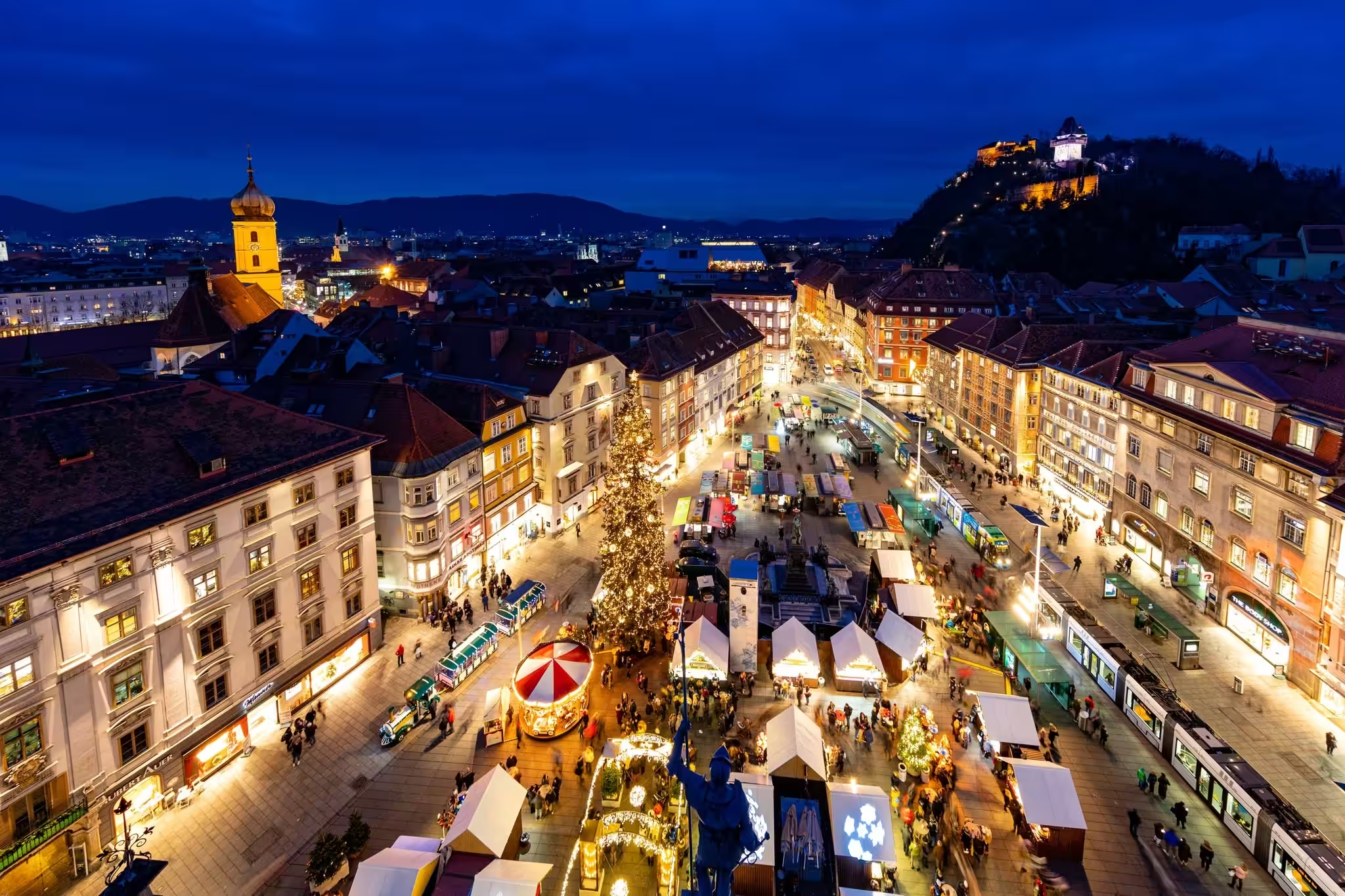
Hauptplatz is the main one and the one on every postcard. The huts ring a big tree brought in from Semriach, a small town in the hills north of Graz, with more than 25,000 lights on it, and from 16:00 the Rathaus behind it lights up as a giant Advent calendar that counts down the days from 1 December.
It’s lovely, but it’s also the busiest square in the city, and trams run straight across it, which is less fun when you’re dodging one with a full mug in your hand.
Go on a weeknight after 16:00 if you can. On Saturday 14 December 2024, counters recorded 87,740 people in the city centre in a single day, and you can guess which square most of them ended up on.
A couple of minutes away, the Franziskanerviertel has the oldest market in the city, the Altgrazer Christkindlmarkt, squeezed into the lanes around the Franciscan church.
It leans rural, with Styrian farm products, crafts, Thuringian glass ornaments and a nativity with live sheep.
If I only had an hour on a weekday, this is where I’d spend it. Right next door, the kids’ Advent on Kapistran-Pieller-Platz has a carousel and a little vintage Ferris wheel, which buys you roughly forty minutes of peace from “are we done yet”.
Glockenspielplatz is small, but time it right. Three times a day, at 11:00, 15:00 and 18:00, the windows in the gable of the Glockenspiel house open, 24 bells play, a wooden couple in traditional dress turns round and round, and a rooster crows to finish the show.
Gottfried Maurer had it built into his house in 1905. The huts here keep Styrian customs going through Advent, like wreath making on 24 November and Barbara twigs on 4 December, when you cut cherry branches and put them in water so they flower by Christmas.
Mehlplatz next door has punch recipes you won’t find at home plus Käsespätzle and fresh waffles, and if you’d rather sit down indoors, Glöckl Bräu on Glockenspielplatz pours its own house beer straight from the wooden barrel.
Färberplatz is where I’d do the gift shopping.
It’s an arts and crafts market where the makers sell their own work in clay, fabric, metal, glass and wood, some of them with live demonstrations, so you get things you won’t see on every other stall in Austria.
It only opens on 27 November, so don’t go looking for it in the first week.
For dinner, head to the Joanneumsviertel, the square outside the Universalmuseum Joanneum, where some of Styria’s best-known restaurateurs cook out of the huts from 14:00 to 22:00.
It’s the one market in Graz where the food is the reason to come.
Afterwards, the Advent Lounge in Schmiedgasse is five punch huts with lounge corners full of blankets and furs, and it’s the closest thing Graz has to a Christmas bar.
The rest are nice if they’re on your way. Freiheitsplatz, by the theatre, has traders from four continents, DJs on Friday evenings and salsa on Saturdays, and it’s new here for 2026 after moving from Tummelplatz, which is where older guides will still send you.
Across the river in Lend, the artsy side of Graz, WonderLEND on Mariahilferplatz has a Ferris wheel and curling, and the Südtiroler Platz market sits right by the Kunsthaus, the blue bubble of an art museum known as the Friendly Alien.
Eisernes Tor, Karmeliterplatz and the Grieskindlmarkt on Nikolaiplatz are pleasant and small, and the last two only open Thursday to Sunday.
With one full day on a Friday or weekend, I’d start at the Schlossberg market when it opens and come back down after lunch.
Be at Glockenspielplatz for the 15:00 show, drift through Färberplatz and the Franziskanerviertel while it’s still light, and reach the ice nativity in the Landhaus courtyard just as it gets dark.
Then Hauptplatz for the Rathaus, dinner at the Joanneumsviertel and a last punch in Schmiedgasse. It’s all walkable, and if your feet give up, the trams around the old town are free to ride anyway.
The Ice Nativity Turns 30
The Graz ice nativity (Eiskrippe) was first put up in 1996, which makes 2026 its 30th anniversary, and it’s the one thing in Graz you won’t find anywhere else.
It stands in the Landhaushof, the courtyard of the Landhaus on Herrengasse, which the Italian architect Domenico dell’Allio built in the 16th century and which still houses the Styrian parliament.
Picture three storeys of stone arcades that look like they wandered over from Venice, and in the middle, a life-size nativity scene made of clear ice.
It takes about 35 tonnes of it. The blocks are frozen from purified water, and a small team led by the Finnish ice sculptor Kimmo Frosti carves the Holy Family, the animals and everyone else and builds the scene up to five metres high.
The part I love is the backup plan. Graz isn’t Lapland, and a mild spell in December can soften the figures, so the team keeps spare sets frozen and swaps them in when the first ones start to melt.
Locals have been known to bet on whether it’ll make it to Christmas in one piece.
More than 160,000 people come to see it every year, and it’s free.
It’s open from 28 November 2026 to 6 January 2027, every day from 08:00 to 21:00, and it’s lit up at dusk, so go after dark.
It’s also one of the few Christmas things in Graz that keeps going after the markets close on Christmas Eve.
From the courtyard, the Krippenweg (nativity trail) carries on through Stempfergasse, where shopkeepers put nativity scenes in their windows through Advent and into January.
In 2025 the route had more than 38 of them. It’s a short, easy browse. If nativity trails are your thing, Bamberg takes them far more seriously, with around 36 stations and more than 400 scenes.
Pink Glühwein and Green Oil
Graz is a city made for grazing. It has called itself Austria’s Capital of Delight, or GenussHauptstadt, since 2008, and the idea behind it is simple.
The city eats and drinks from the farms and vineyards around it, and at the Christmas markets you taste that mostly in the mug.
Look for Schilcher Glühwein.
Schilcher is a pink wine made only from Blauer Wildbacher grapes, grown on roughly 500 hectares of West Styria around Deutschlandsberg, and it’s known for a sharp, sour kick.
Pope Pius VI wrote in his diary in 1782 that it was a rose-coloured vinegar, which was rude, but you can see where he was coming from.
That acidity is exactly why it works hot.
It cuts through the sugar and spice, so Schilcher Glühwein tastes lighter and fruitier than the usual red.
In 2025 it sat at the top of the price range at up to about €5.30, with regular Glühwein from about €4.50.
That’s still cheaper than Vienna, where a mug on Rathausplatz averaged over €6 the year before.
Austria is punch country too, so you’ll see as much Punsch as Glühwein, from apple and orange punch to Feuerzangenbowle, where a rum-soaked sugar cone gets set on fire over the wine.
Kids get Kinderpunsch, which is the same idea without the alcohol.
The market food is mostly standard Austrian comfort food. Käsespätzle, baked potatoes piled with toppings (about €5.50 to €9.50 in 2025), waffles, roasted chestnuts, raclette and chimney cakes.
It’s all good and all filling, and the Joanneumsviertel is the exception where the chefs actually show off.
For proper Styrian food, sit down in a Gasthaus, and that’s where the green oil comes in.
Pumpkin seed oil (Kürbiskernöl) is what Styrians call their green gold, and it’s the one thing you should take home.
It’s dark green, thick and nutty, pressed from a Styrian pumpkin whose seeds grow without hard shells, and it takes about 2.5 to 3 kilos of seeds to make a single litre.
“Steirisches Kürbiskernöl” has had EU protection since 1996, so look for those words on the bottle. Styrians put it on everything.
Try it on Käferbohnen, a salad of big, creamy runner beans with onions, or on Backhendlsalat, a salad topped with Styrian fried chicken.
The dessert version is vanilla ice cream with a swirl of pumpkin seed oil on top, which sounds wrong and is a Styrian classic anyway.
Wrap the bottle well in your suitcase, because those green stains are famously stubborn.
For something sweet, walk over to Hofgasse and the Hofbäckerei Edegger-Tax.
It’s been baking since 1569, became a supplier to the imperial court in 1888, and still has the carved wooden shopfront that was made for it in 1896.
The front alone is worth the detour, and nobody’s going to judge you for leaving with a bag of pastries.
Go Up the Schlossberg
If I had to pick one market in Graz, it would be the Aufsteirern Christmas market on the Schlossberg, the wooded hill that rises straight out of the old town.
It spreads through the casemates, the vaulted remains of the old fortress, around the Liesl bell tower and out across the hilltop, and it’s all Styrian crafts and Styrian food.
It’s calmer than anything down in the streets, and the view over the lit-up roofs is the best in the city.
It’s only open Friday to Sunday (plus 7 and 8 December) until 20 December, and that alone is a good reason to plan your Graz trip around a weekend.
You can ride the lift up through the inside of the rock from Schlossbergplatz for €2.60 each way, take the funicular up from Kaiser-Franz-Josef-Kai, or climb the steps, about 260 of them.
At the top is the Uhrturm, the clock tower that’s the symbol of Graz, and its clock is famously backwards.
The big hand shows the hours and the small hand shows the minutes, because the clock originally only had hour hands, made big enough to read from far away, and the minute hands came later.
It’s the one clock in Austria where you can’t trust the big hand.
The clock tower is only still standing because the people of Graz paid for it.
In 1809 Napoleon’s troops besieged the fortress and couldn’t take it, but the peace treaty that year ordered it torn down anyway, and the citizens raised the money to save the clock tower and the bell tower.
The bell in that tower, the Liesl, was cast in 1587, weighs about 4.6 tonnes and rings 101 times every day at 7:00, 12:00 and 19:00.
Local legend says it was cast from 101 Turkish cannonballs, which historians don’t buy, since bells are bronze and cannonballs aren’t.
The market usually runs past 19:00 on Fridays and Saturdays, so stand near the tower and count along.
The fastest way down is the Schlossberg slide, which drops 64 metres over 170 metres inside the hill and bills itself as the highest indoor slide in the world. You need to be at least 1.3 metres tall, and check the opening hours before you count on it in December.
Graz or Vienna?
Vienna is bigger and grander, with Schönbrunn, the Ringstrasse and a market in front of practically every palace.
It’s also busier, pricier and full of visitors from everywhere, you included.
Graz, on the other hand, is smaller, cheaper and more local, and it runs on Styrian wine and food rather than Habsburg glamour.
My answer depends on whether you’ve been before.
If this is your first Christmas trip to Austria, do Vienna and add Graz for a night or two, since it’s only about two and a half hours away on a direct train.
If you’ve already done Vienna, Graz is the better second trip, and it’s the easier one with kids, because everything is close together and nothing feels like a crowd you have to fight through.
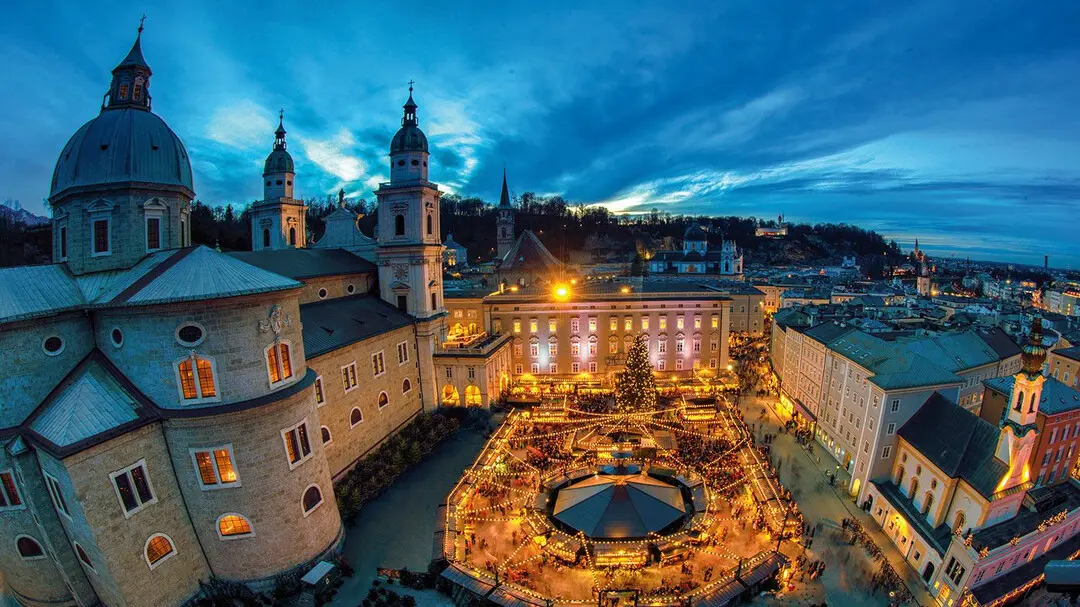
Salzburg is the other obvious rival, and it’s the prettier city with the Silent Night story attached, but it’s around three and a half hours from Graz by train. I’d pair Graz with Vienna and save Salzburg for another winter.
The Koralmbahn, a new railway with a 33-kilometre tunnel under the Koralpe mountains, opened on 14 December 2025 and cut the train from Graz to Klagenfurt to 41 minutes.
That puts the Carinthian lakes within easy reach, including Velden on the Wörthersee, where a giant lit-up Advent wreath floats on the lake.
Velden’s market runs Friday to Sunday until 20 December 2026, plus 7 and 8 December, which happen to be the same days as the Schlossberg market, so you’ll have to decide which weekend day goes where.
So, Is Graz Worth It at Christmas?
Yes, and by more than people expect.
Graz has no single jaw-dropping square like Vienna’s Rathausplatz or the cathedral square in Strasbourg.
It has a whole old town that works as one long, walkable Christmas market, full of Austrians having a good time.
Come Thursday to Saturday, do Hauptplatz on the Thursday night while it’s quieter, spend Friday up the Schlossberg, and leave room in your suitcase for a bottle of pumpkin seed oil.
Christmas itself is quieter.
The main markets close at 14:00 on 24 December (the children’s market on Kapistran-Pieller-Platz stays open to 16:30) and Christmas Day in Austria is a family day with most shops shut, so if you’re in Graz over the holidays, the ice nativity is your best bet.
If you’re staying for New Year’s Eve, Hauptplatz puts on a free show in front of the Rathaus with water, fire, lasers and light instead of fireworks, in five 20-minute rounds from 17:30 through to the midnight countdown.