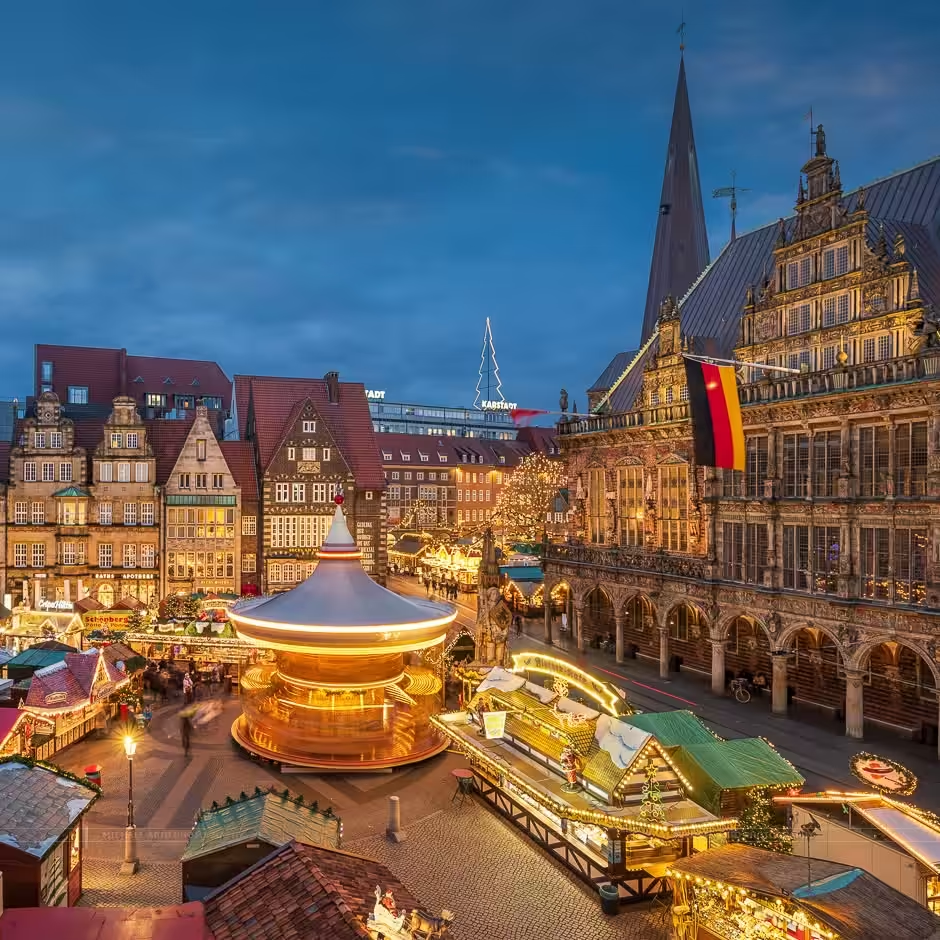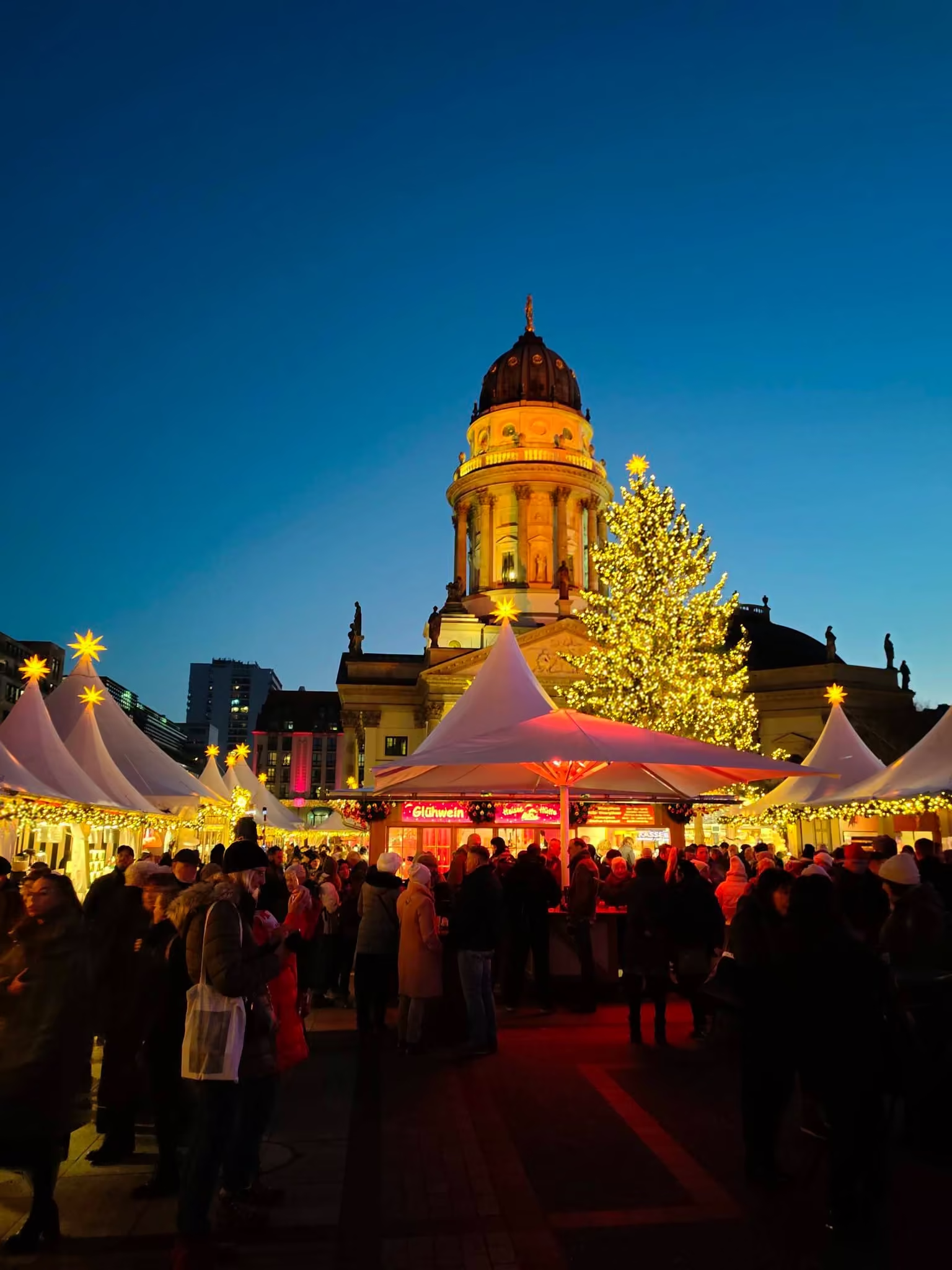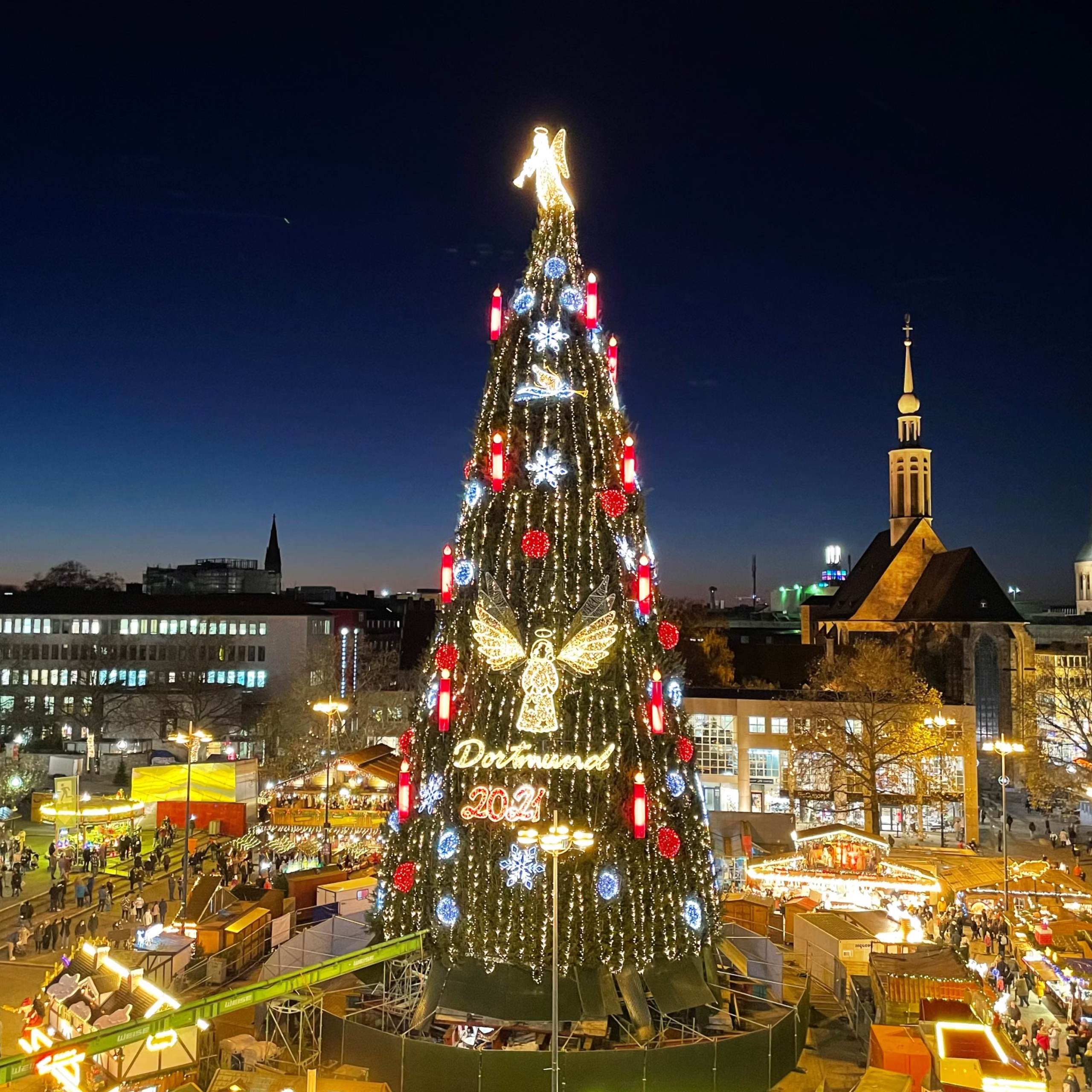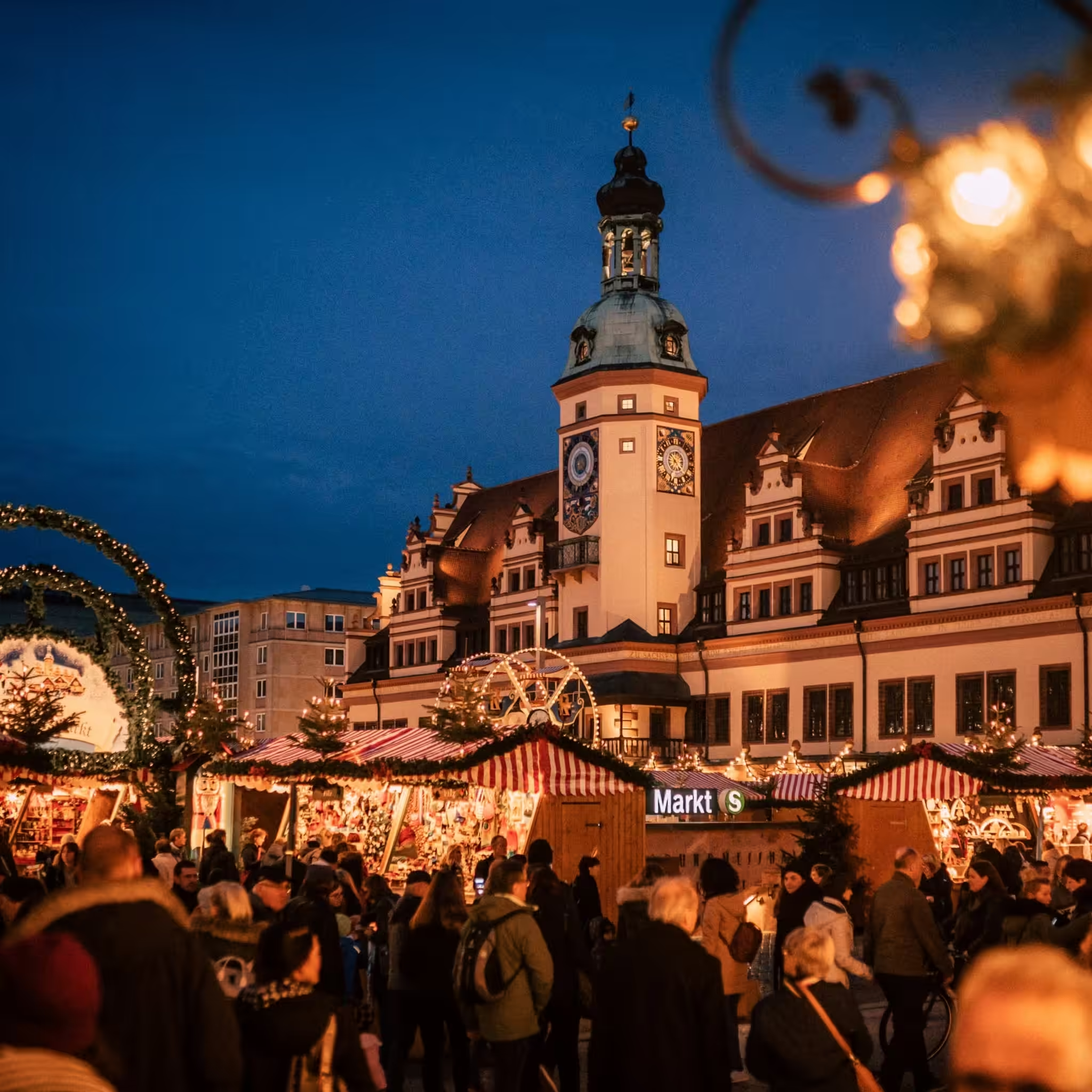
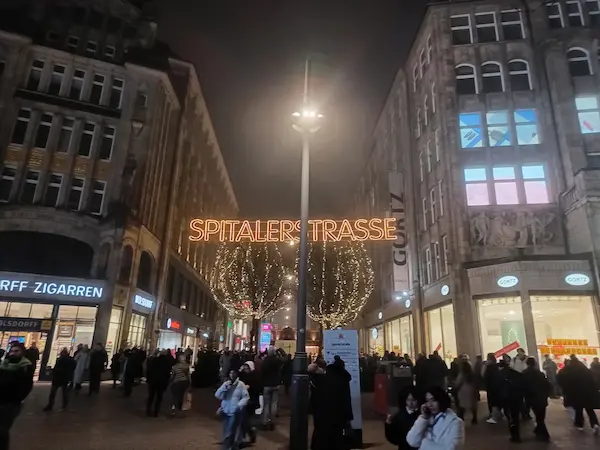
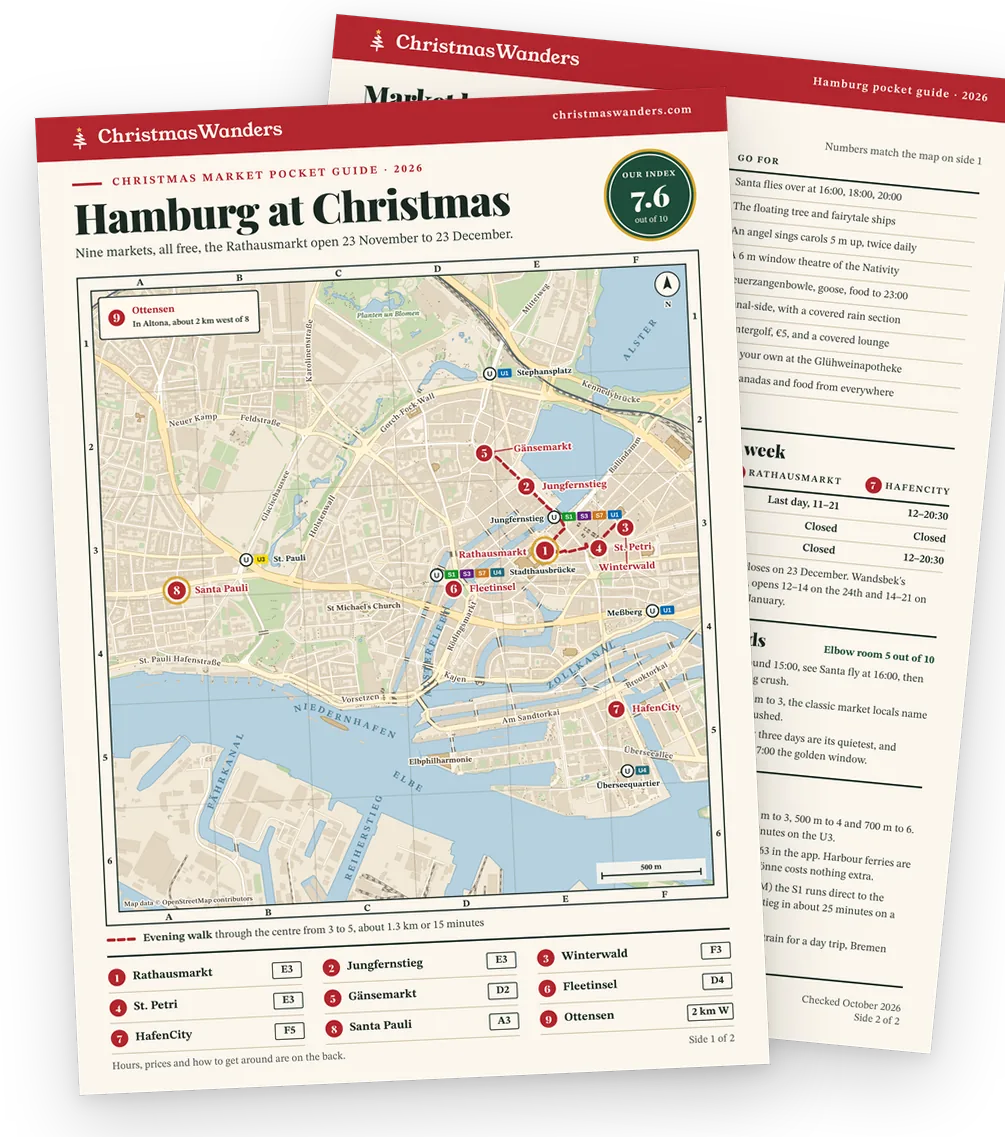
Before I tell you anything about Hamburg, you have to throw out the picture in your head that you have about it.
Whatever you’re imagining, whether that’s the gingerbread town, the snow, the little medieval square where everyone’s choir-singing…well, that’s Bavaria. That’s Rothenburg.
Hamburg is not that, and it would be a terrible waste of a trip to spend the whole time wishing it was.
Hamburg is a port town. For eight hundred years it’s been a merchant city that traded with the world and got rich being practical.
It’s Protestant in that old Hanseatic way: doesn’t gush, doesn’t perform, slightly reserved on the surface. However, when you’re suddenly three glühweins deep at some neighborhood bonfire talking to a stranger about kale, you’ll realize the warmth was there the whole time.
It just wasn’t advertised.
And here’s another thing. Because Hamburg is a real working city and not a Christmas theme park, it doesn’t have one perfect market that everyone poses in front of (although the main one is beautiful).
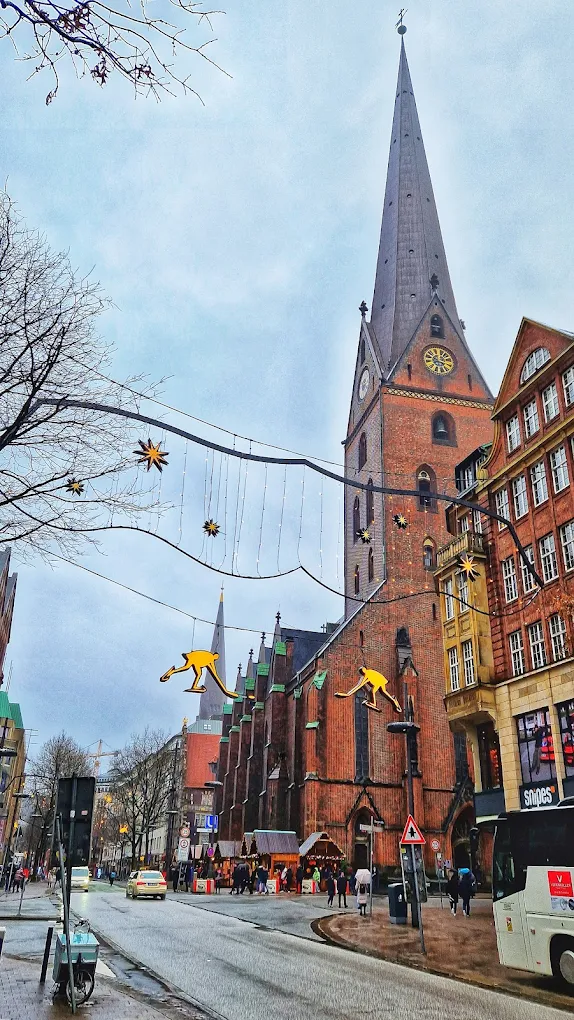
Hamburg does Christmas the way it actually lives, which is spread out into the neighborhoods, the church courtyards, the harbor, the beach bar.
The famous market in front of the town hall is only the front door. Locals barely go there. The real Hamburg Christmas, in my honest opinion, is in the back rooms.
And it’s absolutely stunning.
Let’s get the famous one out of the way
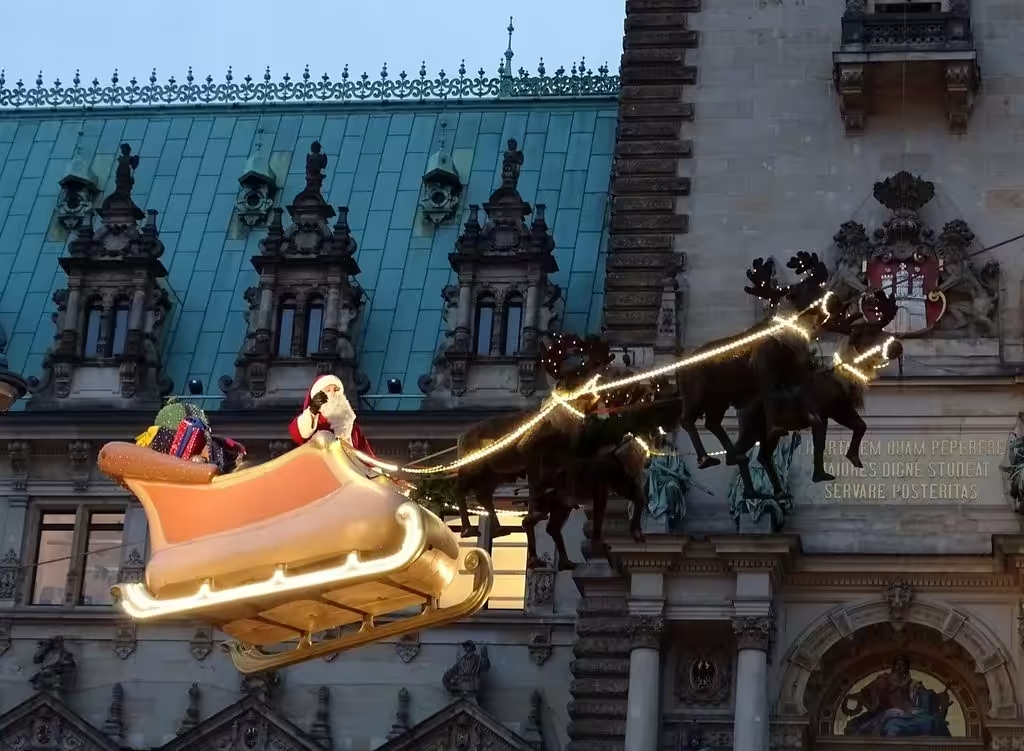
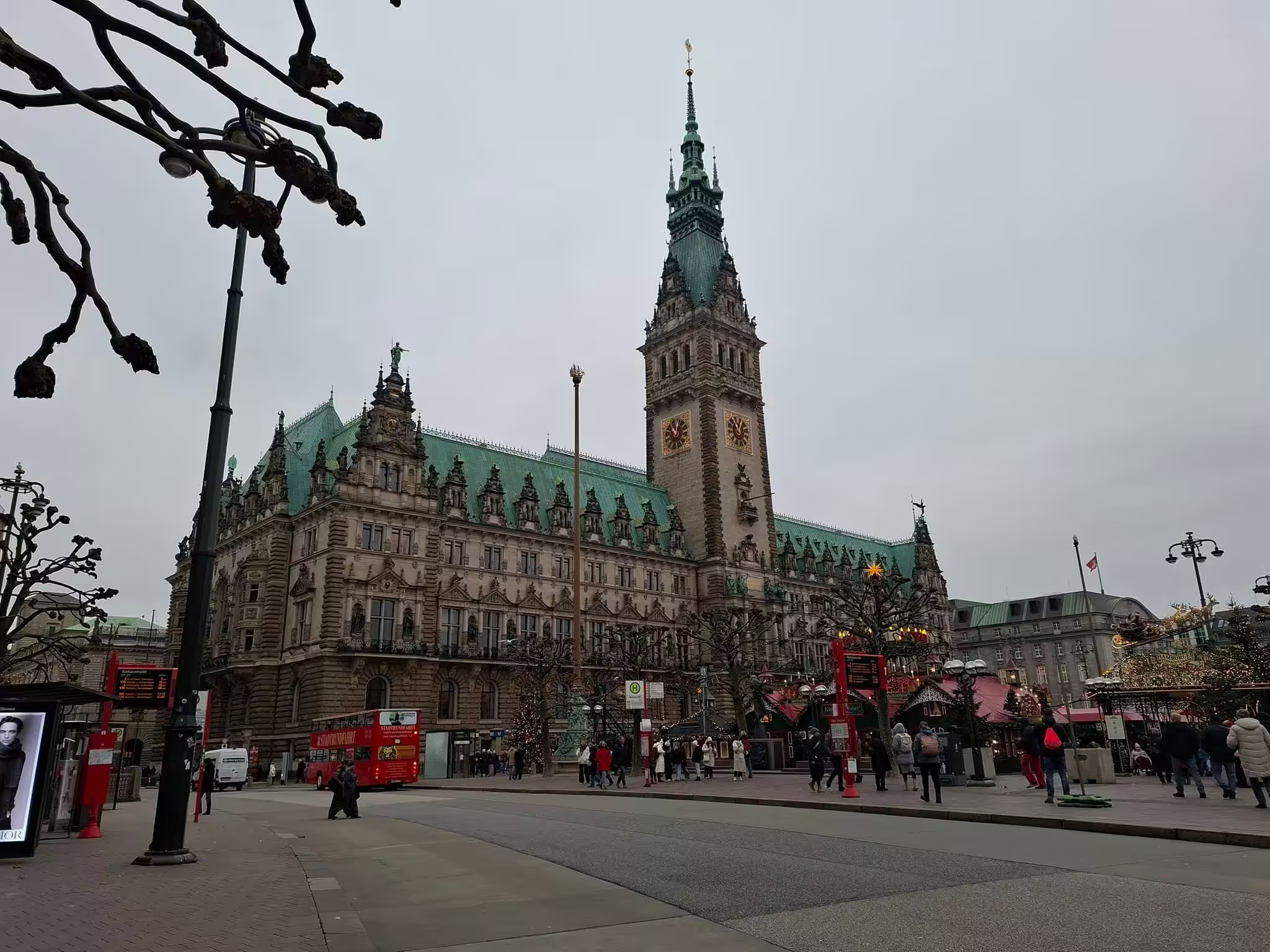
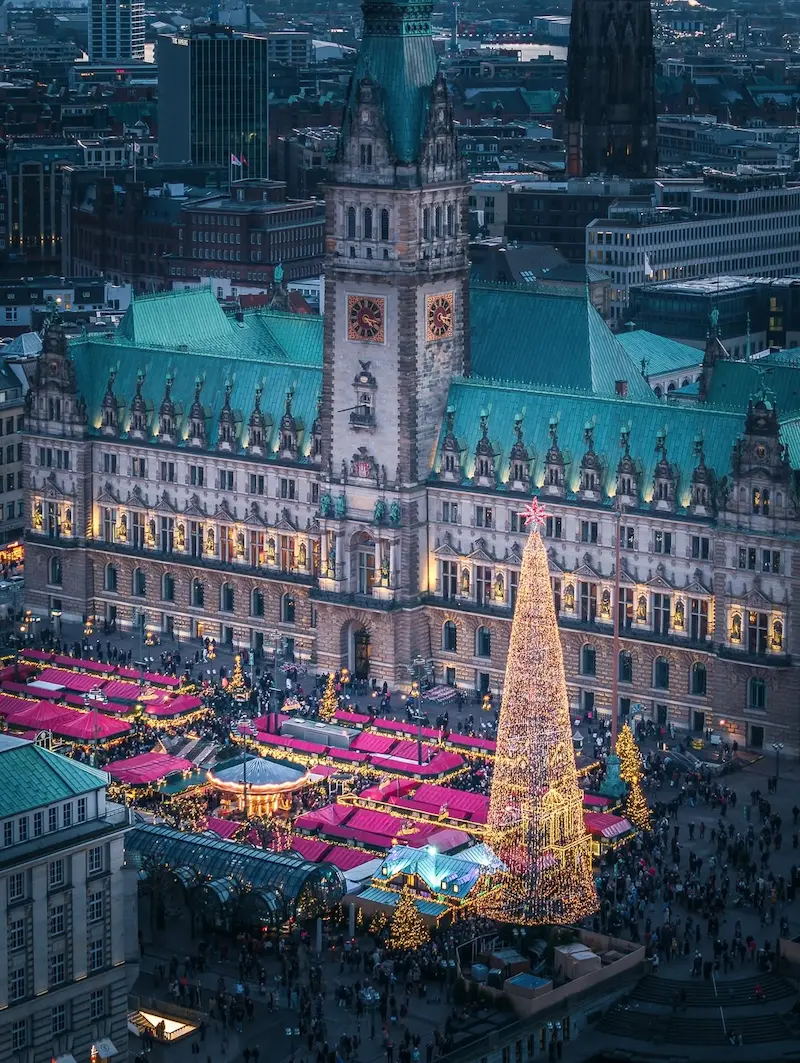
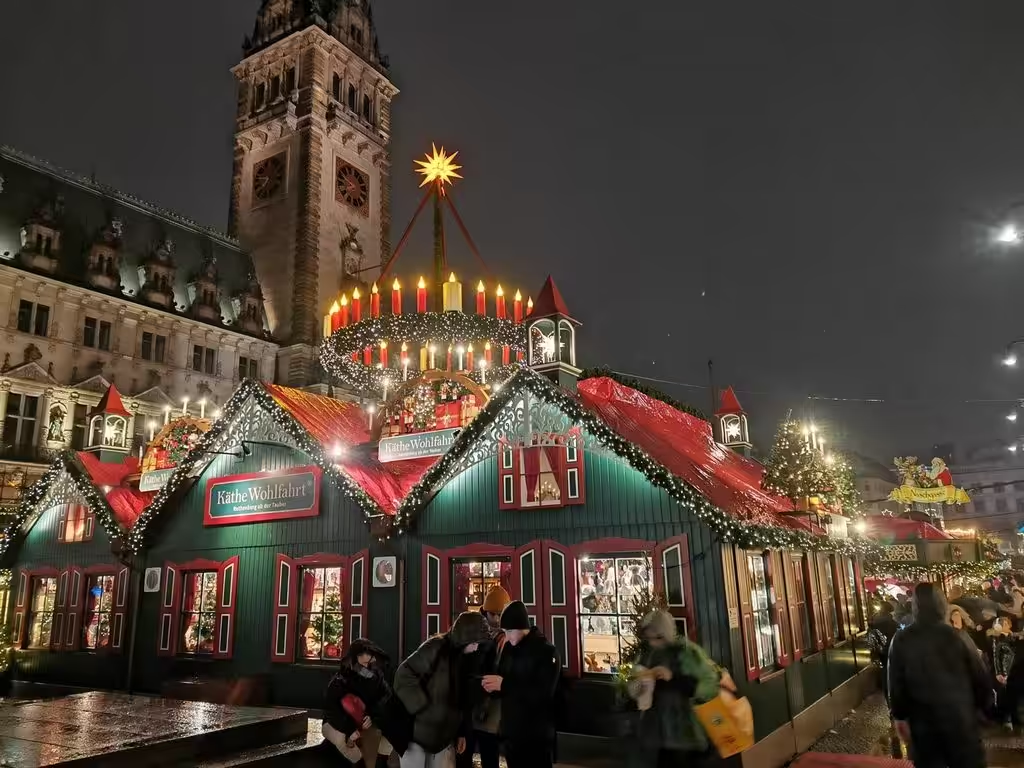
Yes, the market at the Rathaus is beautiful. The city hall behind it looks like a wedding cake built by people with too much money in 1897, and at night, with all the lights on, it absolutely delivers. You should definitely go and see it.
But also, know what you’re walking into…
Three million people visit this one market every season. And that’s why on a Saturday evening, it stops being a market and becomes a queue with stalls attached.
I’ve heard people describing being stuck, completely unable to move, for fifteen minutes, while trying to buy a single bratwurst. This is why locals don’t go there.
What makes this market stand out, however, is the Santa who flies across the square on a sleigh three times a night, at four, six and eight o’clock. He hovers over everyone’s heads and tells the story of Rudolf the reindeer. It’s completely ridiculous and everyone loves it.
On the specialty drink side, you have the glühwein, completely organic, made by a winemaker in the Pfalz with a recipe that exists only for this Christmas market in the entire Germany.
And some years the mugs have Ottifanten on them, which are little cartoon elephants drawn by Otto Waalkes, who is basically Hamburg’s national treasure. Locals collect these mugs and you should too.
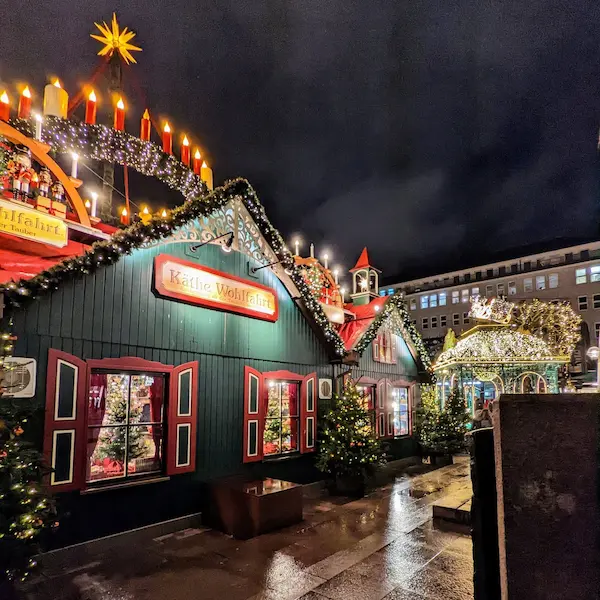
And then there’s the thing I still can’t believe is real. Hidden in the market are six little booths, rebuilt from the original interior of a legendary oyster restaurant that used to stand near the harbor.
The actual furniture where Peter Ustinov and Romy Schneider ate. You can reserve a table, sit in your own wood-panelled séparée, and eat oysters and drink champagne in the middle of a Christmas market. That’s how you do the famous market like someone who knows something.
For obvious reasons, try and go on a weekday, around three in the afternoon. See Santa fly, drink the wine, eat the oysters, and then leave before the evening crush.
Because the Hamburg you actually came for is somewhere else entirely.
The back rooms
So where do the locals actually go, if they rarely touch the famous market? The answer is the thing I find most charming about this whole city. They go to their own street.
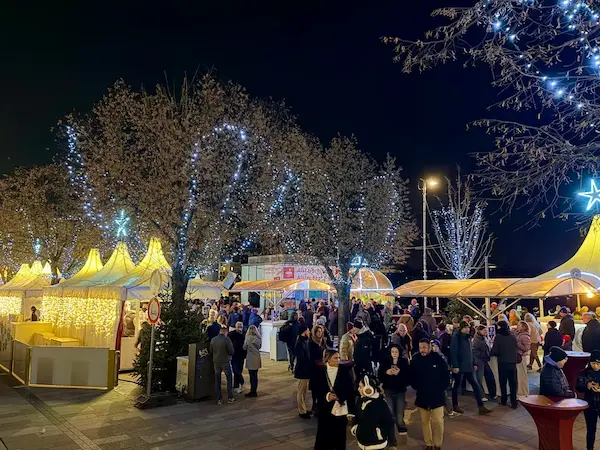
Hamburg’s neighborhoods each run their own little market in December, and I mean little. A church square, a few dozen huts, a bonfire. Nobody flies anywhere.
And these are the markets where you can feel the actual temperature of the city, because the people standing next to you aren’t visiting.
They live two streets over. They’re here every year. This is their living room.
In Eppendorf, for example, the whole thing revolves around a punch hut called the Glühwurm, and there’s a cardboard box where people drop off socks and chocolate and small gifts that later get handed out to homeless folks at Christmas.
In Eimsbüttel, on the other hand, they set up a covered campfire in front of the church, pour proper winemaker’s glühwein, and let the kids loose on a mini sledding hill.
Out in Bergedorf, the market sits in the courtyard of an actual moated castle, and somebody there sells Langos, the deep-fried Hungarian flatbread, which locals absolutely adore.
Ottensen is the one I recommend for food. Empanadas and other things from…everywhere basically.
If the thought of eating bratwurst for five straight days makes you tired, that’s your stop.
Then there’s the one I’d camp in. In the Schanzenpark, a scruffy cultural venue called Schrödingers runs what it proudly calls an anti-Christmas-market.
No Coca-Cola Santas, no kitsch, their words. There’s a fifteen-meter curling lane, table tennis, darts, giant Jenga, and everything’s free except the curling.
They also have a stamp card, and when your tenth glühwein comes up free, you can donate it instead, and it becomes a Christmas meal for someone who needs one.
Over the holidays they feed 1500-2000 people.
And because this is Hamburg, there’s also a beach bar doing Christmas. StrandPauli sits right on the Elbe facing the container cranes, and in winter it becomes a heated ski hut with curling lanes and fondue.
You eat kale with smoked sausage, which is the holy winter dish of northern Germany, and you watch thousand-foot ships slide past in the dark. Snow instead of sand, they call it. Hamburg is the only city I know where the beach club and the Christmas market are the same place.
The North looks back
Here’s a bit of history that you should know about.
For centuries, Hamburg was the hinge of the Hanseatic League, the trading network that ran northern Europe. Bergen, Stockholm, Copenhagen were the partners.
The city got rich selling grain and beer north and bringing stockfish south. And that memory is still in the bricks. And at Christmas, it comes out.
On a small street near the harbor called Ditmar-Koel-Straße, four churches stand almost shoulder to shoulder. The Swedish church, the Norwegian, the Finnish, the Danish.
The old seamen’s missions, built so sailors far from home had somewhere to go.
And for two weekends in November, each of them opens its doors and runs a little Christmas bazaar.
You can buy real Nordic food made by the actual congregations. Glögg, which is glühwein’s more interesting cousin. Handicrafts from home.
These markets are called God Jul, which just means Merry Christmas, and they are, no contest, the markets Hamburgers whisper to each other about.
However, there’s a big catch here. It only runs for two weekends in November and then they’re gone.
Which means that one of the more special things about Christmas in Hamburg is over before most people have even booked their flights.
If you take one piece of planning advice from me, take this one. If you can flex your dates at all, come in late November. Do God Jul, and everything else opens around you in the following days.
You get the secret thing first and the whole rest of the season as a bonus.
The Nordic thread doesn’t stop at the churches, either, by the way.
The market out in Barmbek styles itself as a Scandinavian Christmas village. The brand-new market in the Überseequartier does Nordic flair with Flammlachs, which is salmon nailed to a board and roasted by an open fire, and you can reserve these giant wooden barrels right at the water’s edge where they bring you fondue.
Even the market on Osterstraße, in a perfectly ordinary residential district, went Scandinavian. Nobody told them to, though, the city just leans that way!
So from what I observed, every German city south of here does Christmas the same way. The Erzgebirge wooden angels, the Nuremberg bratwurst, the same ornaments on the same stalls.
Lovely, and interchangeable. Hamburg is the only one that looks across the water and borrows Christmas from the Norwegians.
It’s the only major German market season with a genuinely different accent.
The City on the Water
Nearly every Christmas city has a tree in a square. It’s tradition…not for Hamburg though. Hamburg has one floating in a lake.
That’s the Alstertanne, a big lit-up Christmas tree moored out on the Binnenalster, the lake right in the middle of town.
Nobody I asked could fully explain why it’s there, however. It’s just there. That’s all the justification Hamburg thinks it needs.
Next to it, at the Jungfernstieg pier, five old Alster steamers tie up every November and become the Märchenschiffe. The fairytale ships.
This has been going since 1985, and it is the most Hamburg thing on this entire list.
Let me explain how it works, though. Two of the ships are baking ships. Kids from age three up go aboard, get a little apron and a baker’s hat, and make their own Christmas cookies.
Ten thousand kids do this every year, baking over a hundred thousand cookies out of five tons of dough. There’s a theater ship doing free shows all day, witches and mermaids and a magician with a suitcase.
There’s a face-painting ship.
And then, the stroke of genius, there’s a café ship, where the parents sit with coffee and cake and stare at the floating tree while someone else entertains their children.
For forty years, Hamburg moms and dads have used this as free childcare in the middle of Christmas shopping.
One more bit of real insider knowledge, because the tickets for the baking ships are precious. They’re handed out at a bronze globe sculpture inside the Hanse-Viertel shopping passage, starting at eight in the morning. Locals line up for them. You now know something most people wandering around Hamburg don’t.
The water theme keeps going, too. On December 5th, Nikolaus arrives at the Jungfernstieg with an ice princess, a day early, because Hamburg apparently can’t wait, and kids who recite a poem get presents.
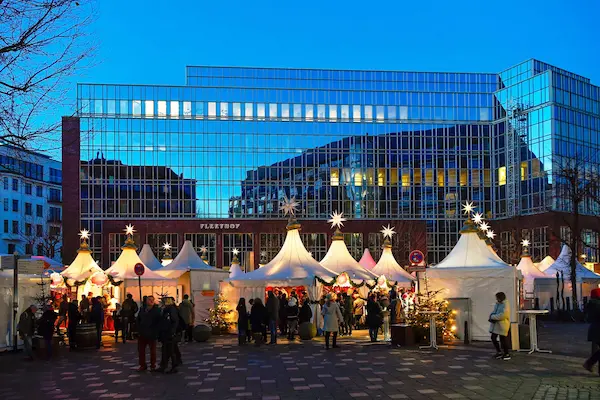
Down in the canals, the little Fleetweihnacht market sits on an island between two bridges, with a covered section built specifically for Schietwetter. That’s the local word for the weather Hamburg is famous for. I’ll let you translate it yourself.
And one Advent Sunday, they even put a market on the deck of the Cap San Diego, a museum freighter in the harbor, and serve something called Capt’n Glühwein with the Elbphilharmonie in the background.
Do you see the pattern? Other cities build their Christmas around a cathedral or a castle. Hamburg builds its around the harbor.
The Reeperbahn answers back
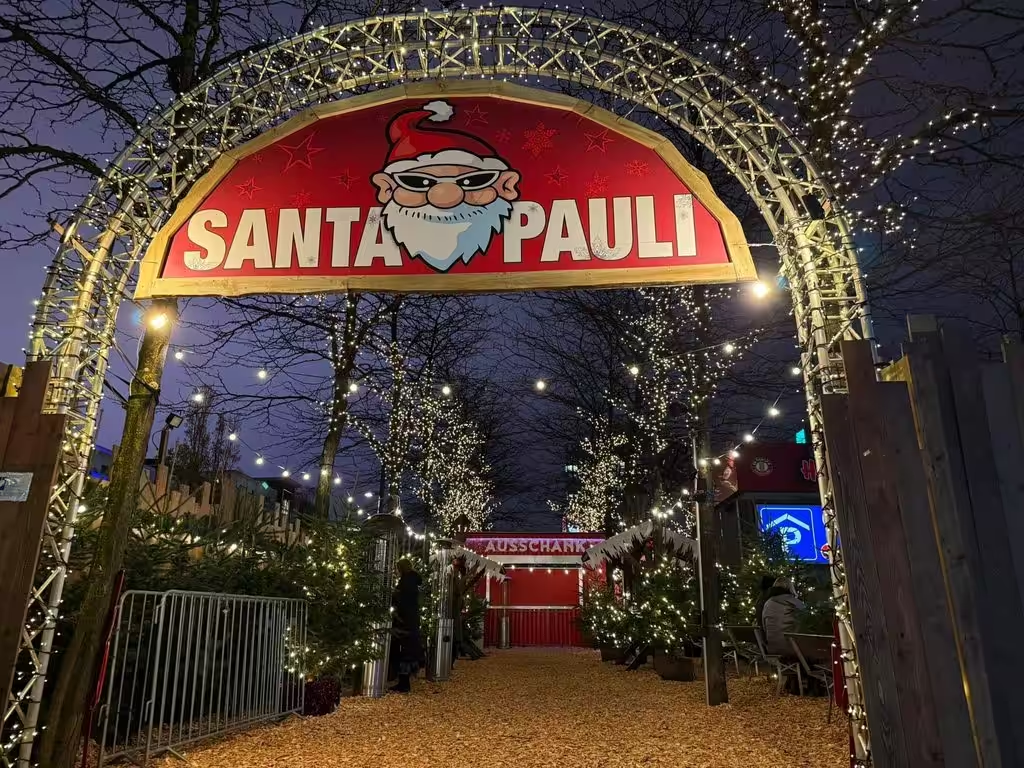
So, the same city that puts three-year-olds in baker’s hats also does this. In St. Pauli, on the square right off the Reeperbahn, there’s a Christmas market called Santa Pauli.
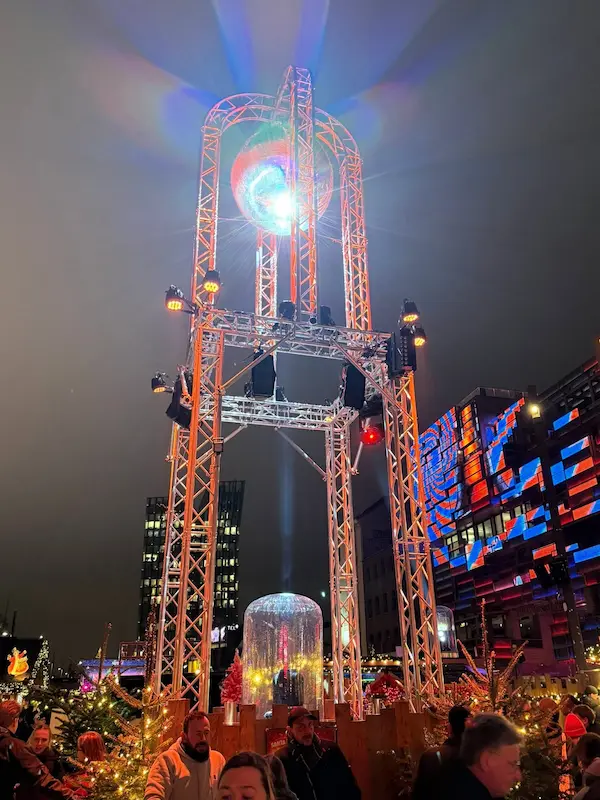
The sign at the entrance calls it “Hamburg’s horniest Christmas market,” and I want to be clear, that’s the official branding. It opens earlier than any other market in the city centre, runs until one in the morning on weekends, and has a fenced-off corner called the Ü18 Tannenwald, which I will leave to your imagination.
Thursday to Saturday, there are shows on the main stage at nine thirty, ten thirty, and eleven thirty, with dancers of every variety, and the crowd is exactly what you’d expect a crowd to be on the Reeperbahn at midnight in December.
Now here’s the part that surprises everyone, including me. It’s actually good.
Not in a “well, it’s an experience” way. In a genuine way. Because underneath the neon and the novelty, Santa Pauli has some of the best drinking in the whole season.
Locals don’t send you there for the shows. They send you there for two specific things.
One is the Glühweinapotheke, the glühwein pharmacy, where you mix your own custom glühwein like an alchemist with a drinking problem.
The other is a stall famous for its hot feta. There’s also the Winterdeck, a bar perched above the square with a fireplace, overlooking the whole glorious mess, serving hot cocktails with names like Bordsteinschwalbe. A curbside swallow. Poetic.
Okay, time to talk about eating, because Hamburg takes that seriously too.
Eating your way through Hamburg
Let me tell you a secret about German Christmas markets. The wooden toys are, for the most part, a lie. The ornaments, the candles, the hand-carved whatever, half of it comes from the same wholesalers, and everyone knows it.
The food is the point, however. That’s no lie.
First, and above everything, Schmalzkuchen. Little fried dough pillows, served hot, buried in powdered sugar.
This is the taste of Hamburg Christmas. You’ll find them everywhere, they’ll burn your fingers, and you’ll be thinking about them in March.
Second, the sausage, and here Hamburg is opinionated. The standard order is a Krakauer with bread and mustard.
Third, and this is the big one, the kale. Remember the stranger at the bonfire I mentioned? This is what he was on about. Grünkohl, curly kale cooked down with smoked sausage, is the sacred winter dish of northern Germany, and kale season is a genuine regional obsession.
Families make ritual trips out to the countryside for it. And in December it shows up at the markets, at StrandPauli, at the neighborhood squares, in vegan versions in Barmbek…. If you want to eat the single most northern German thing that exists, this is it.
Then there’s the harbor talking, of course, because this is Hamburg after all.
Fischbrötchen, the fish sandwich, shows up at markets here the way it never would in Munich, because this is a port and herring on a bun is a birthright.
And the Nordic thread continues with Flammlachs, salmon roasted on a board by open fire, which smells so good it should be illegal to walk past.
For the show with your drink, find the Feuerzangenbowle. They put a rum-soaked cone of sugar over a pot of mulled wine and set it on fire, and it drips, flaming, into the wine below. Gänsemarkt made its name on it, though you can find it around now. It tastes like Christmas with a head start.
The point is, come hungry and graze. That’s how the whole thing is designed.
The fine print
Now the traps, and the first one is calendar-shaped and has ruined real holidays.
Almost every market in Hamburg closes on December 23rd.
If you book the classic trip between Christmas and New Year, you will arrive to a beautiful, festive, completely shut city, and I will feel personally responsible.
Come in the first three weeks of December or at the end of November as I mentioned earlier.
A handful of markets limp on past Christmas, like Bergedorf, Harburg, Barmbek, Osterstraße, Eppendorf and HafenCity, and Wandsbek’s Winterzauber keeps going until 1 January, but by then the party’s mostly over.
Second trap. Totensonntag, the Sunday of the Dead, a somber national memorial day. In 2026 that’s November 22nd, and markets either close completely or open late in the afternoon.
Third, the daily rhythm. The golden window is a weekday between 2 and 5pm. Lit up, atmospheric, and you can still move your arms.
Saturday evening is a contact sport. And here’s the sneaky one: the first two or three days after any market opens are the quietest it will ever be. Everyone waits for mid-December and then complains about the crowds.
Fourth, the weather. It’s Hamburg. There’s a local word for it, Schietwetter, and it means exactly what your instincts tell you it means. Damp, windy, somewhere around freezing, snow a bonus rather than a promise.
Waterproof shoes matter more than a cute coat, because you’ll be standing and leaning all night. There is basically no seating at German Christmas markets. Your feet are the furniture.
The Loose Ends
A few things that I couldn’t fit anywhere else into this piece, but I think everyone should know about them.
- The Winterwald, the forest market on the shopping street, has a singing angel. Twice a day, a curtain opens five meters above the stalls and an actual angel sings carols over the crowd.
- The white tent market on the Jungfernstieg has fancier, pricier goods than the others, and it also has a bakery for dogs. A Hundekuchenbäckerei. Little bone-shaped biscuits that say Good Dog.
- There’s a market in the Stadthöfe courtyards called Marché de Noël that went full champagne bar. Copper mugs, raclette, and a bio rosé glühwein, which sounds like it shouldn’t work and does.
- There’s an LGBTQ+ market called Winter Pride on Lange Reihe that’s a ghost town at four in the afternoon and the right kind of alive at night.
- The Hamburger DOM runs its winter funfair through November into early December. Two hundred fifty showmen, rollercoasters, fireworks every Friday. Nobody puts it in the Christmas guides because it’s technically a fair, which is exactly why it’s great.
- There’s a Christmas parade through the city center on the four Advent Saturdays, at two and five.
- And out on a country estate called Gut Basthorst, there’s a weekend-only market with 300 exhibitors that keeps getting voted one of the prettiest in Germany. It’s the only one that charges entry, eight euros, and the locals pay it happily.
The day trips
Here’s an awkward truth. Ask north Germans about Hamburg’s Christmas markets, and a decent number of them say, go to Lübeck instead.
They’re not exactly wrong to say it. Lübeck is only 45 minutes away by train, the whole old town is a UNESCO site, it’s the marzipan capital of the world, and its market has a magic-to-tourist ratio that makes people emotional.
The smartest play is not to choose between the two. Do both instead. Hamburg is the base, Lübeck is the day trip, and you get two completely different Germanys for one flight.
Lüneburg is the quieter suggestion, a gorgeous little town that comes up in the same conversations, and Bremen is an hour away if you want a third market city just because you can. You can’t lose. The train does all the work.
The verdict
So. Should Hamburg be your Christmas market trip?
If you want the storybook, the single perfect medieval square, the snow-globe town, go to Rothenburg or Nuremberg. They do that better than anyone and there’s no shame in it. If you want grandeur and waltzes, go to Vienna.
But if you want a city that doesn’t perform Christmas and instead just does it, in church courtyards and on boats and under harbor cranes and next to a fireplace above the Reeperbahn, come here.
Hamburg is for people who’d rather find the glühwein pharmacy than the giant Christmas tree. Who’d rather eat kale with strangers at a bonfire than queue for the famous photo. Who want their trip to have a pulse.
Go in late November if you can, catch the Scandinavian church bazaars before they vanish, and give yourself three or four days.
See Santa fly over the Rathausmarkt once, eat oysters in the séparée, then leave the famous market to the crowds and go live in the back rooms.
Bake cookies on a ship. Mix your own wine. Hunt the Langos in Bergedorf like a rare bird. Stand on the beach with fondue and watch the ships go by.
Lower the storybook expectation. Raise the wandering expectation. And Hamburg will become the one you tell everyone about.