The Dortmund Christmas market runs from Thursday 19 November to Wednesday 30 December 2026.
That end date matters more than it looks, trust me, because most of the big markets in this part of Germany shut on 23 December and here we have Dortmund keep going for another week, Boxing Day included.
On a normal day it’s open from 11:00 to 21:00 Monday to Thursday, 11:00 to 22:00 on Fridays and Saturdays, and 12:00 to 21:00 on Sundays.
The Glühwein and food stalls usually stay open up to an hour after that, so you can still get a drink when the craft stalls are closing up..
As for specific dates, there are two dates in November that you need to watch.
The market is closed on Sunday 22 November, which is Totensonntag, the German day for remembering the dead.
People also call it the Remembrance Sunday and in places still shows 23 November, which was last year’s date, so don’t let either of those throw you.
The second date is the tree. Dortmund always switches on its giant tree the day after Totensonntag, which makes it Monday 23 November this year, and for the last few years the lights have gone on at 18:00.
The stalls open a few days before the lighting, so if you come on 19, 20 or 21 November you get the market with the tree standing there dark, which is a bit like going to Blackpool before the illuminations.
On Christmas eve, the working time is pretty short. Only some stalls open, from 11:00 to 14:00, and Christmas Day is closed.
Then it’s back on Boxing Day from 12:00 to 21:00 and open every day until it closes for good on the 30th.
| Date | What’s happening |
| Thu 19 Nov | Market opens, tree not lit yet |
| Sun 22 Nov | Closed for Totensonntag |
| Mon 23 Nov | Tree switched on in the evening (18:00 in recent years) |
| Sun 6 Dec | Shopping Sunday, so the shops open and the centre gets packed |
| Thu 24 Dec | Some stalls only, 11:00 to 14:00 |
| Fri 25 Dec | Closed |
| Sat 26 Dec | Open again, 12:00 to 21:00 |
| Wed 30 Dec | Last day |
What the Christmas Market in Dortmund Is Really Like
Dortmund doesn’t do pretty, in my opinion (no offense Dortmund). But It does big, cheap and late, and if you know that going in, you’ll enjoy it a lot more.
The city centre was bombed so heavily in the Second World War that more than 90 per cent of it was destroyed, and what went back up is a modern shopping district.
The old churches, St Reinoldi, St Marien and the Petrikirche, were rebuilt and they’re the landmarks the market wraps itself around, but there are no half-timbered streets or crooked cobbled lanes here.
The stalls spread through the pedestrian shopping streets and squares of the centre, so you’ll be drinking your Glühwein outside clothes shops and department stores.
Some people find that a letdown and I can understand that. I think it’s just honest, and the upside is that the whole centre turns into the market instead of one pretty square with a queue to get in.
It’s properly big, too. The organisers count more than 250 stalls on ten squares, and in 2024 more than 60 per cent of them sold something other than food and drink, so there’s more here than a long line of sausage huts.
Also, about 2.5 million people visited in 2024, according to the city, which tells you all you need to know about Saturdays (don’t go on a Saturday, got it)?
The thing that surprises most people is that there’s no background music on a Christmas market in Dortmund. The organisers keep the squares free of piped Christmas songs on purpose, and visitors are split right down the middle on it.
Some people love an evening without the same ten songs on loop, and others find it a bit flat.
Locals have a funny relationship with the whole thing anyway. Every year they complain it’s too commercial, too expensive and that the tree is fake, and every year they all turn up.
If you’ve read older guides telling you to go to the medieval Christmas market in Fredenbaumpark, that one’s gone.
It last ran in its old form in 2023, so don’t build a trip around it.
The 45-Metre Tree on Hansaplatz
The tree is the reason most people come, and I’d say it’s worth the trip on its own.
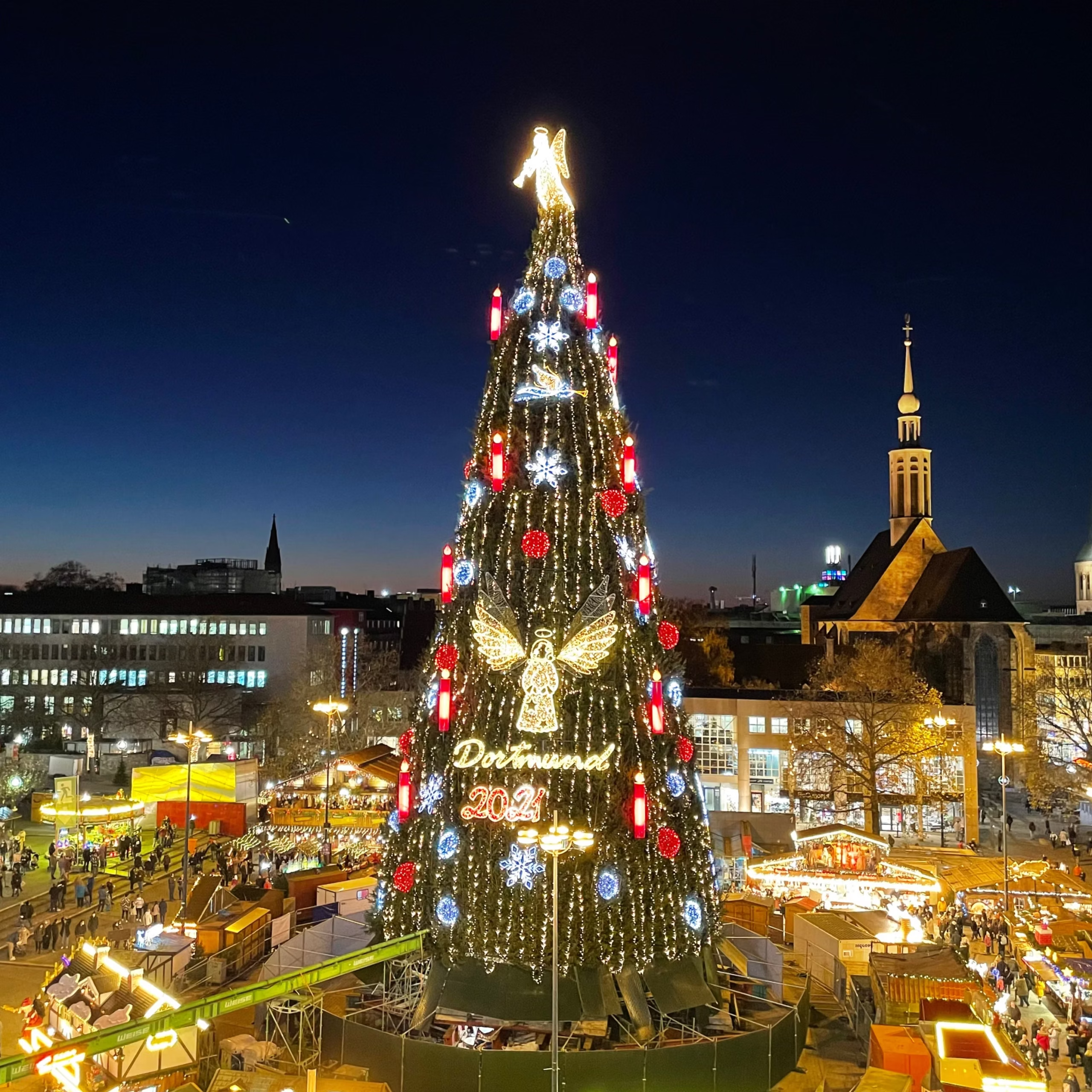
It stands 45 metres tall in the middle of Hansaplatz, and it isn’t one tree.
It’s about 1,200 spruces from the Sauerland hills, grown for the job and fixed onto a steel frame, with a 4-metre angel on top.
The whole thing weighs around 40 tonnes, carries 138,000 LED lights and takes about four weeks to put together. Dortmund has built it every year since 1996.
The organisers call it the biggest Christmas tree in the world, and that’s where you need a pinch of salt.
This is because it’s made of lots of smaller trees, so the title of the biggest depends on how you count.
Guinness lists a 72-metre artificial tree in Sri Lanka as the largest artificial one, and the hillside of lights at Gubbio in Italy has its own Guinness title, and I couldn’t find any Guinness listing for Dortmund.
But stand underneath it and you won’t care about the Guinness record anyway.
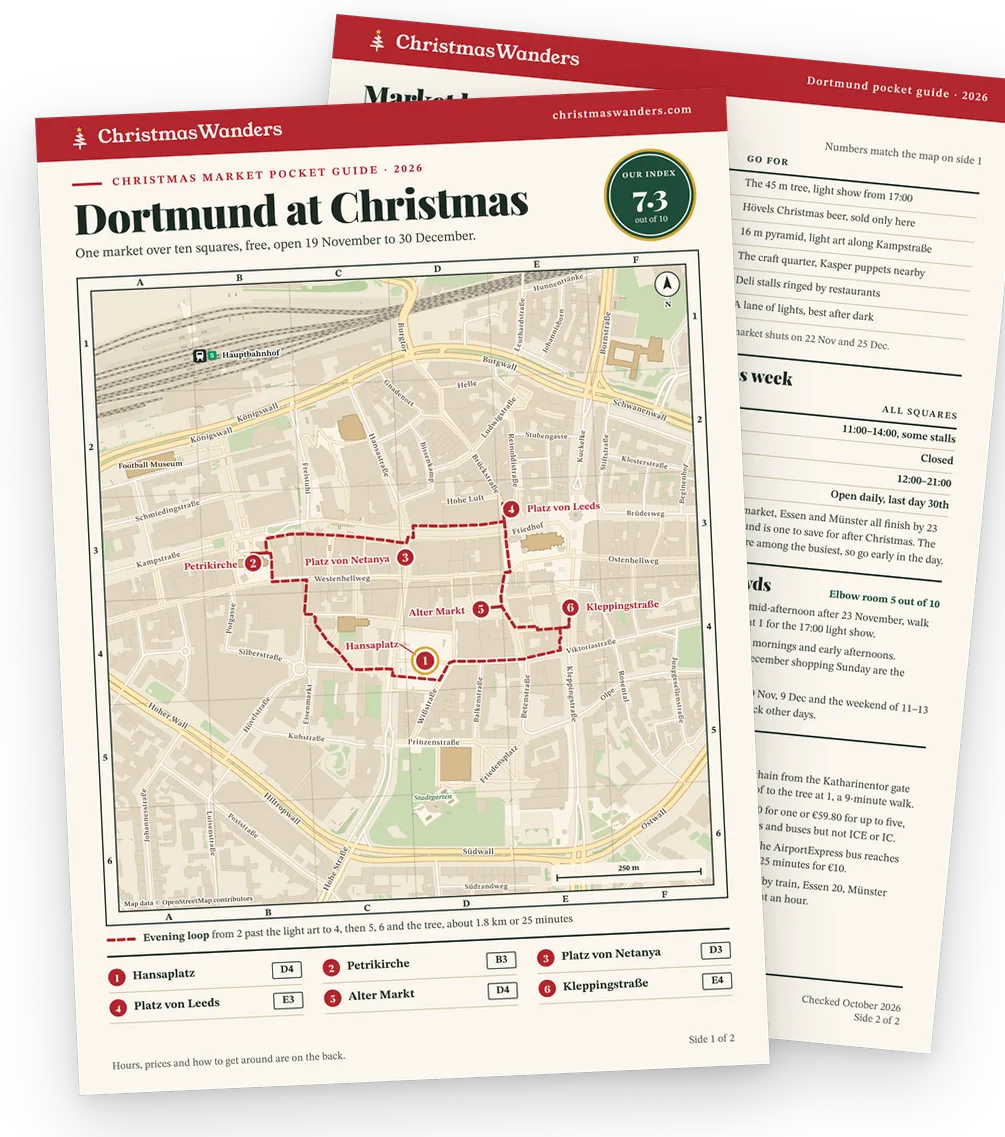
The Squares, in the Order to Walk Them
The market starts almost the second you leave the train station.
Cross over to the Katharinentreppen steps opposite the main exit and you walk in under the Katharinentor, a lit-up gate the organisers put there to welcome people off the trains.
At the bottom of Katharinenstraße you pass the Petrikirche, with stalls on both sides of the church.
It’s the only place selling the Hövels Christmas beer, and it’s where I’d finish, so keep walking for now.
Turn onto Kampstraße and you’re into the light art.
The organisers call it the Dortmunder Zeitreise, a time trip through the city’s history in big light sculptures.
There’s a Hanseatic trading ship, a pithead tower and a miner, a steelworker, a horse-drawn beer cart and a flock of pigeons affectionately called the Ruhrpott flamingos, a nod to the pigeon racing that was hugely popular with the Ruhr’s miners.
Last year there was also a giant DORTMUND sign you could sit in for a photo, right inside the O.
Halfway along Kampstraße is Platz von Netanya, with a 16-metre Christmas pyramid.
Keep going to the end of Kampstraße and you reach Platz von Leeds, named after Leeds, which has been Dortmund’s twin city since 1969.
It’s home to the craft quarter and the Ferris wheel, which was 50 metres tall in 2025, a bit taller than the tree, with closed gondolas and step-free access.
Kids will want the Kasper puppet theatre in the old house on the north side of the Reinoldikirche, a free Punch and Judy style show that runs in any weather.
Right by the church is the Märchenwald, a little fairy-tale forest, and a path from there takes you onto the Alter Markt, the old main square, with food and deli stalls in the middle and restaurants all the way round.
From the Alter Markt, Brauhausstraße leads to Kleppingstraße, which the market turns into a lane of lights running down to Willy-Brandt-Platz.
It’s worth the detour after dark. Then head for Hansaplatz and the tree, which is where the crowd is thickest and where you’ll find the children’s Christmas village and the magic theatre tent on the steps at the south side.
From Hansaplatz it’s a short walk back along the shopping streets to the Petrikirche for that Hövels beer, and from there you’re a few minutes from the station, which makes it the perfect last stop before your train.
Walking the whole loop at an easy pace takes about two hours, and longer if you stop at every Glühwein hut, which you should.
What It Costs
The Glühwein in Dortmund is cheap for a market this size, even if the food is normal market prices.
A mug cost €3.50 in 2025, the same as it’s been since 2023, while Cologne’s cathedral market and Düsseldorf were charging about €5. Add a shot and it’s €5.50.
You also pay a €3.50 deposit on the mug, which you get back when you hand it in.
Dortmund, like nearly every other German city, brings out a new mug design every year and people collect them, so plenty of visitors just keep it as a souvenir.
They do run out, often by the third Advent weekend, so if you want one, don’t leave it until the week before Christmas.
| What | Price in 2025 |
| Glühwein | €3.50, or €5.50 with a shot |
| Mug deposit | €3.50 |
| Reibekuchen, 3 pieces | €5 |
| Bratwurst | €4 to €4.50 |
| Currywurst | €4.50 |
| Fried mushrooms | €7 |
| Crêpe | from €4 |
| Roasted almonds, 100 g | €4 |
| Christmas village for kids | €2.50 |
| Toilets | 70 to 80 cents |
More and more stalls take cards, and in 2025 the Bergmann beer stall took cards only, but plenty of huts still want cash, so keep a few euros in your pocket for the small stuff.
Reibekuchen, Grilled Ham and Dortmund Beer
The food here is Westphalian, filling and not remotely fancy, which is exactly what you want at 7pm in December.
The first thing I’d eat is Reibekuchen, crispy potato fritters that come three to a portion, usually with apple sauce, and there’s a stall for them on Hansaplatz by the tree.
After that, go for Westphalian Grillschinken, ham grilled on the joint and carved into a roll for about €7.
The rest is the usual German market lineup, with bratwurst, currywurst, crêpes, roasted almonds, chimney cake and fried mushrooms.
If you’re vegetarian, vegan or gluten-free, the stall plan on the official website marks the stalls that cater for you, though the big grill stalls didn’t have a veggie sausage between them in 2025.
The drink that makes Dortmund different is beer. This was one of Europe’s great brewing cities, and in the 1950s and 60s its breweries overtook Munich and made Dortmund the biggest beer producer in Europe.
Dortmunder Export, the pale lager first brewed to travel, comes from here.
You’ll see that history in the light sculptures, and you can drink it at the market.
Hövels, a city-centre brewpub on the spot where a brewery was founded back in 1854, makes a Christmas beer every Advent just for the market.
It’s a 4.9 per cent copper-coloured beer with a toasty edge, it’s only sold at the stand by the Petrikirche, and you can buy it in a swing-top jug to take home, which beats a fridge magnet.
Bergmann, an old Dortmund brand that was brought back in 2007, had its own stall on Kleppingstraße in 2025.
If you’d rather drink sitting down, the Hövels brewpub itself is on Hoher Wall, a short walk from the Petrikirche, and Bergmann runs a little 1950s kiosk bar further along the same road.
The one local dish you’re unlikely to find on the market is Pfefferpotthast, a Westphalian beef and onion stew, heavy on the pepper and thickened with breadcrumbs, that was first recorded right here in Dortmund.
In 1378, so the legend goes, a woman called Agnes von der Vierbecke sent the town gatekeeper off to fetch a pot of Pfefferpotthast so that the city’s enemies could get in through the unguarded gate.
The plot failed, and it didn’t end well for Agnes. For a bowl of it, try Zum Alten Markt, the traditional restaurant on the Alter Markt, which has had it on the menu, though it’s worth checking before you go.
When to Go
Weekdays are the easy time, like for every other popular Christmas market.
The organisers say families get the quieter mornings and early afternoons, and the evenings fill up with people coming straight from work.
Thursday and Friday evenings are busy, Saturdays are very busy, the shopping Sunday on 6 December pulls in shoppers on top of the market crowd, and BVB home match days add thousands of football fans to the mix.
The busiest stretch of the whole season is the run-up to Christmas and the days straight after it.
If I were planning it, I’d pick a weekday in late November or early December, once the tree is lit on the 23rd.
Get there mid-afternoon, walk the squares while you can still move, and be on Hansaplatz as it gets dark, which in December is around half past four, so you’re there for the first light show at 17:00.
Then eat, drink and do the lane of lights on Kleppingstraße once it’s properly dark.
Christmas week is where Dortmund earns its place.
Because it reopens on Boxing Day and runs until the 30th, it’s one of the bigger markets you can still visit between Christmas and New Year.
Cologne’s cathedral market, Essen and Münster all finish by 23 December, while Dortmund, Düsseldorf and Duisburg keep going to the 30th and a couple of Cologne’s smaller markets carry on into January, so this corner of Germany is one of the best places to be if you can only travel after Christmas.
Just don’t expect it to be quiet.
Also, make sure you pack for rain and not snow. Dortmund averages about 5°C in the day and 1°C at night in December, it rains a lot, and snow on the ground is rare enough that you shouldn’t count on it.
Football, Kids and the Rest of December
Dortmund is a football city before it’s anything else, and when Borussia Dortmund play at home the centre fills up with yellow and black.
During the 2026 market BVB are at home to Bayer Leverkusen on Sunday 29 November at 19:30, to Inter Milan in the Champions League on Wednesday 9 December, and to Augsburg on the weekend of 11 to 13 December.
A cup game on 1 or 2 December is possible too, depending on how they get on in the round before.
If you can get a ticket, a match and the market make a brilliant weekend, and your match ticket also covers your trip to the stadium and back on buses, trams and regional trains from anywhere in North Rhine-Westphalia.
If football isn’t your thing, pick another day. Stadium tours don’t run on match days or the day before, but the German Football Museum sits right opposite the main station and makes a good rainy afternoon.
A ticket is €19, and it’s closed on 24, 25 and 31 December and 1 January.
For kids, Dortmund does a lot for free.
Last year there were magic shows in the theatre tent on Hansaplatz every afternoon, the Kasper puppet shows by the Reinoldikirche, and a scavenger hunt called 10 Plätze, 10 Fragen.
That’s ten squares and ten questions, and kids collect the answers around the market and pick up a small prize from the events stand on the Alter Markt.
Apart from the rides, the main thing you pay for is the Christmas village on Hansaplatz, where children aged four and up bake and make crafts with Father Christmas and his elves for €2.50.
In 2025 Emma, the BVB mascot, dropped in on Monday afternoons, which went down about as well as you’d imagine.
Outside the market, Westfalenpark puts on Winterleuchten, a ticketed light trail through the park, from 5 December 2026 to 3 January 2027, open from 17:00 every evening except Christmas Eve and New Year’s Eve.
In the centre, the Reinoldikirche plays free organ music on Tuesdays and Thursdays at 16:00 from late November until just before Christmas, which is a nice way to warm up for half an hour, and the Dortmund Bach Choir sings Bach’s Christmas Oratorio there on 12 December.
And look up at the Dortmunder U, the old brewery tower near the station, where 1.7 million LEDs on the roof show short films from early morning until midnight, with a flock of doves flying across it on the hour.
Dortmund as a Base for the Ruhr
The best reason to give Dortmund more than one night is everything around it.
The Ruhr is a string of cities joined up by fast, frequent regional trains, and Dortmund sits at the eastern end as one of the region’s big rail hubs, so you can do a different market every evening and sleep in the same bed.
Bochum is only about ten minutes away.
Its market runs from 19 November to 23 December, and the thing to see is the Flying Santa, a man in a sleigh who flies along a high wire 33 metres above the square at 17:00 and 19:00 every day.
Essen is about 20 minutes, with its International Christmas Market from 13 November to 23 December and the Essen Lichtwochen, a free festival of light that fills the city centre from late October to 2 January.
While you’re there, the old Zollverein coal mine, which is a UNESCO World Heritage Site, turns part of its coking plant into a 150-metre ice rink from 5 December, and skating past the old coke ovens is about as Ruhr as it gets.
If Dortmund’s shopping streets leave you wanting gables and church spires, go to Münster.
It’s about half an hour away by fast train and has six small markets spread through a proper old town, most of them running from 23 November to 23 December.
For half-timbered houses, Hattingen is the one.
It takes about 45 minutes with a change, its market runs from 23 November to 22 December, and from 1 December Frau Holle shakes out her feather pillow from the old town hall window at 17:00 every day, which in German folklore is what makes it snow.
Further out, Düsseldorf is about an hour away and Cologne about an hour and ten minutes by ICE, and both have their own guides on this site, if you want to check them out.
For a day of hopping, the 24hTicket NRW is the one to buy.
It costs €39.80 for one person or €59.80 for up to five, and it covers 24 hours on all the regional trains, trams and buses across North Rhine-Westphalia.
It doesn’t cover ICE or IC trains, so you’ll take the slower regional trains to Münster and Cologne.
Getting to Dortmund from the UK is easy, too. Wizz Air flies daily from Luton to Dortmund in about 70 minutes, and the AirportExpress bus gets you to the main station in about 25 minutes for €10.
So, Is the Dortmund Christmas Market Worth It?
Yes, as long as you know what to expect.
The Dortmund Christmas market is a big, late-running city market with cheap Glühwein and a 45-metre tree in the middle, and it doesn’t pretend to be a fairy tale.
If you want a cathedral, cobbles and a postcard old town, Cologne does that better, and Münster is the prettier town half an hour up the line.
It is also the easiest base for a few nights of market hopping around the Ruhr. It suits value hunters, families, football fans and anyone who can only travel after Christmas.
It won’t suit you if the old-town setting is the whole point.