The Frankfurt Christmas market runs from Monday 23 November to Tuesday 22 December 2026.
It’s open from 10:00 to 21:00 Monday to Saturday and from 11:00 to 21:00 on Sundays, and like almost every German Christmas market it’s free to get in.
In recent years it has opened on the Monday after Totensonntag, the Sunday when Germans remember their dead, which falls on 22 November this year.
The end date is the one to watch. The market closes on the 22nd, two days before Christmas Eve, and nothing is open on the squares over Christmas itself, so if you’re planning a trip for Christmas week, you’ll miss it.
The good news is that most of the 2026 programme is already out, so you can plan around it.
| When | What’s on |
| Tuesday 3 November | The tree arrives on the Römerberg |
| Monday 23 November, early evening | Opening ceremony on the Römerberg stage, with the Frankfurt Opera’s Christmas concert, the carillon of St Nicholas Church at 17:05 and the Lord Mayor’s speech at 17:10 |
| 24 November to 20 December | Artists’ Christmas market inside St Paul’s Church, free |
| Opening night, then Wednesdays and Saturdays, 18:00 | Brass players on the gallery of St Nicholas Church |
| Saturday 28 November, 16:30 to 17:00 | The Grand Bell Ringing, 50 bells in 10 churches |
| 4 to 21 December | Second part of the artists’ market, in the Römer town hall, free |
| Sunday 6 December, 17:10 | St Nicholas on the Römerberg stage |
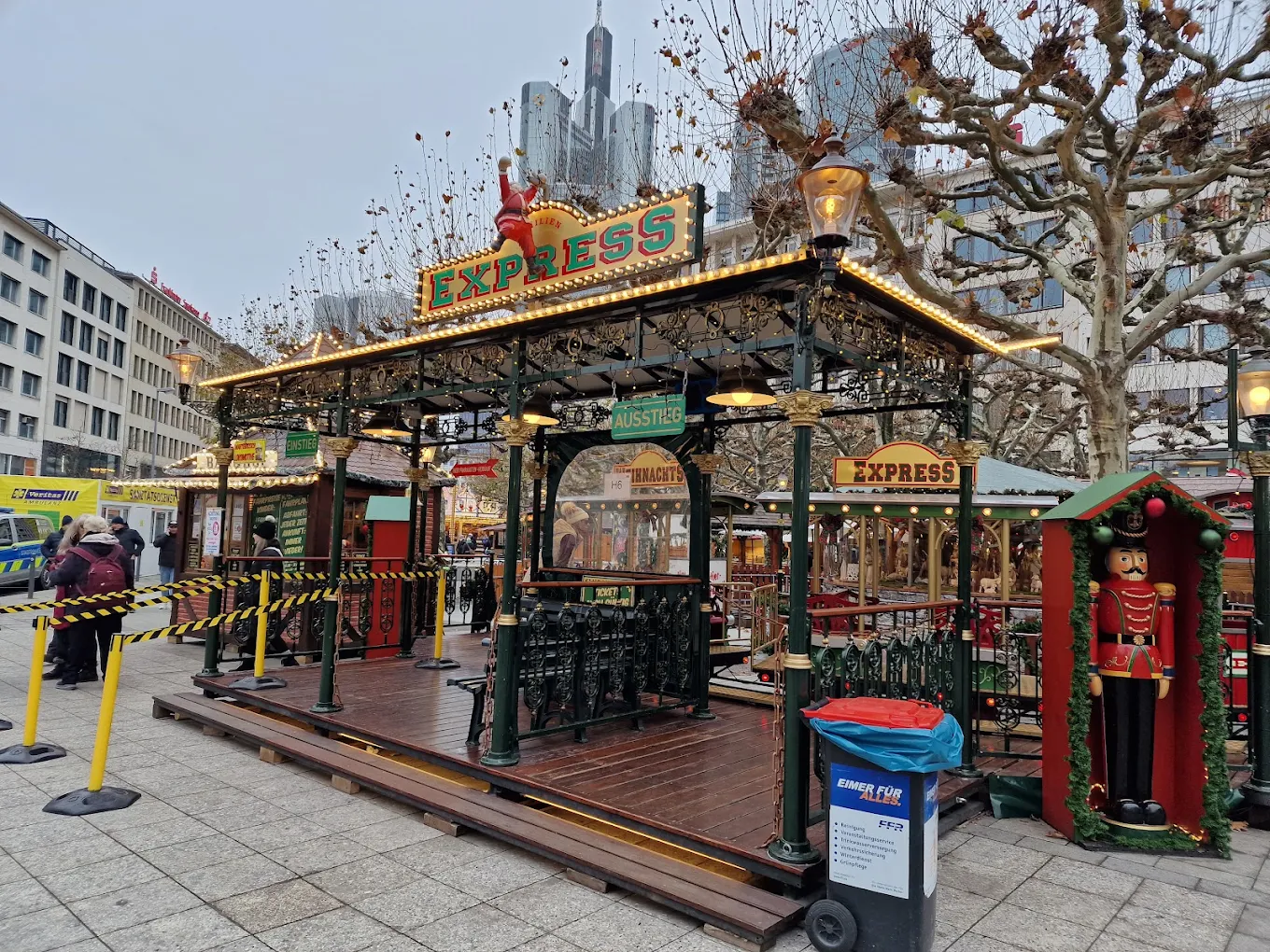
| 12 and 13 December | Christmas rides on a historic train from the Eiserner Steg |
| Tuesday 22 December | Last day |
| Thursday 24 December, 17:00 to 17:30 | The bells ring again for Christmas Eve, after the market has gone |
The Walk From the Skyline to the River
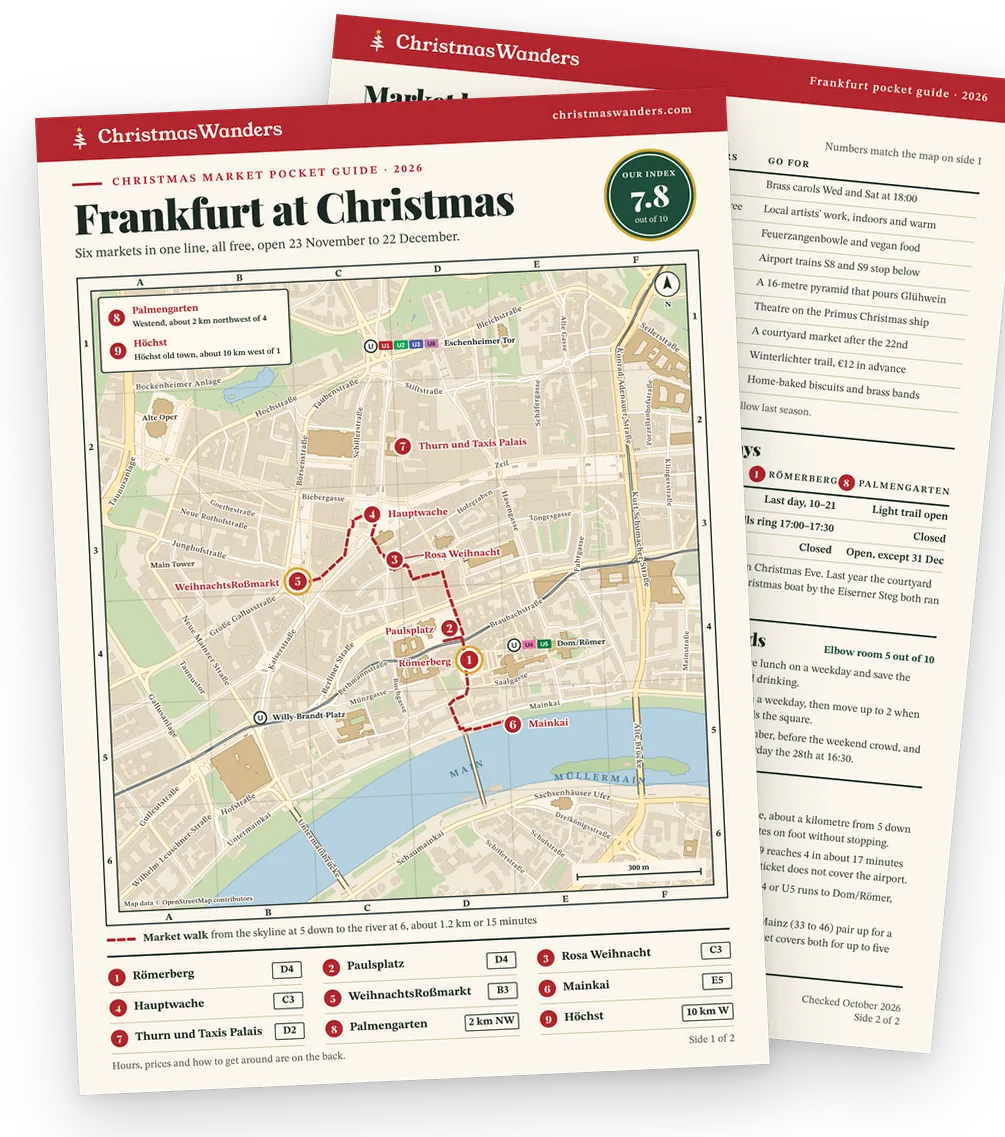
Frankfurt has six Christmas markets, strung together through the city centre with more than 230 stalls between them, and the best way to see them is to walk the whole thing from north to south.
You start under the glass towers of the banking district and finish on the bank of the Main. It’s about a kilometre end to end, and the stalls go all the way.
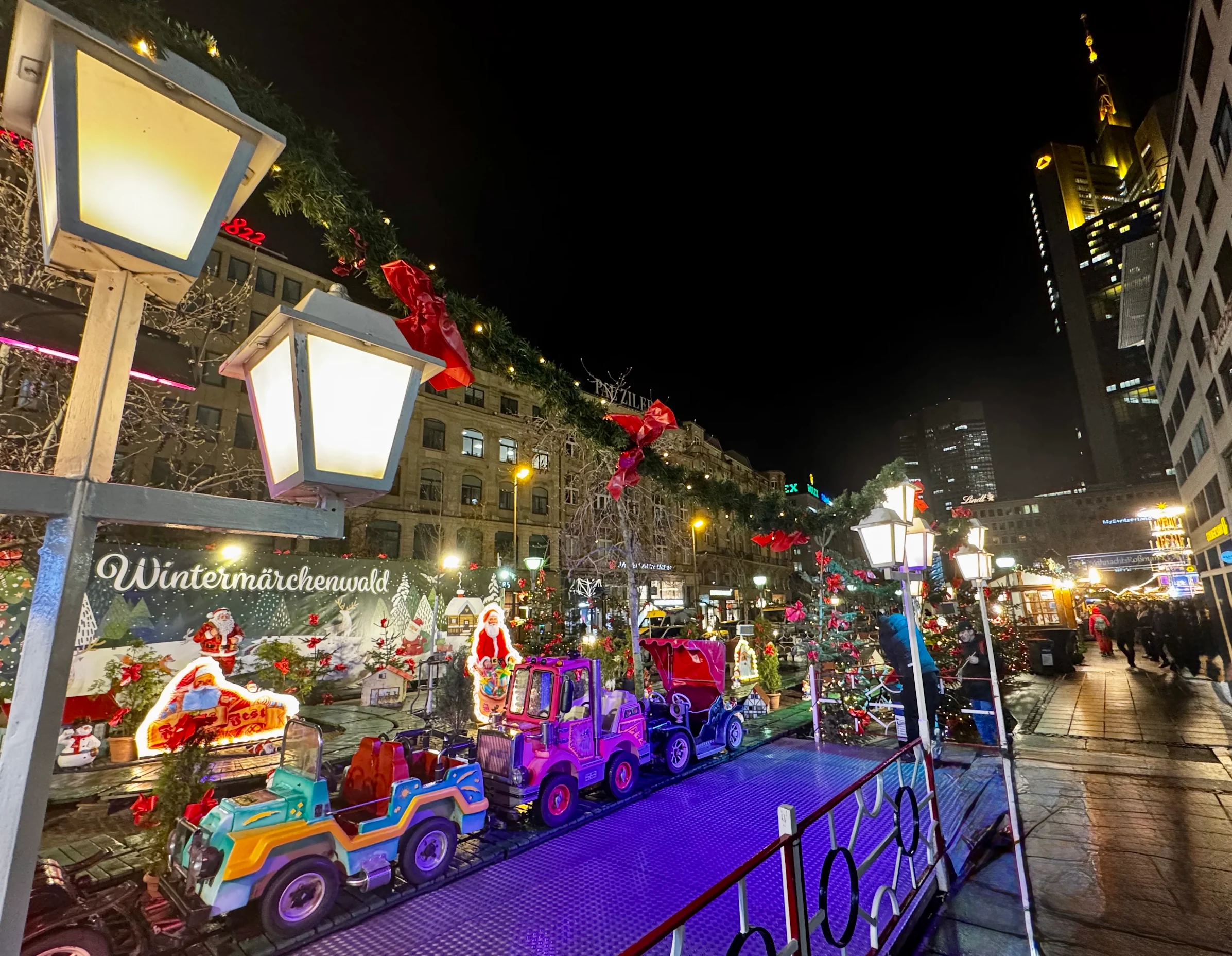
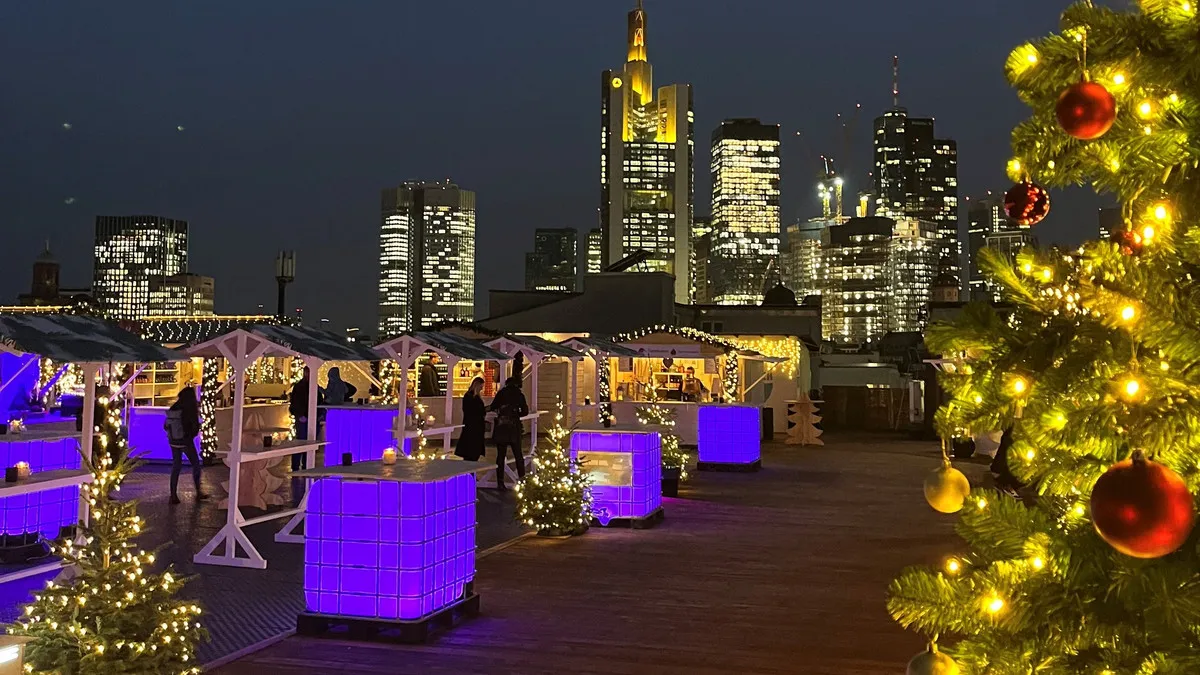
If I was in your shoes, I’d start at the WeihnachtsRoßmarkt, which only joined the market in 2021 and is the most Frankfurt-looking part of it. There’s a 16-metre Christmas pyramid that doubles as a Glühwein bar, a small Ferris wheel, and a sparkly horse-drawn carriage to pose with in front of the Gutenberg monument, all with the skyscrapers right behind.
If you’ve only ever seen Christmas markets in front of churches and town halls, this one feels a bit odd at first, and then it starts to make sense.
A couple of minutes on is the Hauptwache, the little baroque guardhouse at the end of the Zeil, Frankfurt’s big shopping street.
Almost every S-Bahn and U-Bahn line stops underneath it, so this is where a lot of people come up from the trains and get their first look at the market.
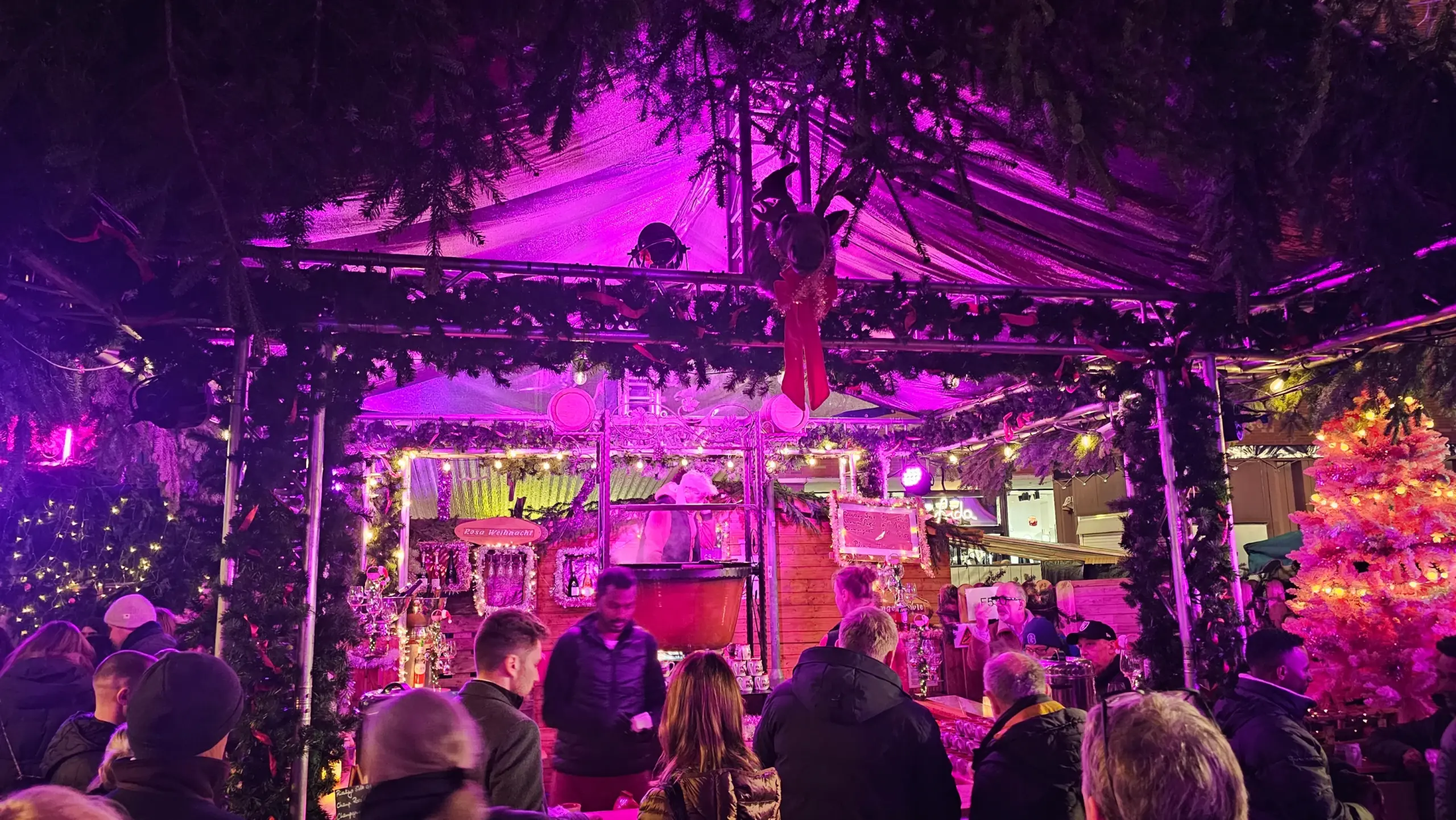
From here, head down towards the Römer and you’ll hit Friedrich-Stoltze-Platz, which goes pink for the season.
This is the Rosa Weihnacht, or Pink Christmas, a meeting place for Frankfurt’s LGBTQ+ community that’s open to everyone.
It does hot cocktails, homemade soups and a giant kettle of Feuerzangenbowle, the one where a rum-soaked sugar cone is set on fire over mulled wine, and it’s known for its vegetarian and vegan food.
Next is Paulsplatz, beside St Paul’s Church, where Germany’s first freely elected parliament met in 1848.
Inside the church, from 24 November to 20 December, Frankfurt’s own artists show their work at the 104th artists’ Christmas market, and from 4 December a second part in the Römer lets you meet them and buy.
Both are free, both are warm, and they make a nice change from the wooden huts outside.
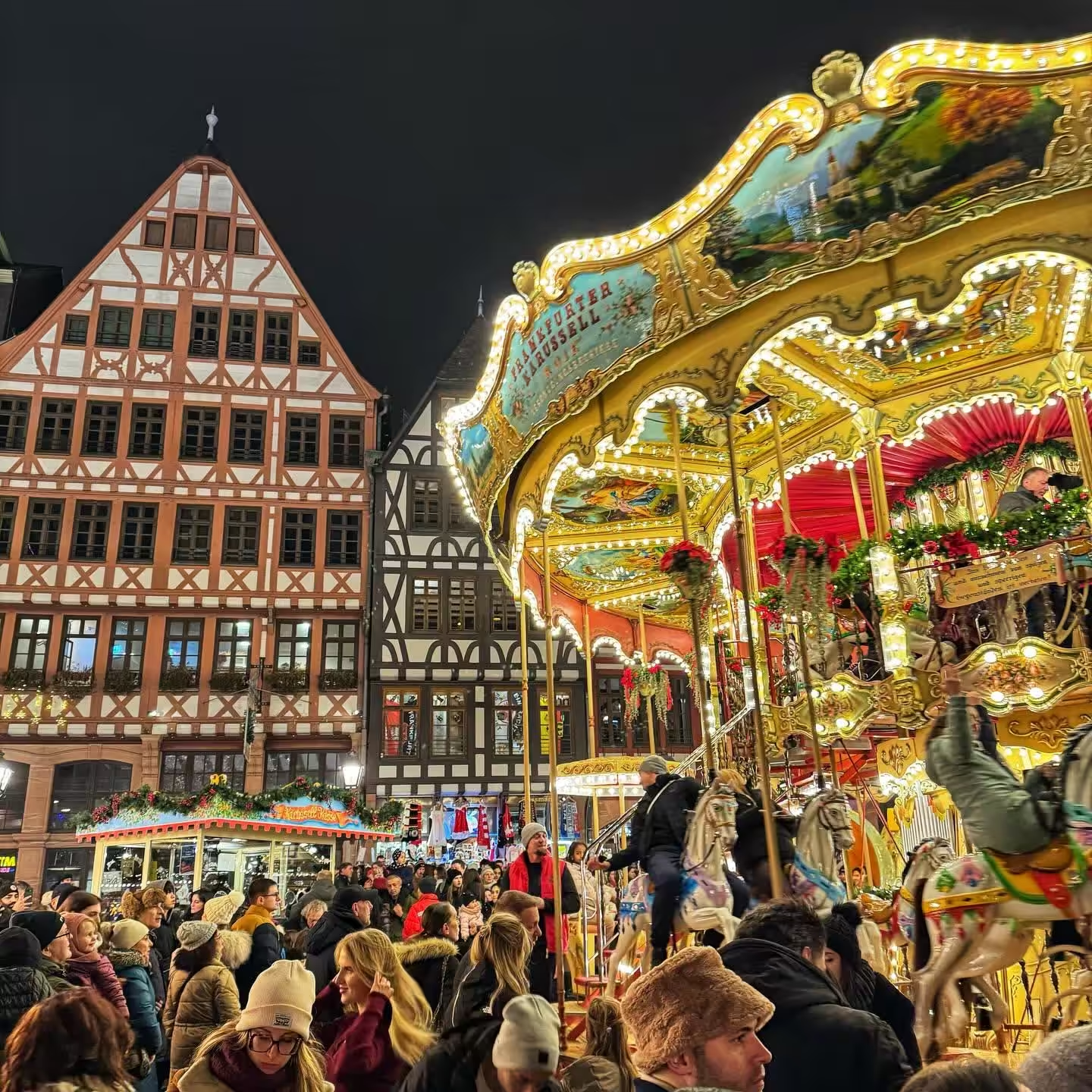
Then you come out onto the Römerberg, the old town square, with the giant tree, the main stage, a traditional carousel and the thickest crowds.
If you’re sending Christmas cards home, take them to the tourist office stall under the tree. Stamped cards and letters handed in there get a special Christmas postmark for free, as long as they have proper stamps and not the ones you buy in an app.
The last stop is the Mainkai, on the river.
Stalls run along the bank, and the children’s market, which started in 2025, sits on the riverbank by the Eiserner Steg footbridge.
It has the Primus Christmas ship, a lit-up boat moored on the Main with theatre, music and fairy tales on board, plus a craft room and a historic children’s carousel.
New this year, more than 50 Christmas trees decorated by Frankfurt children are dotted around the market.
When you’re done, walk out onto the Eiserner Steg and look back. You get the old town and the cathedral tower in front of you and the skyscrapers behind them, and that one view sums up Christmas in Frankfurt better than any of the squares do.
The Old Town That Isn’t as Old as It Looks
The Römerberg looks like the oldest corner of Frankfurt but most of it isn’t really.
The Römer itself, the town hall with the stepped gables, has been the town hall since 1405.
But in March 1944 Allied bombing raids destroyed almost the entire old town and killed about 1,000 people.
The Römer burned out too, and what you see today was rebuilt in the early 1950s.
The row of half-timbered houses facing the Römer, the one in every photo of the market, was rebuilt between 1981 and 1983 and opened on the market’s opening day in November 1983. They’re careful re-creations rather than exact copies, and they’ve only been there for about 40 years.
Behind them, between the Römerberg and the cathedral, is the Dom-Römer quarter, which everyone calls the New Old Town.
It opened in 2018 with 35 buildings on the old plots, 15 of them faithful reconstructions of houses lost in the war and 20 new ones designed to fit in.
The lane through the middle follows the old coronation route, the path newly crowned emperors walked from the cathedral to the Römer for their banquet.
It’s the nicest part of town to wander when the market gets too busy, and the Struwwelpeter Museum is in there too.
Heinrich Hoffmann, a Frankfurt doctor, wrote Struwwelpeter as a Christmas present for his three-year-old son in 1844 because he couldn’t find a picture book he liked.
I don’t think any of this makes the Römerberg fake.
The city decided to rebuild the square it lost, and you can stand in the New Old Town, look up at the cathedral and see the banking towers over the rooftops at the same time, which is a far more interesting picture than a postcard medieval town.
If that’s what you’re after, Bamberg or Regensburg come much closer. Frankfurt doesn’t pretend to be either of them.
The market is a lot older than the buildings around it though.
Christmas markets in Frankfurt are documented from 1393, which makes this one of the oldest in Germany, and it used to be called the Christkindchesmarkt.
For a long time only Frankfurt traders were allowed to sell there, and right up to the 1870s and 1880s local parents bought their children’s toys at the market and nowhere else, mostly wooden carts, cloth dolls and, later, rocking horses.
Another interesting fact is that the tree changes every year, and it usually gets a name.
This year’s is Nikolaus, a 26-metre, roughly 70-year-old spruce from Wald-Königsleiten in Austria, between Tyrol and Salzburg.
It’s named after St Nicholas, the patron saint of the village church there and of the Old St Nicholas Church on the Römerberg.
For Nikolaus, 300 new trees are being planted, and when the season’s over its wood will be made into park benches.
Frankfurters are not shy about mocking a scrawny tree, but last year’s Frau Holle, a 28-metre fir, was called the most beautiful tree the city had ever had, so Nikolaus has a lot to live up to.
And if you read anywhere that the Frankfurt tree is 30 metres tall, ignore it, because the tree and its height change every year.
The Saturday the Whole City Rings
If you can pick your weekend, pick the first one. On Saturday 28 November, from 16:30 to 17:00, 50 bells in 10 churches across the city centre ring together for half an hour in a fixed order.
In German it’s called the Großes Stadtgeläut, in English the Grand Bell Ringing, and it’s the best Christmas moment Frankfurt has, even though it has nothing to do with a stall.
The bells have rung together for big occasions since 1347, when they were rung for the funeral of Emperor Louis IV, but the version you’ll hear was planned after the war.
In 1954 the city asked a bell expert from Mainz, Paul Smets, to turn the bells of all those churches into one giant peal, and it wasn’t finished until 1995.
It starts with the citizens’ bell of St Paul’s Church and builds up church by church until the cathedral comes in at the end with the Gloriosa, a bell of almost 12 tonnes that’s the second-heaviest bronze bell in Germany after the big one in Cologne Cathedral.
When the half hour is up, the St Paul’s bell carries on alone for another five minutes.
There’s no single best spot, because the sound moves around the old town.
The city’s own favourite places to listen are Paulsplatz, the Hauptwache, the Römerberg and the Eiserner Steg, and I’d start on the Eiserner Steg and walk slowly up to the Römerberg so the bells reach you from different sides as each church joins in.
If you were planning to climb the cathedral tower that day, go earlier in the day, because it closes at 16:00 on the 28th and the last climb is at half past three.
Then stay on the Römerberg, because at 18:00 the brass players climb up to the gallery of the Old St Nicholas Church and play carols over the square.
They do this every Wednesday and Saturday during the market, so you’ll have other chances, but getting the bells and the brass on the same evening is what makes this the weekend to book.
The small Swedish Christmas market in Preungesheim is on that weekend too, and last year so was the one-weekend Höchst market, in Frankfurt’s other old town out to the west.
The bells ring once more on Christmas Eve, from 17:00 to 17:30. The market’s long gone by then, but if you happen to be in Frankfurt for Christmas, that’s where you want to be at five o’clock.
Hot Apple Wine and Bethmännchen
Every Christmas market in Germany sells Glühwein.
What makes Frankfurt different is apple wine. Apfelwein, or Ebbelwoi in the local dialect, is Frankfurt’s cider.
It’s dry and quite sour, and the city drinks it all year round in the old taverns of Sachsenhausen across the river.
At the market it’s heated up with sugar and spices, and hot apple wine, heißer Apfelwein or heißer Äppler on the boards, sits right next to the Glühwein at lots of the drinks stalls.
It’s lighter and fruitier than mulled wine, it costs the same, and on a cold night it’s what I’d order first.
If you like it, go and try the cold version properly. Cross the river to Sachsenhausen, where the taverns pour it from a Bembel, a grey stoneware jug painted in blue, into a Geripptes, a glass with a diamond pattern that’s said to make it easier to grip.
Apfelwein Wagner on Schweizer Straße is open every day from 11:00 until midnight, Atschel near Südbahnhof opens daily from noon, and Zum Gemalten Haus, with its painted walls, is closed on Mondays and Tuesdays.
At weekends the Ebbelwei-Express, a brightly painted old tram, does an hour-long loop of the city for €8, and that includes a bottle of apple wine and a bag of pretzels.
The sweet thing to take home is Bethmännchen, little balls of marzipan with three almond halves pressed into the sides.
They’re named after the Bethmann banking family, and the story goes that there used to be four almonds, one for each of the Bethmann sons, until one of them died and an almond was taken off.
Nobody agrees on the details, so treat it as a legend, but they’re very good, and there are Bethmännchen stalls on several of the squares. Brenten are the other Frankfurt marzipan biscuit, pressed into wooden moulds and baked, and Goethe, who was born here, was apparently a fan.
Keep an eye out for Quetschemännchen too.
They’re little figures made of dried plums and nuts held together with wire, traditionally a chimney sweep or a musician, and they’re supposed to bring luck.
In the 1800s a shy young man would send one to the woman he liked. If she kept it he was in with a chance, and if it came back, that was his answer.
For something savoury, look out for Frankfurter Würstchen, the thin beech-smoked sausages that come in twos with mustard or horseradish.
You’ll find the usual potato pancakes, roasted chestnuts and waffles all over the market as well.
If you’re feeling brave, the local cheese, Handkäs mit Musik, is a sour-milk cheese marinated in vinegar and oil and served with raw onions.
The music is what the onions do to you later. It’s more of a tavern dish than a market one, so save it for your night in Sachsenhausen.
What It Costs
Frankfurt sits at the pricier end of the region, but it’s not out of line for a big German city.
In 2025 the organiser said a classic Glühwein cost €4 to €4.50 on average, while the showmen’s association, which speaks for the stallholders, put it at €4.50 to €5 and said Frankfurt was at the top end of prices in Hesse.
The truth is somewhere in between and depends on the stall. Hot apple wine costs the same as Glühwein, and a bratwurst was about €5.
| What | Price in 2025 |
| Glühwein or hot apple wine | €4 to €5, depending on the stall |
| Bratwurst | about €5 |
| Official mug, bought outright | €4 |
| Mug deposit | not published, last reported at €3 in 2022 |
| Artists’ market, the bells, the brass | free |
Every year there’s a new official mug, and people collect them.
The deposit goes on top of your first drink and you get it back when you return the mug, but Frankfurt doesn’t publish the amount, so check the board before you pay.
If you want to keep the mug, just keep it. The organiser told the local press that walking off with your mug is common, accepted practice, and the stalls build that into the deposit.
Last year you could also buy one outright for €4 at the tourist office in the Römer and at the hut under the tree.
Don’t be surprised if you’re handed a mug from an older year, because old stock is kept in storage. That came in handy in 2024, when the brand-new mugs turned out not to be heat-proof and had to be pulled on opening day, and the stalls poured into around 30,000 spares until replacements arrived.
Nobody publishes how many stalls take cards, so bring some euros in coins and small notes. The ticket machines for the trains do take contactless.
When to Go
About 2.3 million people visited Frankfurt Christmas market last year, which works out at close to 80,000 a day on average, so it’s never empty.
Like most big German markets, it’s usually calmest on weekday mornings and early afternoons and busiest on Friday and Saturday evenings, and the Römerberg tends to be where it’s tightest.
If you want to actually look at the stalls, go before lunch on a weekday and save the evenings for eating and drinking.
The week I’d pick is the first one. Arrive on the Wednesday or Thursday, 25 or 26 November, when the market’s open but the weekend crowds haven’t arrived, and stay until Saturday the 28th for the bells and the brass.
Opening night on Monday 23 November is busy but fun if you can make it. Hotel prices in Frankfurt jump during big trade fairs at the Messe, and this year the two big November fairs are over by the 20th, before the market opens.
Make sure you pack for cold and damp rather than snow. December days in Frankfurt average about 5°C, nights hover around freezing, and it rains on about ten days of the month.
Snow is rare these days. Over the last ten Decembers there were only seven days in total with snow lying at the airport weather station, so a white Christmas market is a lucky bonus, not something to plan around.
The sun sets at about twenty past four and it’s properly dark by five, so the lights are on from late afternoon.
If your dates fall after the 22nd, the main market is over, but there are a few things that keep going.
The Palmengarten, the city’s botanic garden, runs its Winterlichter light trail from 5 December to 10 January, closed on 24 and 31 December, with timed tickets at €12 in advance.
Last year the smaller markets in the courtyard of the Thurn und Taxis Palais and on the Christmas boat at the Main Terrasse by the Eiserner Steg both ran until 30 December. Shops close by 14:00 on Christmas Eve.
Landing at Frankfurt Airport
Frankfurt Airport is one of the biggest hubs in Europe, so a lot of people pass through Frankfurt every December without ever leaving the terminal.
That’s a shame, because this is one of the easiest Christmas markets in Germany to get to from a plane. Head down to the Regional Station under Terminal 1, take the S8 or S9, and you’re at the Hauptwache in about 17 minutes.
Trains run every 10 to 15 minutes, and from the Hauptwache it’s a five-minute walk to the Römerberg, so you can be holding a mug of something hot within about half an hour of getting on the train.
A single from the airport into the city is €6.90.
The thing that catches people out is that the cheap Frankfurt city day ticket, €7.75, doesn’t cover the airport.
If you want a day ticket that does, the Frankfurt Card is €13 for a day, covers the airport, gets you discounts at museums and the Main Tower, and costs a bit less than the transport company’s own airport day ticket.
You can buy it at the DB Travel Centre in the Regional Station.
From the UK there are direct flights to Frankfurt Airport from Heathrow, Gatwick, London City, Manchester, Birmingham and Edinburgh, though it’s worth checking the smaller routes are running on your dates.
From London it’s about an hour and a half in the air. Don’t confuse it with Frankfurt-Hahn, which is where Ryanair flies from Stansted.
Hahn is about 120 kilometres away in the Hunsrück hills, and the bus into Frankfurt takes about two hours and ten minutes, from €18.99.
The flight can still work out cheaper, but you’ll get to the market about two hours later than if you’d landed at the main airport, and longer if you have to wait for a bus.
If you’d rather go by train, it’s about five and a half hours from London, with Eurostar to Brussels and then a direct ICE to Frankfurt’s main station that takes about three hours. From the main station it’s three minutes on the U4 or U5 to Dom/Römer, right next to the market.
Frankfurt as a Base for Other Markets
This is where Frankfurt really earns its place.
Its main station is the biggest rail hub in Germany, and there are plenty of good markets within an hour or so, most of them on regional trains you can hop on without booking.
If you stay three or four nights, you can do Frankfurt properly and still fit in two or three other towns.
| Market | Train from Frankfurt main station | 2026 dates |
| Darmstadt | 17 minutes | 16 November to 23 December |
| Hanau | 13 minutes by ICE, 20 to 30 by regional train | 23 November to 22 December, to be confirmed |
| Wiesbaden | 32 minutes | 24 November to 23 December |
| Mainz | 33 to 46 minutes | 26 November to 23 December |
| Heidelberg | about 1 hour by ICE | 23 November to 22 December, to be confirmed |
| Michelstadt | 1 hour 18 minutes | 27 November to 20 December, Wednesdays to Sundays only |
| Rüdesheim | about 1 hour 25 minutes, with a bus from Wiesbaden until 12 December | 19 November to 23 December |
| Cologne | about 1 hour 20 minutes by ICE | 16 November to 23 December, closed 22 November |
| Strasbourg | about 2 hours by ICE or TGV | from 27 November, end date not out yet |
| Nuremberg | about 2 hours 40 minutes by ICE | 27 November to 24 December |
My top two are Wiesbaden and Mainz, which sit facing each other across the Rhine and are easy to do together in one day.
Wiesbaden’s Sternschnuppenmarkt, the shooting star market, fills the palace square, and there’s a 45-metre Ferris wheel nearby on Mauritiusplatz.
Mainz puts its market around the cathedral. Both are also open a day longer than Frankfurt, until the 23rd.
Rüdesheim, on the Rhine, has a market of nations with stalls from more than 20 countries, but the railway along that bank of the river is closed for works up to and including 12 December, so until then it’s a train to Wiesbaden and a replacement bus.
Michelstadt, out in the Odenwald hills, has a market around a very pretty half-timbered town hall, but it’s only open Wednesday to Sunday, so check the day before you go.
And on the first three Advent weekends, Ronneburg Castle, about an hour east, holds a historic Christmas market inside the castle with a medieval market out front, at €10 for adults.
Further afield, Cologne, Strasbourg and Nuremberg are all direct on the fast trains.
For the short hops, the Hessenticket is the one to buy.
It costs €43.50 for up to five people for a whole day on regional trains, buses and trams across Hesse, and it also covers Mainz.
It’s valid from 09:00 on weekdays and all day at weekends, but it doesn’t cover the ICE, and Heidelberg is outside its area. You’ll see the Deutschlandticket mentioned a lot too, but it’s a monthly subscription at €63, and if you buy it after the 10th of the month you can’t cancel until the end of the following month, so it rarely makes sense for a short trip.
So, Is the Frankfurt Christmas Market Worth It?
Yes.
Frankfurt isn’t the prettiest Christmas market in Germany. Nuremberg and the small towns in Bavaria and Alsace have it beat on old-world charm, and it isn’t as big a party as Cologne.
What it does have is a long, easy walk of markets from the skyscrapers down to the river, an old town square the city rebuilt decades after the war, hot apple wine in the city that made apple wine famous, and one Saturday in November when the whole city rings.
It’s also one of the easiest big German markets to reach from most places (especially UK), and a great base for other markets nearby.B
If you’re choosing between Frankfurt and Munich or Cologne for a single trip, Cologne has more markets and more going on, Munich has the cosier, more traditional Bavarian Christmas feel, and Frankfurt wins on how easy it is to get to and how many other towns you can add in a day.
And if the name sounds familiar, it might be because of Birmingham. Frankfurt and Birmingham are twin cities, and Birmingham’s Frankfurt Christmas Market runs from 5 November to 24 December this year.
It’s a fun market, but it can’t bring the Römer, the bells or a proper glass of apple wine with it.