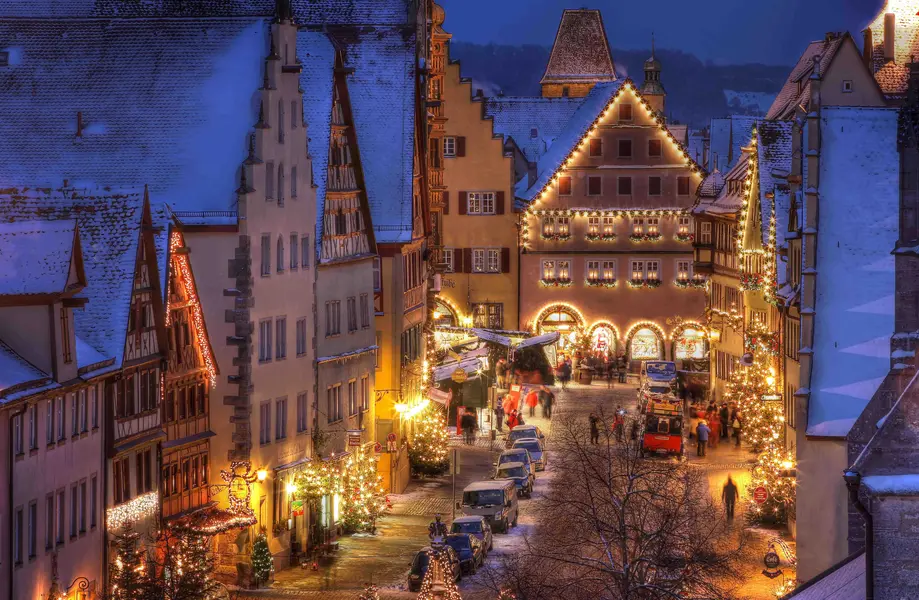
Esslingen’s Christmas market is really two markets, and the one people cross an ocean for isn’t the Christmas one.
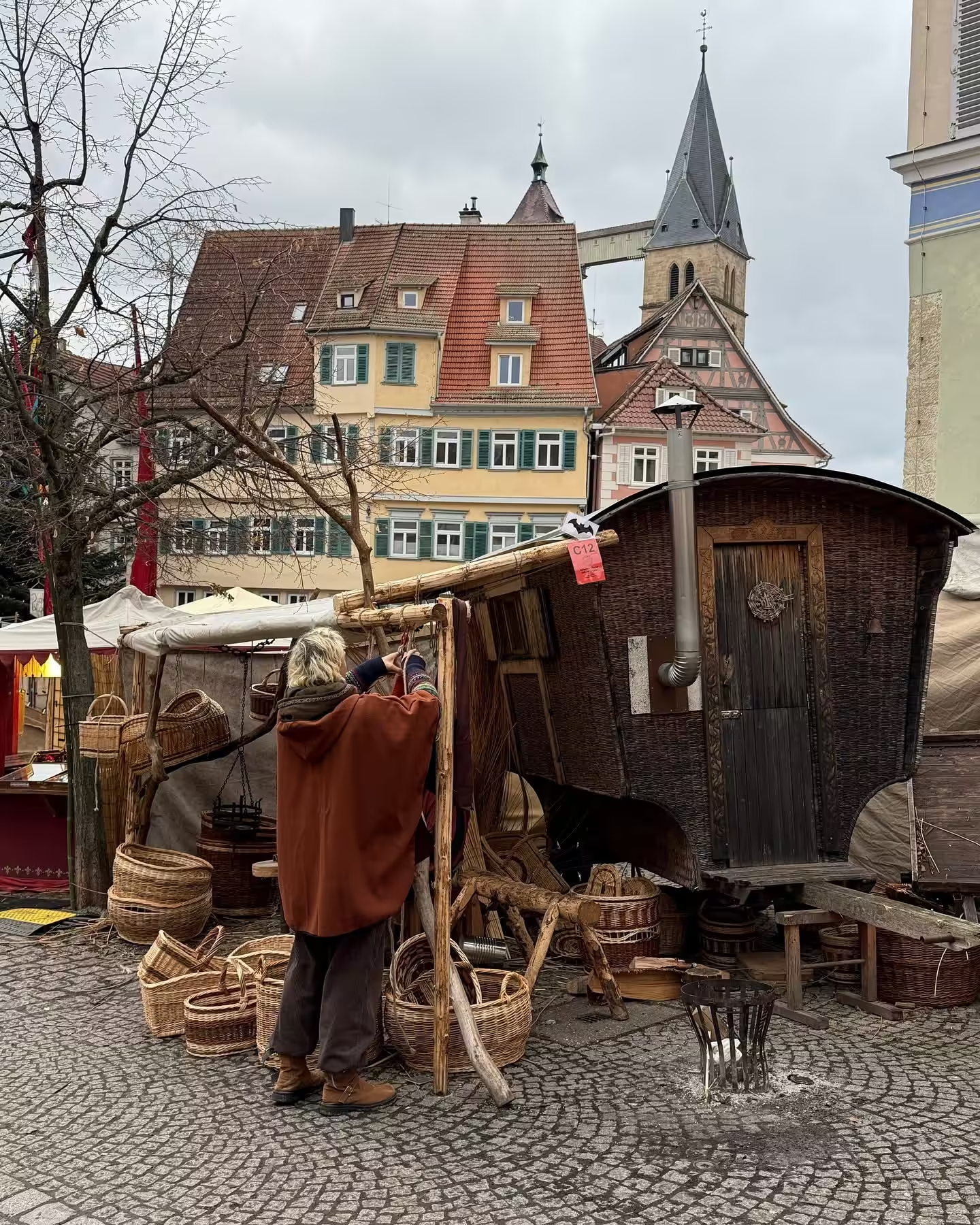
It’s the medieval market. Blacksmiths, glassblowers, pewterers and spoon carvers, all in costume, working by candle and torchlight in the lanes around a 600-year-old town hall. There are fire artists, a tavern called the Wild Rooster, and a wooden hot tub you can book for you and seven friends.
The regular Christmas market sits right next door on the Marktplatz, and it’s certainly lovely, but it’s also the same woodcraft, crêpes and Glühwein you’d find in any German town this size.
I think the Esslingen medieval Christmas market is the most fun Christmas market day trip in Germany, and it’s only 15 minutes from Stuttgart. But it only works if you pick the right day, the right hour, and the right half.
Esslingen Christmas Market 2026: Dates, Hours, and Where Everything Is
The Esslinger Mittelaltermarkt & Weihnachtsmarkt runs Tuesday 24 November to Tuesday 22 December 2026. It sticks to a simple rule: it opens on the Tuesday before the first Sunday of Advent and closes on the 22nd at the latest. So there’s no Christmas Eve trading, and nothing at all between Christmas and New Year.
Opening hours:
| Day | Hours |
| Sunday–Thursday | 11:00–20:30 |
| Friday & Saturday | 11:00–21:30 |
| Opening day (Tue 24 Nov) | stalls from 16:00, ceremony at 17:00 |
The opening ceremony happens on the Rathausplatz stage with the Lord Mayor, and it’s traditionally followed by a parade of all the performers through the market. If you like a bit of pomp, that’s a good first evening.
Entry is free. Instead of a ticket, the organisers ask for a voluntary Kulturspende (a culture donation) in boxes at the medieval gate, the Neues Rathaus, the lane down to the Hafenmarkt and the nativity scene.
That money goes towards the free programme, so if you stay for the fire, I’d drop a couple of euros in.
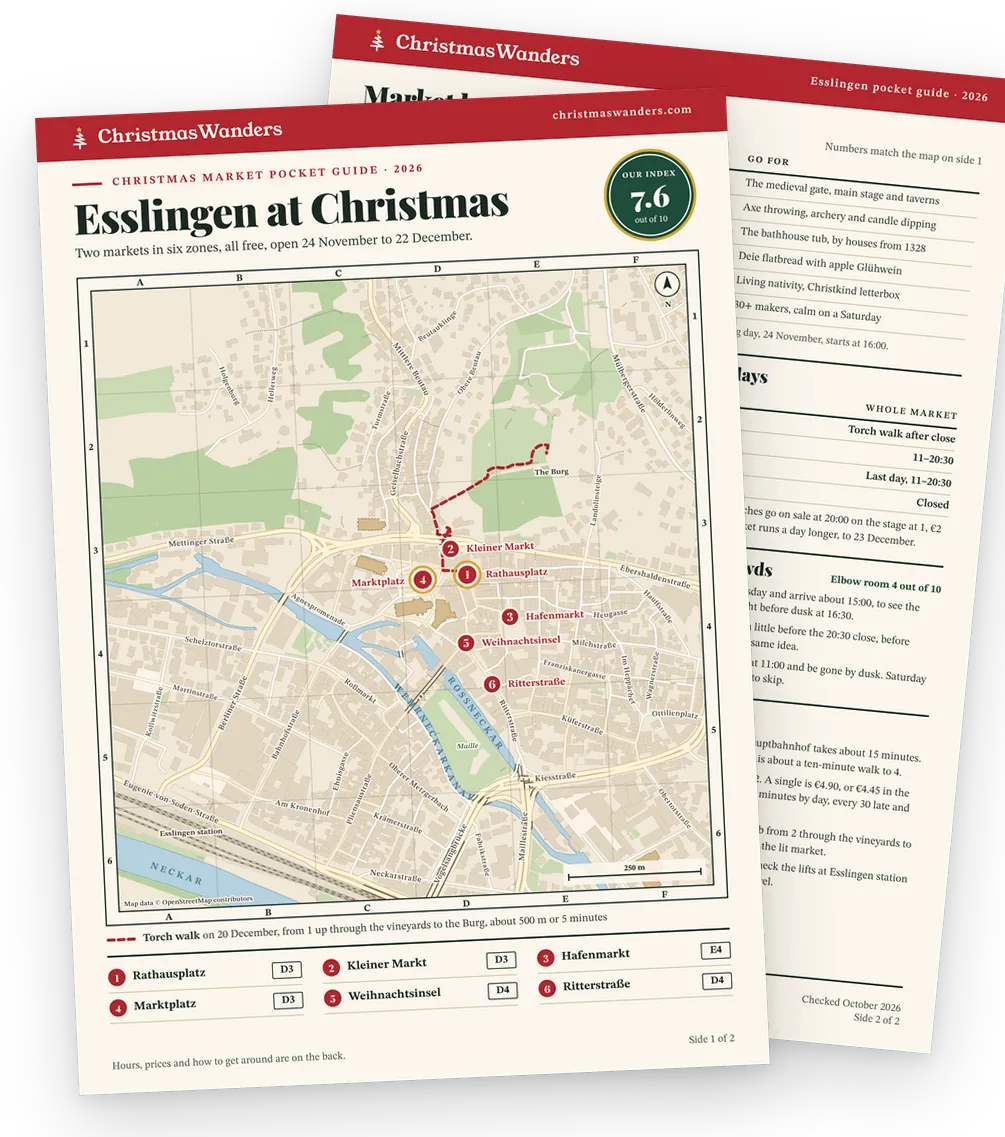
Now, where is it? Most guides say “the Marktplatz,” which is only the Christmas half. The market is really four zones strung through the old town of Esslingen am Neckar, and they’re all a few minutes’ walk apart.
| Zone | Where | What’s there | When |
| Christmas market | Marktplatz, beside St. Dionys | 80+ classic Christmas stalls, a historic carousel, the Glühwein pyramid | daily |
| Medieval market | Rathausplatz → Kleiner Markt → along the Altes Rathaus → Hafenmarkt | craft stalls, taverns, three stages, Zwergenland, the bathhouse | daily |
| Weihnachtsinsel | Postmichelbrunnen (Fischbrunnenstraße) | a living nativity and the Christkind letterbox | daily |
| Adventsmarkt | Ritterstraße | 30+ makers and craftspeople | Advent weekends only: 28–29 Nov, 5–6, 12–13 and 19–20 Dec |
Altogether that’s about 180 stalls and around 500 programme points on three stages, which is a lot of Middle Ages for one small old town.
The Hafenmarkt is the part people miss. It sits at the far end of the medieval market, past the Altes Rathaus, and it holds the bathhouse, the fairy-tale tent and some of the best-looking houses in town.
If you’ve walked around the Marktplatz, seen a nice Christmas market and wondered what the fuss is about, you haven’t found it yet.
Two Markets in One Old Town (and Which One You Came For)
| Medieval market | Christmas market | |
| Where | Rathausplatz to Hafenmarkt | Marktplatz |
| Light | Candles, torches and open fire | Fairy lights and the Glühwein pyramid |
| Sound | Minstrels, jugglers, street theatre | Background carols and a carousel |
| Stalls | Working craftspeople: blacksmith, pewterer, glassblower, spoon carver, weaver | Erzgebirge woodcraft, felt hats, honey, snow globes, nativity figures |
| Food | Hemp pockets, knights’ flatbreads, venison goulash, tavern spiced wine | Maultaschen, Deie flatbread, Kässpätzle, crêpes |
| Best for | The only-in-Esslingen experience, photos after dark, kids who want to throw axes | Gifts, a calmer Glühwein, grandparents, prams |
| Crowds | Narrower lanes, packed on weekend evenings | An open square with more room to breathe |
The medieval market is why you come. It’s been running since 1998, and what struck me most is how seriously it takes the craft side. The organisers cap food stalls at 30% of the whole market, so it never turns into one long snack queue, and a good share of what’s left is people making things right in front of you.
That’s a big difference from other cities. In Munich, the medieval market on Wittelsbacherplatz is a themed corner of a much bigger event, and I’ve written about the themed-market tax you pay there. In Esslingen, the medieval market is the main event.
My favourite thing on it is the little clay lanterns shaped like Esslingen’s own buildings. It’s the one souvenir here that couldn’t come from anywhere else.
Is the Christmas half special? Not really. It’s a good small-city Christmas market, and without the medieval market next door, I doubt many people outside Baden-Württemberg would make the trip.
So start with the medieval half, and start at the gate.
Inside the Medieval Market
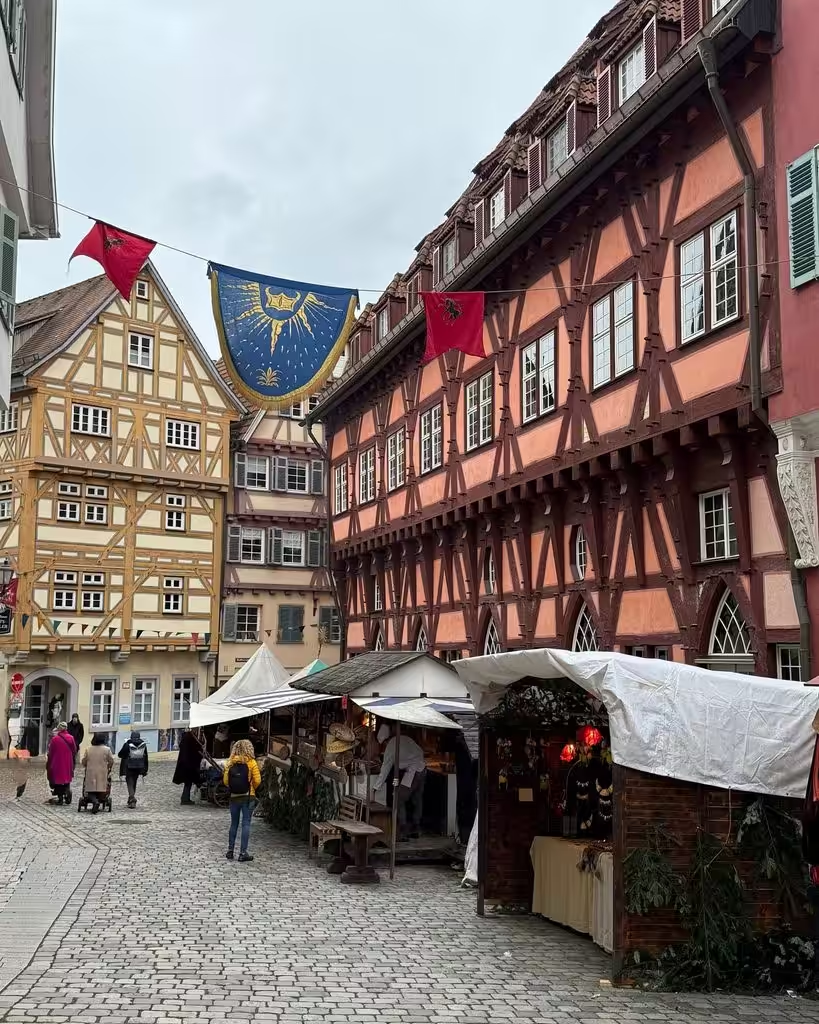
You walk into the medieval market through a big gate, the Mittelaltermarkttor, by the Neues Rathaus. Past it, the fairy lights give way to candles and torches, the stallholders are in costume, and the carols get swapped for minstrels.
The craft stalls are the heart of it. The official traders list includes a blacksmith, a pewterer casting jewellery, a glassblower, a stonemason, a weaver and a spoon carver, plus stalls selling furs, leather masks, leather-bound books, incense, spices and berry wines.
In 2025 they added a Gutenberg-style printing workshop that teaches bookbinding, which is exactly the kind of gloriously specific thing I love about this market.
This is where Esslingen earns its reputation. Watching someone hammer a hook into shape is a very different experience from picking a glass bauble off a shelf, and it’s why the medieval half doesn’t feel like dress-up. In my Germany guide I called it “the real thing, zero corn,” and I stand by that.
Then there are the taverns. Taverne Wilder Hahn (the Wild Rooster) has spots on both the Rathausplatz and the Hafenmarkt and pours its own home-made spiced wines. The Hirtentrunk stands in front of the Neues Rathaus with Flammkuchen and Glühwein, and the Kerbholztaverne is up in Zwergenland.
Three stages run all day: the Rathausplatz, the Hafenmarkt, and Zwergenland on the Kleiner Markt. You’ll see stilt walkers, jugglers, acrobats, storytellers, minstrels, dancers and the ones on every poster, the fire artists.
The programme changes daily and gets posted on pillars at the market entrances and on boards by each stage. Check it when you arrive rather than planning your whole day around one act.
Each year a rotating cast of guest artists joins the regulars, and the 2026 calendar might actually decide your dates:
| Dates (2026) | Guest artist |
| from 26 Nov | Argentum |
| 28 Nov – 9 Dec | Schmierenkomödianten |
| 30 Nov – 5 Dec | Gabino |
| 1 – 4 Dec | Zirkus Meer |
| 6 – 11 Dec | BraAgas |
| 7 – 10 Dec | Duo Diabolus |
| 11 – 14 Dec | Zirkus Krims Krams |
| 12 – 17 Dec | Krless |
| 15 – 17 Dec | Eisenhans |
| 18 – 20 Dec | Saboï |
I can’t tell you much about most of these from the listing alone. What I can tell you is that Eisenhans is billed as a Kraftakrobat, a strongman acrobat, which sounds like a perfectly good reason to visit in mid-December.
A handful of extras need booking (the workshops open for booking in October):
| What | When (2026) | Price |
| Guided evening tour of the medieval market | Wednesdays 25 Nov, 2, 9 and 16 Dec, 18:00–19:30 | €18, includes a punch |
| Estampie concert (medieval music) in the Altes Rathaus | Thu 10 Dec, 20:30 | €27 seated, €15 standing |
| Raunächte workshop in the fairy-tale tent | Fri 11 Dec, 18:00 | €29 |
| Singing workshop | Sat 12 Dec, 11:00–14:00 | €40 |
Expect these to be in German. The concert is the one I’d grab. It’s in the old town hall, with a band celebrating 40 years on stage, and it’s capped at 150 people.
Weapons are banned across the whole market, show weapons included, and since 2024 it’s been an official weapons-free zone. So the toy sword stays at the hotel. Flags and bulky items are out too, and so are your busking ambitions, because street music is banned.
The strangest booking in the whole market, though, is a bath.
Yes, there’s a hot tub (the medieval bathhouse)
Down on the Hafenmarkt, a few steps from the oldest row of half-timbered houses in Germany, there’s a medieval bathhouse. A real one, with hot water!
It’s a big wooden tub (a Badezuber) that fits about eight people, filled at around 37°C, and groups rent it by the hour while the market carries on around them. It’s run by Marita Wolff, who goes by the Zuberwölfin (roughly, the tub she-wolf), and you book directly with her at esslingen@badezuber.de.
It’s wildly popular. Local press reported it booked out a year ahead in both 2022 and 2023, and I couldn’t find a price published anywhere, so email early and ask.
Swimwear is completely normal. This is a family market with a nativity scene around the corner, not a Roman orgy.
If you can’t get a slot, it’s still fun to walk past and wave at people sitting up to their shoulders in hot water in December.
Fire, torches, and the castle that never was
Fire is the medieval market’s signature. Fire artists spin torches through the lanes after dark, the market’s posters feature a fire-breather, and on one night of the season the whole market walks up the hill with torches.
There’s no fixed nightly fire-show time published, so this is where the programme boards come in. The rule of thumb is simple: the fire comes out once it’s dark, and in Esslingen that’s early. The sun sets at around 16:30 for the whole run of the market.
The torch procession to the Burg (Fackelumzug zur Burg) is on Sunday 20 December 2026. Torches go on sale at 20:00 at the Rathausplatz stage for €2 each, and once the market closes, the procession sets off from there and climbs up to the Burg.
By then, a huge bonfire has been stacked on the castle grounds for hours. More than a thousand people form a circle around it, the market traders light it, and the party starts from there. It’s been happening since 2006, timed around the winter solstice.
If your dates are flexible, this is the night to aim for. It’s the last Sunday before the market closes, so it’ll be busy, but it’s the most Esslingen thing Esslingen does.
As for the Burg, the tourist office calls it “the castle that wasn’t,” and that’s accurate. It was never a castle. It’s the top end of the old town fortifications with walls, a watchtower called the Hochwacht, and the Dicker Turm (literally the Fat Tower) from 1525, which has been closed to the public since 2011.
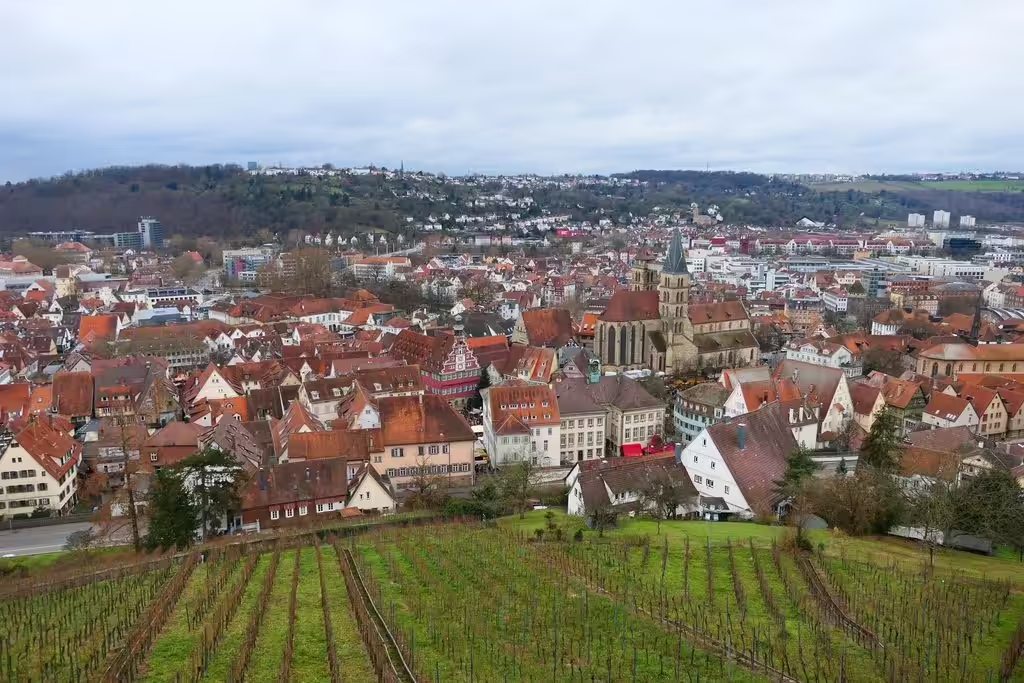
You get up there on the Burgstaffeln, steps that climb through the vineyards, and the official market plan marks the footpath up from the Kleiner Markt. It’s the best view over the town, and at dusk, with the market lit up below you, it’s the photo nobody else in your group will have.
It’s a proper climb, though. (Stuttgart is famous for its hillside stairways, the Stäffele, so the locals think nothing of this. You might.) Do it before the Glühwein, not after.
What to eat and drink (swabian, “medieval”, and everything else)
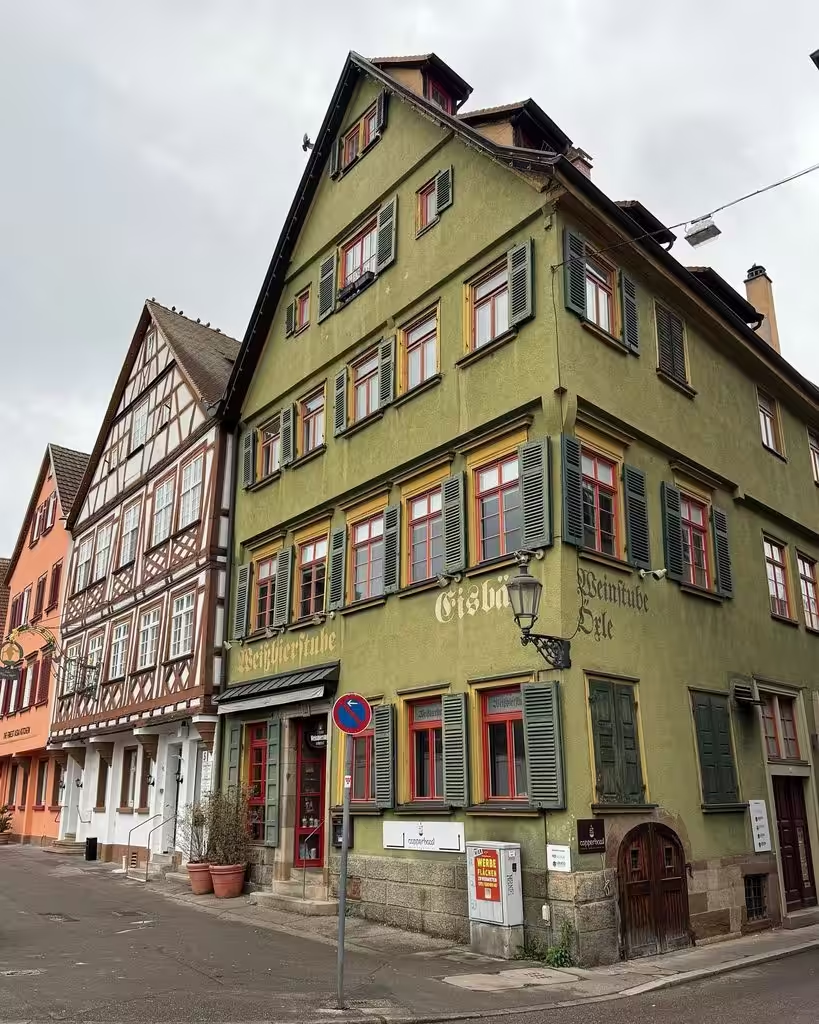
The food at the Esslingen Christmas market splits three ways and includes proper Swabian dishes, “medieval” market food, and the imports every German market has now. All three are fine, but only the first two are something worth traveling for.
I’d start with the Swabian stuff. The dish to find is Deie (you’ll also see it spelled Dinnete), a thin yeast flatbread baked with toppings that the local press likes to call Swabian pizza. The Deie-Backhaus on the Christmas market bakes it and pairs it with an apple Glühwein made from local orchard apples, which is what I’d drink here over the regular stuff.
Maultaschen, the Swabian pasta pockets (legend says monks invented them to hide meat from God during Lent), have their own stall, the Maultaschenbörse in front of the Kielmeyerhaus. And Kässpätzle, egg noodles baked with cheese and crispy onions, turn up on both sides of the market, including at the Wanderbäcker next to the Altes Rathaus.
Then there’s the medieval menu, which reads a bit like a fantasy novel. Stuffed hemp pockets from the Hanfbeckerey on the Rathausplatz, Ritterfladen (knights’ flatbreads) and soups from the Schlemmerey on the Hafenmarkt, venison goulash, Wuchteln, Grillfackeln, dumplings from Oli’s Knödeley, Stockbrot you bake yourself over the fire, and something called Lustschnecken, which I’ll let you discover on your own.
A lot of it comes in vegetarian or vegan versions, which medieval Swabia was not known for. The hemp pockets are what I’d try first, simply because you won’t find them at many other markets.
When it’s properly cold, the Tee- und Mokka Stube on the Hafenmarkt is the warm-up stop for tea and mocha instead of yet another Glühwein.
And then the imports. Lángos, crêpes, raclette bread, “Almpizza”, and cinnamon rolls and strudel from a Bulgarian bakery called Poushe. You’ll recognise most of it from other markets. It’s really good.
For drinks, it’s Glühwein, Kinderpunsch for the kids, and spiced and berry wines at the medieval taverns. Mead has turned up at the taverns in past years as well.
However, the best drink in Esslingen doesn’t come from a stall. It comes from a 13th-century cellar right between the two markets.
Kessler turns 200: the sekt cellar between the markets
Sektkellerei Kessler is the oldest Sekt house in Germany, and 2026 is its 200th year.
Georg Christian von Kessler founded it in Esslingen in 1826, after years working at Veuve Clicquot in Reims. The house still sits in the old Speyrer Pfleghof, with cellars going back to the 13th century, and on the 2026 market plan it’s marked right between the Marktplatz and the Rathausplatz.
So on your way from the Christmas half to the medieval half, you walk straight past the oldest sparkling-wine house in the country, in its birthday year! I’d stop.
The Kessler Karree and Hofbar are open Tuesday to Friday 11:30–20:00 and Saturday 10:00–20:00 (closed on Sundays), which slots neatly into a market afternoon. A glass of Sekt at 15:00 on a Tuesday, then the medieval market at dusk, is my idea of a very good day.
The cellar tours are the harder ticket. The regular open tour costs €25, takes about 90 minutes with three tastings, and caps at ten people, and the tourist office warns that the tours are often booked out for months. In an anniversary year, I’d book the moment you know your dates.
Esslingen is also a wine town, which the market mostly hides. Vines were documented here in 778, the steep terraces on the Neckarhalde date back to around 1220, and of the roughly 1,200 hectares of medieval vineyards, about 82 are left.
For a proper glass, the Vinothek am Marktplatz pours wine from more than 50 local grower families, and the old wine taverns (Weinkeller Einhorn, Palmscher Bau and Kleine Traube) are where to find a warm table and a Trollinger, Württemberg’s local red.
When to go: a million visitors, one small old town
About a million people visit the Esslingen market every year, and a frightening number of them pick the same few evenings.
Even the organisers would rather you skipped Saturday. Their own FAQ recommends Monday to Friday, says weekends are very busy, and advises families with prams and wheelchair users to skip weekends altogether.
Weekend evenings get jam-packed, with long queues at the food stalls and even longer ones for the toilets. In 2025, the third and fourth Advent weekends were the busiest of the whole run.
My advice is to go Tuesday to Thursday, and arrive around 15:00. You get the medieval market in daylight, when you can actually watch the blacksmith work, and then dusk at around 16:30, when the candles and torches take over. Eat, catch the fire artists once it’s dark, and head for the station a little before the 20:30 close, before everyone else has the same idea.
Mondays work too. Friday and Saturday evenings are the crush, and both run late, until 21:30. A Saturday at 19:00 is the one slot I’d avoid completely.
Weekday mornings are the quietest time of all, though schools book guided tours, so you may end up sharing the blacksmith with a class of ten-year-olds.
If a weekend is your only option, arrive at 11:00 and be gone by dusk. The one upside is the Adventsmarkt on Ritterstraße, which only runs on weekends.
The time you need depends on how much of Esslingen you want:
| If you want to… | Plan for |
| Walk both halves and have one Glühwein | 2 hours |
| Eat properly, watch a couple of shows and see the fire | 3–4 hours |
| Add Kessler, the Burg and the old town | half a day, into the evening |
| Join the torch procession (Sun 20 Dec) | stay until well after 21:00 |
One more thing, because it will come up. There’s a paid medieval latrine in front of the Altes Rathaus (a euro in 2024), but the better options are the public toilets: the accessible “Toilette für alle” at the Agneshof, the one in the Mittlere Beutau underpass, and the Hafenmarkt toilets by the Café am Museum.
And if you were thinking of bringing the dog, the organisers politely suggest leaving it at home. Crowded lanes, open fire and dropped sausages are a lot for any dog.
Kids, on the other hand, are very much invited.
Esslingen with kids
Esslingen might be the best Christmas market in Germany for kids who’ve outgrown carousels, because the medieval half lets them throw things.
Their corner is Zwergenland (dwarf-land) on the Kleiner Markt. There’s archery, axe and knife throwing, a crossbow “dragon hunt”, a catapult, a castle siege game, a Viking carousel, a chain carousel, and the “smallest Ferris wheel in the world”, which somebody actually turns by hand!
The candle workshop on the Kleiner Markt is the calmer option. Dipping a candle costs €3.50 for a taper and €4.50 for a ball candle (from age 3), and drawing a beeswax candle is €4.80 per 100 g (from about age 6). On the Fridays and Saturdays before each Advent Sunday, it stays open until 21:30.
The free stuff is lovely too, by the way. The fairy-tale tent (Märchenzelt) on the Hafenmarkt has storytellers from 27 November, with no booking needed. The only catch for international families is that the stories are told in German.
Over at the Weihnachtsinsel, the living nativity has real sheep, newborn lambs and two donkeys next to a life-size Mary and Joseph. The Christkind letterbox there promises a reply to every letter that includes a return address. (Worth knowing before your kids write their list, not after.)
And for the little ones, there’s the historic carousel on the Marktplatz, which is the one ride nobody has to throw anything at.
When small legs give out, the old town around the stalls is worth a slow loop.
The old town behind the stalls
The best thing about the medieval market is that it’s not a film set. The buildings are real, and a lot of them are seriously old.
The Hafenmarkt houses (numbers 4 to 10) were built between 1328 and 1331, and the tourist office calls them the oldest continuous row of half-timbered houses in Germany. The medieval market, the bathhouse and the fairy-tale tent run right past them, so you’re drinking spiced wine in front of houses that were already 160 years old when Columbus set sail.
The Altes Rathaus started life in 1422/23 as a trade and tax house, then got its Renaissance north façade in 1586–89 from Heinrich Schickhardt, Württemberg’s star architect at the time. On it hangs an astronomical clock from 1589, and above that a 29-bell Glockenspiel that plays daily at 8:00, 12:00, 15:00, 18:00 and 19:30, with the melody changing every month. Try to be standing in front of it at 15:00 or 18:00.
Stadtkirche St. Dionys, the twin-towered church over the Marktplatz, is where Esslingen’s story starts. The town dates its history to 777, and you can see the excavations under the church on a guided city tour.
Klein-Venedig (Little Venice) is the canal quarter along the Rossneckar, with working water wheels and mills recorded since 1428. It’s a short walk from the Hafenmarkt, and it’s the quiet corner where you can finally hear yourself think.
The Innere Brücke from 1286 is a bridge lined with houses and, handily, two cash machines.
Getting there, and why Stuttgart is usually the better base
Esslingen is about 15 minutes from Stuttgart Hauptbahnhof on the S1, and the regional trains that stop here are a few minutes quicker. From Esslingen station, it’s roughly a ten-minute walk to the Marktplatz.
Esslingen is in VVS zone 2, so from central Stuttgart you need a two-zone ticket. After the fare rise on 1 September 2026, a single costs €4.90 (€4.45 in the app), and a two-zone day ticket is €8.90 in the app, which pays for itself on the way back. Since September, up to three kids aged 6 to 14 ride free on a day ticket too. The Deutschlandticket (€63 a month) covers the S-Bahn and regional trains too.
S-Bahn trains run every 15 minutes during the day, and every 30 minutes late in the evening and on Sundays. After closing time, you might wait a bit on the platform with half of Swabia.
Check the lifts if you’ve got a pram, a wheelchair or a suitcase. During the 2025 market, the lifts to two of the platforms at Esslingen station were out of action for the entire run, and local press was still reporting lift problems in June 2026. Look up the lift status in the DB app before you travel.
Driving is possible, of course, but not much fun. Take the A8 to the Esslingen exit, follow the B10 and the parking guidance signs, and aim for the Altstadt garage on Kiesstraße (358 spaces, open 24/7) or the Neckar Forum garage, which caps its evening rate at €6 from 18:00. Expect both to fill up at weekends.
Where to sleep?
For most people, Stuttgart. It has far more hotels, its own big market and trains to everywhere, so it’s the easy base for a few days in the region.
Stay in Esslingen itself if you want the old town after the day-trippers have gone home, or if you’re coming for the torch procession, which runs late on a Sunday night.
Esslingen vs Stuttgart vs Ludwigsburg (pick one per day)
| Esslingen | Stuttgart | Ludwigsburg | |
| 2026 dates | 24 Nov – 22 Dec | 25 Nov – 23 Dec | 24 Nov – 22 Dec |
| Size | ~180 stalls | ~250 stalls | ~150 stalls |
| From Stuttgart Hbf | ~15 min (S1) | you’re already there | 12 min (S4/S5) |
| Latest close | 21:30 (Fri/Sat) | 2026 hours not yet published | 23:00 (Arsenalplatz, Fri/Sat) |
| Best at | Medieval crafts, fire, feeling like another century | Size, history, decorated stall roofs | A baroque square full of illuminated angels |
Esslingen vs Stuttgart. Stuttgart’s market is one of the oldest in Europe, first documented in 1692, with around 250 stalls across the Schlossplatz, Schillerplatz, Karlsplatz and Marktplatz and 3.5 to 4 million visitors a year. It’s famous for its elaborately decorated stall roofs, and there’s even an award for the most beautiful stall.
It’s big, it’s handsome and it’s very much a city-centre market. The usual line is that Stuttgart is bigger and more commercial while Esslingen feels more authentic, and I agree with it. If you only have one evening, spend it in Esslingen.
Stuttgart also runs one day longer, to 23 December, which makes it your backup if you land after Esslingen has closed.
Esslingen vs Ludwigsburg. Ludwigsburg’s Baroque Christmas Market fills the town’s baroque Marktplatz with about 150 stalls under illuminated angels, and the Arsenalplatz extension stays open until 23:00 on Fridays and Saturdays. It’s the prettiest square of the three and the latest-running. It’s also the most conventional, so go for the look, not for surprises.
Don’t do two in one day. It’s easy on paper, since the trains are short, but big markets are tiring and they all peak at the same hour. Esslingen by day into dusk, then Stuttgart or Ludwigsburg the next evening, makes for a much better trip.
If you’re building a bigger trip, Nuremberg is the classic next stop, and Strasbourg and Alsace are close enough to pair with Stuttgart. And if the medieval streak is what sold you on Esslingen, the Stallhof medieval market in Dresden is the other one I’d put on your list.
So, is Esslingen worth it? (my final thoughts)
Yes, as long as you go for the right half.
The Christmas market on the Marktplatz is a good small-city market and not much more. The medieval market wrapped around it is the reason I keep recommending Esslingen to people because it has a working craft fair, a stage show and a fire festival that run every day for four weeks, 15 minutes from a major city, with a Sekt house turning 200 in the middle.
If you go, tell me in the comments which guest act you caught and whether you managed to get into that hot tub. And if you’re still choosing between cities, every market on the Index is scored on the same criteria, so you can compare them properly.