What makes Alsace Christmas markets different?
Alsace has spent centuries being passed back and forth between France and Germany, and you can taste it at the Christmas markets. The stalls sell bredele (tiny Christmas biscuits), pain d'épices and kougelhopf, the vin chaud comes red or white, and half the street signs read like German with a French accent.
The other thing is how close everything sits. Strasbourg, Colmar and a dozen wine villages fit inside an hour of each other, so one trip can take in five or six markets without a single long transfer.
The history goes deep too. Strasbourg has held its Christkindelsmärik since 1570, which makes it the oldest Christmas market in France. Sélestat, a short train ride south, keeps a town account book from 1521 that mentions guards watching over the trees cut for Christmas, the oldest known written mention of a Christmas tree. The page is on show at the Humanist Library from 21 November to 31 December (closed on Mondays and on 25 and 26 December), and it's free to see.
Time your trip around 6 December if you can. It's St Nicholas Day, a Sunday this year, and bakeries all over Alsace sell manala, little brioche men you eat with hot chocolate. St Nicholas usually brings Hans Trapp with him, the black-bearded bogeyman who deals with the naughty kids, so it's a good day to be well behaved.
Strasbourg or Colmar?
My answer is both, because they're under half an hour apart by train and they do different jobs.
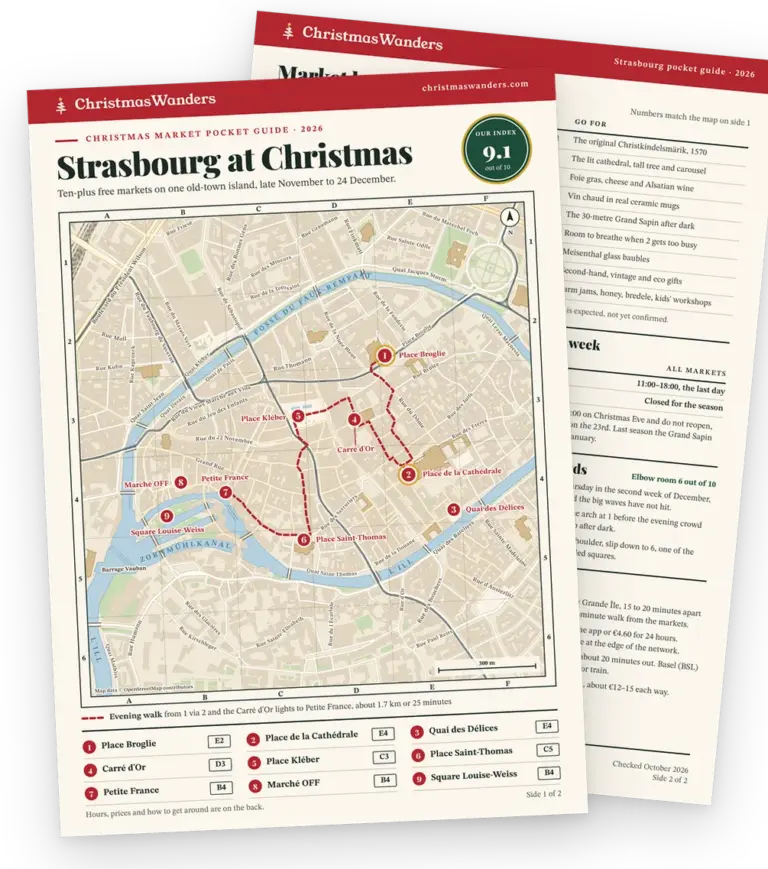
Strasbourg is the big one. Eight official markets spread over 11 squares around the cathedral, more than 300 chalets, a Christmas tree on Place Kléber that stood 31 metres tall last year and lights strung over nearly every street on the Grande Île. It drew just over three million visitors last season, and you feel every one of them on a Saturday afternoon.
Strasbourg divides people. Some find it tacky and overrun at weekends, and I'd still call it the best-decorated city in France at Christmas. Go on a weekday and you'll see why.
My favourite corners of Strasbourg are the three smaller markets. The Quai des Délices has Alsace winegrowers pouring white vin chaud, the square Louise-Weiss market only lets in producers from Alsace, and the Marché OFF on Place Grimmeissen trades from shipping containers and even has a quiet zone for when the crowds get too much.
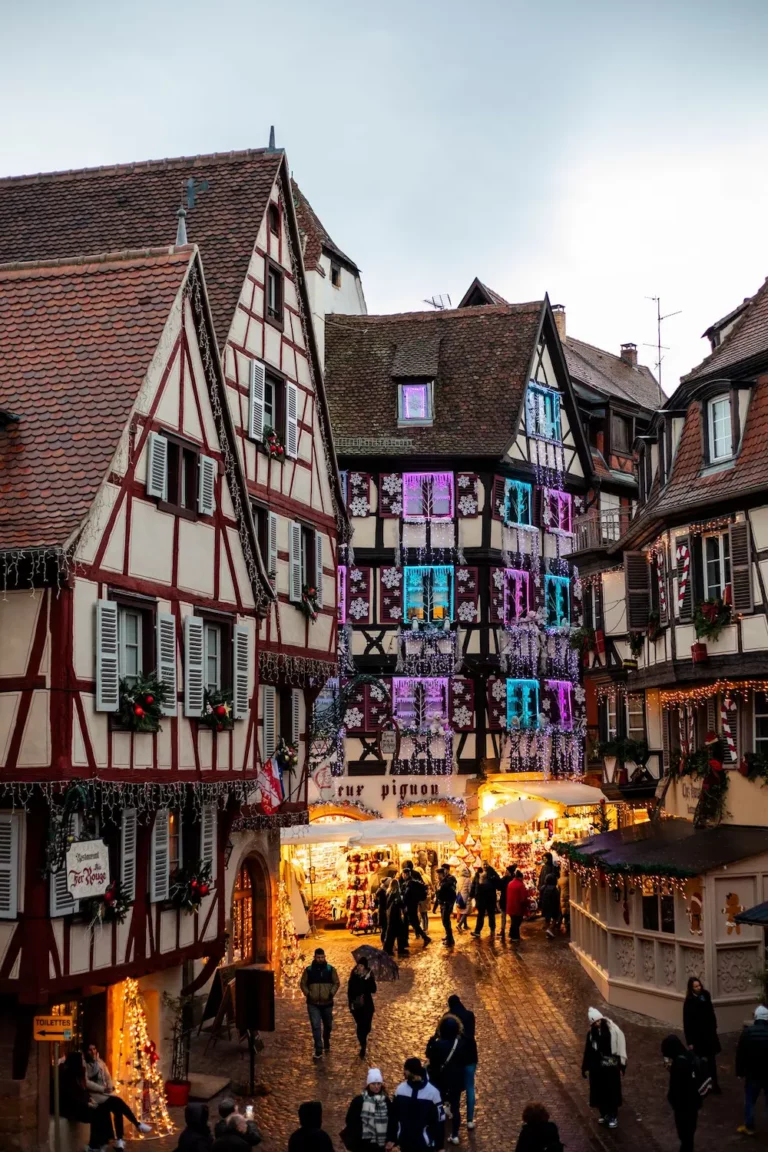
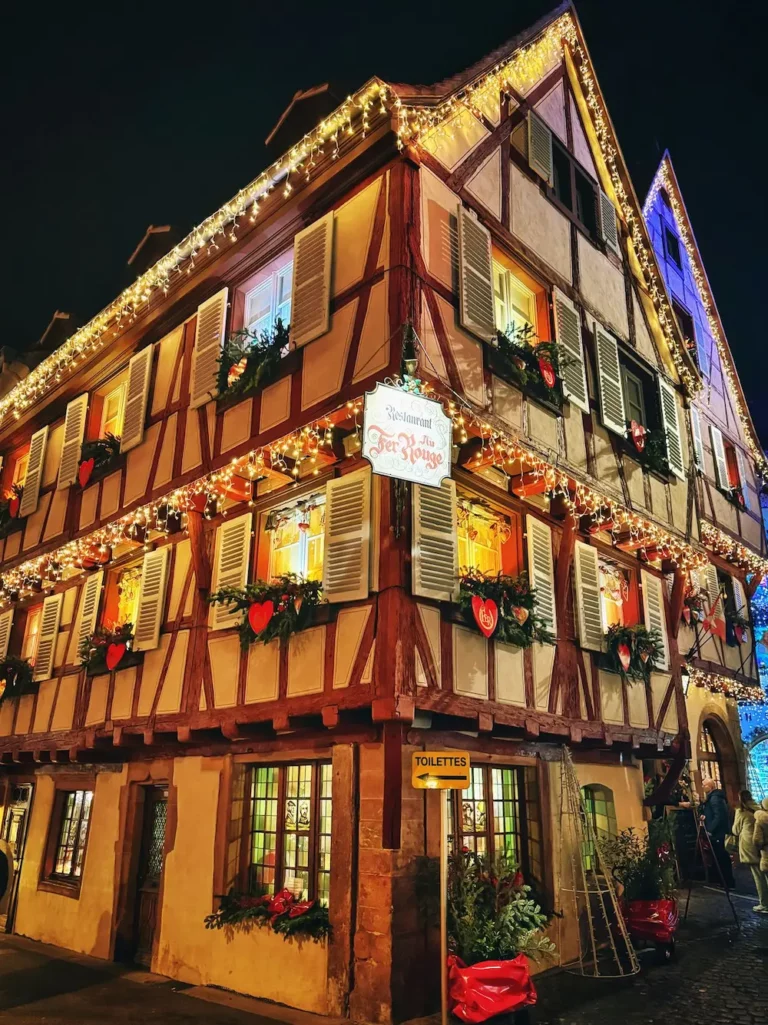
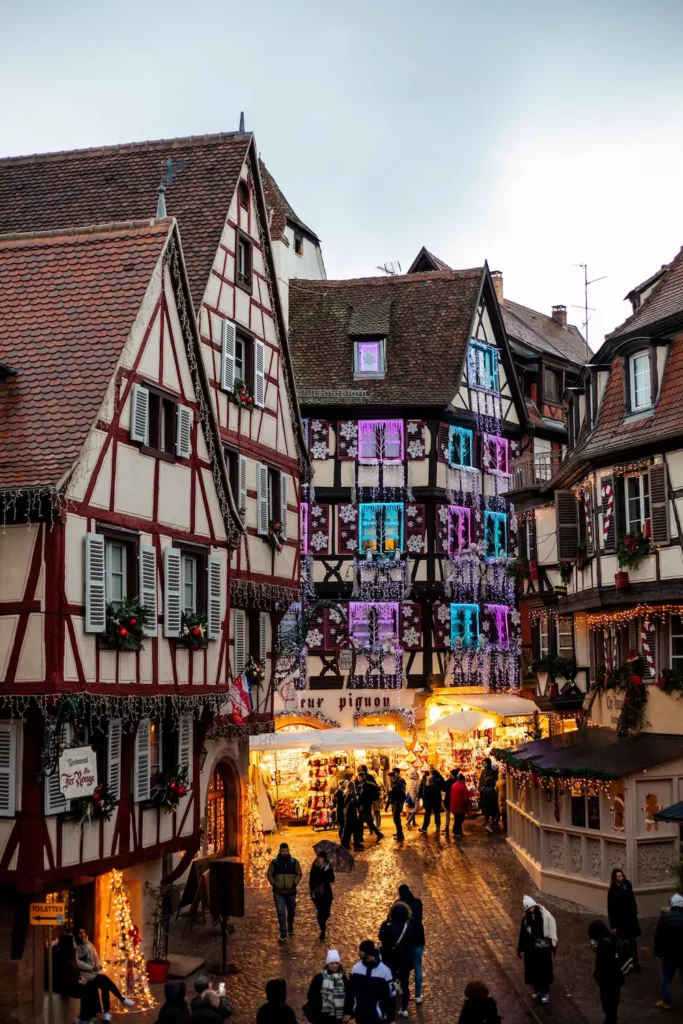
Colmar is the pretty one. Six themed markets sit inside a half-timbered old town that looks like an Advent calendar even in July. There's a children's market in Little Venice, where kids' choirs sing from lit-up boats on Wednesday and Saturday evenings from 17:00, and vin chaud was a euro cheaper than in Strasbourg last season. It's also the better base for the villages, because every Christmas shuttle leaves from Colmar station.
One catch with Colmar. Its markets close at 19:00 on Monday to Thursday, and it's properly dark by about 17:00, so a weekday visit gives you two hours under the lights. Get there in the afternoon and stay for dinner.
Sleep in Colmar if the villages are the point, sleep in Strasbourg if you want a bigger city with more going on after dark, and take a weekday trip to the other one.
Why do the villages decide your dates?
Most people book Strasbourg first and try to squeeze the villages in later, and that's backwards. The big two run every day for a month. The villages don't.
Kaysersberg opens on four Advent weekends only, Friday to Sunday, from 27 November to 20 December. Ribeauvillé's medieval market runs on just four days, 5–6 and 12–13 December. Riquewihr is open every day but finishes on 20 December. Pick your village days first, fit Strasbourg and Colmar around them, and you'll see everything.
Each village does one thing really well. Kaysersberg is the craft market, about 30 chalets vetted by a local association in a valley under a ruined castle, and it's the one I'd put first.
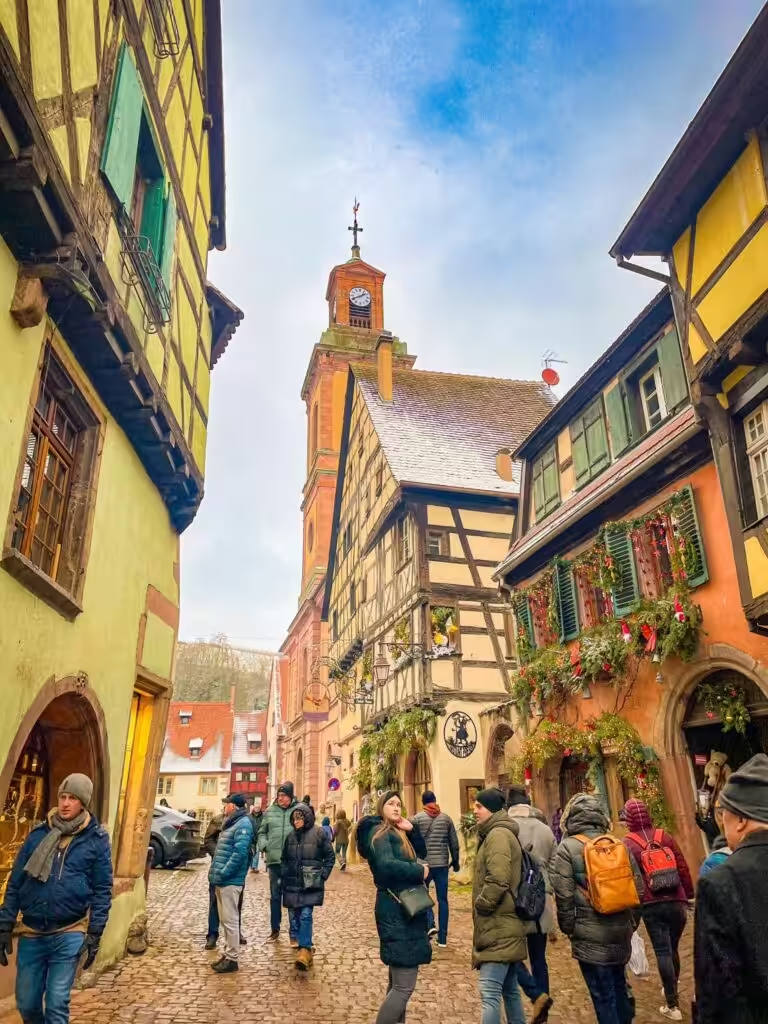
Riquewihr has the prettiest street in Alsace, climbing past wine cellars to the Dolder gate. Ribeauvillé is a full medieval show with minstrels, costumed beggars and spit-roast boar, great fun and absolutely packed on all four days. Eguisheim winds its stalls round the village's circular lanes and runs to 30 December, but it shuts from 24 to 26 December.
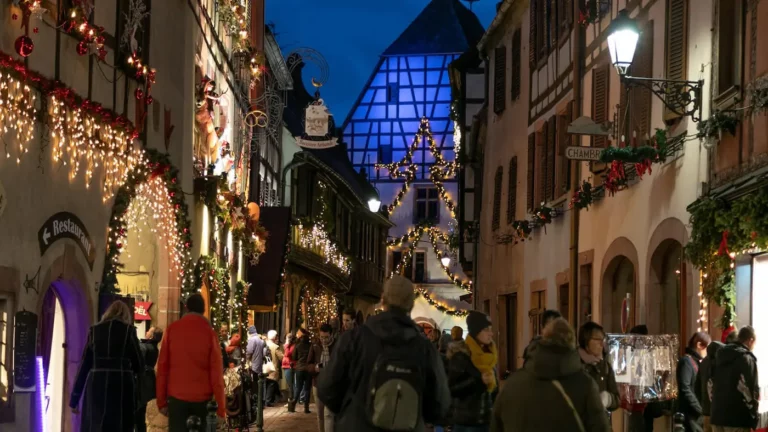
Then there's Turckheim, which almost nobody plans for and everybody should. The official crowd forecast rates it fluid or moderate on almost every day of the season, and it has a night watchman who walks the streets at 21:00 every evening from 1 to 30 December, Christmas Eve and Christmas Day aside, with a lantern, a halberd and a tricorn hat, singing in Alsatian. It's a short bus or train ride from Colmar, and the town bus costs €1.50 by card or €2 in cash.
Two villages a day is the limit. The light goes before five, the roads and buses fill up, and anyone who tries three ends up seeing the third one in the dark from a bus queue.
How many days do you need?
Three to five days covers Alsace properly. Give Strasbourg one or two of them, Colmar one, and the villages one Friday, Saturday or Sunday when the shuttles run. With five days you can add Turckheim, Eguisheim or Obernai without rushing anything.
Go much longer and the markets start to blur. By the second week every chalet seems to sell the same wooden star, and that's your sign to swap a market for a winstub lunch or a wine cellar.
How do you avoid the crowds?
You can't avoid them completely, but Alsace tells you exactly when they'll come. The Colmar tourist office publishes an official 2026 crowd forecast, day by day and hour by hour, for Colmar and nine villages around it, and Strasbourg publishes its own busy times.
The pattern is easy to remember. Saturday is the worst day everywhere, from lunchtime until closing, and Sunday is close behind, busy in Strasbourg from the moment the stalls open. In Strasbourg, Monday, Tuesday and Thursday are quiet all day, Wednesday gets busy from 14:00 because French schools finish early, and Friday fills up after 16:00.
In Colmar the quietest windows are the opening days, 23 to 26 November, and 14 to 17 December. Riquewihr is calmest from Tuesday 15 to Friday 18 December. Kaysersberg only runs at weekends, so go on a Friday, ideally 27 November or 18 December, which the forecast rates as moderate. Stay away from Colmar on 21 and 22 December, when everyone who left it late turns up at once.
One more trick works in Strasbourg, where the stalls stay open until 21:00. Do your shopping in daylight, sit down for a long dinner when the after-work crowd arrives around 17:00, and walk back through the markets after 20:00, when they thin out and the lights are still on.
Can you do Alsace without a car?
Yes, and in December you probably should. Parking in the villages is chaos, Colmar's centre is closed to cars during market hours, and Strasbourg keeps cars off the Grande Île altogether, with checkpoints and bag searches at the ways in.
The trains do the heavy lifting. Strasbourg to Colmar takes 26 minutes at the fastest, with 28 trains a day and fares from €6. Sélestat is 10 minutes from Colmar, Mulhouse about 20, Obernai is half an hour from Strasbourg, and Paris to Strasbourg is from 1 hour 43 by TGV.
The easiest way into the wine villages is the Christmas shuttles from Colmar station, and they have rules worth knowing before you land. They run from 27 November to 20 December. Tickets are online only, they go on sale on Thursday 12 November at noon, and there's a fixed number for each day. A small batch of last-chance tickets goes on sale three days before each travel day.
The wine-village loop through Kaysersberg, Riquewihr and Ribeauvillé runs Friday to Sunday only and costs €17 for the day with unlimited hops. Eguisheim has its own line too, €8 from Monday to Thursday between 1 and 17 December (except Monday 14 December) and €17 from Friday to Sunday. Children under 12 ride free but still need a booked ticket, and the Alsa+ regional pass isn't valid on any of them.
Regular buses fill the gaps on the other days. Line 816 runs from Colmar to Riquewihr and Ribeauvillé for €4, about nine times a day from Monday to Saturday but only four times each way on Sundays. Line 813 to Kaysersberg doesn't run on Sundays at all, and the open-top wine-route bus you might find online stops for the winter in October.
If there are a few of you, the Alsa+ Groupe Journée pass covers two to five people on every regional train, tram and bus in Alsace for €45 on a Saturday, Sunday or holiday, though not the TGV or the Christmas shuttles. With four of you, that works out at €11.25 each for the whole day. And in Colmar itself, all local buses are free on the Advent weekends, 5–6, 12–13 and 19–20 December.
What does it cost?
Entry is free at every market in Alsace. A cup of vin chaud was €4 in Colmar and mostly €5 in Strasbourg last season, with fancy white, organic or fruit versions up to €7. Strasbourg adds a €1 deposit on the cup, which you get back at any drinks chalet. That makes Alsace cheaper than Vienna, where punsch runs €5.50 to €5.80 plus a €5 mug deposit, and about level with Nuremberg at €4.50.
A plain tarte flambée costs €10 to €11 on the market, a plate of spaetzle or sauerkraut €9 to €12, and a light lunch for two with a tarte flambée, a white sausage and two vin chaud comes to about €30 on the main squares. The same lunch at the producers' market on square Louise-Weiss costs less than half that. Bredele sell for €30 to €40 a kilo at the chalets, and yes, you will buy some. In Kaysersberg the printed mugs cost €2 and aren't refundable, so take your own cup if you'd rather not collect them.
The real cost is the hotel. On market weekends central Strasbourg rooms can cost two or three times their normal rate, and one four-star that charges €187 off-peak was listed at €546 for a market weekend last season. Weeknights cost less in both cities, and in Colmar a package break is about €40 a person cheaper if you arrive between Sunday and Wednesday. Book early, then go midweek.
What's open on Christmas Eve and Christmas Day?
Strasbourg usually closes at 18:00 on 24 December and that's the end of its season. Colmar keeps going. It's open until 17:00 on Christmas Eve, from 10:00 to 20:00 on Christmas Day, and on 26 December too, which is a public holiday in Alsace even though it isn't in the rest of France.
Colmar is the only market in Alsace open on the 25th. Its six markets run to 29 December, and the gourmet market and big wheel on Place Rapp carry on until 3 January.
If you're here between Christmas and New Year, you still have options. Obernai runs until 31 December, Turckheim and Haguenau to 30 December, and Mulhouse and Sélestat to 27 December. They all close on Christmas Day itself, but they're back on the 26th.
Should you cross the border too?
You're right on the Rhine, so it's tempting, and it's easy. Strasbourg's tram D crosses the river into Kehl in Germany, and Colmar is 44 minutes from Basel at the fastest by train.
The catch is the calendar. Freiburg runs from 19 November to 23 December and Basel from 26 November to 23 December, so both pack up before Alsace does. Freiburg's Glühwein was €4 to €5 last season, basically Alsace money, while Basel charges around CHF 6 plus a CHF 4 deposit for the mug.
If you do one border day, make it the Black Forest. The Ravenna Gorge market sits under a railway viaduct in a valley near Freiburg and is one of the most beautiful Christmas markets in Germany. It's timed-ticket only, and all 75,000 tickets sold out on the first day of sales last season. This year's go on sale on 14 October at 10:00, so treat it like a concert and book that morning.