A question I get more often than you’d expect… Can you base yourself in Düsseldorf, do the Cologne Christmas market, and save some money on the whole thing?
Yes, the answer is a resounding yes!
However, framing Düsseldorf as a discount ticket into the Rhineland’s Christmas season is probably doing this city a disservice, in my opinion, because Düsseldorf is one of the more underrated Christmas market spots in Germany in its own right.
It runs thirteen markets, it keeps pouring beer and wine after the stalls close, and it has one eggnog stand that I planned a whole evening around (more on the Malfertheiner family shortly, don’t worry).
So is Düsseldorf worth visiting for Christmas, and should it be your base? The answers are related, but they’re not the same.
What the Düsseldorf Christmas Market Actually Is
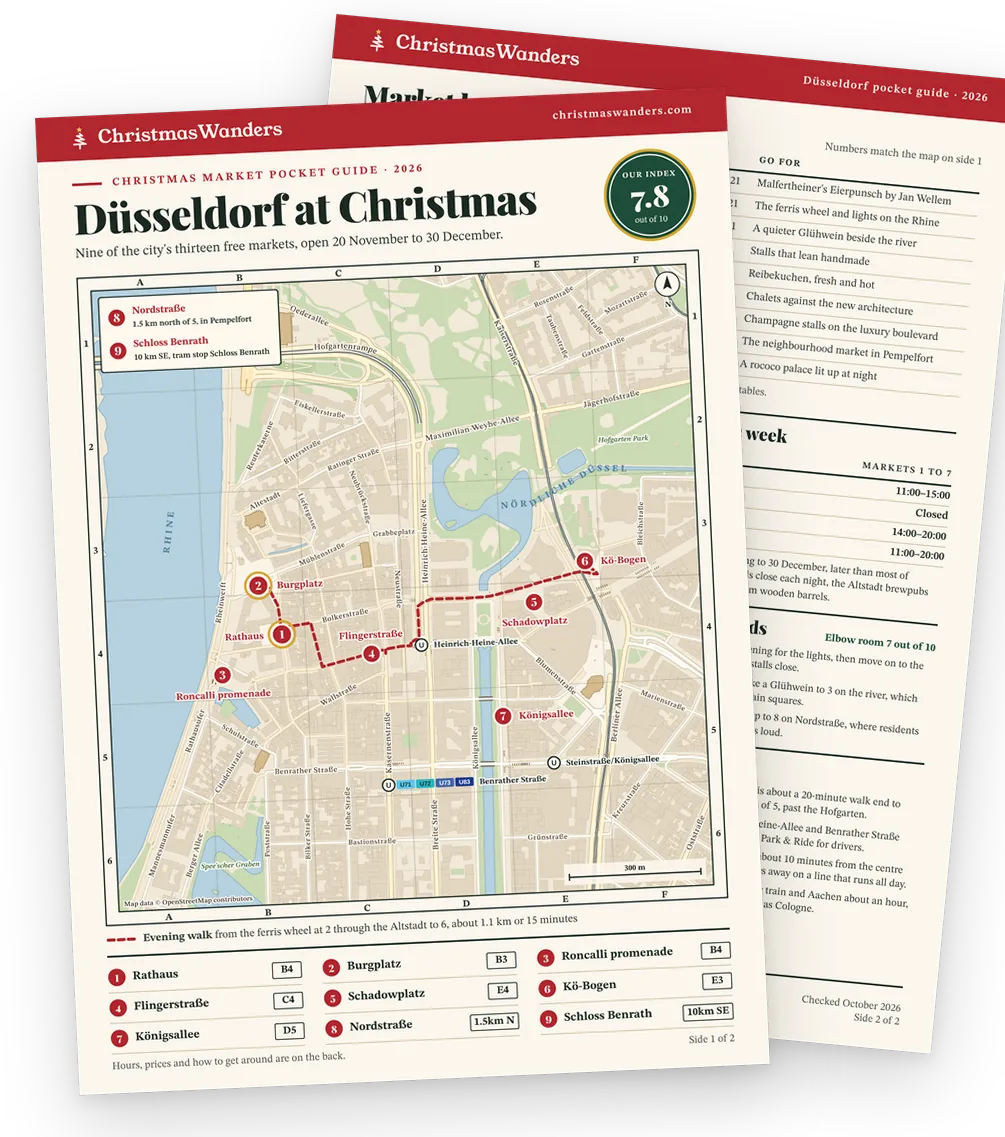
The core crawl, from west part of the city to the east:
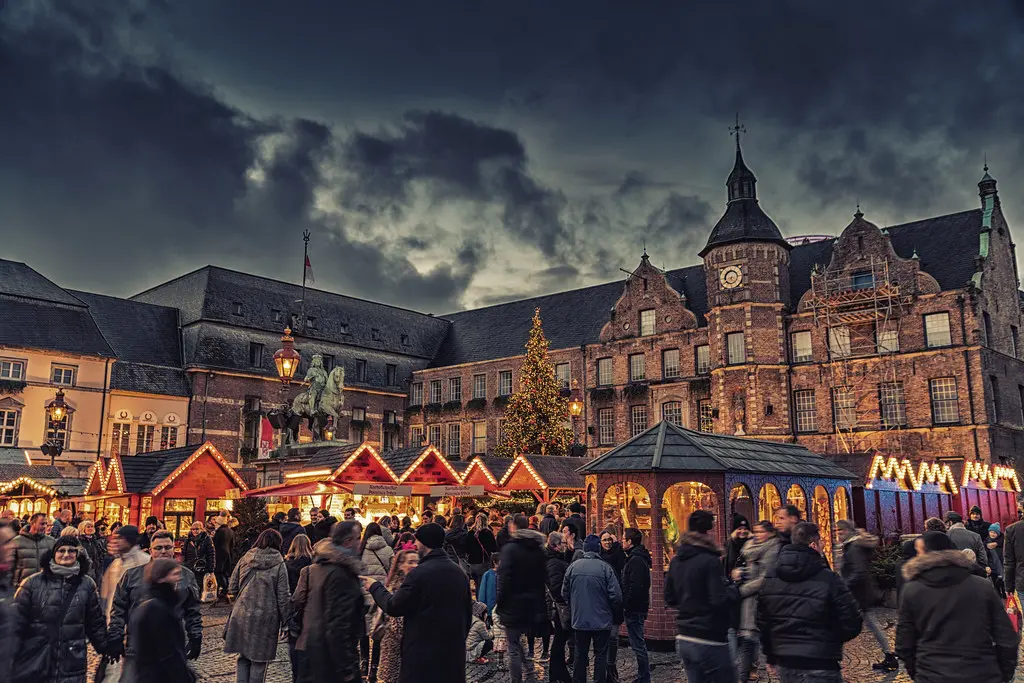
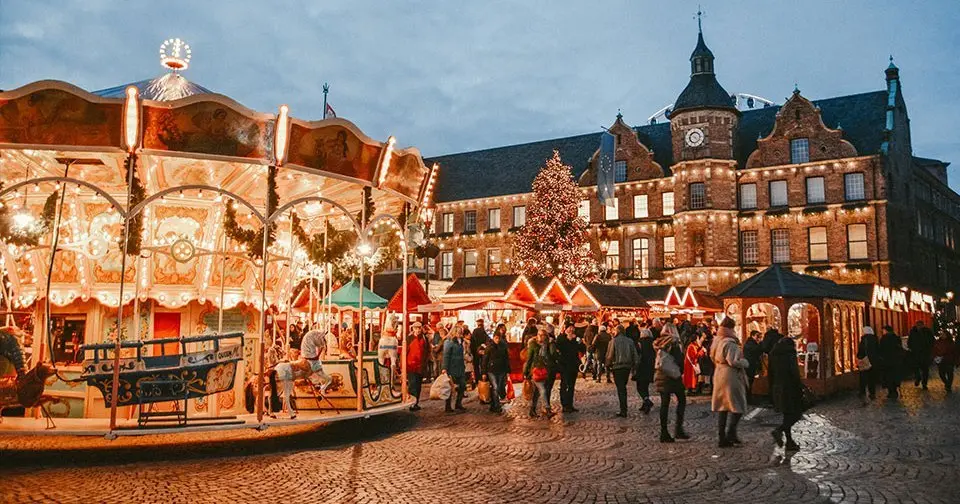
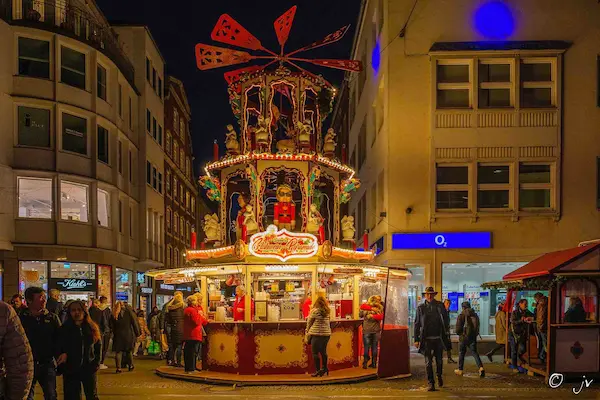
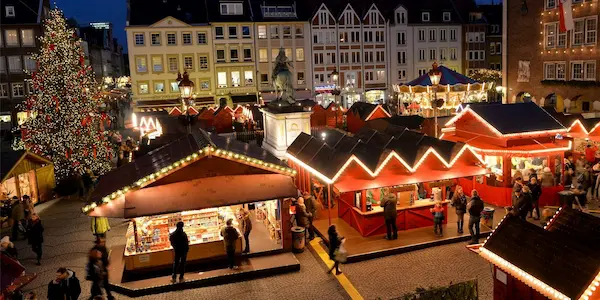
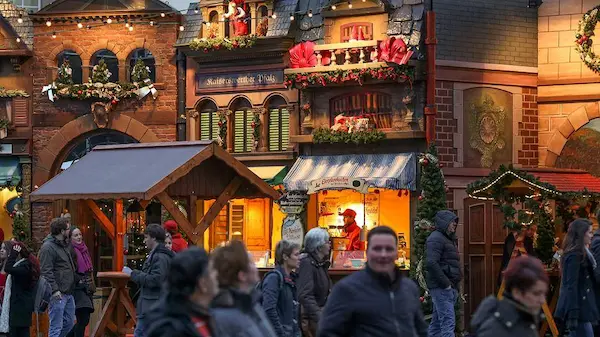
- The Rathaus market in the old town, around the official Christmas tree, with the Handwerkermarkt (the craft market) stretching in front of the illuminated Town Hall. This is the heart of it.
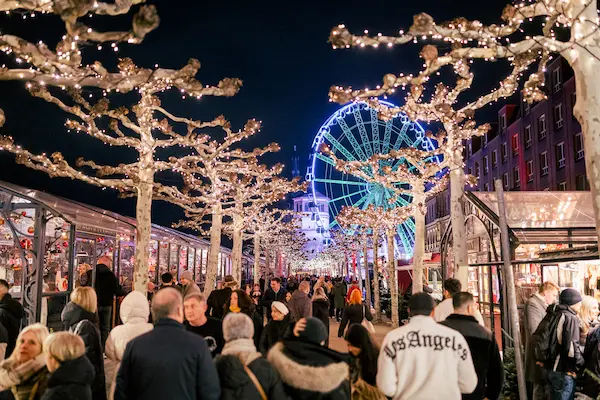
- Burgplatz, at the foot of the old castle tower by the Rhine, with the ferris wheel rising over the river. Walk down to the promenade after browsing, because the lights reflect on the water, and the market looks twice as expensive as it is.
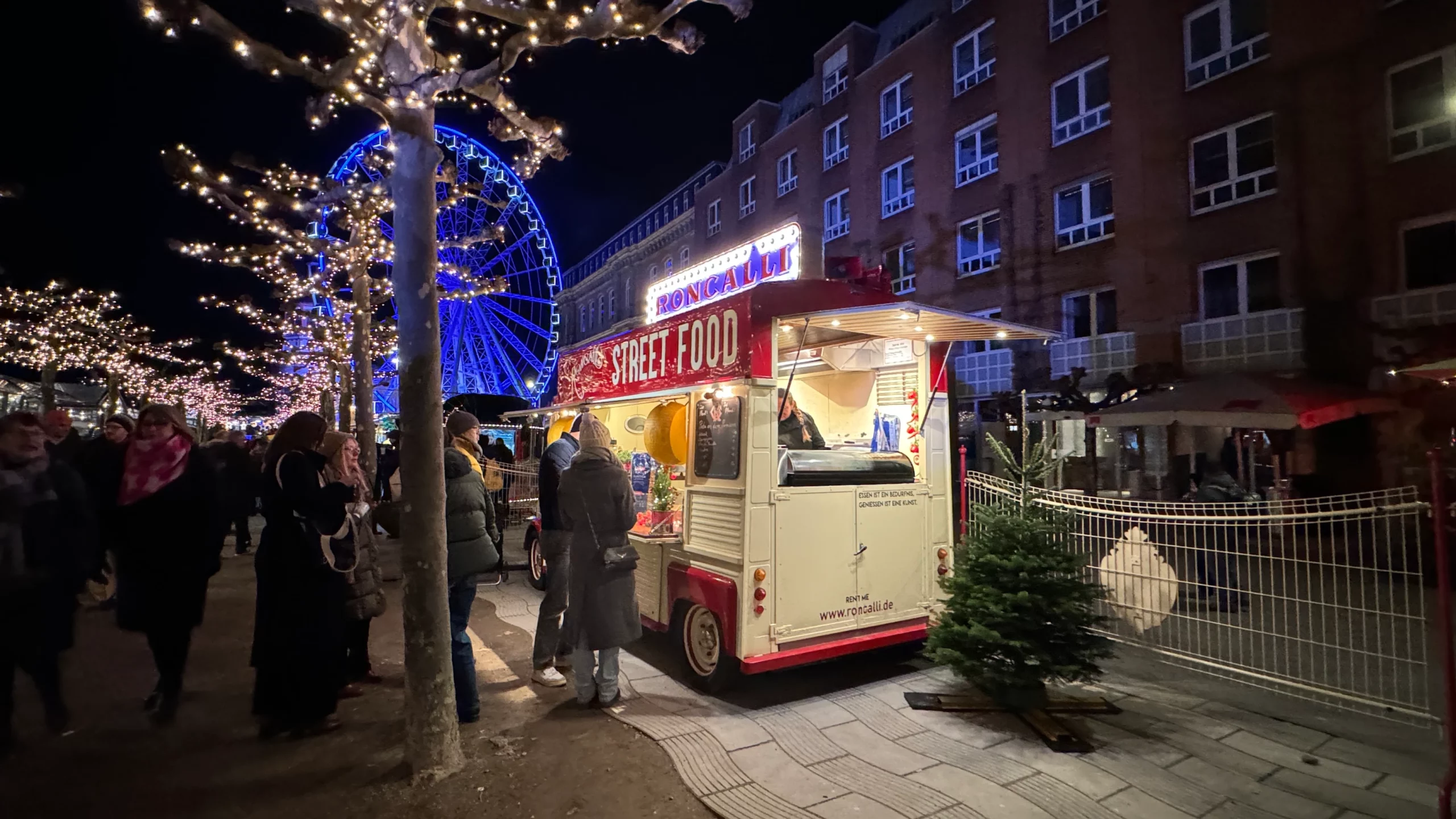
- The Roncalli Weihnachtspromenade, the riverside stretch between Burgplatz and the Landtag. The promenade gets less crowded than the main squares, so it’s the quiet-glühwein spot.
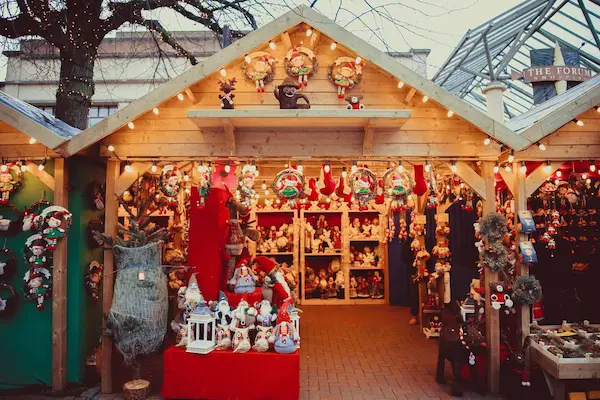
- Flingerstraße, running from the old town toward the Kö, where the stalls mostly lean handmade.
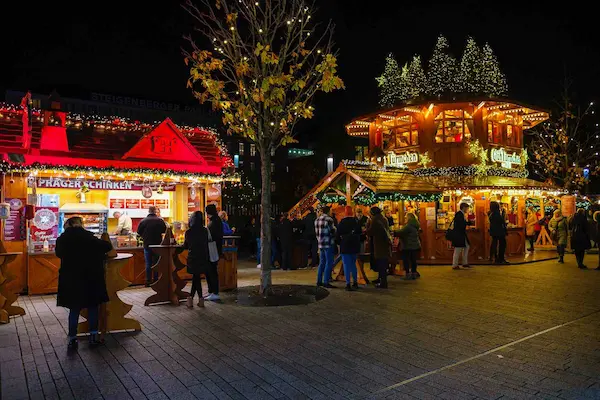
- Schadowplatz, the workhorse gift market, and the one where the Reibekuchen are fresh and hot (filed for later, this matters).
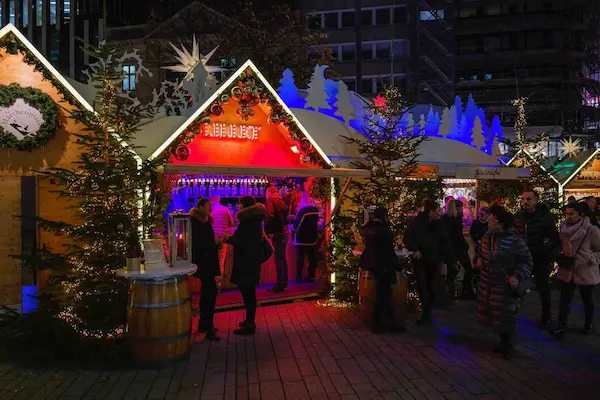
- Kö-Bogen I and II, at the modern end of the boulevard, where the new architecture makes an odd, kind of striking backdrop for traditional chalets. Kö-Bogen II is the calmer of the two, in my experience.
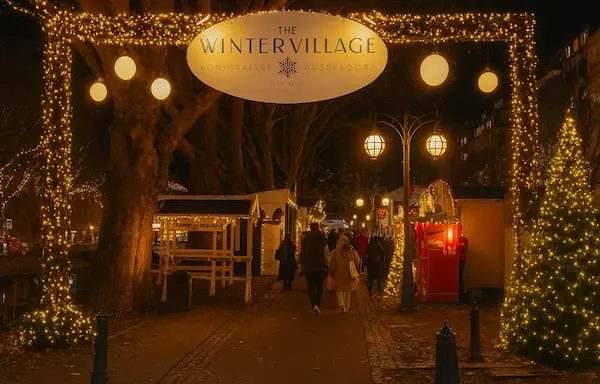
- The Königsallee market, the Winter Village on the luxury boulevard. This is Düsseldorf’s glamorous walk-through, and the champagne stalls are the only real splurge I’d recommend (Christmas wants to see your credit card, apparently).
- Schadowstraße, which I’ll be honest about, as its neighbors are prettier. It’s only a line of stalls on a shopping street, good for present-buying variety but that’s about it.
Here are also the outliers, which is usually where people go on their second day in Düsseldorf:
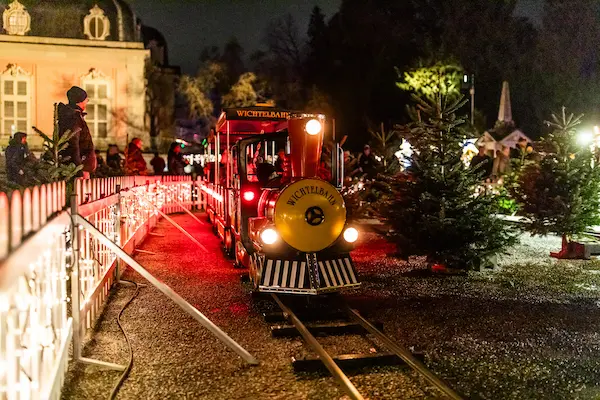
- Schloss Benrath Weihnachtszauber, at the rococo palace in the Benrath district, where the palace is lit up at night. Worth the trip just for this stunning view.
- Nordstraße in Pempelfort, the neighborhood market, and it’s where the crowd escapes if the old town gets loud.
- Areal Böhler, out near the trade fair grounds, which is sort of for the younger crowd with live music and a different vibe entirely.
- Arcaden market, inside a shopping centre, which I mention because it’s the weather backup. When the Rhine rain arrives, so does everyone else.
The Engelchen-Markt, on the other hand, with its gold stalls and its music pavilion, is the pick of the lot for all of those looking for handmade products.
Food and Drink: Is There Anything Special? Yes, One Family and One Beer
You can get glühwein and a bratwurst at literally any German Christmas market, so I try to judge a market by what I can’t get anywhere else.
Düsseldorf has two of such things and they both come in a cup.
The first is wine and eggnog you can get from the Malfertheiner stand. For more than 35 years, the Malfertheiner family has run the traditional mulled wine and eggnog punch stand on the Handwerkermarkt, in the same fixed spot right behind the Jan-Wellem monument in front of the Town Hall.
The eggnog punch in question is Eierpunsch, the warm German egg-and-white-wine cocktail that a lot of markets serve as an afterthought.
In Düsseldorf, however, this one is a signature drink. Velvety, spiced, served in front of an illuminated Town Hall… absolutely amazing and unforgettable.
They’ve won the best-eggnog award at the market many times, and they have loyal regulars who come back every single year, and visitors such as myself who have it on their must-visit list.
The second thing is Altbier led by the Altstadt, the old town in Düsseldorf, which markets itself as the longest bar in the world with something close to 260 pubs, bars and breweries packed into half a square kilometre.
Altbier is the local style, a top-fermented copper ale that the brewpubs pour straight from wooden barrels. My experience and what I’ve heard from locals first-hand is that you go to the Christmas market for the lights in the early evening, and then go to Altstadt in the later parts of it.
As for the food in Düsseldorf, I’d describe it as the standard bratwurst-and-glühwein Christmas market food, which is good, don’t get me wrong, but not travel-worthy.
The one stall I really liked is at Schadowplatz and its fresh Reibekuchen, the Rhineland’s potato pancakes with apple sauce.
The region here does have some amazing food such as the Rheinischer Sauerbraten (pot roast in sweet-and-sour raisin gravy), the Himmel un Ääd (“heaven and earth”: black pudding, mashed potato, apple sauce), the Halve Hahn (which translates as “half a chicken” and is not a chicken at all, and it’s rye bread, thick Gouda, butter, and mustard…Those live in the old-town restaurants, which is where you end the evening after you finish your stroll through the Christmas markets of Düsseldorf.
By the way, Düsseldorf is considered one of the great mustard cities of the world, which sounds made up until the Halve Hahn arrives and you finally get it.
Beyond the Markets: Is Düsseldorf Worth It As a City?
This is where the base question really gets decided, so let’s take it seriously.
Because here’s the thing about Cologne: it has the cathedral, and the cathedral is magnificent, but once you’ve done the cathedral and the market squares, Cologne’s December evening is mostly… Cologne.
Düsseldorf gives you a full city day between mulled wines, and in December daylight, I think that matters a whole lot.
The walk to start with is the Rheinuferpromenade which is the riverside promenade from the old town south toward the Media Harbor, with Frank Gehry’s leaning buildings at the end of it.
It’s cold, wide, with the Rhine doing its grey winter thing and you have this huuuge ferris wheel behind you. This walk takes about an hour, and you are absolutely going to enjoy it.
Then you have the Rheinturm, which is the 240-metre TV tower by the promenade, with the viewing deck everyone photographs. The detail I love here is the strip of lights running up its shaft which aren’t exactly decoration. It’s one of the world’s largest decimal clocks, telling the time in lights since the 80s.
You can decide whether that’s charming or very German (it’s both, obviously).
You also have the Hofgarten, the grand old 18th-century park that wraps around the eastern edge of the center. Use it as the between-markets breather.
I know people will say it’s really only bare trees, gravel paths and statues with pigeons on them. It’s not a Christmas activity exactly, but a winter walk there with a coffee is a nice palate cleanser between the market crawl and the museums.
And since I am a museum fan, the museums in Düsseldorf are definitely worth your daylight hours, which not every German Christmas city can say.
The Kunstsammlung (K20 and K21, two buildings) is one of Germany’s great modern art collections, with Kandinsky, Picasso, Richter, Beuys, Warhol between them.
The K21 is the famous one for visitors, because of In Orbit, Tomás Saraceno’s giant net suspended 25 metres above the museum’s piazza, which you can climb out onto.
Yes, really. You put on overalls, you climb out over the void, and you look down at the marble floor through a net.
It’s the single best bad-weather December activity in the city.
So: is Düsseldorf worth it beyond the markets?
Yes!
Rhine Christmas Markets vs Bavarian Christmas Markets
I honestly did not see too many comparisons of this kind on the World Wide Web, so I’ve decided to do one.
In my experience, the German Christmas market world has two big families.
There’s the Bavarian cluster (Munich, Regensburg, Nuremberg, up into Saxony for Dresden), and there’s the Rhineland cluster (Cologne, Düsseldorf, Dortmund, Essen, Aachen, Bonn).
They’re quite different so I think everyone should know it before they decide to book their trips.
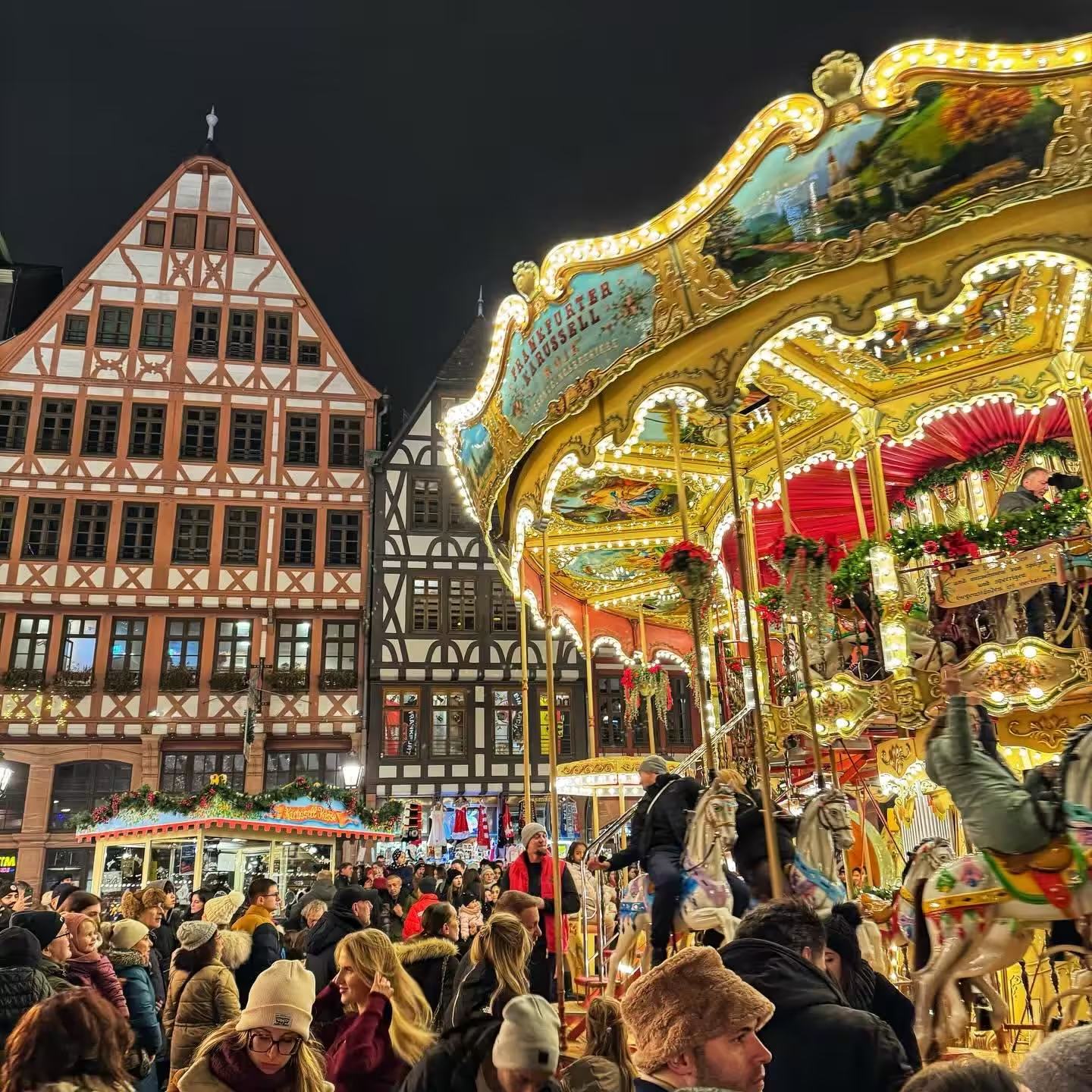
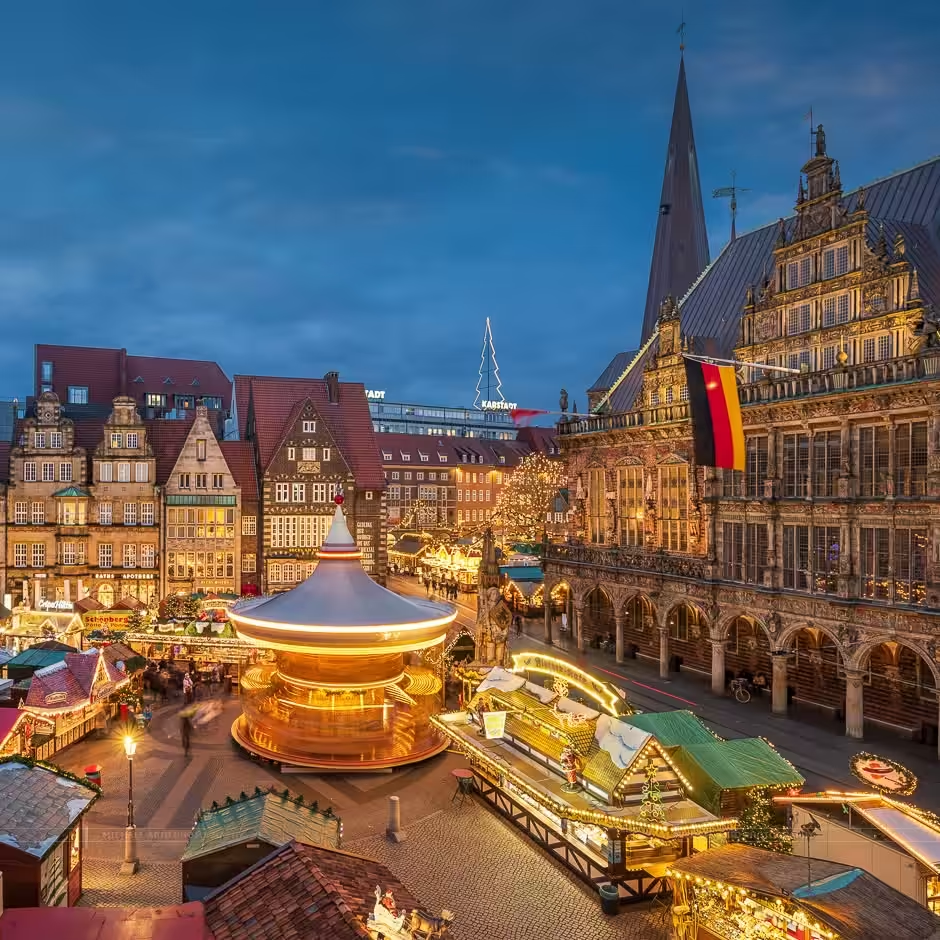
The biggest Bavarian Christmas markets’ pitch is the postcard effect. Half-timbered and medieval, spires and lanterns, the Christkind opening ceremony in Nuremberg, the torchlit palace courtyard in Regensburg, the never-bombed old town.
This is the Germany of the imagination, and it earns it, at least from my perspective.
The Rhineland pitch is somewhat different. It has fewer postcard squares but more sprawl, more markets per city, more variety, more convenience, and more fun per hour.
In Rhineland, everything pairs with everything, too (Cologne to Düsseldorf is 25 minutes on a train that runs all day), the region opens earlier than the rest of Germany (Cologne’s markets open on 13 November, weeks before Nuremberg), and the season runs later too (Düsseldorf, for example, keeps going to 30 December).
Bavaria seems to get all of the world’s tourists in December which can’t be said about the Rhineland since the crowds in Rhineland are more German (for those who want more of a local feel).
So how do you choose between the two families?
In my experience it comes down to one question: is this your first German Christmas market trip?
If it is, go Bavaria. The postcard feel is important, and you should see the archetype before you start seeing all the variations.
If you’ve done the classics, or you’re a market-hopper who wants five cities in a week with zero rental car and late-night trains between them, the Rhineland is built for you, and Düsseldorf might be its most underrated base.
How Düsseldorf Ranks Against the Big Names
Düsseldorf is not Nuremberg, let’s be real about that.
It has no cathedral moment, no 1434 pedigree, no teenage angel opening proceedings from a balcony. Nobody’s grandmother took a black-and-white photo of the Düsseldorf market.
But at the same time, no single square in Düsseldorf ever feels like the shoulder-to-shoulder thing like Nuremberg’s or Cologne’s cathedral market becomes on a December Saturday, because four million people a season aren’t being poured into
How Many Days, and Should You Combine It?
I think one day covers the core crawl. The central stretch from Burgplatz to the Kö is maybe a 20-minute walk end to end, so you can do the main markets, the ferris wheel, and the eggnog stand in one long afternoon-and-evening.
You’ll miss the outliers, though, and in my experience, they’re the second day’s business with Benrath’s lit palace, the Pempelfort neighborhood market, a proper museum afternoon, and an Altstadt brewery crawl after the stalls close.
Two days is the sweet spot when it comes to Düsseldorf in December.
If you can do three or four nights, turn Düsseldorf into the full Rhineland base and make sure you visit the rest of the earlier mentioned markets.
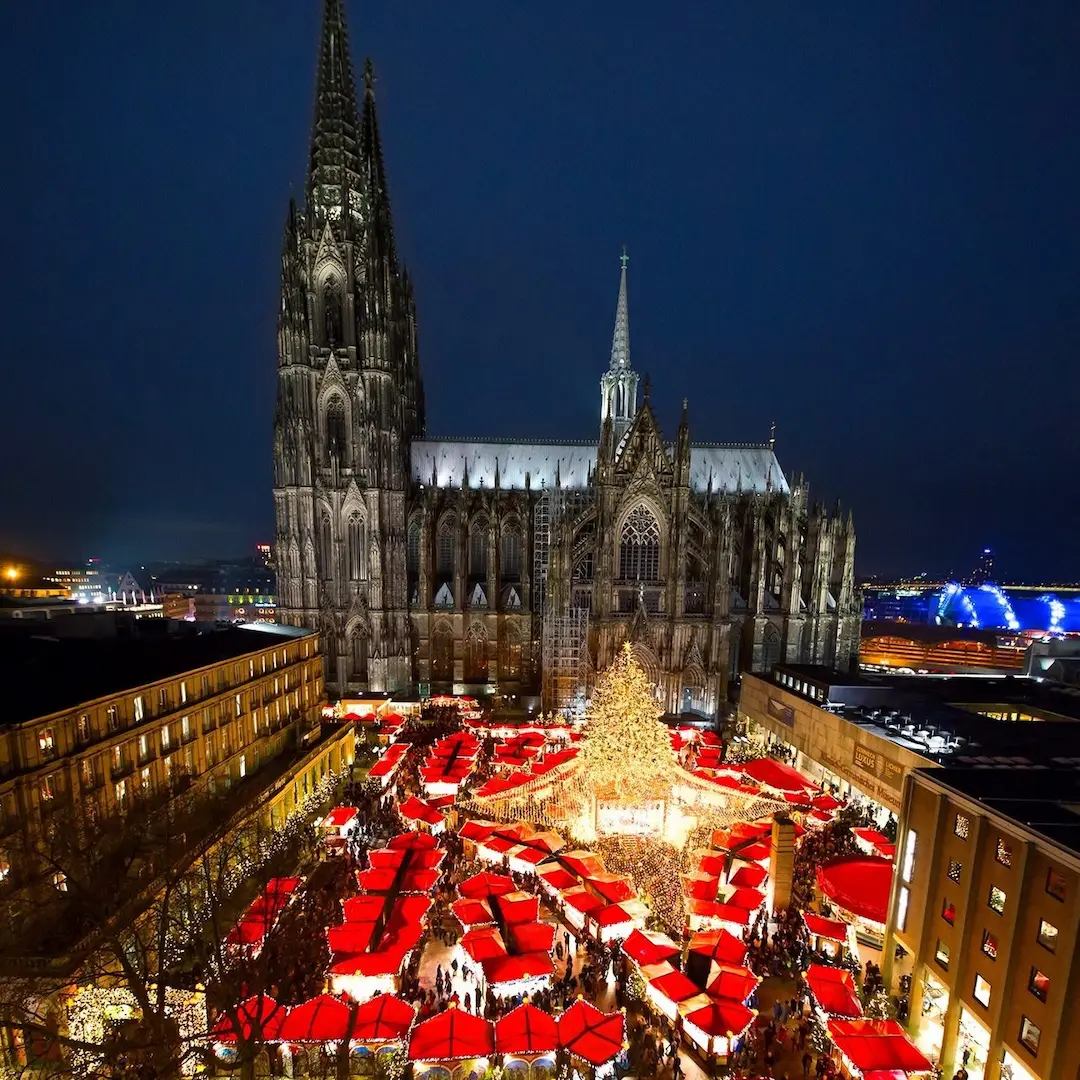
And yes, Düsseldorf is a good base for Cologne, with rooms that are much cheaper in December than Cologne’s. And since Cologne is only 34 km away, it’s an easy day trip on the 25-minute line.
And beyond that, Düsseldorf base gets you all of this:
- Duisburg and Essen, short hops, quieter and more local.
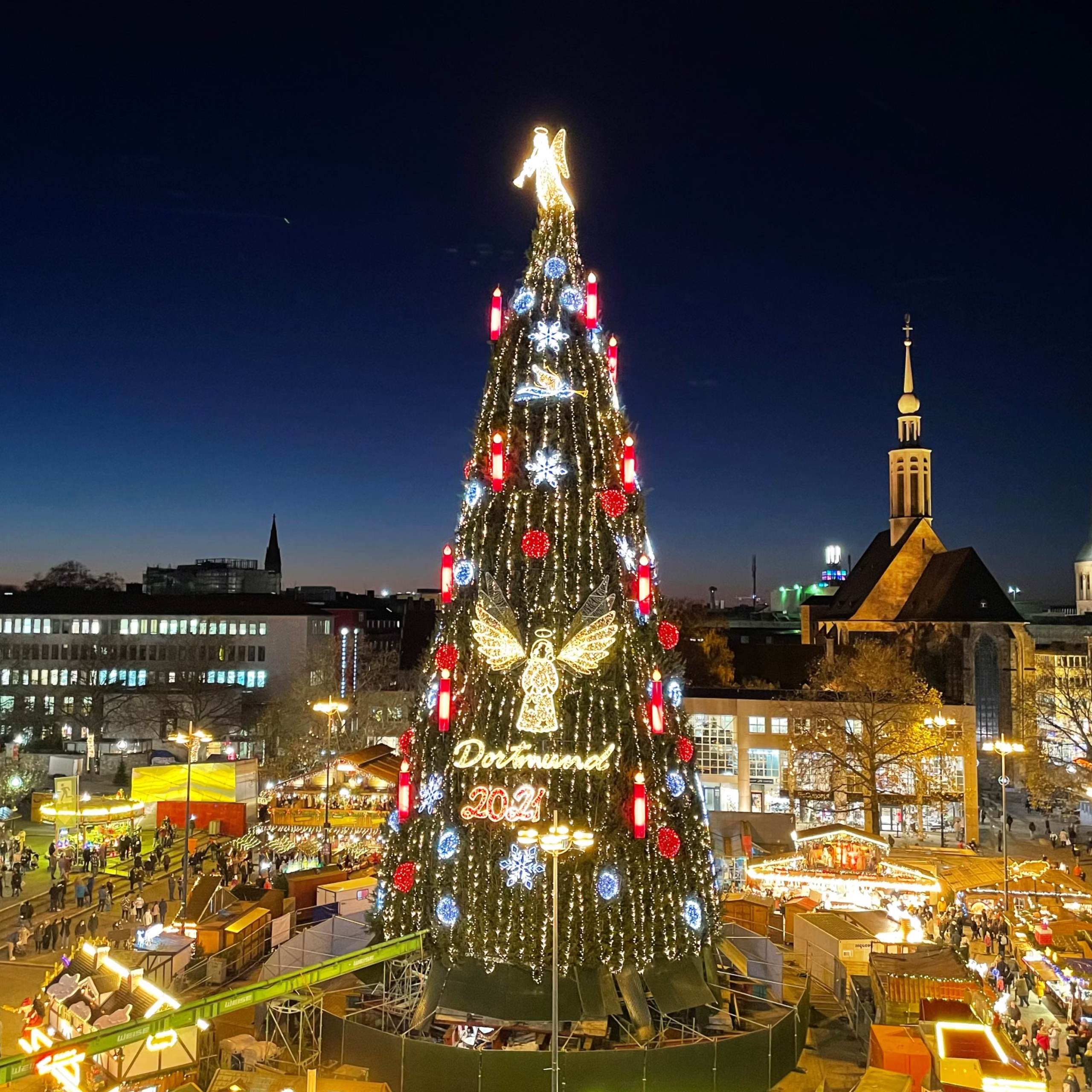
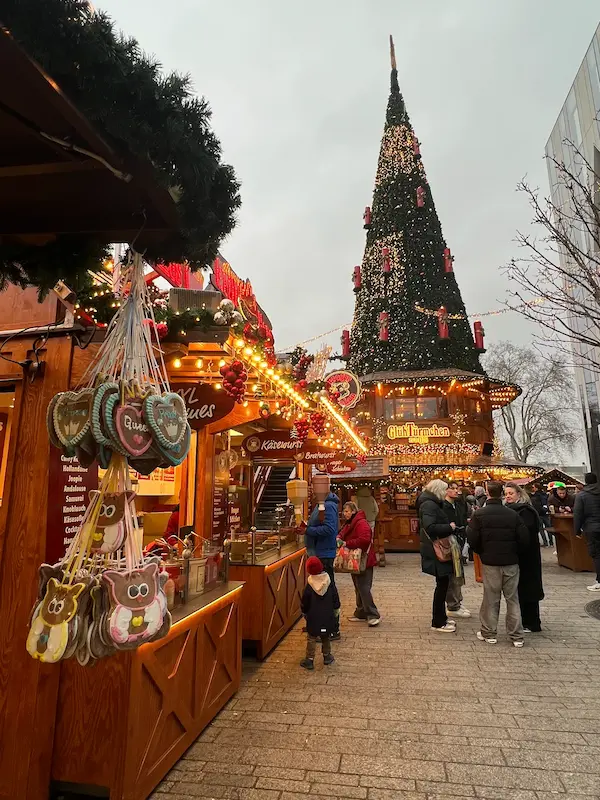
- Dortmund, in under an hour, with the giant-tree market.
- Aachen, about an hour, cathedral, printen, and a market that squeezes right up against the border.
- Bonn, on the same line as Cologne, a stop most people skip.
And for getting in, Düsseldorf’s airport (DUS) is one of Germany’s big international hubs, about a 10-minute train from the center. Works beautifully, if you ask me.
Conclusion: Where Düsseldorf Ranks, and the Verdict
Where does Düsseldorf rank among German Christmas markets?
It ranks pretty high on my list. You can see the full index on our website for current Christmas market rankings. Browse it before you book.