What Are Christmas Markets in Norway Like?
Norway ought to have the best Christmas markets in Europe, and it doesn't. I'd go anyway, because every one of its small, expensive squares has something wonderful sitting right next to it.
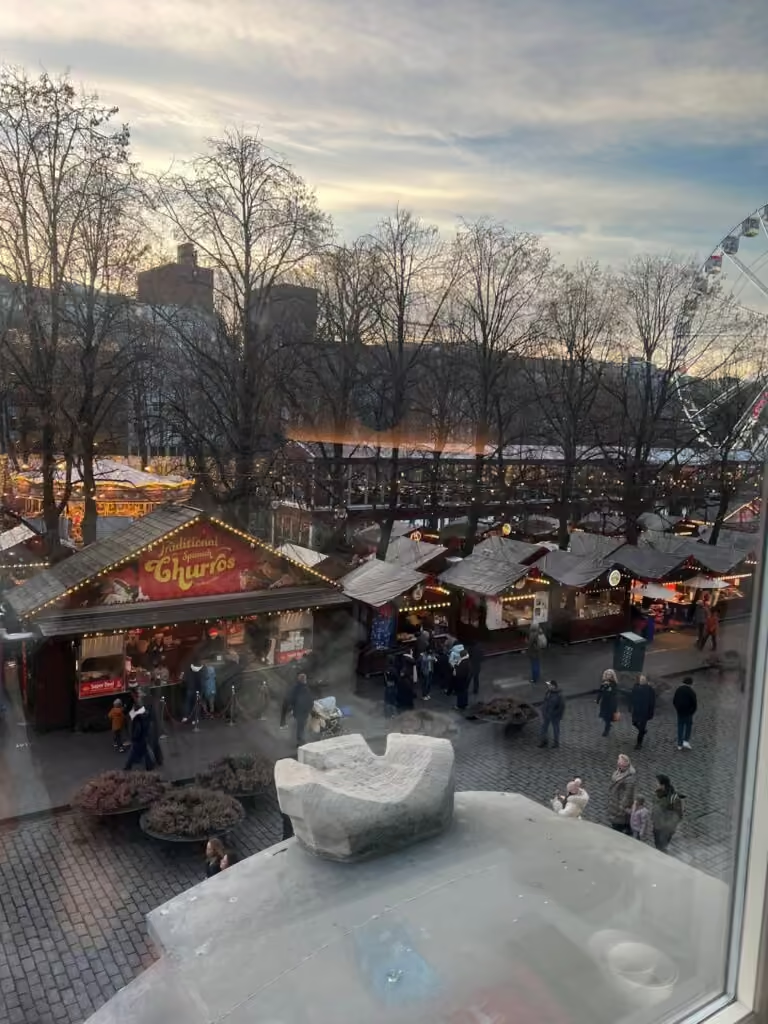
If you turn up with Germany in your head, the squares will let you down. Oslo's big market is a funfair with a few dozen stalls, Bergen's is a bright fairground by a lake, and Tromsø's is a ring of huts round some fire pits.
Then you walk a few minutes in Bergen and you're inside a town made entirely of gingerbread, built by the city's kindergartens, schools and families. A bus across Oslo drops you at an open-air museum full of craft stalls and old farmhouses, and in Tromsø the sun stops rising a week after the market opens, which leaves you drinking your gløgg by a fire in the polar night.
The fairs are the part that won't wait for you. The folk museum fair in Oslo gets two weekends, the old mining town of Røros gets four days and Egersund, near Stavanger, gets two long weekends, all of them in the first half of December.
For a first trip to the Christmas markets in Norway, pick one of the first two weekends of December and base yourself in Oslo, then add Bergen for the gingerbread or Tromsø for the northern lights.
When Are the Christmas Markets in Norway in 2026?
The Christmas markets in Norway run from Saturday 7 November 2026 to Sunday 3 January 2027, and Oslo's Jul i Vinterland is open for the whole of it.
Bergen and Tromsø both join on Friday 20 November. Bergen's stalls come down on Tuesday 22 December, before Christmas has even started, while Tromsø keeps going for as long as Oslo does.
You can walk into all three for nothing, and seasons that long are handy if your dates are fixed. The fairs worth travelling for are far fussier about when you come.
Thursday 3 to Sunday 6 December is when Norway has the most going on. Røros holds its whole market in those four days, Egersund has the first of its two long weekends, Trondheim opens on the Thursday, and on the Saturday and Sunday the Norsk Folkemuseum fair in Oslo and Lillehammer's market are both on.
If you can't make that, the weekend after is nearly as good. The Folkemuseum and Lillehammer are back on 12 and 13 December, and Egersund runs again from Thursday the 10th.
After the 13th the weekend fairs are finished. What's left is the city squares, Trondheim's until the 21st, and the smaller markets in Stavanger, Henningsvær and Hadeland.
The Best Christmas Markets in Norway
The best Christmas market in Norway is in Oslo, but only on those two fair weekends, and with a few more days I'd add Bergen before anywhere else. Our Index has the two cities almost level, at 6.7 and 6.6, and I'd split them the same way.
Oslo (My Pick)
Oslo gets my vote because of the Christmas fair at the Norsk Folkemuseum, out on Bygdøy, a bus ride from the centre.
The museum is a collection of old farmhouses in the open air, and for the fair it sets more than a hundred craft stalls among them, dresses the houses for Christmases from 1769 to 1959 and bakes lefse on the spot. This is the Norwegian Christmas I'd been hoping the city square would give me.
The Folkemuseum fair in Oslo costs NOK 200, with under-18s free, and it's open from 10:00 to 16:00 on all four days. Bus 30 goes from Jernbanetorget every five minutes on fair days, on an ordinary NOK 46 city ticket.
Back in the centre, the Oslo Christmas market most people mean is Jul i Vinterland, which runs along Spikersuppa on Karl Johans gate with a skating rink, a Ferris wheel and 42 stalls. It's a funfair with chalets attached, and there are more corn dogs than Norwegian cooking.
I like it best after dark, mostly for the rink. The ice doesn't open until Saturday 28 November, three weeks after the stalls, and I'd time an Oslo trip for after that.
An evening visit suits the opening hours anyway, because Jul i Vinterland in Oslo doesn't open until noon on weekdays, and if you want alcohol in your gløgg, the Gløgghus is the only place that pours it.
Bergen
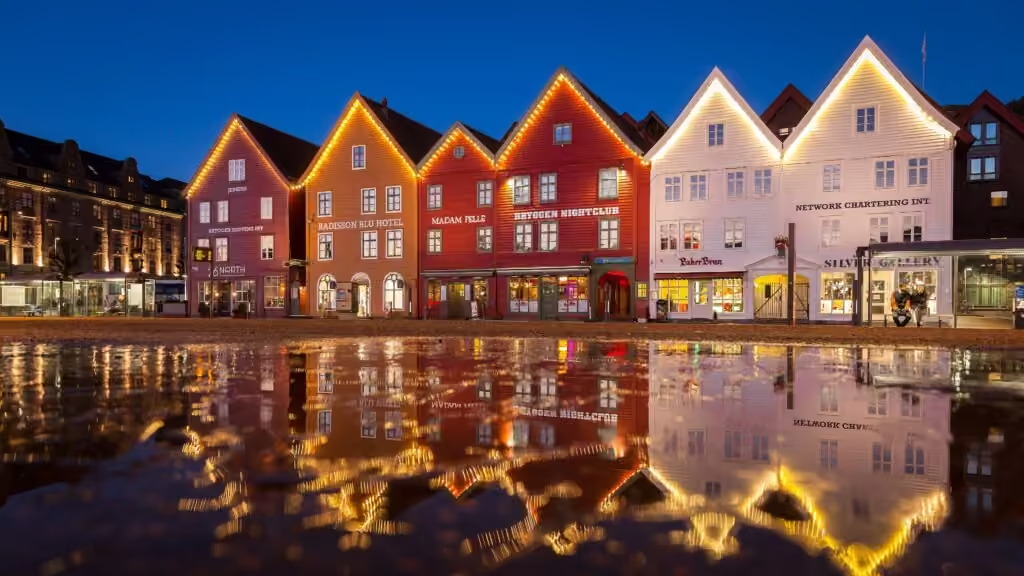
Bergen's market is a fairground first and a Christmas market second.
The Bergen Christmas market puts 94 stalls, food huts and rides on Festplassen, by the lake, under a Ferris wheel and a carousel. It's bright and good fun with children, and nobody would call it historic.
I'd go to Bergen for Pepperkakebyen. It's six minutes from the stalls, a whole gingerbread town baked and built by people who live there, from kindergarten classes up, and it got to me in a way a row of chalets never has.
Pepperkakebyen in Bergen stays open until 10 January, long after the market has gone, and that makes Bergen a real option for a New Year trip.
Bring a proper waterproof whenever you come, because Bergen is the wettest of the three, with about 20 wet days in December. On a dry evening, take the Fløibanen up Mount Fløyen, which runs until midnight.
Tromsø
Nobody should fly to Tromsø for its Christmas market, and I'd still go back tomorrow.
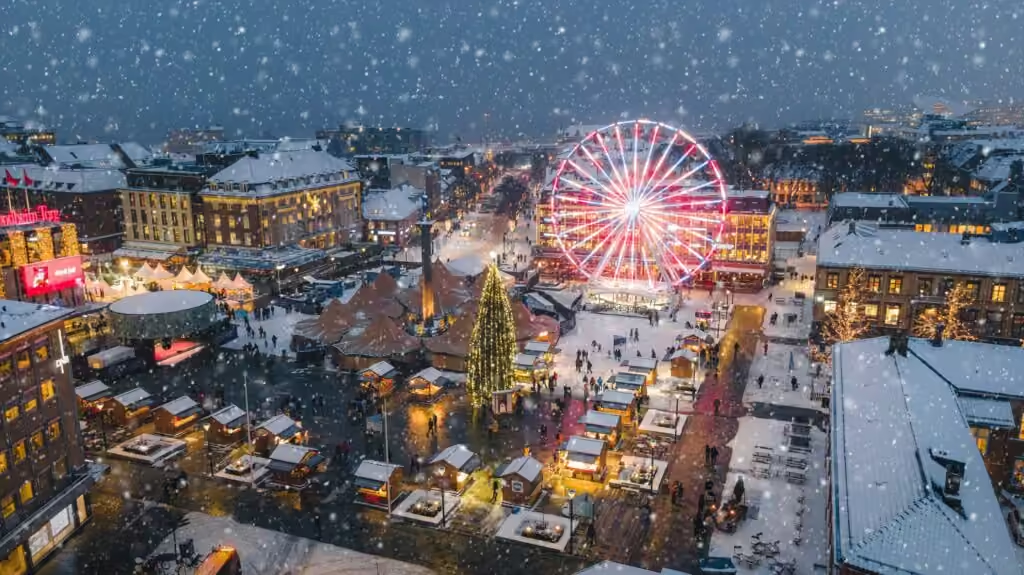
The Tromsø Christmas market is about 20 stalls on Stortorget, most of them selling food, gathered round open fire pits from 11:00 to 19:00. It only came back in 2025, and it won't keep you long.
Tromsø sits 350 km inside the Arctic Circle, and the polar night in Tromsø lasts from 27 November to 15 January, which means that after its first week the market never sees the sun. You stand at a fire with something hot in your hands in the middle of all that dark, and no row of chalets in Germany can give you that.
I'd book the northern lights, the dog sledding and the whale watching first and warm up at the fire pits between them. Don't count on a white square, though, because December can bring rain instead of snow even this far north.
Røros
Røros has everything the city squares are missing, and it's my answer when people ask which town in Norway is the most Christmassy.
It's a UNESCO-listed mining town of wooden houses that mostly has fresh snow in the weeks before Christmas, and for its market the streets fill with craft stalls, horse-drawn sleighs and real reindeer. Netflix filmed Home for Christmas there, which tells you how it looks in December.
Getting there is the hard part. Røros is about two and a half hours by train from Trondheim and about five from Oslo with a change at Hamar, which makes it an overnight trip, and with a market that short there's no second chance if the dates don't suit.
Trondheim
Trondheim is the city to pair with Røros, since the two share a railway line and a first week of December.
Its market on Torvet had about 80 exhibitors last year, with large lavvo tents for the cafés and stages, farm food and handcraft on the stalls, and a 45-metre Ferris wheel with closed gondolas.
It's about seven hours from Oslo by train, so only add Trondheim if Røros is already in the plan.
Egersund, Stavanger, Fredrikstad and the Small-Town Fairs
Away from the cities Norway does small-town fairs, and on paper several of them beat the big squares.
- Egersund turns itself into Julebyen, the Christmas town, for its two long weekends. It's a German-style market of nearly 100 stalls among small wooden houses, run by volunteers since 2004, and it's about an hour from Stavanger with a train to take you.
- Stavanger has a market in the Byparken from 28 November to 19 December. The day I'd aim for is Sunday 29 November, when the wooden houses of Gamle Stavanger hold their own market from 11:00 to 16:00.
- Fredrikstad holds Jul i Gamlebyen in its star-shaped fortress town at weekends, from 10:00 on Saturdays and 12:00 on Sundays until 16:00. The first two weekends of December are the safe ones to plan round, and a free ferry carries you across to the old town after the train drops you at Fredrikstad station.
- Hadeland Glassverk is a glassworks an hour north of Oslo that has been going since 1762. Its market is free and open every day until 23 December, from 10:00 to 16:00, and you can blow your own bauble while you're there.
- Lillehammer puts about 120 stalls in the town centre on the same two weekends as Oslo's folk museum fair, and its own open-air museum, Maihaugen, holds a market on 28 and 29 November.
- Henningsvær, out in Lofoten, spreads its market through the whole village at weekends until 20 December, with ceramics and glass to buy and kicksleds to hire.
- Mosjøen lays what it calls the world's longest porridge table on the morning of Friday 4 December, and I can't think of a more Norwegian way to open a Christmas market.
What Do Christmas Markets in Norway Cost?
You already know Norway is expensive, and the markets do nothing to change your mind. In Oslo a cup of gløgg was NOK 59 and a sausage NOK 99 in 2024.
Bergen is where people get caught. Gløgg there was NOK 149 last year, and NOK 40 of that was a souvenir cup, so ask for your gløgg in Bergen without the souvenir cup unless you want to take it home.
Budget for the airport before you budget for drinks, because Oslo's is the pricey one. The Flytoget express gets you into town in 19 minutes for NOK 276, while Bergen's light rail takes about 45 minutes for NOK 51 and the Flybuss in Tromsø 15 minutes for NOK 125.
The best parts of a Norwegian December cost little or nothing, which helps. Skating in Oslo is free, the polar night is free, and a day at the folk museum fair comes to less than two of those Bergen cups.
What's the Weather Like in Norway in December?
That depends on which Norway you've picked, because the three cities have almost nothing in common.
Oslo is the drier one and properly cold, with December days at about 1°C and nights at -3°C. Bergen is mild and soaked, around 6°C by day, and Tromsø sits between freezing and -5°C in the dark.
Our snow odds study says Oslo gets snow on 32% of market days and Bergen on 30%, which is about one day in three. That's no guarantee, but in England the best any city manages is 2%.
If a white Christmas market is the whole point, go inland to Røros. For Oslo and Tromsø it's proper winter boots and more layers than you think you need.
Getting Between Oslo, Bergen and Tromsø
Norway is long, and you can't hop between its markets by train the way you can further south. From London the rail journey to Oslo alone takes about 38 hours, so I'd fly.
Once you're in Oslo, the Bergen Railway takes about six and a half hours to reach the west coast, with four or five trains a day and a sleeper at night. It's the one long journey here I'd pick over a flight.
Check which departure you're booking, though, because the 14:25 from Oslo to Bergen is a replacement bus until 12 December, and the 06:19 coming back is too. That's a long time on a coach.
Tromsø has no railway at all. It's a two-hour flight from Oslo, and in winter there are direct flights from Heathrow, Gatwick and Luton, which lets you skip the capital and go straight to the Arctic.
The slow way north is the coastal ship from Bergen, which takes about three days and 18 hours to reach Tromsø. That's a holiday in itself, and a strange way to get to 20 stalls.
Crossing the Border
Sweden is nearer to Oslo than Bergen is, at least by train. Direct trains from Oslo reach Gothenburg in 3h32, about every two hours, and the Gothenburg Christmas market at Liseberg is a whole amusement park dressed for Christmas.
Stockholm is 5h21 from Oslo, with five trains a day on weekdays, and the Stockholm Christmas market stands on Stortorget in the old town. Either one is a reason to look at the Christmas markets in Sweden before you book Oslo on its own.
Denmark takes a night. The ferry to Copenhagen leaves Oslo every day at 16:30 and takes 17 and a half hours, so you sleep on board and wake up in time for the Copenhagen Christmas market, with the rest of the Christmas markets in Denmark a train ride on.
From Tromsø the neighbour to visit is Finland. The Arctic Route bus runs across to the Rovaniemi Christmas market in winter, which opens up the Christmas markets in Finland without going back south first.
Christmas Week in Norway
Norwegians celebrate on Christmas Eve, and Oslo's market closes for it. It shuts early on the 23rd, at 18:00, and doesn't open at all on the 24th.
Jul i Vinterland in Oslo opens on Christmas Day and Boxing Day, from 11:00 to 20:00, which gives you somewhere to go on two public holidays. It carries on until the season ends, with another 18:00 finish on New Year's Eve.
Bergen's stalls have closed by then, but the gingerbread town opens from 09:00 to 13:00 on Christmas Eve, shuts on Christmas Day and is back from 13:00 to 18:00 on Boxing Day.
Tromsø's market runs through the holidays, though it hasn't published its hours for 24 to 26 December, so don't build a day round it. The Arctic Cathedral holds Christmas Eve services at 12:00, 14:00 and 16:00, which is where I'd rather be that day anyway.
Move between cities before 24 December, because the night trains don't run on 24, 25, 26 or 31 December, and in Tromsø the shops and restaurants keep short hours over Christmas.
So, Are the Christmas Markets in Norway Worth It?
For the stalls alone, no. Oslo's market is small next to Strasbourg's or Budapest's, and you'd be flying in for a few dozen chalets and a corn dog.
For a December trip, yes, and I'd go back to any of the three cities. You get lefse baked in front of you among old farmhouses, a town made of gingerbread and a fire in the polar night, with a small market beside each one as the excuse.
Book Oslo for one of the two Folkemuseum fair weekends, add Bergen if you want a second city, and go to Tromsø for the northern lights and let the market be a bonus.