How Do Christmas Markets in Sweden Work?
I get more excited about December in Sweden than about countries with far bigger markets, and it comes down to a ring of strangers dancing round a tree at Skansen and a hill of six million lights in Gothenburg.
The stalls are almost beside the point, which is lucky, because there aren't many and they keep odd days. Skansen's market in Stockholm, the street market in Haga and nearly every castle and small-town fair open at weekends only, Malmö's square adds just the Thursday, and Liseberg in Gothenburg is shut from Monday to Thursday for the whole of November.
Midweek that leaves you very little. Stockholm's main market had 41 huts last year and closed at 18:00 on most nights, and from Monday to Thursday there's no Skansen to go on to.
Plan a Christmas trip to Sweden round a Friday to Sunday, and if you can choose which one, make it the first or second weekend of December.
When Are the Christmas Markets in Sweden in 2026?
The Christmas markets in Sweden's cities run from Saturday 14 November to Wednesday 30 December 2026. Liseberg in Gothenburg is the only one that spans all of it, on Fridays to Sundays in November, with Wednesday and Thursday evenings added from 2 December and every day from the 16th.
Stockholm keeps a shorter season inside that one. Stortorget opens on Saturday 21 November and finishes on Wednesday 23 December, and Skansen's market runs on Fridays to Sundays from 27 November to 20 December.
The castle markets are the reason to come early. Tjolöholm, south of Gothenburg, holds its market on three weekends from 20 November, and it's finished by 6 December.
If a castle isn't on your list, wait a week or two. Friday 4 to Sunday 6 December is the fullest weekend in Sweden. In Stockholm the Royal Stables open for their only three days and the boats run out to Vaxholm's market, Tjolöholm has its last weekend, and Uppsala, Jamtli in Östersund and Gammelstad up in Swedish Lapland are all due to hold theirs.
The weekend after has less on and one thing the first can't match, because Sunday 13 December is Lucia.
Lucia on 13 December
Lucia moves me more than any Christmas market in Sweden does. A girl in white with candles in her hair walks through the dark with a line of singers behind her, and nothing on a market square comes close to it.
This year it falls on a Sunday, when the weekend markets are open as well, and for the week around it the bakeries are full of lussekatter, the S-shaped saffron buns that go with it.
Skansen is the easy place to see it in Stockholm, with Lucia concerts in Seglora Church at 11:00, 13:00, 14:30 and 16:00, all included in the ticket. Gothenburg takes it outside, sending Lucia up Avenyn in a parade of vintage vehicles to a free concert that's expected at about 17:30.
Be in Sweden for Lucia on Sunday 13 December if your dates can bend that far, and eat a lussekatt while it's still warm.
The Best Christmas Markets in Sweden
I've made Gothenburg my pick because no evening in Stockholm matches Liseberg after dark, but a whole weekend I'd spend in Stockholm, where Skansen, Stortorget and the day trips give you far more to do.
Gothenburg (My Pick)
Liseberg is an amusement park with six million lights on it, and I'd pay to walk round it even if every stall were shut.
More than 2,100 firs stand dusted in fake snow, a tree of light 116 metres tall rises over the hill, and this year a new trail of lights runs for a kilometre round it. Skating is part of the ticket, and our Index puts Gothenburg just ahead of Stockholm, 6.6 to 6.4.
The Gothenburg Christmas market inside all that is smaller than the fuss suggests, 46 stalls across three little markets, and on a December weekend the paths between them turn into one slow queue. Be at Liseberg for 15:00 on a Wednesday or Thursday between 2 and 17 December, when you walk in at dusk and can still get near the stalls.
Forty-six stalls won't get through a present list, and I'd do mine in town before Liseberg opens. Haga's cobbled main street fills with stalls from 11:00 to 16:00 on the four Advent weekends, and Kronhuset, finished in 1654, changes its market theme every few days. Both are free.
The one Gothenburg market that needs a car is Tjolöholm, a Tudor-style castle 40 km south of the city, with choirs, carriages and a fire show on every market day. It's the grand one, and I'd hire a car for it.
Stockholm
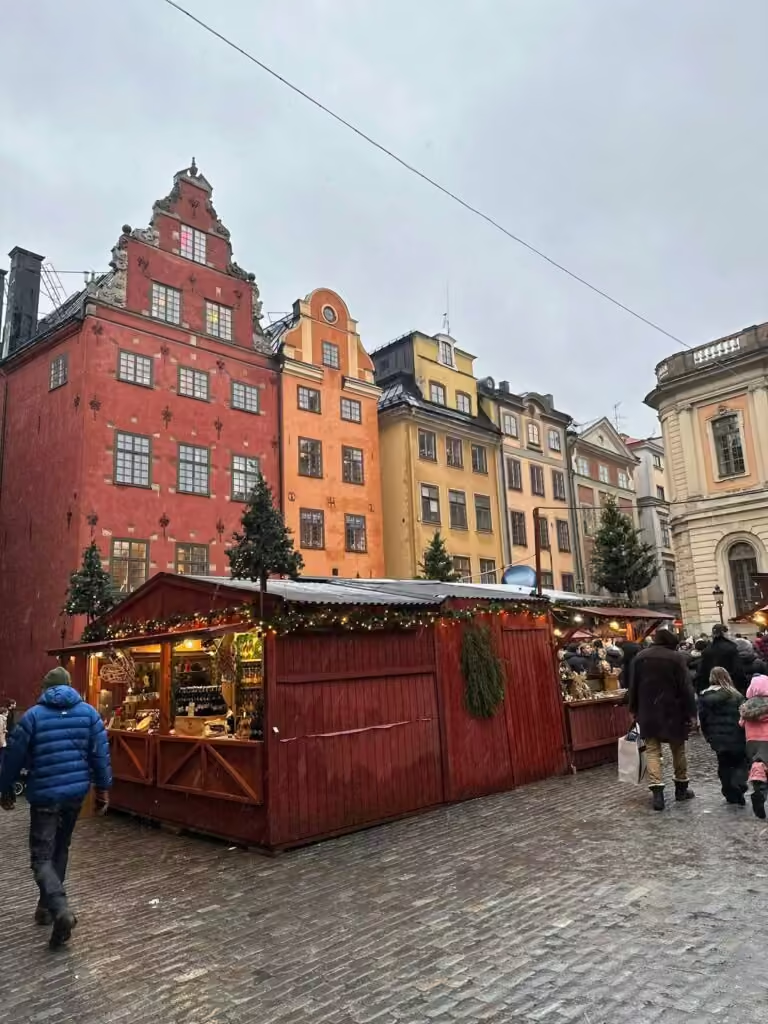
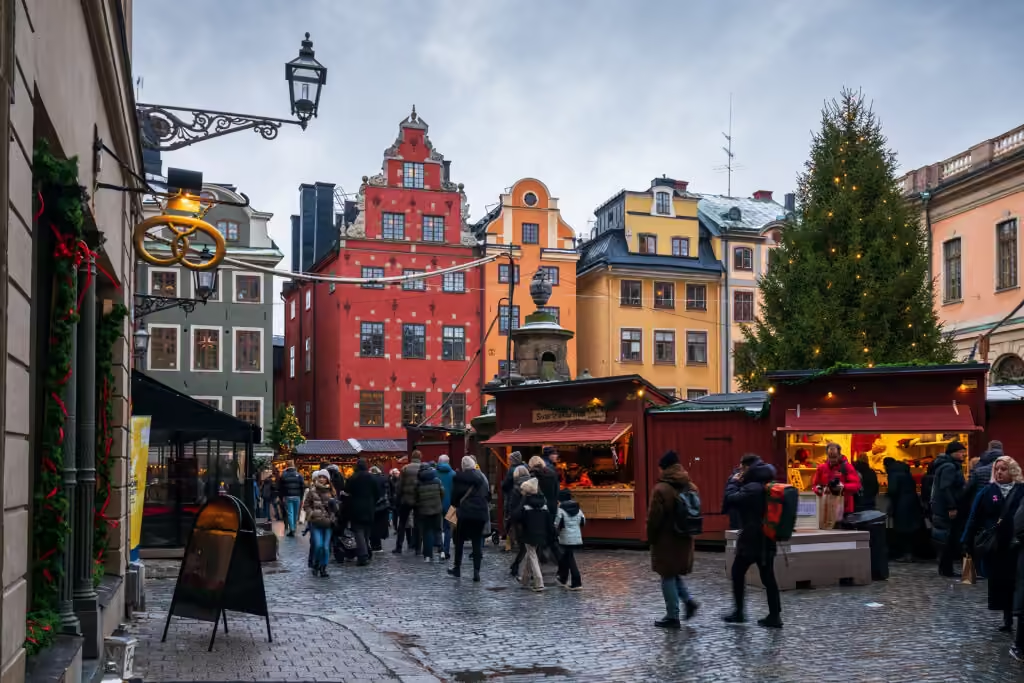
Stockholm's main market would disappoint me almost anywhere else. Stortorget is a ring of red huts you can walk round in 20 minutes, and it nearly didn't happen this year, after the police asked for vehicle barriers the organiser struggled to pay for, so expect a few of the stalls round the corner on Järntorget.
I forgive it everything, because it has stood in one of the loveliest squares I know since 1837 and it sells mostly Swedish crafts. The Stockholm Christmas market I'd cross Europe for, though, is out on Djurgården, at Skansen.
Skansen is an open-air museum of old Swedish houses, with bonfires along the paths and a folk band by the tree, and five times a day everyone joins hands and dances round it, strangers included. Get in the ring, because I've rarely been happier at a Christmas market.
Skansen's market in Stockholm is open Friday to Sunday only, and Friday is the calm day. You pay full museum entry, because there's no market-only ticket, and the stalls themselves are fairly ordinary, which is why I'd give it half a day and see the houses.
What I'd do with the other half of that day depends on the weekend. On Saturday 28 November more than 600 student companies take over Kungsträdgården, and during that first weekend of December about 70 Swedish craftspeople set up among the King's horses in the Royal Stables, which is where I'd buy presents.
I'd keep the Sunday for getting out of town. Sigtuna, the oldest town in Sweden, holds its market on the four Advent Sundays, about an hour away by train and bus, and Vaxholm's is about an hour by boat through the islands on an ordinary transport ticket, on 5 and 6 December only. Uppsala's historical market by the cathedral is 38 minutes away and due back that same weekend, after drawing 30,000 people in its first year, 2024.
Malmö and Lund
Malmö is the Swedish market you can reach without sleeping in Sweden. It's 39 minutes from Copenhagen by train, and Malmö's market is open Thursday to Sunday on the four Advent weekends, from 11:00 to 18:00 on Gustav Adolfs torg, starting on 26 November. It's free, and its last weekend isn't firm yet, so check before a late trip.
I'd go a little further if the dates fit, because Lund has the better idea. Kulturen, the town's open-air museum, opens its old houses with costumed guides for a single Christmas weekend, 27 to 29 November, and charges 160 SEK.
Jamtli, Gammelstad and the North
For a market in proper winter you have to go a long way north. Jamtli, in Östersund, is another open-air museum, with nearly 200 craftspeople, horse-drawn sleighs and dog sledding, on that first weekend of December.
Gammelstad, a UNESCO-listed church town outside Luleå in Swedish Lapland, holds its market on the Saturday and Sunday of the same weekend, from 12:00 to 16:00. It bans coloured and flashing lights from the stalls, which tells you what kind of market it wants to be.
I'd only go for either if the north is the holiday and the market is the bonus.
What Do Christmas Markets in Sweden Cost?
Getting in costs less than you'd fear in Sweden, and the glögg is the let-down.
The square and street markets are free, Stortorget, Haga, Kronhuset and Malmö among them. Liseberg costs from 125 SEK online, 20 SEK less than at the gate, and that covers the lights, the markets and the rink, while the Royal Stables charge 120 SEK at the door.
A cup of glögg was 60 SEK on Stortorget last year and a small one 37 SEK at Liseberg, and at the stalls it's often weak or alcohol-free. I'd drink it to warm my hands and go to a bar for the real thing.
The meal to spend on is a julbord, the Swedish Christmas buffet of herring, salmon, meatballs and ham. At the Veranda in Stockholm's Grand Hôtel it's 1,195 SEK, and it's the one big bill of the trip I wouldn't skip.
Paying for all of it is easy, because you won't need cash. Liseberg is cashless, a tap of a contactless card gets you onto the metro in Stockholm for 43 SEK and the trams in Gothenburg for 38 SEK, and the Swish signs on the stalls need a Swedish bank account, so ignore them.
What's the Weather Like in Sweden in December?
The sun sets at 14:46 in Stockholm in the middle of December and at about 15:24 in Gothenburg, which sounds grim and is half the reason the lights work.
It's colder on the east coast than the west. Stockholm sits at about 3°C by day and just below freezing at night, while Gothenburg is a degree or two milder and a good deal wetter.
Our snow odds study found snow on the ground on 35% of Stockholm's market days and 16% of Gothenburg's, so Stockholm is a slightly better bet than Oslo, and Gothenburg mostly gets by on the fake kind.
Whichever you choose, dress for standing on a hill. Skansen is exposed, windy and colder than the town below it, and Liseberg always feels a few degrees colder than the streets outside.
Getting Around Sweden by Train
Fly in, because London to Stockholm takes about 38 hours and two nights by rail. From Arlanda the express train reaches the centre in 18 minutes for 349 SEK, and the coach takes about 40 minutes from 99 SEK.
The fastest Stockholm to Gothenburg train takes 3h18, with a direct one about every hour in the daytime, and from 2 December I'd use it to catch both cities on their quiet days, Liseberg on a Wednesday or Thursday evening and Skansen on the Friday.
Malmö is another 2h18 beyond Gothenburg on the fastest train, and it makes more sense as an afternoon out of Copenhagen than as a stop on a Swedish trip.
Crossing the Border
Denmark is the obvious next country, since Malmö is only a bridge away from it. The Copenhagen Christmas market is about three and a half hours from Gothenburg on a direct train you don't need to book, and Tivoli makes a good match for Liseberg if lights are what you came for.
From Stockholm it's a longer haul, 6h02 with a change at Malmö while the direct trains are suspended, and I'd only do it as part of a trip through the Christmas markets in Denmark.
Norway is two hours nearer to Gothenburg than to Stockholm. Trains reach the Oslo Christmas market in about three and a half hours from Gothenburg, about four times a day, and the direct ones from Stockholm take from 5h30, with the rest of the Christmas markets in Norway beyond.
Christmas Week in Sweden
Swedes celebrate on the 24th, and every market in Stockholm has packed up by then.
Liseberg reopens from 26 to 30 December, from 12:00 to 20:00, after shutting on the 24th and 25th, and that makes Gothenburg the only big Swedish market you can still visit after Christmas.
If you're in Stockholm over Christmas anyway, Skansen's park stays open without its market, from 10:00 to 14:00 on Christmas Eve and until 16:00 from Christmas Day. Buy anything you want to drink before then, because Systembolaget, the state off-licence, is shut from 24 to 26 December.
So, Are the Christmas Markets in Sweden Worth It?
They are if you come at a weekend. A Tuesday in Stockholm gives you one small square that's shut by 18:00, and from Friday to Sunday the same city has bonfires at Skansen and a ring of people joining hands, which no German market has given me.
Do Liseberg midweek, then Stockholm from Friday 4 to Sunday 6 December, or move the whole thing a week later for Lucia, and bring proper boots, because the best of Sweden happens outdoors.