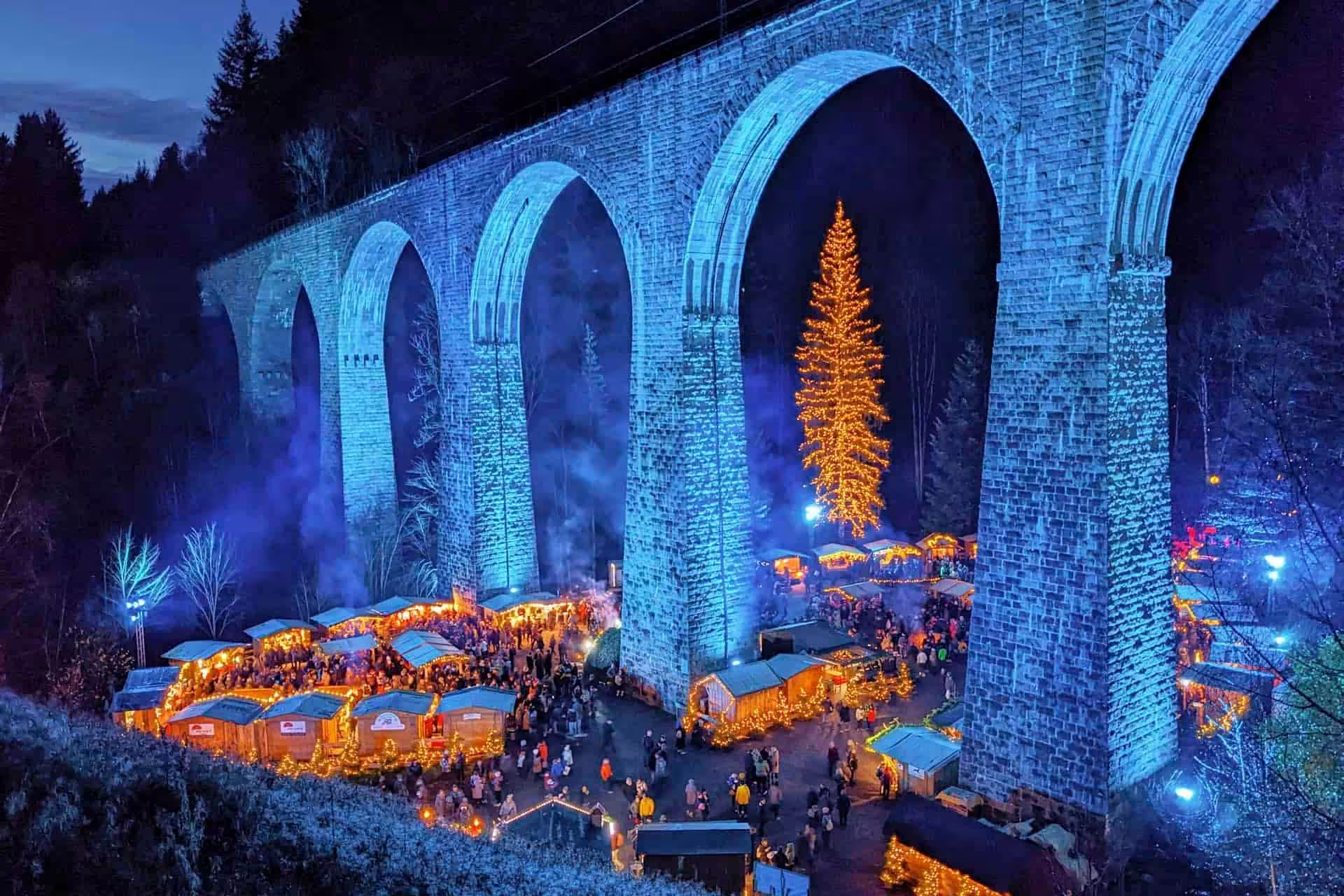
Most people find out about the Ravenna Gorge Christmas market the same way. A reel pops up sometime in November, there’s a huge stone railway bridge glowing purple over a valley full of wooden huts, a lit-up train rolls across the top of it, and they think, right, we’re doing that this year.
Then they open the ticket page and every single slot says sold out. It sold out weeks ago. In 2025 all 75,000 tickets were gone in about ten hours on the first day of sale.
The Ravenna George Christmas market is small. It’s about forty wooden huts in a narrow side valley of the Höllental, roughly 25 km east of Freiburg between Hinterzarten and Breitnau, and about two hours is enough to see all of it.
The thing that makes it special is where it sits, right under a 224-metre granite viaduct that lights up in colour after dark while trains of the Höllentalbahn cross over your head.
What makes it hard, however, is that you can’t just turn up. There’s no ticket office at the gate and no walk-ups, not even if you ask nicely. Everything is sold online in timed slots, and the 2026 sale opens on Wednesday 14 October at 10:00 German time.
So your whole trip gets decided in a few minutes on a Wednesday morning in October.
Pick the right slot and the right way in, and you get one of the best evenings Christmas in Europe has to offer. Leave it a week, and you get the reels.
When Ravenna Gorge Tickets Go on Sale for 2026
The market runs over four Advent weekends in 2026, from Thursday 26 November to Sunday 20 December, and this year it opens on Thursdays too, not just Friday to Sunday.
Thursday is a short evening from 16:00 to 21:00, and the other three days run from 14:00 to 21:00.
The one exception is Thursday 10 December, which is the Wäldertag, an evening kept for locals from the surrounding villages, so it isn’t on sale to the rest of us. That leaves fifteen public days in total.
| 2026 | |
| Dates | Thu 26 Nov to Sun 20 Dec, Thursday to Sunday only |
| Thursday hours | 16:00 to 21:00 (10 Dec is locals only) |
| Friday to Sunday hours | 14:00 to 21:00 |
| Afternoon ticket | €7.50 |
| Evening ticket | €9.50 |
| Children 6 to 15 | Free with an adult, or €4 if the ticket includes the shuttle |
| Slot length | About 2 hours |
| Tickets on sale | Wed 14 Oct 2026, 10:00 German time, online only |
Kids go free, but they still need a ticket in your booking, so count everyone when you order.
Tickets can’t be refunded either. You can move to another slot if there’s space, sometimes for an extra charge, but you can’t hand them back.
None of this used to matter much. The market started in 2010 as a fairly local Advent thing, until Instagram found it.
The first time it sold out completely before opening day was 2024, and that year the tourism board said it was fielding calls from all over Germany and abroad from people chasing tickets that didn’t exist anymore.
Then 2025 went further. Sales opened in mid-October, the booking system got overloaded even though the organisers had added server capacity since the year before, and all 75,000 tickets were gone in roughly ten hours.
The market was still six weeks away.
The new Thursdays are the organisers’ answer to that, and it’s a bit of a U-turn.
Back in 2024 they said adding weekdays wasn’t possible, because the regional farms and makers who run the huts can’t staff a whole week and the gorge physically can’t hold more people.
For 2026 they found a middle ground and added three Thursday evenings (26 November, 3 December and 17 December).
Prices went up by a euro too, for the second year running. It’s more supply, but not a lot more, and nobody knows yet if it’s enough to stop the whole thing selling out on day one. I wouldn’t count on it, though.
Which Time Slot to Book
Every ticket is for a slot of about two hours, and the organisers do ask you to leave when yours is up.
That sounds tight but for a market this size it’s completely fine, because 40 huts isn’t Nuremberg.
My advice is to book the latest afternoon slot you can get, the last one before the 16:00 price line.
You pay the cheaper price, you arrive with enough light to actually see the gorge, the granite arches and the forest climbing up on both sides, and then about an hour into your slot the colours come on and you get the night version as well.
That’s two markets for €7.50. The evening slots after 17:00 give you the classic look, full dark and full lights from the minute you walk in, but you pay more to see less of the valley. Thursdays only open at 16:00, so those are all evening slots.
And the day you choose matters almost as much as the hour you are choosing.
Saturday evening is the busiest time of the week, and even with timed entry the photo spots and the path up to the viewpoint get packed after dark.
Book How You’ll Get There at the Same Time
Most people trip up here by buying an entry ticket, feeling relieved, and figuring out transport later. At Ravenna Gorge that doesn’t work, because the way in needs to be part of the booking.
When you book, you choose between entry only, entry with a shuttle seat from one of the local stations, or entry with the Freiburg shuttle, and parking is a separate reservation on top of that, by the way.
Parking is the tightest thing on sale, too.
There’s only the small car park at Hofgut Sternen next to the market, and when I bought it at 10:00 on sale day in 2024, every parking ticket was gone by 13:00, well before entry sold out.
So if you’re driving, grab the parking reservation first. If you don’t get one, don’t drive. There’s nowhere else to leave a car, and they won’t let you just pull in.
| How you get in | What you book | Good to know |
| Freiburg shuttle | Round trip from Freiburg’s central bus station (ZOB, platform 7) with entry included | The only option with a guaranteed seat both ways. It was €24 including entry in 2024 |
| Train and local shuttle | Entry plus a shuttle from Himmelreich, Hinterzarten or Titisee | Free for adults, €4 for kids 6 to 15. Buses run at fixed times matched to your slot, but seats aren’t guaranteed |
| Walk from Hinterzarten | Entry only | About 45 minutes on the winter trail through the Löffeltal, and you’ll walk back in the dark, so bring a headlamp |
| Car | Entry plus a parking reservation at Hofgut Sternen | Nothing bigger than a VW bus and no motorhomes. Parking sells out first |
For most people I think the Freiburg shuttle is the smart pick.
You stay in Freiburg, which is a great Christmas city on its own, you don’t need a car, and it’s the only bus where the seat is actually yours on the way back.
The train plus local shuttle is the cheaper route, especially with a Deutschlandticket or a KONUS guest card.
KONUS is the card many Black Forest hotels and guesthouses hand out at check-in, and it makes local trains and buses free, though it doesn’t cover the market entry.
Strollers and wheelchairs need to be booked on the shuttle in advance.
The train ride itself is a nice bonus, by the way.
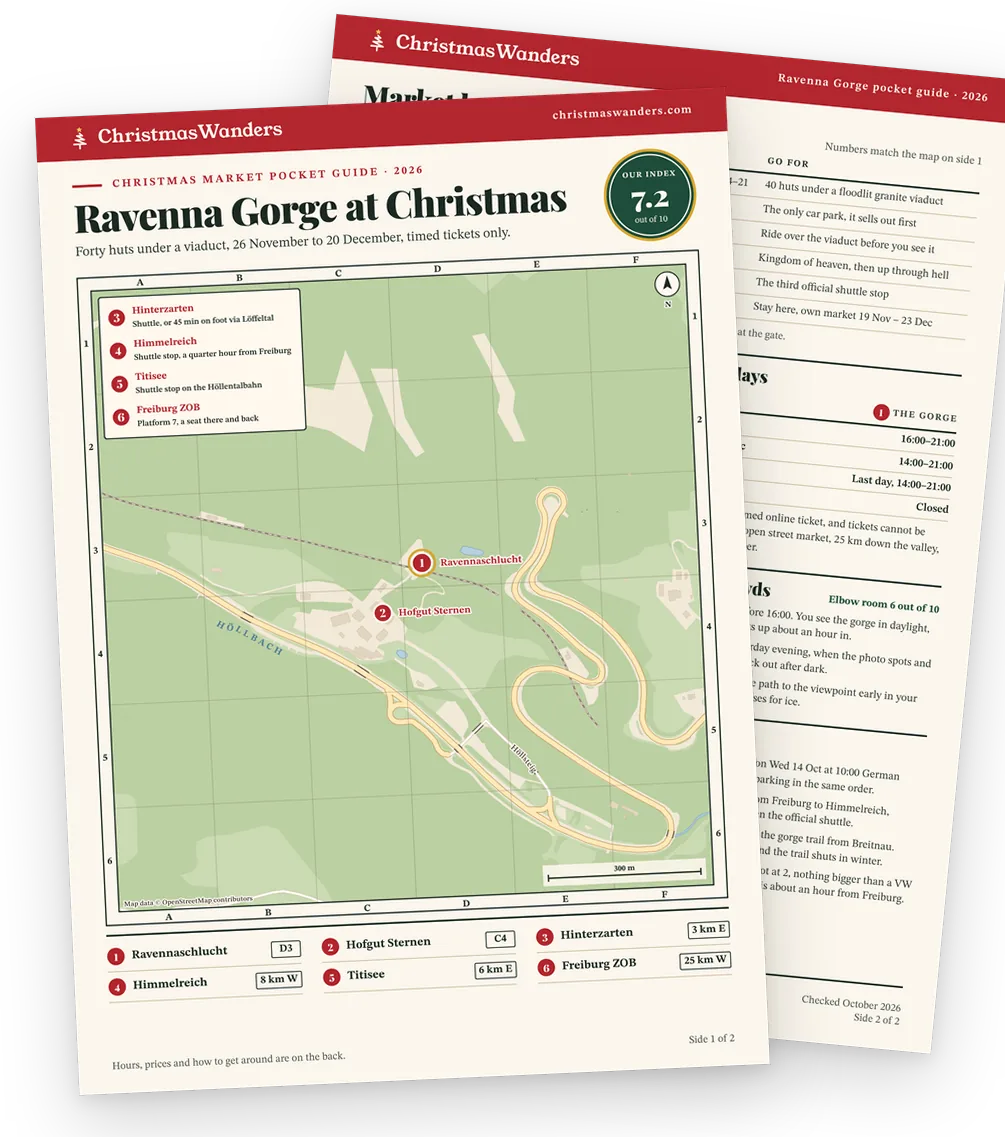
From Freiburg the Höllentalbahn reaches Himmelreich in about a quarter of an hour, and Himmelreich means “kingdom of heaven“.
From there the line climbs straight up through the Höllental, the valley of hell, and crosses the Ravenna viaduct on its way to Hinterzarten. Not many Christmas markets make you ride from heaven through hell to get there, and it’s a lot prettier than it sounds, in my opinion.
If you get off at Hinterzarten, you’ve already crossed the bridge you’re about to stand under.
Skip Posthalde, the little halt that looks closest on the map. It isn’t one of the official access points and no shuttle runs from it.
The trail through the Ravenna Gorge itself, down from Breitnau, is also officially closed every winter because of ice, and anyone who walks it anyway still has to show a valid ticket at the bottom.
And if you’re flying in, Basel-Mulhouse is the closest airport, about an hour from Freiburg by airport bus, so Freiburg is your gateway either way.
What to Do If It’s Sold Out
Please don’t buy from resale sites. Tickets turn up on them every year at silly prices, and the tourism board has warned more than once that some are fakes or copies that get turned away at the entrance.
Since nothing is refundable, there’s nobody to complain to afterwards. Buy only from the official Hochschwarzwald ticket page.
The legitimate side doors are organised trips.
Coach companies around southern Germany sell day trips with entry included, and the US Army MWR office in Stuttgart has run tours there too, so if you’re part of the military community in Germany, check with yours.
Those trips come with entry already sorted, which makes them worth a look after the public sale is gone.
In 2024 there was also a private heated hut package with mulled wine, a two-hour stay and two parking spaces for €169. It hasn’t been announced for 2026 yet, so keep an eye out if the budget stretches.
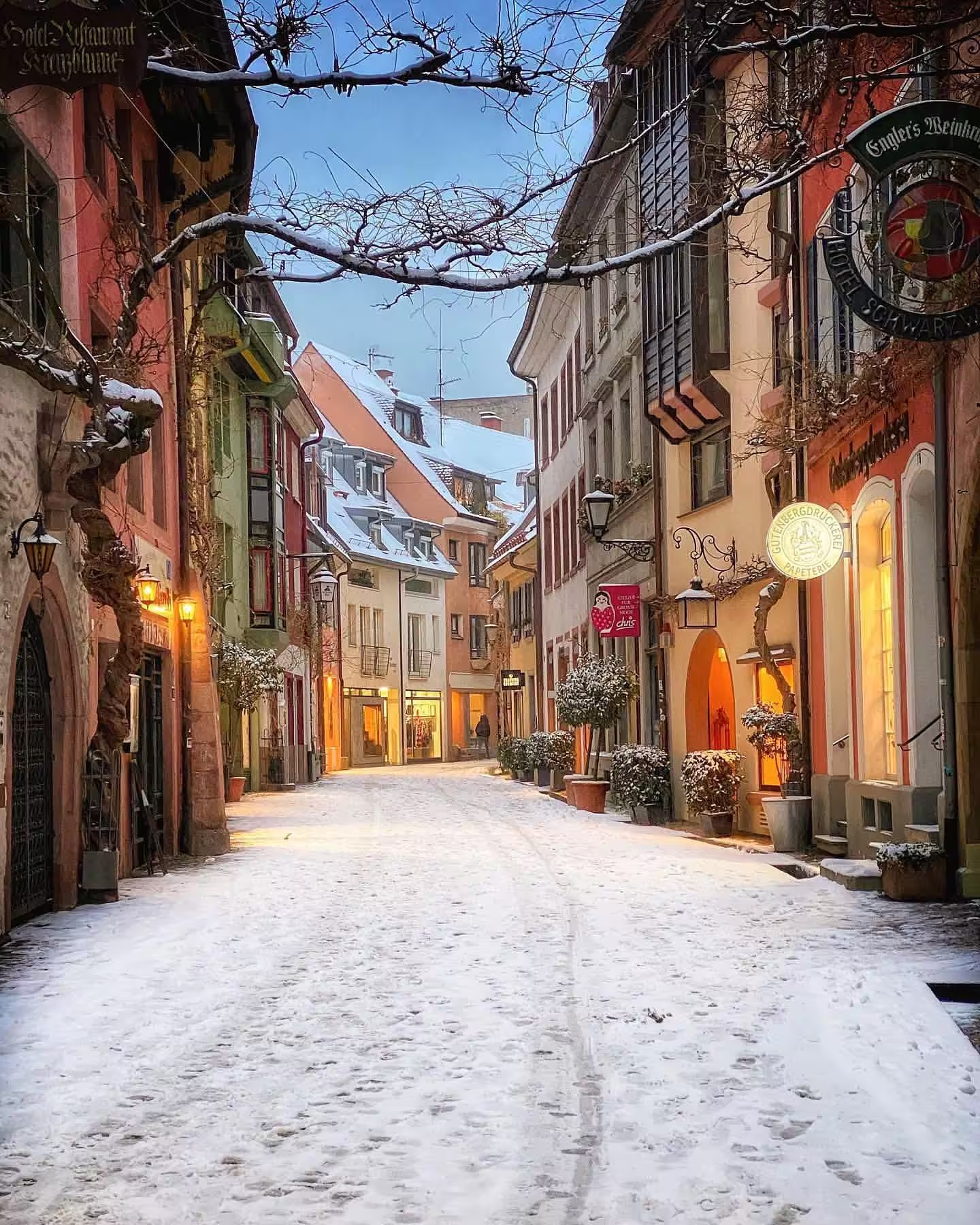
If none of that works, the Black Forest has a pretty good plan B. The Freiburg Christmas market is 25 km down the valley.
It’s free, it has more than 140 stalls spread across the old town, and it runs from 19 November to 23 December.
Gengenbach, about an hour north of Freiburg, turns its whole town hall into a giant Advent calendar with a new window lit every evening. Neither of them has a viaduct. Both of them will let you in.
What’s Actually Down in the Gorge
The first thing you’ll notice is the bridge, because it’s enormous.
The Ravenna viaduct is 36 metres high, roughly a twelve-storey building, and 224 metres long, with nine granite arches marching across the valley.
The market is tucked in right underneath it between steep wooded slopes. After dark the arches are floodlit and cycle through red, green, blue, white and purple, and every so often a lit-up train slides across the top.
Plenty of Christmas markets have a pretty backdrop. At this one, the backdrop is the whole point.
Under it are about forty wooden huts built from local timber, and the rule for stallholders is regional only.
That’s a real difference from the big city markets. You won’t find the same imported ornaments you’ve already seen in five other towns.
What you get is Black Forest ham, honey and bee products, local wines and gin, chocolate, woodwork and, yes, cuckoo clocks.
If you want a gift that actually came from the place you bought it, this is one of the better markets for it. If you want to shop for hours, it’s too small, and a good part of the site is food.
The extras are small but nice. An illuminated nativity trail winds through the woods around the market, with lit stations telling the Christmas story.
There’s also a short, steep path, three to five minutes, up to a viewing point above the huts where you get the whole viaduct and the market in one frame.
That path gets slippery and closes when it’s icy, so go up early in your slot while it’s open and before everyone else has the same idea.
Kids get a Christmas post office where they can send off their wish list, plus a market rally with riddles and a small prize at the end.
The whole site is unpaved and the path down from the car park is steep, so wear proper boots, not city shoes, because it can turn to mud quickly when it rains.
Wheelchairs are possible but definitely hard work. Dogs are discouraged by the way, and drones are banned because the gorge is a protected bird area.
The lights run on 100% hydropower and only stay on during opening hours, which is a good look for a market that’s mostly about a lit bridge.
What to Eat and Drink
The food is regional too, and it’s better than it needs to be.
The one to look for is Flammlachs, salmon fillets pinned to wooden boards and slow-cooked next to an open fire until they’re smoky and soft.
After that there’s Käsespätzle with cranberries, Flammkuchen, Schupfnudeln, farmhouse raclette, soup served in a bread bowl, smoked trout and plenty of Black Forest ham.
Most dishes run from about €4 to €12.
Glühwein was around €4 last season, plus a €3 deposit on the mug, which you can keep as a souvenir.
The drink I’d order first, though, is the Nikolausi, a hot baked-apple liqueur topped with cream.
There’s Feuerzangenbowle as well, the flaming rum punch Germans love for reasons that become clearer after the second one.
Bring cash too, because the gorge has a weak mobile signal and card machines often can’t connect, so most stalls end up cash only, and there’s no ATM on site.
Take out enough in Freiburg or Hinterzarten before you come. I’d plan on €40 to €50 a person if you want food, a couple of drinks and a small gift.
The Bridge, the Hotel and the Valley
The viaduct you’re standing under isn’t the first one.
The Höllentalbahn opened in 1887, and the original bridge over the gorge was a steel lattice sitting on three sandstone pillars.
By the 1920s it couldn’t cope with heavier locomotives, and trains had to crawl across it at 15 km/h. Work on the granite replacement started in August 1926 and it opened in December 1927.
Less than twenty years later it was nearly lost.
On 21 and 22 April 1945, with French troops moving into the Black Forest and the war days from ending here, German army engineers blew up part of the bridge.
It was rebuilt under French occupation and reopened on 22 December 1947, with trains running the whole line again the next day.
So the bridge everyone photographs at Christmas was, quite literally, a Christmas present 79 years ago.
It’s also the only heatable bridge on the entire Deutsche Bahn network, which feels about right for a structure that spends every December being admired in the cold.
Right beside the market is Hofgut Sternen, an old coaching inn at the foot of the gorge.
Marie Antoinette stopped here in 1770 on her way to France to marry the future Louis XVI, and Goethe stayed in 1779. It’s still a hotel, it’s the closest place to sleep by a long way, and after a Nikolausi or two that short walk home is a very nice thing to have.
The name Ravenna, by the way, has nothing to do with the Italian city. It most likely comes from the French word ravine, which is a very plain name for such a pretty place.
So, Is the Ravenna Gorge Christmas Market Worth It?
Yes, if you go in with the right idea of what it is. This is not a market you spend a day at.
It’s two hours, forty huts and a view, and the view is the best one any Christmas market in Germany has.
On our Index it scores a 10 for atmosphere and a 4 for getting there and around, the lowest access score of any market I’ve rated. Both numbers are fair, in my experience.
The people who come away disappointed usually expected more market.
As for how I’d do it again, I’d aim to stay two nights in Freiburg. Spend one afternoon at Freiburg’s own market in the old town, and on the other day take the Freiburg shuttle to a late afternoon slot at Ravenna Gorge, so you see the valley in daylight and the viaduct lit up before you head back for dinner.
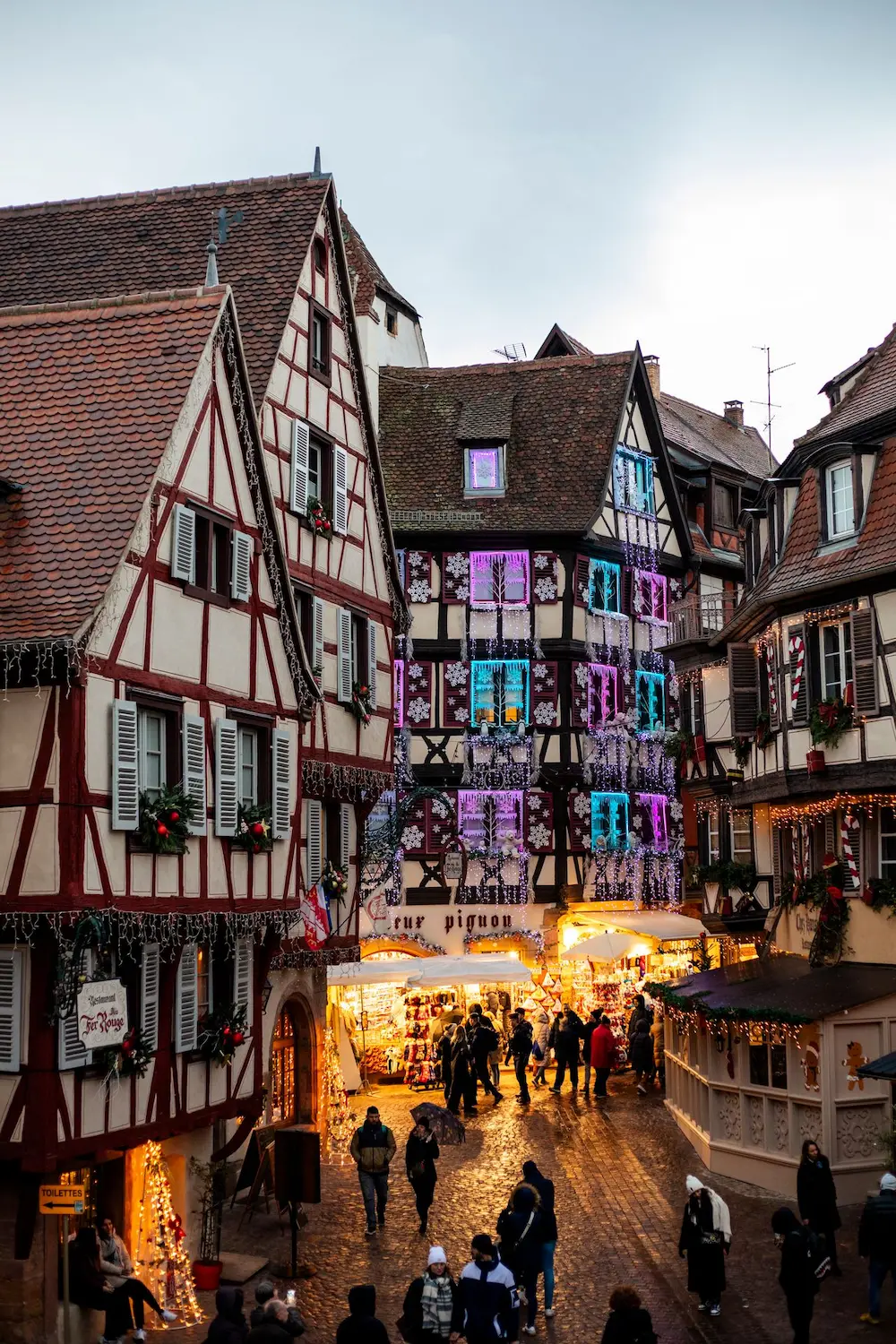
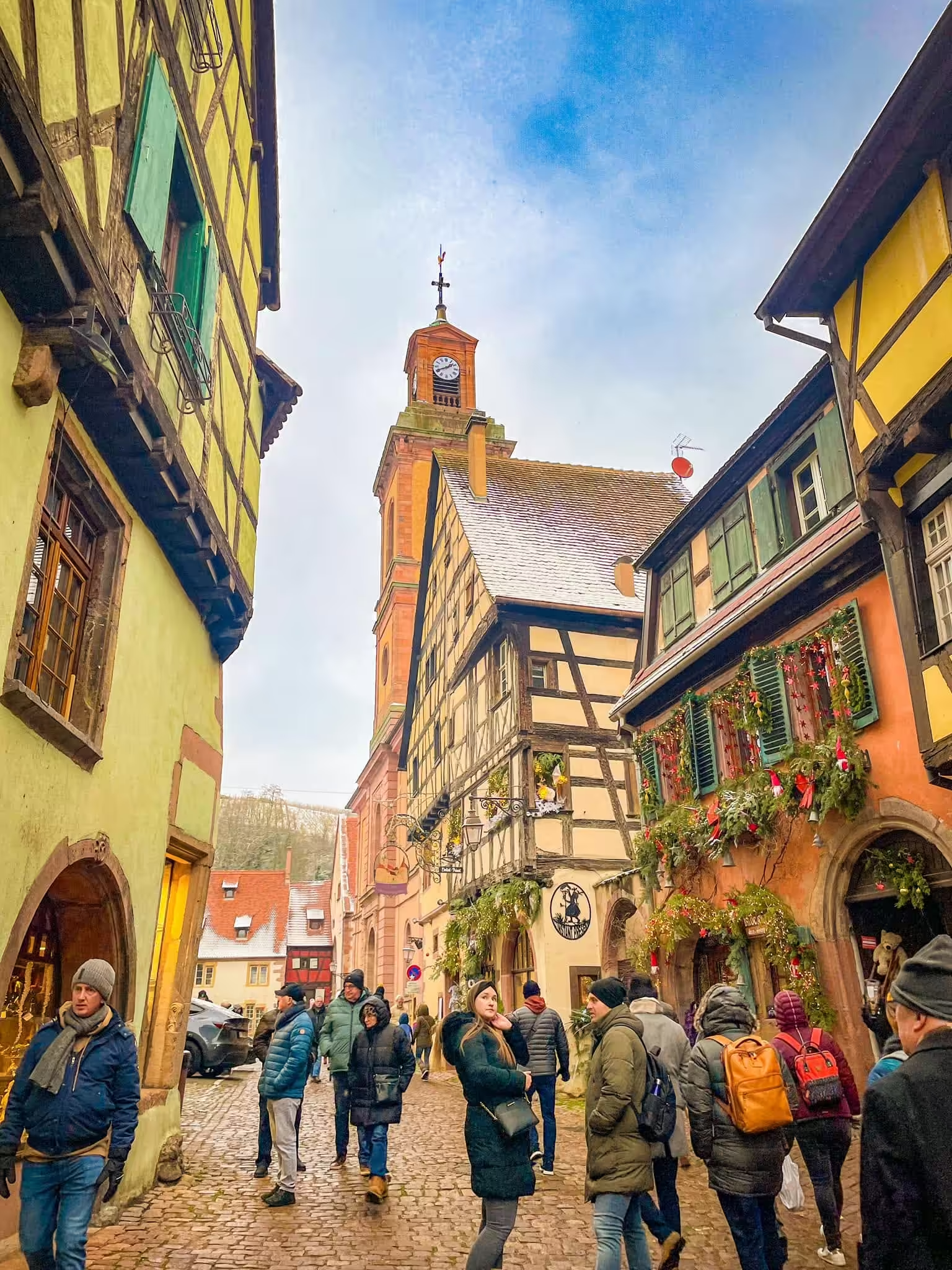
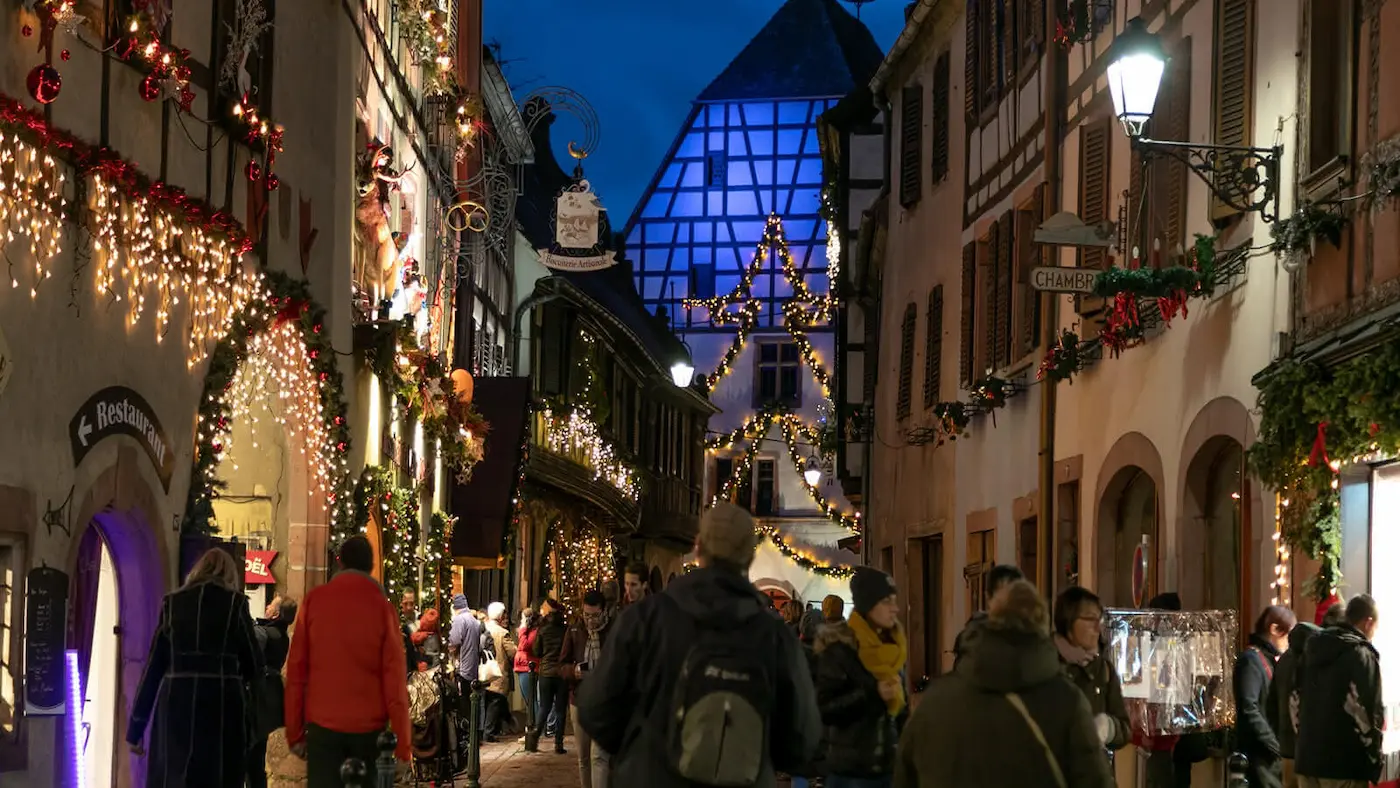
With more time, the Alsace markets are right across the Rhine, and Colmar, Kaysersberg and Strasbourg all work as day trips from Freiburg, which turns one gorge into one of the best Christmas market trips in Europe.
If you’ve been, tell me in the comments which slot you picked and whether the Nikolausi lived up to it.
If you’re still choosing where to go, every market on the Index is scored on the same six things, so you can compare them properly. And set an alarm for 14 October.