Why the Leipzig Christmas Market?
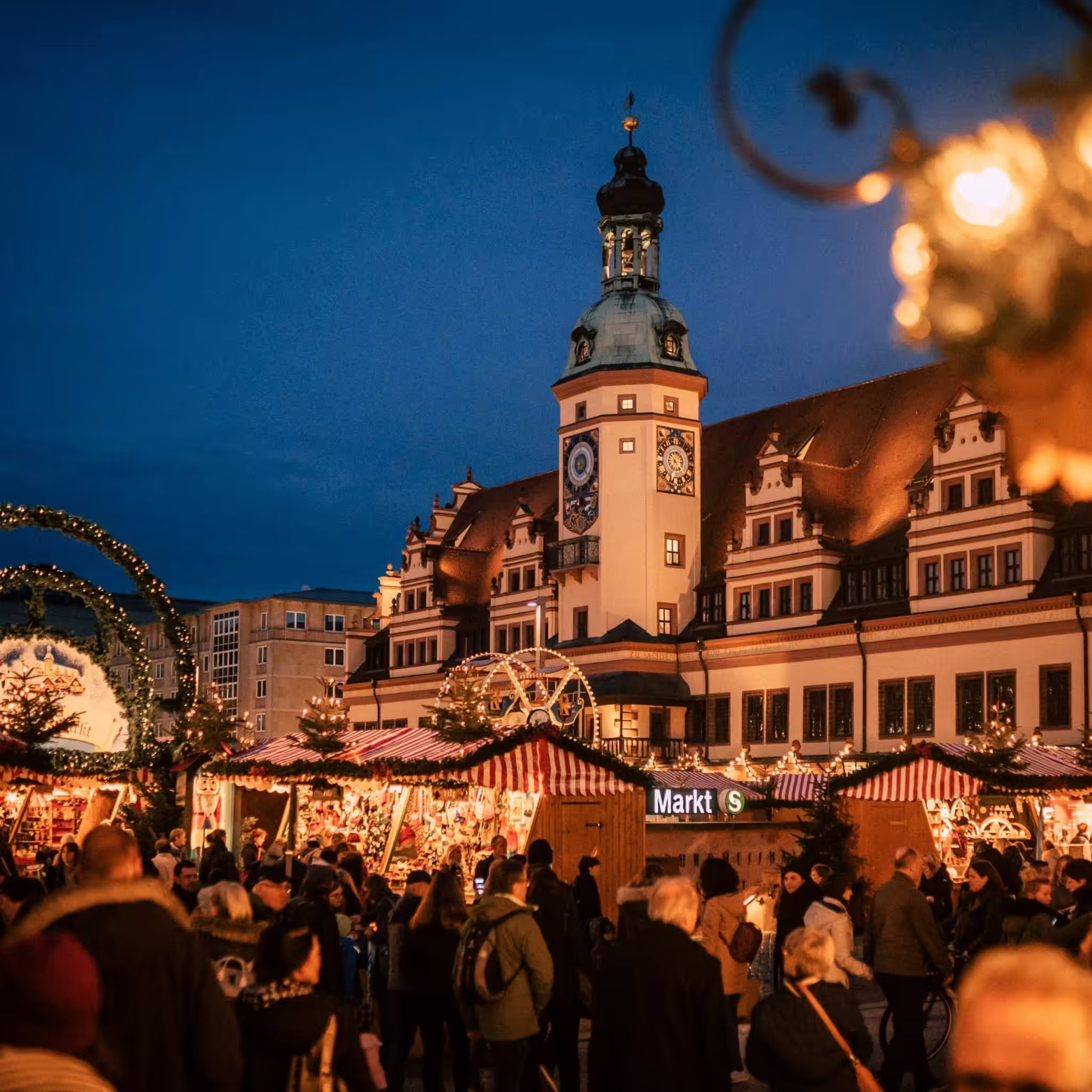
The Leipzig Christmas market is huge. There are more than 300 stalls spread across seven areas of the old town, and more than two million people came through Leipzig in 2025. Now, you’d expect that to feel like a crush, and on the Markt on a Friday night it definitely is, yeah, no lying about it.
Step off the main square, though, and it opens up.
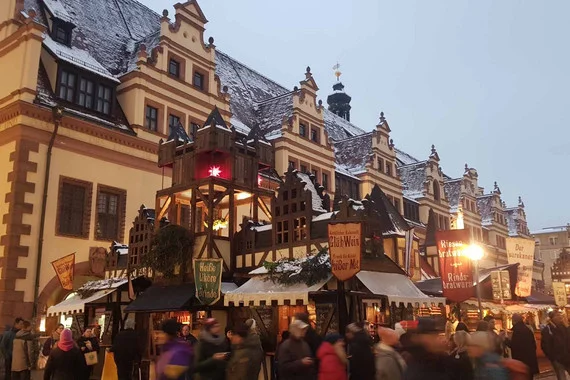
Each area has its own theme, from the medieval craft market behind the town hall to the Finnish village with its open fire, so when the Markt gets too much, there’s always a corner with room to breathe.
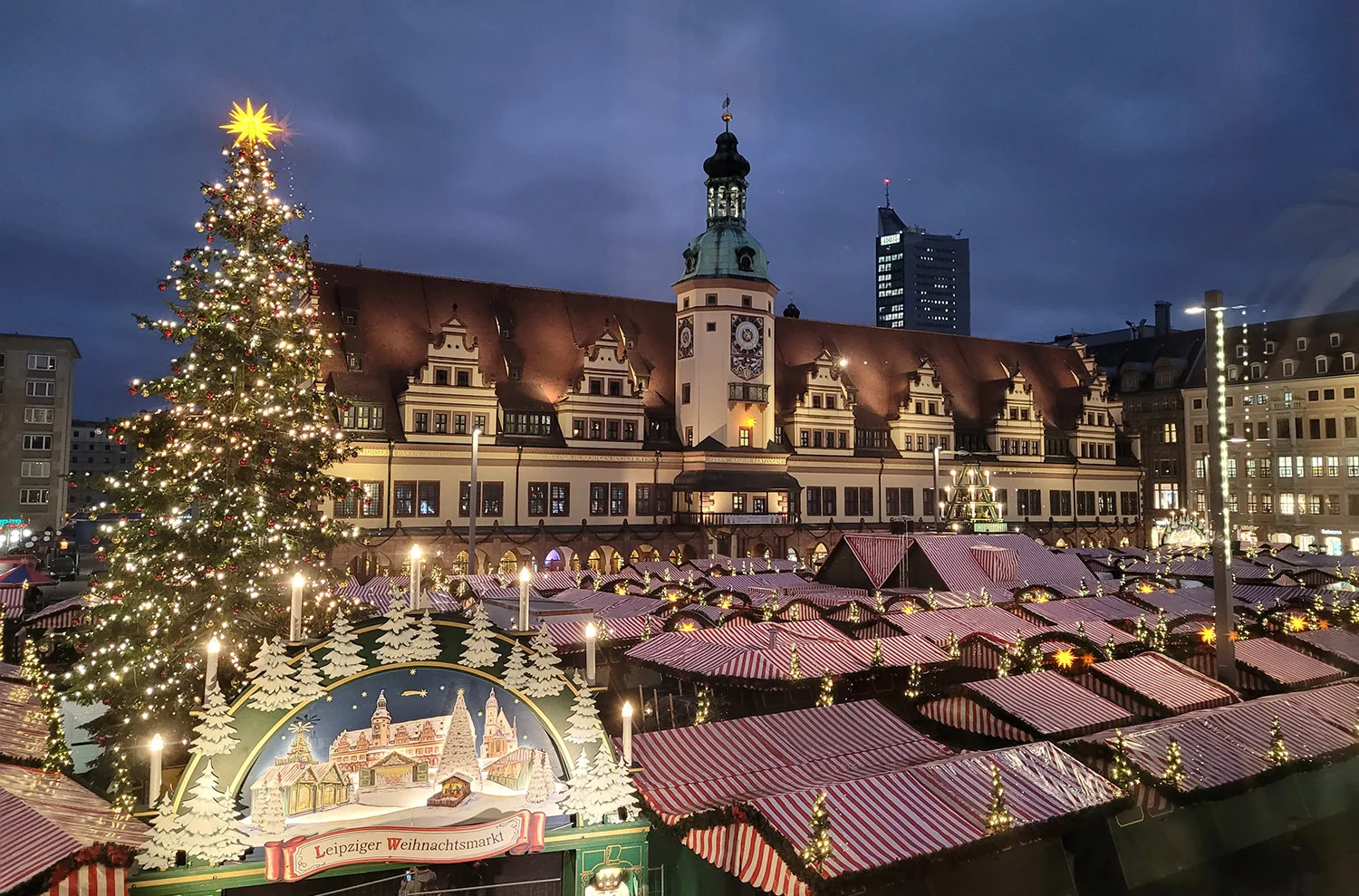
You’ll still want to be back on the Markt for the brass. Leipzig is a music city, with Bach’s own church a few minutes away and a market going since at least 1458, and every evening players come out onto the balcony of the Old Town Hall and play over the whole square. For many tourists, this is the moment the entire evening builds around.
You’ll also want a mug in your hand while they play, and in Leipzig, it won’t cost you much. In 2025 Glühwein ran €4.50 to €5, against €5 to €7.50 on Marienplatz in Munich and up to €7.50 in Berlin.
Leipzig Christmas Market 2026 Dates and Hours
The Leipzig Christmas market (Leipziger Weihnachtsmarkt) runs from Tuesday 24 November to Wednesday 23 December 2026, with free entry.
It’s open 11:00 to 21:00 Sunday to Thursday and 11:00 to 22:00 on Fridays and Saturdays. On opening day the stalls are up by 14:00, and the tree on the Markt is lit at about 17:00.
The season winds down in two steps. On 22 December every area closes at 20:00, and that’s the end for everything except the Markt. Then on 23 December only the Markt is open, until 20:00.
After that it’s done for the year, so there’s no market on Christmas Eve or Christmas Day.
| Date | What’s on |
|---|---|
| Tue 24 Nov | Opening day, stalls from 14:00, tree lit at about 17:00 |
| Fri 11 to Sun 13 Dec | Bach’s Christmas Oratorio in the Thomaskirche |
| Fri 18 Dec | Last Friday before Christmas, expect the biggest crowds |
| Tue 22 Dec | All areas close at 20:00, last day for everything except the Markt |
| Wed 23 Dec | Last day, only the Markt is open, until 20:00 |
| From Thu 24 Dec | Closed until next season |
Over the whole run, snow is a long shot. Our snow odds study found snow on only 12% of Leipzig’s market days over 21 winters, against 16% in Dresden, for example.
How to Plan Your Evening in Leipzig
Within any of those weeks, you should aim to go Monday to Thursday and arrive in the afternoon. Weekday afternoons give you room to look at the stalls properly, and the crowds swell after dark nearly every day.
On Friday and Saturday evenings they swell the most, however. That’s when the Markt and Grimmaische Straße pack tight, and the last Friday before Christmas, 18 December, is the worst of the lot, in my experience.
So try to spend the afternoon on the somewhat quieter squares and look to arrive at the Markt for the brass. Ideally, try to start on the Naschmarkt around 16:00, move on to the Nikolaikirchhof as the lights come on, and be on the Markt in time for the first notes.
The brass plays at 18:00 Monday to Thursday, 19:00 on Fridays, and at 13:00 and 19:00 at weekends. Get a Glühwein, find a spot facing the town hall and be there five minutes early.
The stage on the Markt fills in around the brass. Last year it ran a programme every day from 16:30, with Santa taking visitors on Thursdays and Fridays. Nothing is piped through the stalls, so the brass and the stage are your music for the night.
Once the Markt fills up after the brass, duck behind the town hall to the Naschmarkt or head south to Burgplatz. Both stay calmer when the main square is full.
The Market, Area by Area
That evening route covers the old core, and the rest is close by, because all seven areas sit inside the old-town ring. Allow two to three hours for the full loop with a couple of drink stops.
Naschmarkt
Your afternoon starts here, and the Naschmarkt is my favourite corner of the whole market. It’s the medieval market, in the small square behind the Old Town Hall facing the old stock exchange, and the craftspeople work right in front of you, from candle dippers to blacksmiths.
My recommendation goes to ordering the mead while you watch them do their work. Drinks here come in the medieval market’s own clay mugs, dated with the year, so bring them back here for the deposit rather than to a regular stall.
Nikolaikirchhof
You’ll be here as the lights come on. A big Ore Mountain Christmas pyramid stands over the small square by St Nicholas Church, ringed by stalls selling Feuerzangenbowle, waffles and wooden decorations from the Erzgebirge.
The Nikolaikirche itself is where the 1989 Peaceful Revolution started, and it’s worth ten minutes inside before you head back for the brass.
Markt
The Markt is the traditional centre, in front of the Renaissance Old Town Hall, with the stage and a tree about 20 metres tall hung with 300 red and gold baubles and roughly 3,000 lights.
It’s also where the crowds are thickest, so see the tree, catch the brass and move on. If it’s the cold you need a break from, walk through the Mädler Passage, the grand covered arcade just off the Markt.
Swiss Village on Burgplatz
If you’d rather sit down, head south. A few minutes down Petersstraße, the Swiss village has served Swiss food on Burgplatz since 2024, and you eat in old cable-car gondolas. There’s an Eisstock lane too, a kind of Alpine curling, that you can book through the Petersbogen shopping centre.
Augustusplatz and the Finnish Village
The other way out of the old core is east along Grimmaische Straße, about five minutes on foot. Its stalls are the plain ones, so walk it rather than linger.
It brings you out on Augustusplatz, between the Opera House and the Gewandhaus, and this is the family end.
There are life-size fairy-tale scenes hiding deliberate mistakes for kids to spot on a quiz sheet, children’s rides and a 38-metre Ferris wheel.
Trams run straight through the square, and it feels more like a funfair than an old town, so come here for the kids and the wheel. The square only gets its ice rink after the market, when the Eistraum opens on 15 January 2027.
The grown-ups get the Finnish village by the Mendebrunnen fountain, the cosy part of the square. A log house more than 200 years old is back for 2026, there’s a big tipi around an open fire, and the stalls sell Scandinavian crafts, reindeer hides and Moomin goods.
What to Eat and Drink
That tipi fire is where I’d start eating. Leipzig’s best food is tied to one stall or one square, so it pays to know where each one is.
- Fire-cooked salmon with a berry Glögi in the Finnish village, eaten by the open fire, is my pick for a cold evening.
- Feuerzangenbowle is the one to order on the Nikolaikirchhof. A rum-soaked sugar cone is set on fire over a pot of mulled wine, and the stall pours it into the pyramid’s own mug. Fire, rum and sugar. You’re having one.
- Kräppelchen are little fried dough balls rolled in sugar, and the stand on Reichsstraße is the one to find. Expect a long queue, and join it anyway.
- Handbrot is a loaf baked around ham and cheese and served hot with sour cream, at about €6.50 to €7. It’s dinner in one hand.
- Grünkohl stew from the stall behind the Nikolaikirche is the kale dish you won’t find anywhere else in the market.
- The fried cheese skewer with garlic sauce at the Käsehütte is greasy in the best way, and its apple punch is very good, though not cheap.
- Glühwein from the Lions Club stand by the tree on the Markt goes to a good cause, so if you’re having one anyway, have it there.
Most of that list is meat, cheese or rum, but vegans do fine here too.
Last year there was vegan bratwurst and Flammkuchen by the Nikolaikirche, a lentil burger from Die Suppenköchin at the medieval market and vegan Glühwein at Plauderstübchen on Augustusplatz.
Not every stall is worth the money, and keep in mind that prices go up every year. A roast pork roll by the Ferris wheel on Augustusplatz can cost €7 with a slice you have to hunt for, a €8.50 salmon roll can be mostly bread, and a €7 cup of chocolate strawberries can hold three strawberries. Make sure you check the price sign before you order.
The price on the sign doesn’t include the mug, either. Drinks come with a deposit on top, €4 for a Glühwein mug in 2025 and €5 for a kids’ mug, which you get back when you hand the mug in, or you keep the mug as a souvenir.
Bring cash for all of it, deposits included, because most stalls don’t take cards. The restaurants around the squares do, of course.
What to Buy
Keep some of that cash for the Naschmarkt, because the best things to buy are made in front of you there. The Nikolaikirchhof has the Erzgebirge woodwork, and the shopping-street rows repeat each other, so I wouldn’t spend long on those.
If you’d rather take home something to eat or drink, buy Leipziger Lerche and a bottle of Gose. The Lerche is a little shortcrust pastry filled with marzipan, and Gose is the city’s sour beer. You’ll find both all over the centre.
Leipzig Beyond the Stalls
The brass on the town hall balcony is only the start of the music in Leipzig.
Bach was cantor at the Thomaskirche, and he’s buried there. Book the Christmas Oratorio on 11, 12 or 13 December 2026 if your dates line up.
It starts at 19:00 on the Friday and 17:00 on the Saturday and Sunday, with the Gewandhausorchester and the Thomanerchor, the boys’ choir Bach himself led. Tickets start at about €92 at the Gewandhaus box office.
If that’s too much, the Thomanerchor also sings motets in the church most Fridays at 18:00 and Saturdays at 15:00, and a printed programme for about €3 gets you in. Check the church’s Advent schedule before you go.
Whichever you go to, book dinner for afterwards, and book it ahead even on a weeknight, because the restaurants in the centre fill up during the market.
Plenty of locals skip the busy centre altogether in December and head out to the neighbourhood markets. My pick is the Felsenkeller market in Plagwitz, a medieval market in a beer garden under chestnut trees hung with stars. In 2025 it had a blacksmith where you could forge your own nail and Grimm fairy tales told on a laterna magica every hour.
If medieval isn’t your thing, Werk 2 in Connewitz is the hipster one, full of local craftspeople and a tram ride out to Connewitz Kreuz. Feinkost is the third. None of the three has its 2026 dates out yet.
Getting There and Day Trips by Train
Come by train. Driving in December means grim traffic around the centre and about €10 for four hours of parking. The S-Bahn stops at Leipzig Markt station, right under the main square, and Leipzig Hbf, the main station, is 10 to 15 minutes’ walk away.
From the Hbf, two more big markets are a direct train away.
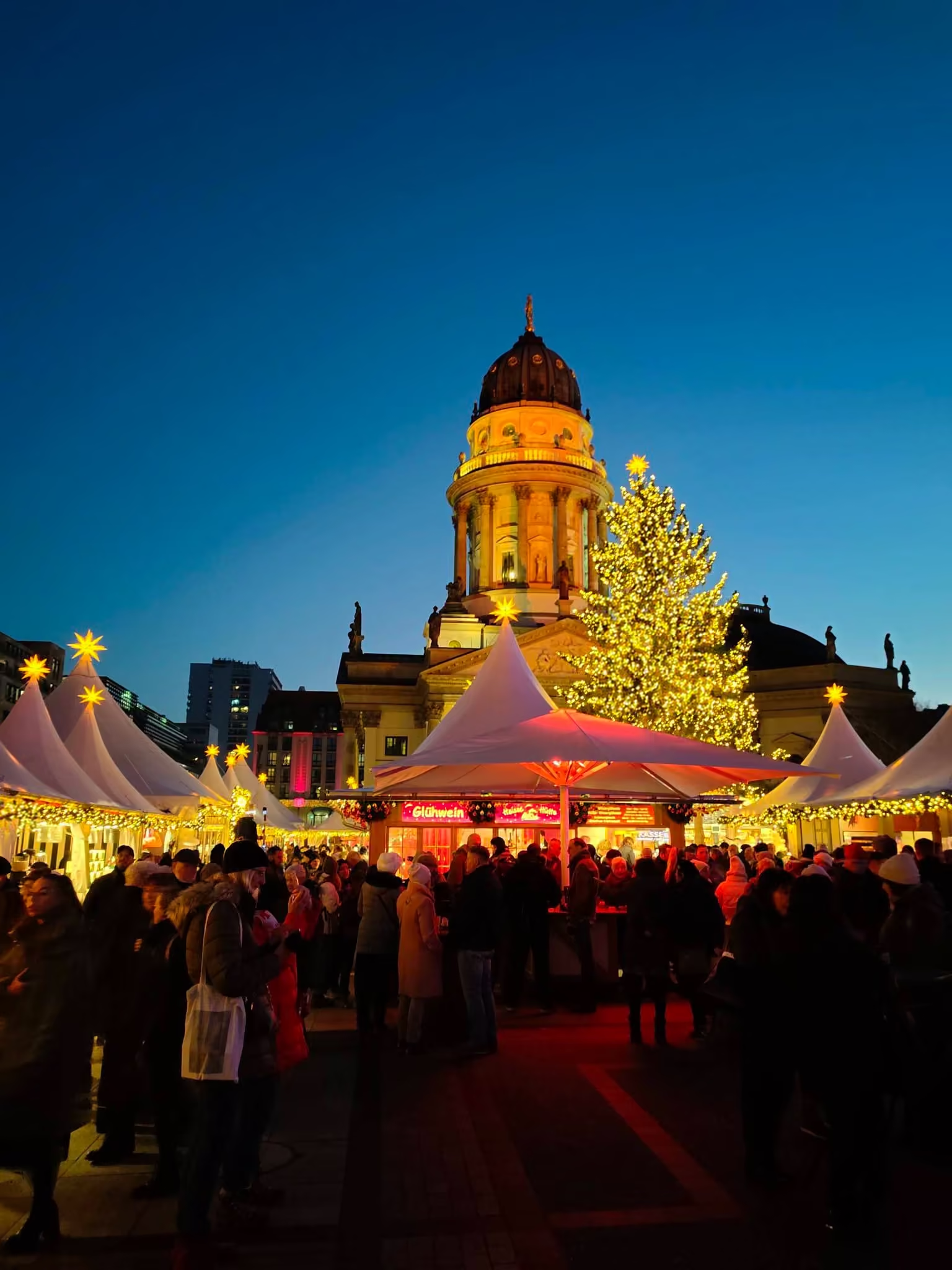
- Berlin is 1 hour 14 minutes by direct ICE, with fares from about €18, while the regional trains take nearly twice as long. Its Gendarmenmarkt market charges €2 entry.
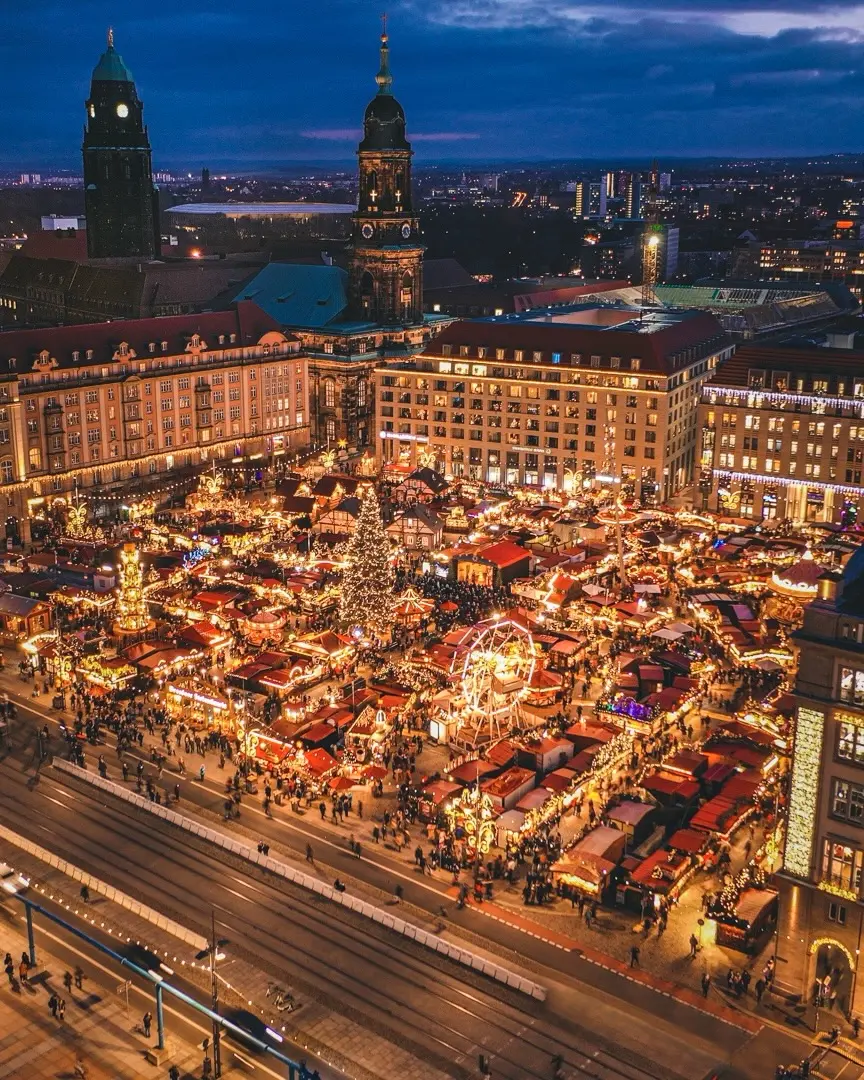
- Dresden is about 65 minutes by direct ICE or IC, or about 90 minutes on the hourly regional train, which the Deutschlandticket covers. Its Striezelmarkt has been going since 1434.
If You’re There Over Christmas
Dresden also saves Christmas Eve. The Striezelmarkt opens from 10:00 to 14:00 on the 24th, so you get one more market after Leipzig closes on the 23rd. Berlin’s Gendarmenmarkt stays open later that day, from 11:00 to 18:00, and runs until 31 December.
Back in Leipzig, the Felsenkeller market ran until 30 December last year, closed from 24 to 26 December, so check it once the 2026 dates are out. If you’re still around after Christmas, Weimar’s market runs until 4 January 2027.
Is the Leipzig Christmas Market Worth It?
Yes, for a night or two, ideally paired with Dresden. It suits music lovers best, and families get a whole square of rides and fairy tales on Augustusplatz. It’s spacious, it’s good value and the food goes well beyond bratwurst.
Make it work by going Monday to Thursday and timing the evening around the brass. Then get your Feuerzangenbowle under the pyramid and a bag of Kräppelchen on Reichsstraße.