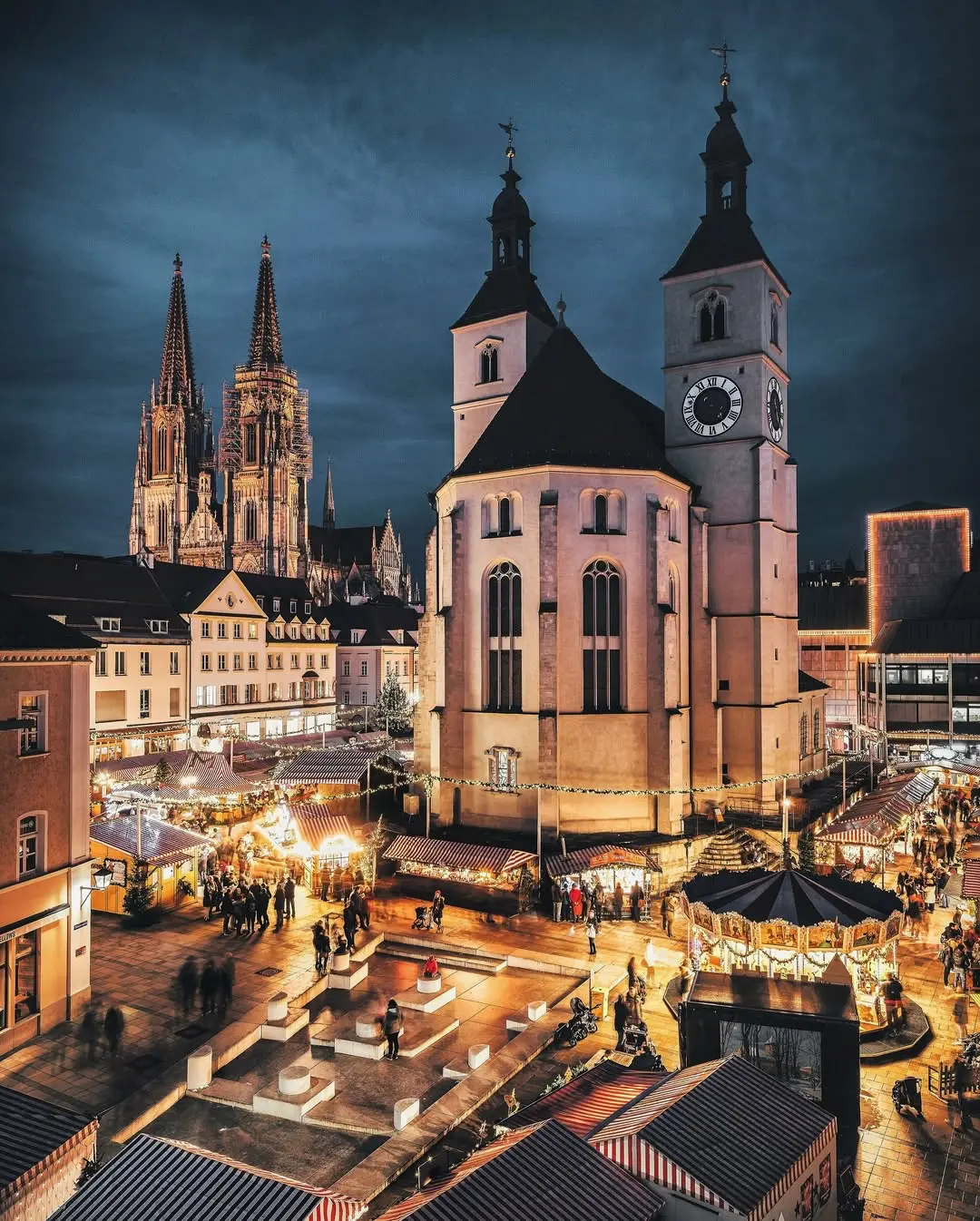
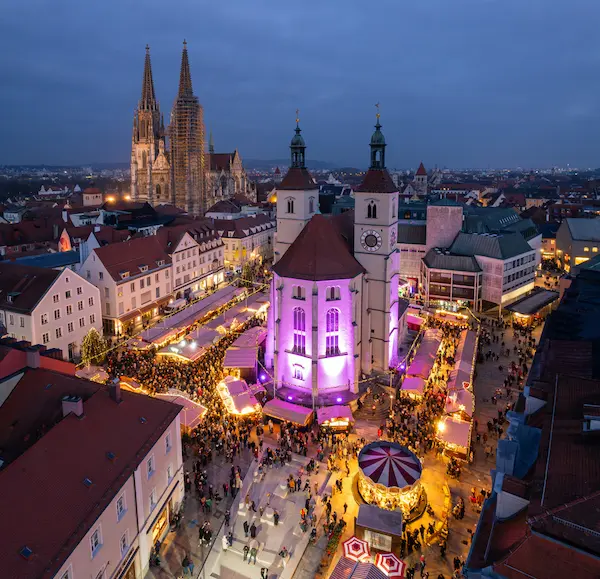
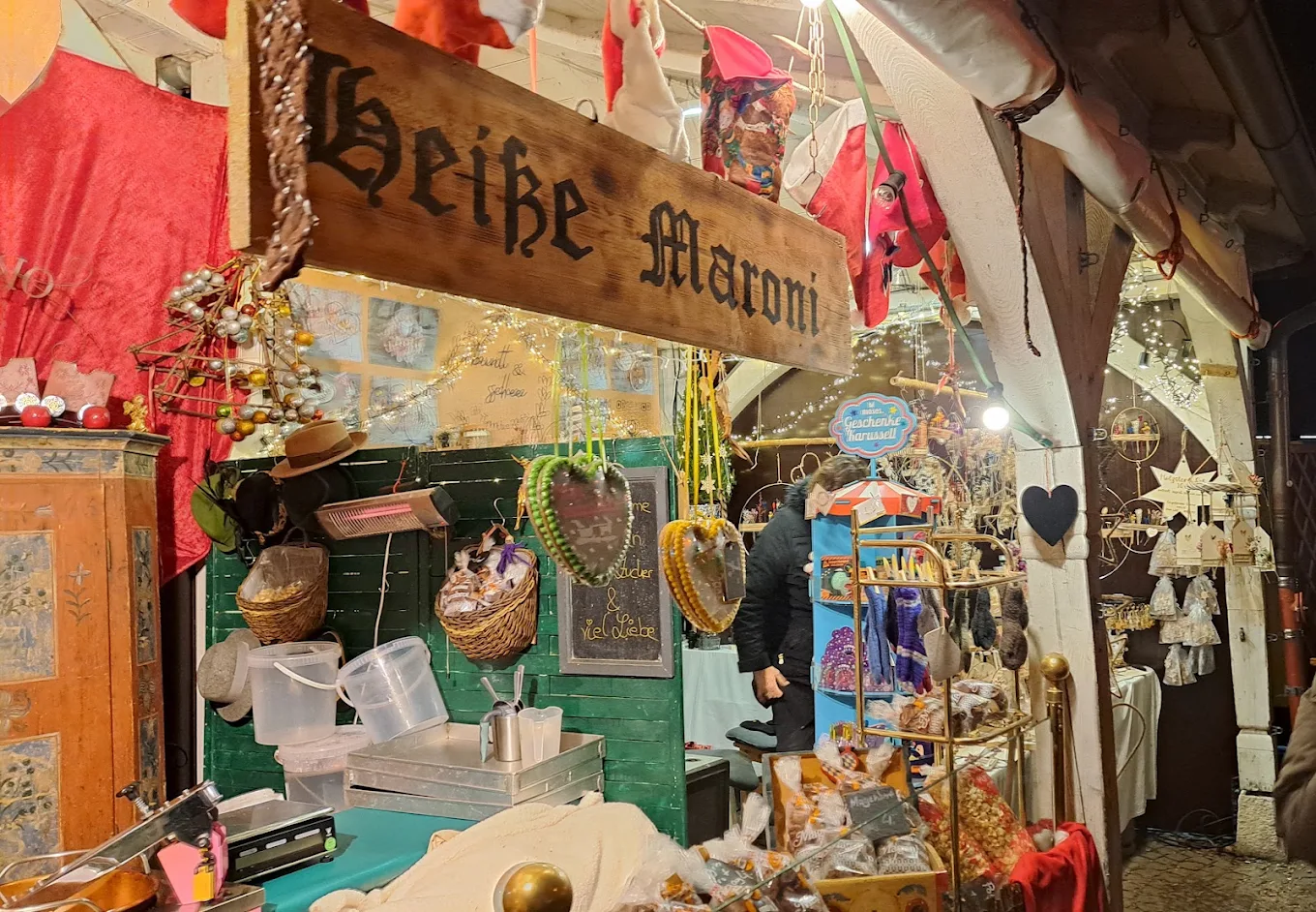
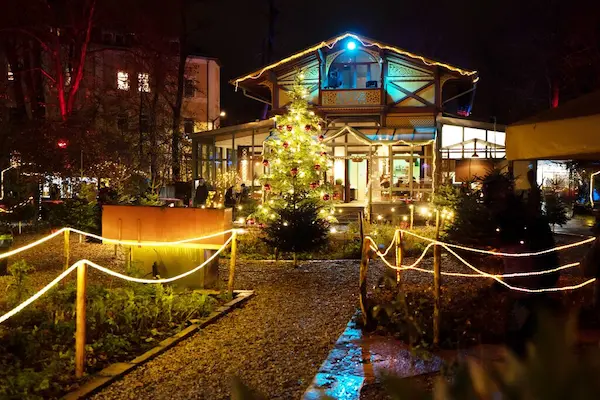
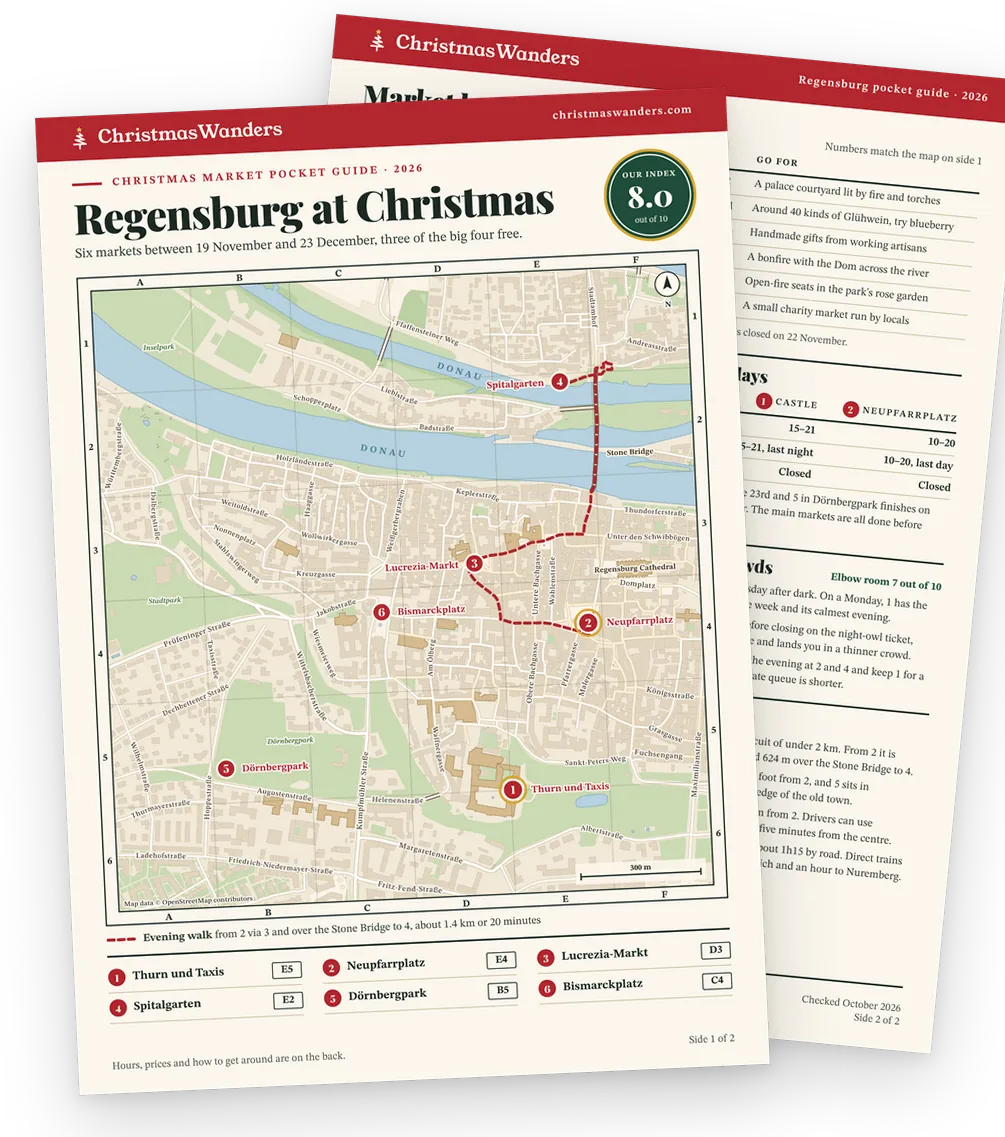
The Regensburg Christmas Market (German: Regensburger Christkindlmarkt) is the Bavarian market that locals often rate over Nuremberg.
With four markets, each with a distinct personality, set in a UNESCO medieval old town where roughly 1,500 buildings still stand from the 13th to 15th centuries, Regensburg is the largest intact medieval town north of the Alps.
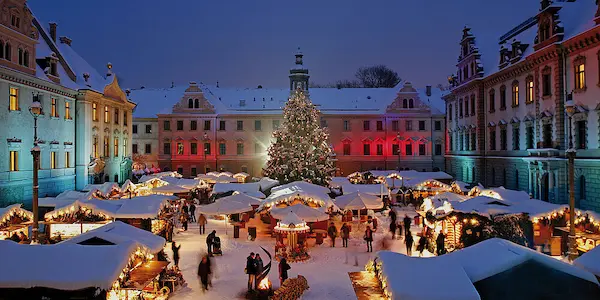
The distinctive draw of Regensburg’s Christmas market offering is the Romantischer Weihnachtsmarkt at Schloss Thurn und Taxis, a fire-lit craft market in the courtyard of a princely castle, and it’s probably one thing here you can’t get anywhere else in Germany.
Regensburg is the city you come to when you want the German Christmas market without the Munich shuffle or the Nuremberg tour-bus scale. The Altstadt is walkable end to end in twenty minutes, the four markets are scattered across it like a single market broken into chapters, and three of the four are free. The fourth (the castle one) charges admission but it is definitely worth paying for..
If I had to place Regensburg against its rivals in one line: Nuremberg is the template, Munich is the bigger-city version, and Regensburg is the one where the centre gives you space and the castle courtyard gives you something no other German market has.
The castle market (the reason to come)
The Romantischer Weihnachtsmarkt auf Schloss Thurn und Taxis runs 20 November to 23 December 2026 (closed 22 November, Totensonntag) in the courtyard of the Princely Castle of Thurn und Taxis — Schloss St. Emmeram, on the south edge of the Altstadt. Hours drift by day: Monday–Thursday 15:00–21:00, Friday 15:00–22:00, Saturday 14:00–22:00, Sunday 14:00–21:00.
It is the only one of Regensburg’s four markets that charges admission, and the tickets are one-entry-only, so buy online in advance for the early-bird discount and to skip the Saturday queue, of course.
What you get for the money is a market unlike any other in Germany. The castle courtyard is lit mostly by fire with open hearths in the stall streets, torches burning around the grounds and very few electric lights.
The huts sell handmade craft rather than the imported tat that dominates the central markets in bigger cities in Germany (and Europe in general). The food is slightly different too and you can find things like wild boar on a spit, Old Bavarian potato soup served in a hollowed bread loaf, and named drinks you won’t find at Neupfarrplatz, such as the Fürstenkelch and the Blaublut.
There’s a Children’s Magic Forest under century-old maple trees with nostalgic rides, and in past seasons a petting zoo with native animals (alpacas have made cameo appearances too). Dogs are allowed on a leash, as well, so that’s a big plus (for dog lovers such as myself).
The Christkind visits this market rather than the Christkindlmarkt, which is a small inversion that tells you which one the city treats as the headline.
So as you can see, it’s popular, and on a Saturday evening you’ll queue, without a doubt. The crowds thin markedly as the night progresses and the night-owl ticket both halves the price and lands you in a calmer market.
The consistent verdict, having weighed the fee, is that the castle market earns it. It is the one thing in Regensburg you can’t replicate elsewhere, and €6.50–€13.50 is a fair price for that.
The other three markets (each a different thing)
The castle gets the attention, but three free markets do the actual volume, and each has a personality the others don’t.
The Regensburger Christkindlmarkt on Neupfarrplatz is the main market, the oldest (tradition dates to the 18th century; first documented 1791), and the one the city brands “the most beautiful Advent market in Bavaria”, a Facebook-poll superlative worth treating with the skepticism a Facebook poll deserves.
It wraps the Neupfarrkirche, has roughly 70 stalls, a central stage with daily performances (the Regensburger Domspatzen choir appears), and a historic children’s carousel. The standout here is the drink variety with around 40 glühwein variations, including two genuinely regional ones such as Heidelbeerglühwein (blueberry mulled wine from the Bavarian Forest) and Apfelglühwein (apple mulled wine from Upper Palatinate orchards).
The Original Regensburger Bratwurst is the default food almost everyone opts to eat at this market. It’s a free entry, of course, and open 23 November–23 December, Sun–Wed 10:00–20:00, Thu–Sat 10:00–21:00, like majority of German Christmas markets.
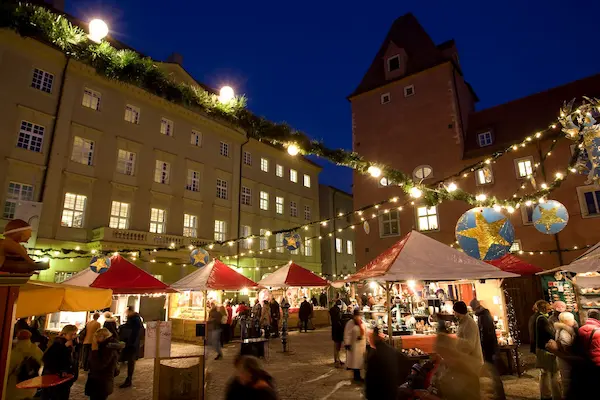
The Lucrezia Markt spreads across Haidplatz and Kohlenmarkt (two squares but only five minutes apart) and is the arts-and-crafts market (the ones I absolutely enjoy). Long-running, pure artisan stalls with beeswax candles, ceramics, jewellery, paper art, soaps etc. If you’re shopping for actual handmade gifts rather than ornaments-from-a-shipping-container, this is definitely where you do it. It’s also free entry, 27 November–23 December, Sun–Thu 11:00–20:00, Fri–Sat 11:00–21:00.
The Adventsmarkt at Katharinenspital / Spitalgarten is the one regulars love very much, in my own experience.
Set at the foot of the Stone Bridge (Steinerne Brücke) on Stadtamhof (over the river, a little hidden) with the Regensburg Cathedral rising behind it.
It’s small, it’s family-oriented, there’s a bonfire, and the vendors are honestly friendlier than the central squares.
It’s the quiet favourite of the four for many reasons, because it’s the coziest, and the market to come to when the others have worn you out.
When to go (and how to beat the crowds)
Regensburg’s markets are smaller than Munich’s or Nuremberg’s, which is most of the point, but they still jam on a Saturday. Here’s how I’d play it.
- Go on a weekday. Tuesday–Thursday is the calmest. The castle market’s Monday €6.50 ticket is both the cheapest entry and the cozies evening, which should be the play if your dates allow it, of course.
- Go after dark. The markets are lit for the evening, and the castle courtyard especially comes alive once the fires are the main light source. The atmosphere switches on at dusk so arriving in the afternoon is fine for Neupfarrplatz shopping, but the markets are an evening thing.
- The castle market after 19:00 gets you the night-owl discount and the thinner crowd. The trade is fewer hours since you’re arriving with about two left (but those are the best hours).
- Avoid Saturday at the castle. It’s the €13.50 ticket and the longest queue. If Saturday is your only option, do Neupfarrplatz and Spitalgarten instead, and save the castle for a weeknight.
- Totensonntag (22 November 2026) closes the castle market; the others don’t open that day either. Plan around it.
My pick is a Tuesday or Wednesday in early-to-mid December, like for almost every Christmas market out there. Neupfarrplatz and Lucrezia in the afternoon, Spitalgarten for an early-evening glühwein by the bonfire, then the castle market from 19:00 for the night-owl ticket and the fire-lit finale.
What to eat & drink
Regensburg’s food is more regionally specific than the standard German-market rotation, and the castle market in particular breaks from the bratwurst-and-glühwein default.
- The Original Regensburger Bratwurst. The city’s signature sausage, grilled, served in a semmel. The Neupfarrplatz default.
- Heidelbeerglühwein (blueberry mulled wine). From the Bavarian Forest, a deep red-purple pour that’s the city’s most distinctive drink. Find it at Neupfarrplatz.
- Apfelglühwein (apple mulled wine). From the Upper Palatinate orchards. The lighter alternative to the blueberry. Also at Neupfarrplatz.
- ~40 glühwein varieties at Neupfarrplatz. The sheer variety is the point. Neupfarrplatz pours more glühwein variations than any market its size I’ve come across, and the regional fruit-wine versions are the ones worth seeking out.
- Wild boar on a spit, and potato soup in a bread loaf. The castle market’s food break from the standard rotation. The bread-loaf soup is the thing to eat when the cold gets into you.
- Fürstenkelch and Blaublut. The castle market’s named drinks, unique to Thurn und Taxis, not found at the free markets.
- Gebrannte Mandeln. Candied almonds, the German-market default snack. Present everywhere.
✦ The mug deposit (Pfand): Regensburg’s markets use the standard German Pfand system with a refundable deposit on the glühwein cup.
Day trip or overnight?
Regensburg is small. It’s too small to be the only destination on a German market trip, if you ask me, but it’s the perfect one-night stay or day trip.
A direct train from Munich runs in about 1.5 hours, with frequent departures through the day which means it’s close enough to do as a day trip and far enough that an overnight lets you do the castle market properly (after 19:00, with the night-owl discount) without watching the clock for the last train.
If you’re pairing cities: Munich → Regensburg → Nuremberg is the natural Bavarian triangle, all connected by direct ICE in roughly 1–1.5-hour hops.
Do Regensburg as the middle night.
Tips for visiting
- Buy the castle ticket online in advance. Early-bird discount plus skip-the-queue. The Saturday queue at Schloss Thurn und Taxis is the one queue in Regensburg worth avoiding.
- Bring cash. The castle market warns not all stalls accept cards; there’s an ATM on site, but the free markets’ smaller stalls prefer cash too.
- Dress for the cold. The castle courtyard is exposed, the fires notwithstanding. Layers, real coat, gloves. December in Bavaria sits around freezing, and you’re standing still outdoors for hours.
- Don’t confuse the markets. Three are free, one (the castle) is paid. Visitors occasionally pay at the castle expecting the others to charge too — they don’t.
- The Christkind visits the castle market, not the Christkindlmarkt. If the Christkind is the thing you want, Schloss Thurn und Taxis is the address.
- Verify the schedule before you build an itinerary. The four markets run on slightly different dates and hours (the small Dörnbergpark market runs 19 November to 20 December, the castle opens 20 November, and the others open 23–27 November and close 23 December). Check tourismus.regensburg.de for the current season’s confirmations.
Independent Christmas journaling. All of the opinions on this website are mine and written from my personal perspective, with my love for Christmas behind it.