Riquewihr has about 1,050 residents, and every Advent roughly 450,000 people come to see its Christmas market.
That’s more than 400 visitors for every person who lives there. It’s got to the point where one street in the old town has signs asking visitors to keep it down because residents are resting (locals call it the rue du silence), and the head of the local tourist office said last December that she’d stopped promoting the market altogether.
When a tourist office stops advertising its own Christmas market, you know something’s up.
Riquewihr at Christmas really is as pretty as everyone says, or nobody would come.
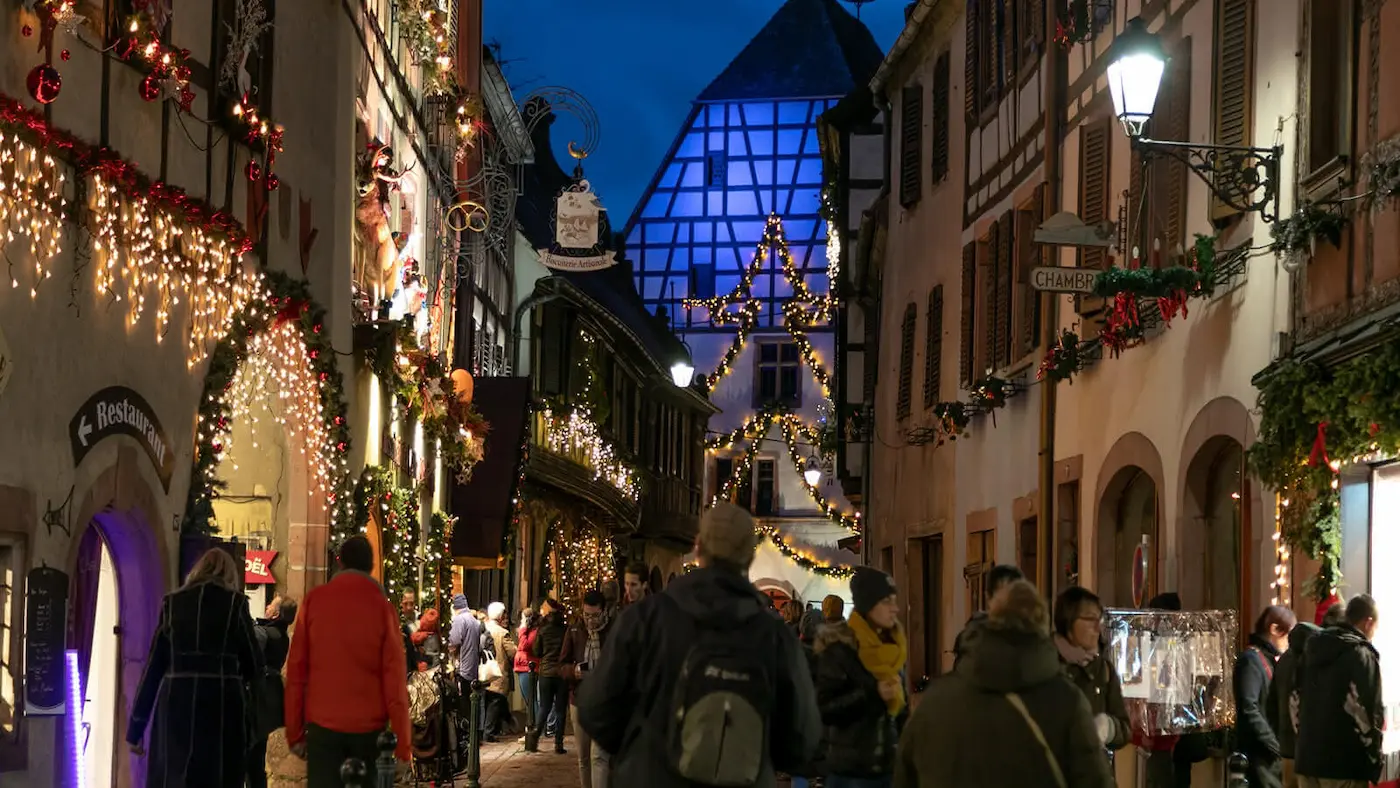
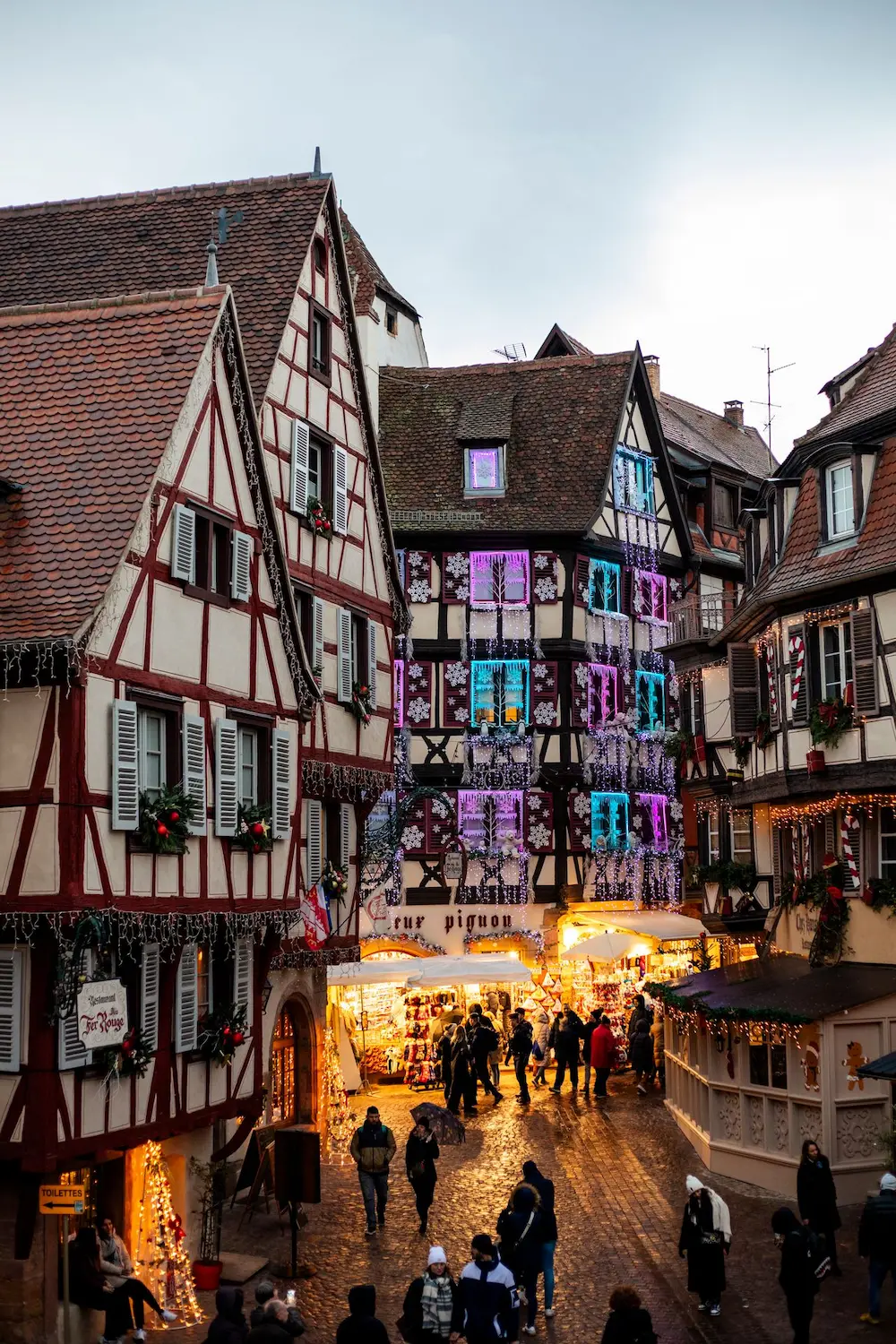
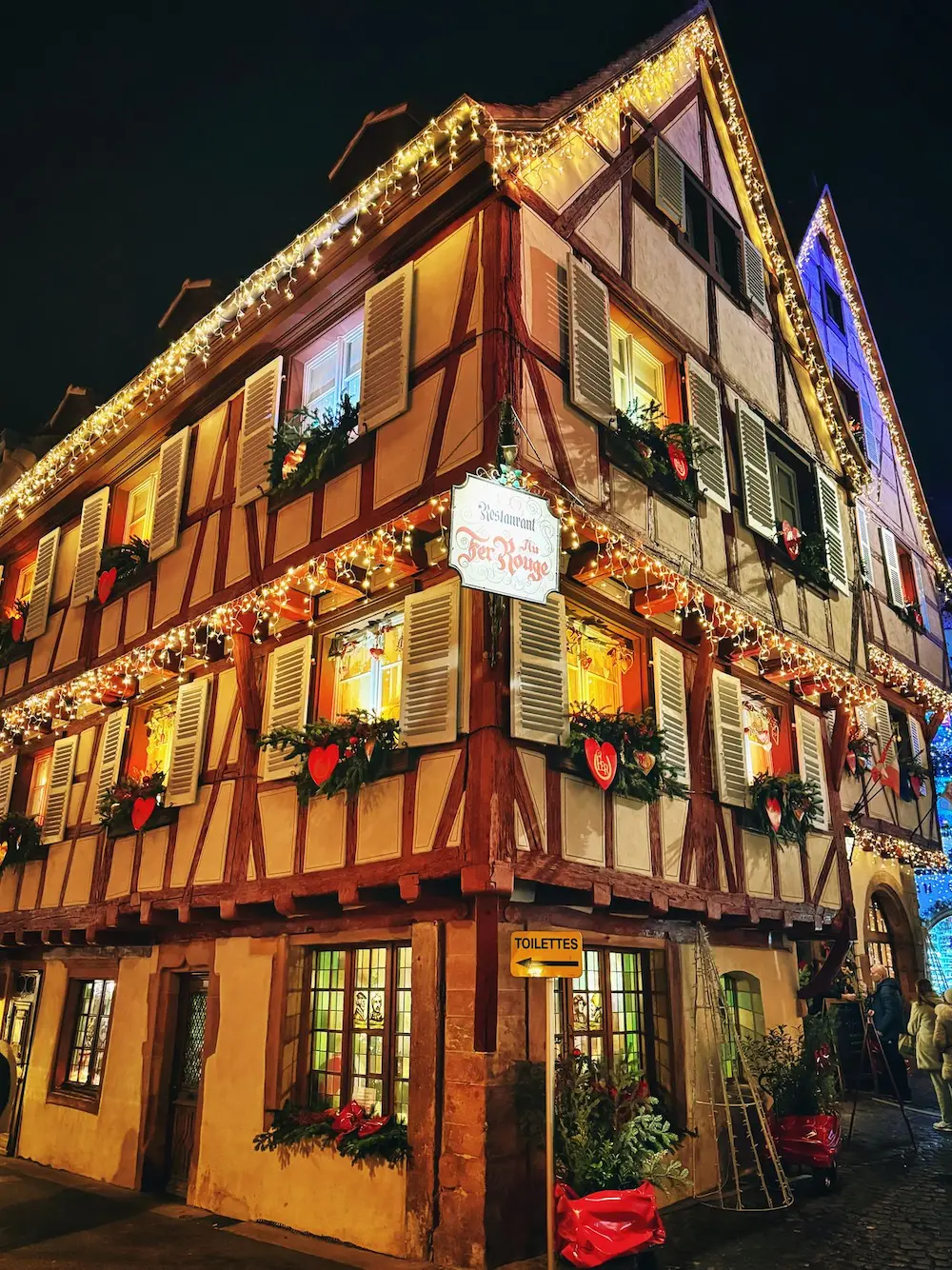
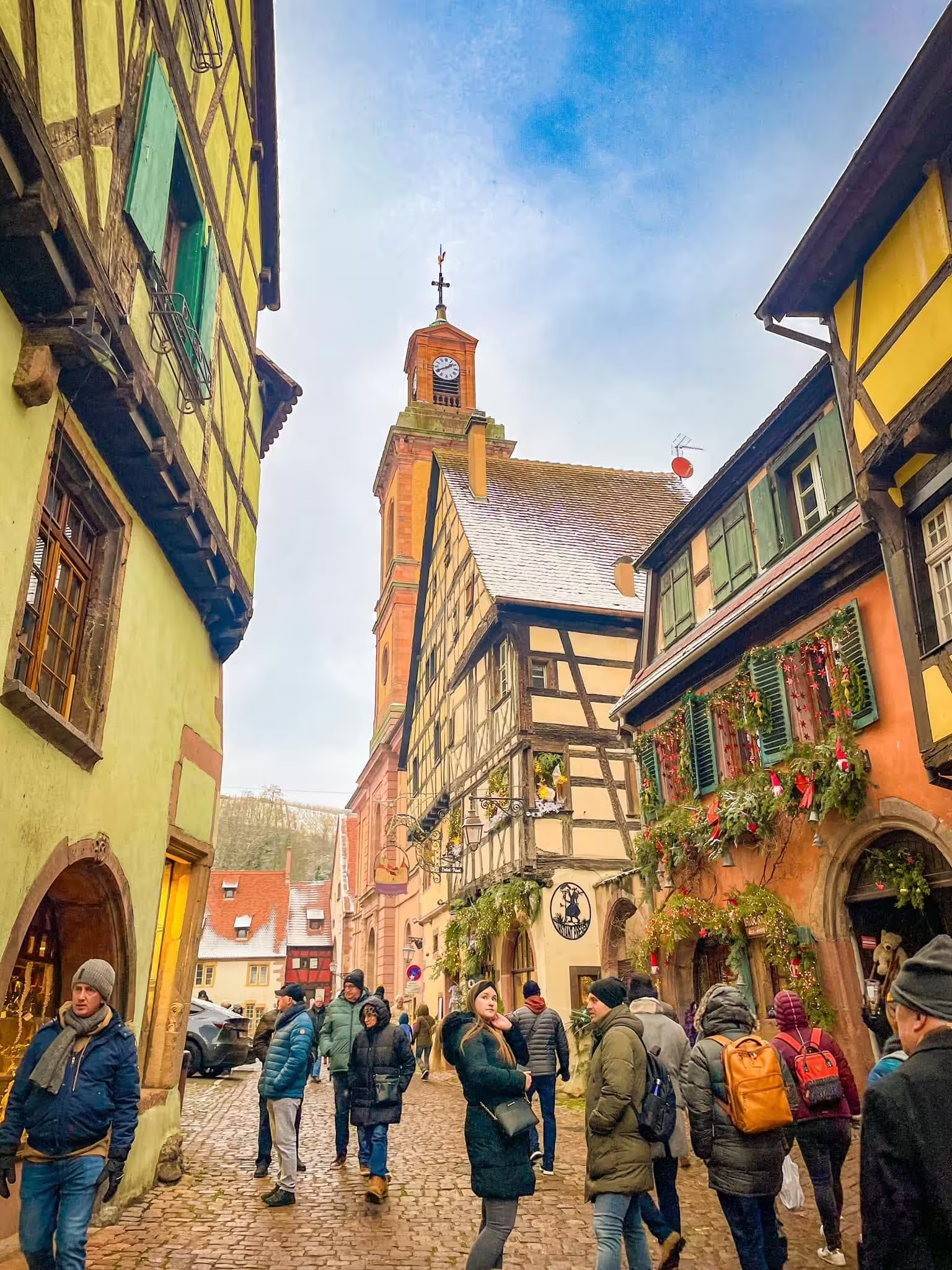
Half-timbered houses in yellow, pink and blue lean over one main street that climbs from the town hall to a medieval gate tower, every door and window is dressed for the season, and the smell of wine drifts out of cellars that families have run for three or four hundred years.
And if you turn up at 14:00 on a Saturday, you’ll see most of it over the shoulders of a coach group.
Riquewihr is easy to get right, though. The chalets are the smallest part of it.
The village itself is the real market, the wine is the real souvenir, and the crowds follow a timetable you can plan around.
Riquewihr Christmas Market 2026 Dates and Hours
| 2026 | |
| Dates | Fri 27 Nov to Sun 20 Dec, open every day |
| Monday to Friday | 10:00 to 18:30 |
| Saturday and Sunday | 10:00 to 19:00 |
| Opening day (Fri 27 Nov) | 10:00 to 20:00 |
| Entry | Free |
| Christmas Eve and Christmas Day | Closed, the market ends on 20 December |
The dates follow the same pattern every year.
The market opens on the Friday before the first Sunday of Advent and closes on the fourth Advent Sunday, so if you’re in Alsace for Christmas week itself, the chalets have already gone.
The decorations stay up and the wine shops and Christmas shops stay open, but the market doesn’t.
A lot of guides still say the market stays open until 19:30 at weekends. The official 2026 listing says 19:00, and on weekdays the stalls shut at 18:30, which is early for a village that looks its best after dark.
The street lights and decorations stay on after the chalets close, and walking the lit streets once the stalls are shut is one of the best things you can do here.
Why Riquewihr Gets So Crowded
It’s mostly maths. Riquewihr is a walled village of about 300 by 220 metres with basically one main street and no train station, and it sits right on the Alsace wine route between Colmar and Kaysersberg, which is the road every Christmas coach tour of the region drives.
The Christmas markets of the Haut-Rhin department pulled in nearly four million visitors in 2024, and Riquewihr takes a big slice of that because it’s on every “prettiest village in France” list, including the official one, Les Plus Beaux Villages de France.
The village has been trying to manage it.
There are Christmas shuttles and a park and ride to keep cars out, free pocket ashtrays handed out to smokers, and the rue du silence itself, a street in the old town with signs asking for discretion.
One of them reads “keep calm and eat bretzels”, which is the most Alsatian request I’ve ever come across. None of it is enforceable.
The mayor, Daniel Klack, has said openly that residents no longer feel at home in December, while also pointing out that the village lives off those visitors.
The tourist office now points people towards quieter markets nearby and asks them to come on weekdays.
Kaysersberg, 4 km down the road, went further, and its mayor keeps that market to Friday, Saturday and Sunday so residents get their weekdays back.
I don’t think any of that means you should skip Riquewihr. It means you should do it well.
Come on a weekday rather than a weekend, take the bus rather than the car, stay overnight if you can, and spend your money in the family cellars and shops that actually live here all year.
That also happens to be the version of Riquewihr that’s the most fun.
When to Go (and When Not To)
The tourist office publishes a crowd forecast calendar for the whole Colmar area, built from real attendance figures from 2024, and it’s the single most useful thing you can look at before planning Riquewihr.
It rates each day from low to very high. For Riquewihr, most weekend slots come up very high, most weekdays in early December come up high, and the only stretch that eases off to moderate is the final week, Monday 14 to Friday 18 December.
If your dates are flexible, that’s your window.
Time of day matters nearly as much. The coaches and day trippers arrive from late morning and keep coming through the afternoon, and on weekends the access roads are saturated from lunchtime.
The mornings are calmer, and the other calm window is after the stalls close. On a weekday the chalets shut at 18:30, the coach groups head back to their buses, and the decorated streets stay lit for whoever’s left.
Once the sun sets and the day crowds are gone, she says, the village is yours.
That’s the whole case for sleeping in Riquewihr.
There’s a handful of small hotels and plenty of guest apartments inside the walls, and if you’re staying, the evening and the early morning belong to you.
You can walk the main street at 08:30 before a single chalet opens, have dinner in a winstub with the lanes empty outside, or go to the men’s choir Christmas concert in the Protestant church on Friday 4 December at 20:00.
It’s free, and nobody on the last bus to Colmar will ever hear it.
How to Get to Riquewihr Without Losing Your Afternoon
Riquewihr has no train station, so everyone arrives by road, and that’s where a lot of visits go wrong.
| Option | Cost | Runs | Good to know |
| Bus 816 from Colmar station | €4 each way | Every day | 28 minutes to Riquewihr Poste, a minute’s walk from the market. Nothing leaves Colmar between 07:40 and 11:10. Last bus back 18:13 Monday to Saturday, 17:43 on Sundays |
| Christmas shuttle, lines 1 and 2 | €17 a day, under-12s free with a reserved seat | Fri to Sun, 27 Nov to 20 Dec | Leaves from Colmar station and links Riquewihr with Kaysersberg and Ribeauvillé on the same ticket. Stops at Rue du Stade |
| Naturoparc park and ride | €10 per car | Sat and Sun, 28 Nov to 20 Dec | In Hunawihr, with a shuttle every 30 minutes from 09:45 to 18:30 |
| Driving in | Paid parking | Any day | Workable on a weekday morning, a bad idea on a weekend afternoon |
The bus is the bargain.
For €4 you get from Colmar station to the bottom of the village in under half an hour. Some pages, the official market page included, still call it line 16, but it’s 816 now. Its weak spot is the timetable.
There’s a big gap in the morning, and the last bus back leaves at 18:13, so you can’t hang around for the evening. On a weekday I’d take the 14:10 from Colmar and the 18:13 back.
You get the afternoon light, the lights coming on around half past four, and the main street as the crowds start thinning out, and you’re back in Colmar for dinner.
Coming from Strasbourg, it’s about half an hour by train to Colmar, and then the same bus.
At the weekend the shuttle is worth the €17. It runs more often, it runs later into the evening, and line 2 connects Riquewihr and Kaysersberg in about 20 minutes, so you can do both villages on one ticket.
Seats per day are limited, and tickets go on sale online on Thursday 12 November at 12:00, so book early if you’re going on a Saturday. If you really have to drive at the weekend, use the Naturoparc park and ride instead of trying to get into the village itself.
The Village Is the Real Market
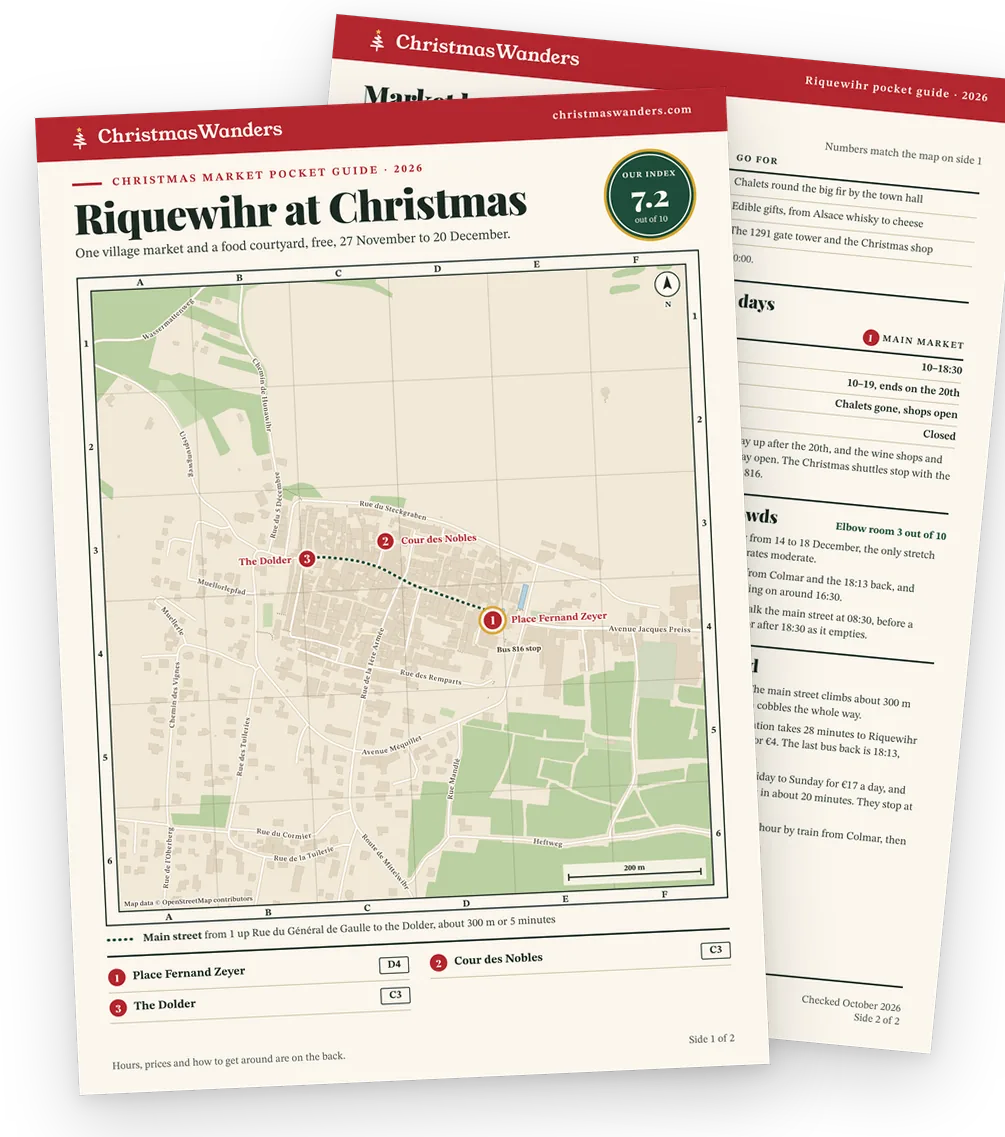
The chalets are at the bottom of the village, around the big fir tree on Place Fernand Zeyer next to the town hall and under the trees of the Esplanade des Remparts.
There’s no official stall count (guides claim anything from forty to more than a hundred), and it’s a small, pleasant, fairly standard Alsace spread of hand-painted baubles, wooden toys, candles, gingerbread, bredele biscuits, pretzels, roast chestnuts and vin chaud.
You’ll see it all in half an hour.
Then you walk uphill, and that’s what people really come for. Rue du Général de Gaulle climbs about 300 metres from the town hall to the Dolder, and every house on it is dressed for Christmas, with wreaths on the doors, garlands along the half-timbering, stars in the windows and little scenes set up in the shop fronts.
At the top stands the Dolder itself, a 25-metre gate tower built in 1291 along with the first ramparts, which is the photo everyone takes. Walk up one side of the street and down the other, and duck into the side lanes too, because the quieter streets behind the main one are just as decorated and carry a fraction of the people.
Plan around two stops on the way up. The Féerie de Noël, near the foot of the Dolder, is a two-floor Christmas shop run by Käthe Wohlfahrt, the Rothenburg company famous for its year-round Christmas shops.
It opened here in 1995, trades most of the year, has a giant nutcracker outside and, most days in December, a queue to get in.
Go early in the day or late. It’s very much a German Christmas shop in a French village, which, given Riquewihr’s history, is fitting.
The other is Le Sentier des Saveurs in the Cour des Nobles, a private courtyard in the upper old town where the same couple fills eleven wooden chalets with food every Christmas.
This is where I’d buy the edible gifts. Think Alsace whisky, smoked charcuterie, cheese, chocolate, local brandy and jars of gingerbread and bredele.
It’s small and a bit hidden, which in Riquewihr in December is a compliment.
If you’ve got kids with you, pick up the Christmas treasure hunt too. They collect letters around the village to spell a mystery word and claim a small reward at the tourist office, which keeps them busy on the walk uphill.
You’ll probably also hear that Riquewihr inspired Belle’s village in Disney’s Beauty and the Beast. It gets repeated everywhere, usually alongside Ribeauvillé, but I couldn’t find a single Disney source that says so. It doesn’t matter much.
The village looks the part either way.
Riquewihr Is a Wine Village First
Take the Christmas away and you still have one of the most important wine villages in Alsace.
The vineyards run right up to the ramparts, and the hill behind the village, the Schoenenbourg, is a grand cru famous for its Riesling that also shelters Riquewihr from the north wind.
The families who make that wine have been here a very long time. The Hugels settled in 1639 and are now on their twelfth and thirteenth generations, with cellars under sixteenth-century buildings in the middle of the village.
The Dopffs have made wine in Riquewihr since 1574, and Pierre Dopff was one of the people behind the creation of the Crémant d’Alsace appellation in 1976. If the weather’s kind, walk a few minutes up into the vines behind the walls for the view back over the rooftops. It’s the best free thing in Riquewihr and a lot quieter than the main street.
That makes the wine shops and tasting rooms along the main street the best shopping in the village.
A bottle of Schoenenbourg Riesling or a crémant from the family that grew it is a much better souvenir than a bauble made somewhere else, and the money stays in Riquewihr, which the residents on the rue du silence will appreciate.
Drink the local version of Christmas while you’re at it. Alsace vin chaud is usually made with local red wine, and you’ll often see a white version too, made with Alsace whites, which is lighter and more fragrant and the one I’d try first.
Riquewihr’s stalls also pour a few things you won’t see at most markets, like hot Poire Williams (pear brandy) and hot gin.
Pace yourself on those, because the cobbles on the main street are steep enough sober.
What to Eat in Riquewihr
The chalets cover the snacks, which means gingerbread, pretzels, roast chestnuts, kougelhopf and bredele.
For a proper meal you want a winstub, the Alsace version of a wine tavern, and Riquewihr has plenty of them inside the walls.
Order choucroute, the local sauerkraut piled with sausages and pork and cooked in Riesling, or baeckeoffe, meat and potatoes slow-baked in white wine in a sealed pot, or a tarte flambée if you just want something quick.
Book lunch if you can, or eat before noon or after 14:00, because the restaurants fill up fast at midday when the coaches are in.
If you’re staying overnight, dinner is where Riquewihr turns into a different place.
The lanes are empty, the lights are still on, and there’s a bottle of Riesling on the table that was made a few hundred metres from where you’re sitting.
A Short History of Riquewihr
Riquewihr looks the way it does thanks to two strokes of luck. For nearly five centuries, from 1324 until the French Revolution, it belonged to the counts and later dukes of Württemberg, a German house ruling from far away.
That’s why the village went Lutheran in 1534 and why it still has the Protestant church where the men’s choir gives its Christmas concert.
The second bit of luck came in the winter of 1944 and 1945, when the fighting around Colmar left neighbouring villages like Bennwihr and Ammerschwihr largely in ruins.
Riquewihr came through almost untouched, mostly because it sits in a dead end off the main roads.
So the walls, the Dolder, the Thieves’ Tower from around 1550 (torture chamber included) and the sixteenth-century houses are all still standing, and the village looks today more or less as it did in the sixteenth century.
On a quiet December morning, before the first coach arrives, you’d believe it.
So, Is the Riquewihr Christmas Market Worth It?
Yes, on the right day.
On a weekend afternoon it’s one of the most frustrating Christmas outings in Alsace, with jammed roads, queues for everything and a main street you shuffle up rather than walk.
On a weekday in mid-December, or in the evening after the day crowds leave, it’s one of the prettiest.
On the Index it scores 8 for atmosphere and 3 for elbow room, and both of those numbers describe the same village at different hours.
If you’re choosing between the villages around here, this is how I’d split them.
Colmar is the big one and the easiest base, with the train station and the most markets.
Kaysersberg, 4 km away, only runs Friday to Sunday and has the castle ruins and the river. Riquewihr is the one to do on a weekday, for the main street, the wine and the Christmas shop, ideally with a night inside the walls.
And if a weekend is all you’ve got, take the shuttle, do Kaysersberg first and Riquewihr late in the day as the coaches are leaving, and use the same €17 ticket for both.
If you’ve been, tell me in the comments which day you went and how busy it was, because that’s the single most useful thing another reader can know about Riquewihr.
And if you’re still comparing, every market on the Index is scored on the same six things, so you can see how it stacks up. Just keep your voice down on the rue du silence.