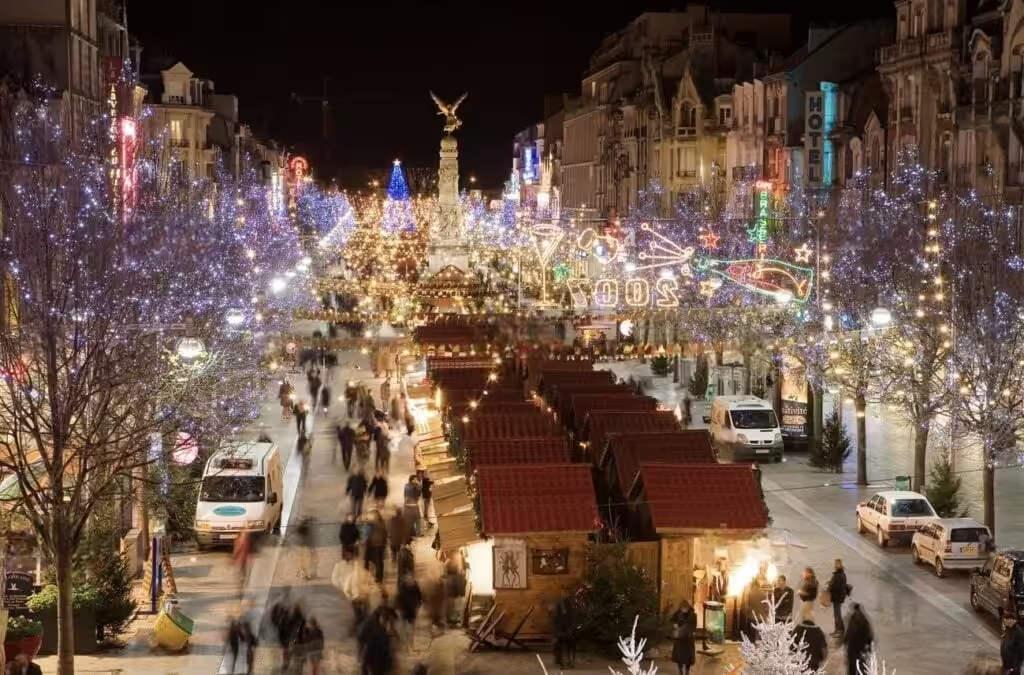
Lille’s Christmas market fits on one square.
It’s 90 wooden chalets on Place Rihour, fenced in with bag checks at the gates, and more than a million people a season try to squeeze into it.
That’s worth knowing before you book, because Lille gets sold hard in the UK as a Christmas market break, and the market on its own isn’t big enough to carry a trip.
The city around it is. Lille is 82 minutes from London on the Eurostar, and at Christmas it feels closer to Belgium than to Paris.
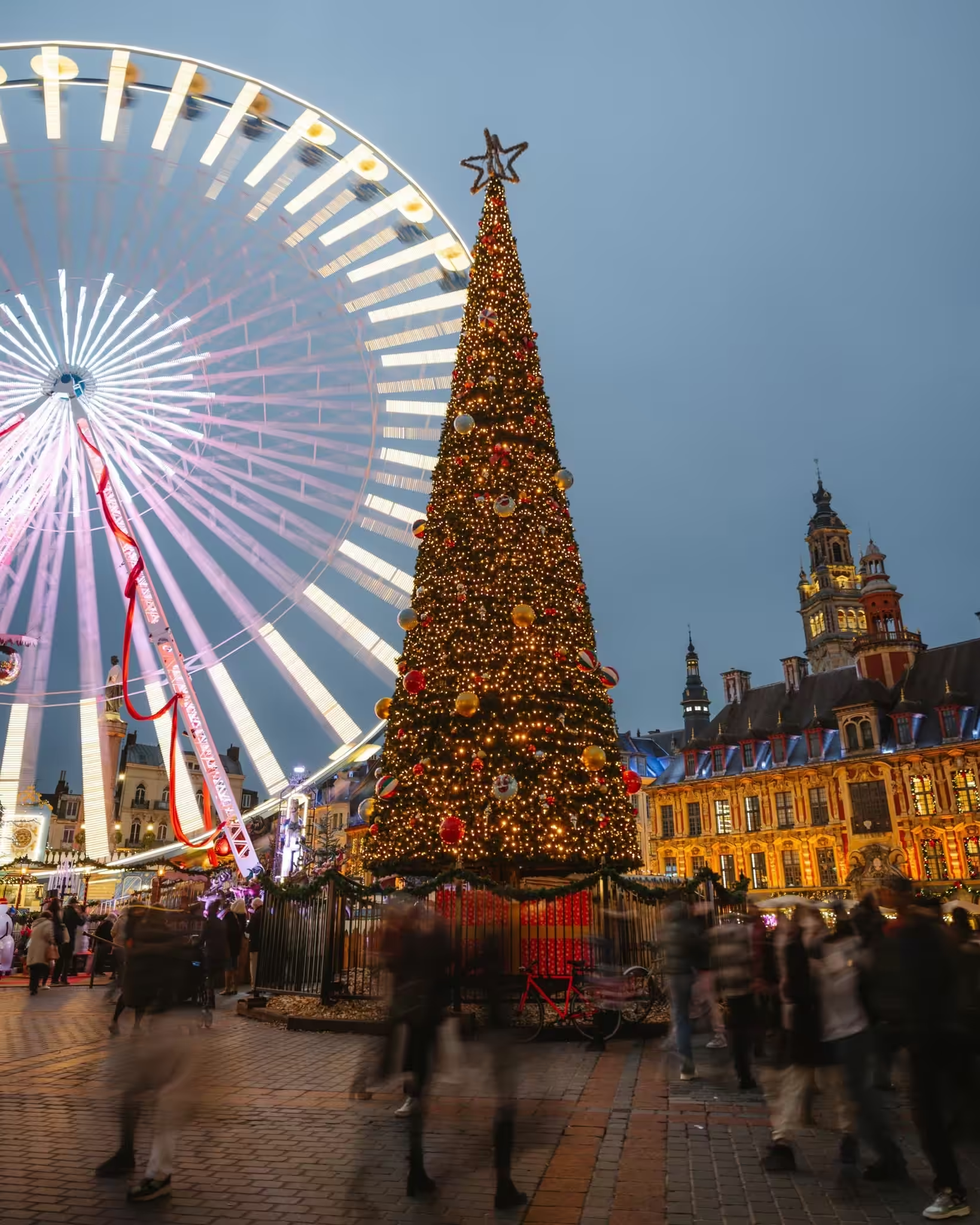
Saint Nicolas matters here, there’s a shop that has been selling sweets on the same street since 1761, people drink beer rather than wine, and a 50-metre Ferris wheel turns over the Grand’Place.
Come for Lille and the market is a lovely bonus. Come only for the market and you’ll probably wonder what the fuss was about.
Lille Christmas Market 2026 Dates and Hours
The Village de Noël opens on Wednesday 18 November 2026 and runs until Wednesday 30 December.
Those dates come from the organiser, the Lille federation of shops and traders, and they’re still marked provisional, so check them again before you book anything you can’t cancel.
The market is open from 11:00 to 20:30 Sunday to Thursday and from 11:00 to 22:00 on Fridays and Saturdays. On Christmas Eve it closes at 18:00, it’s shut all day on Christmas Day, and then it reopens for a last few days before closing at 18:00 on the 30th.
Entry is free. The Ferris wheel on the Grand’Place is separate and paid, and it hangs around well after the chalets have gone.
In 2025 it stayed up until about mid-January, and a heated chalet next to the Goddess column on the Grand’Place stayed open until 19 January.
Nobody has confirmed yet whether that chalet comes back for 2026.
| Date | What’s on |
| Wed 18 Nov | Village de Noël opens on Place Rihour |
| Every Wednesday | Kids’ workshops and shows at the market (2025 programme) |
| Weekend evenings | Music and light parades through the market (2025 programme) |
| Fridays and Saturdays | Market open until 22:00 |
| Night of 5 to 6 Dec | Saint Nicolas brings sweets to good children across the north |
| December weekends | Sustainable Christmas market outside La Piscine in Roubaix (2025 pattern) |
| Thu 24 Dec | Market closes at 18:00 |
| Fri 25 Dec | Market closed |
| Wed 30 Dec | Last day, closes at 18:00 |
| Mid-January | The Ferris wheel comes down (2025 timing) |
Lille in December is grey, wet and windy far more often than it’s snowy, and the wind comes straight across the Grand’Place with nothing to stop it.
Pack a proper waterproof and something warm for your head.
When the rain gets serious, the estaminets are your shelter, and so is Le Furet du Nord on the Grand’Place, a bookshop so big you can lose an hour in it without noticing.
What the Market Is Really Like
Place Rihour is a small square beside the Palais Rihour, the Gothic palace of the Dukes of Burgundy that now holds the tourist office, and the market has been set up here for more than 30 years.
The 90 chalets are packed in tight inside a fenced area, with security and bag checks at the entrances, which is standard for big French markets now.
The chalets sell a mix of French Christmas food and gifts, like foie gras, truffles, chocolate, gingerbread, regional sweets, candles, jewellery and things made from wood, leather and metal.
Traders come from all over France, so a fair amount of it you could find at any French Christmas market.
The stalls I’d hunt for are the northern ones, with Christmas beers, gingerbread and sweets from the region.
There’s also a solidarity chalet that hosts a different Lille charity every few days, which is a good place to spend a few euros.
For food it’s tartiflette, raclette, crêpes, waffles, hot chocolate and vin chaud, plus oysters, because this is France and oysters are a Christmas thing here.
If I had to take one thing home that’s actually from the north, it would be a bottle of Christmas beer, with a slab of gingerbread or a bag of Bêtises de Cambrai as runners-up.
Bêtises are striped mint sweets from Cambrai, about an hour south of Lille, and the name translates as “Cambrai blunders”, because the story goes that they were invented by an apprentice who got the recipe wrong.
It’s the rare mistake that people have been buying on purpose for well over a century.
The crowds are the part nobody puts on the poster.
More than a million visitors a season in one square means it gets very tight. On Friday nights and weekends the queue just to get through the bag check can run to an hour, and once you’re in you shuffle more than you stroll, with separate queues at the busiest food stalls.
Lille is also a regular on UK coach tours and school Christmas trips, so on a Saturday you may hear as much English in the queue as French.
You can dodge most of that. Come Monday to Thursday, ideally before 16:00, and try the side entrance by the Rihour metro stop, which is usually quicker than the main gate on rue Jean Roisin.
Wednesday afternoons are the exception, because Wednesday is the traditional kids’ afternoon in France and the market runs its children’s programme then, on top of Santa’s chalet, which is there all season. Expect families and face paint.
Great if you’ve got kids with you, one to skip if you haven’t. And don’t build your whole day around the chalets. An hour is enough to see all 90, eat something and have a vin chaud.
The Grand’Place and the Big Wheel
Two minutes from Place Rihour, the Grand’Place gets the 50-metre Ferris wheel and an 18-metre Christmas tree.
Its official name is Place du Général-de-Gaulle, after the general who was born a few streets away in 1890.
The wheel has 36 gondolas, and in 2025 a ride cost €7 for adults and €5 for children under 1.40 metres, by card or cash.
It also kept turning until midnight, long after the market shut, and that’s when I’d ride it. The queue is short late at night, and the square below is lit up and mostly yours.
From the top you look straight down on the Vieille Bourse, the old stock exchange, built in 1652 and 1653 as 24 identical Flemish Renaissance houses wrapped around a courtyard.
It’s the building that tells you you’re in Flanders and not Paris. Walk through the courtyard on your way past, where second-hand booksellers set up and people play chess.
The column in the middle of the square is the Colonne de la Déesse, the Goddess column.
It remembers 1792, when about 20,000 Austrian soldiers besieged Lille and bombarded it for nine days and nights, and the city still wouldn’t give in.
The column went up in 1845, and Lille people have called the figure on top “the Goddess” ever since.
On the far side of the Vieille Bourse, on Place du Théâtre in front of the Opéra, there’s the Idéal Chenille, a caterpillar ride built in 1922 with a red velvet hood that folds down over the cars as it spins.
Small kids love it, and even if you don’t ride, it’s worth two minutes to watch the hood come down.
For the best view in town, walk about fifteen minutes south-east to the town hall and ride the lift up its 104-metre belfry, which is on the UNESCO list with the other belfries of northern France and Belgium.
It costs €9, and the last lift of the day goes at 16:45, which in December is right around sunset.
A Northern Christmas
The clearest sign that Lille looks north at Christmas is Saint Nicolas. In the north and east of France he arrives on the night of 5 to 6 December with sweets for good children, a few weeks before Père Noël does his rounds.
Lille’s favourite song is about exactly that.
P’tit Quinquin was written in 1853 by Alexandre Desrousseaux, a songwriter from the old working-class Saint-Sauveur district, in the local Picard dialect that people here call Ch’ti.
It’s a lullaby about a poor lacemaker trying to get her crying little boy to sleep, and she bribes him the way every tired parent does.
Tomorrow he’ll get gingerbread and plenty of sugar, she tells him, and next month it’s Saint Nicholas day, when the saint will come to see him one evening with his donkey.
Lille had around 15,000 lacemakers at the end of the 18th century, and Saint Nicholas was their patron saint, so the song is closer to home than it sounds. It became the city’s unofficial anthem, and a white statue of the mother and her baby stands a few minutes’ walk west of the market.
If the word Ch’ti rings a bell, it’s probably from Bienvenue chez les Ch’tis, the 2008 comedy about a post office manager sent to the far north.
It became one of the biggest box-office hits in French history and made the whole country laugh at the north, and then fall a little bit in love with it.
The other northern Christmas thing to look for is the coquille de Noël, a sweet brioche shaped like a baby in swaddling clothes, which is the infant Jesus.
From Tournai across the border down to Lille it’s called a coquille, while in Liège it’s a cougnou. Bakeries start making them around Saint Martin’s Day in November, keep going through Saint Nicolas and carry on to the New Year.
You eat it with hot chocolate, plain or with butter, and nobody seems to find it strange to bite the head off a baby-shaped bun. Look in bakery windows, not at the market.
Around Saint Nicolas you’ll also see gingerbread and speculoos, the thin spiced biscuits that go with the saint on both sides of the border, piled up in the same windows.
Waffles, Welsh and Christmas Beer
Méert is the address everyone ends up at, and it earns it.
It has been on rue Esquermoise since 1761, which makes it one of the oldest pâtisseries in France, and the shopfront with its woodwork, gilding and mirrors has been a listed historic monument since 1980.
The thing to buy is the gaufre fourrée, a thin oval waffle split in half and filled with butter, sugar and Madagascar vanilla, eaten at room temperature and wrapped in paper.
It’s nothing like a Belgian waffle. It’s flat, soft and very sweet, and it took off after a Belgian confectioner named Meert took over the shop in 1849.
By 1864 he was supplying King Leopold I of Belgium, and the story goes that de Gaulle had them sent to the Élysée. Buy a box for the train home.
For a proper meal, find an estaminet, the old-fashioned northern taverns with wooden tables and beer on every one of them.
My pick is the Welsh, which is the north’s heavier, more orange version of Welsh rarebit.
It’s toast spread with mustard, a slice of ham, then a load of cheddar melted in beer poured over the top and grilled until it bubbles, usually with fries on the side.
It’s a lot, and it’s exactly what you want after a cold evening on the Grand’Place.
The other classic is carbonnade flamande, beef slow-cooked in brown beer with mustard and a slice of gingerbread melted into the sauce, so the Christmas spice turns up even in the stew. Potjevleesch, cold white meats set in jelly and served with fries, is the one for the brave.
Wash it down with a Christmas beer. Brewers in northern France and Belgium put out special Christmas beers every winter, usually darker, stronger and spicier than their regular ones, and Jenlain, from a village near Valenciennes in the Nord, is one name to look for.
The northern chalets at the market sell them by the bottle, and the bars have plenty more.
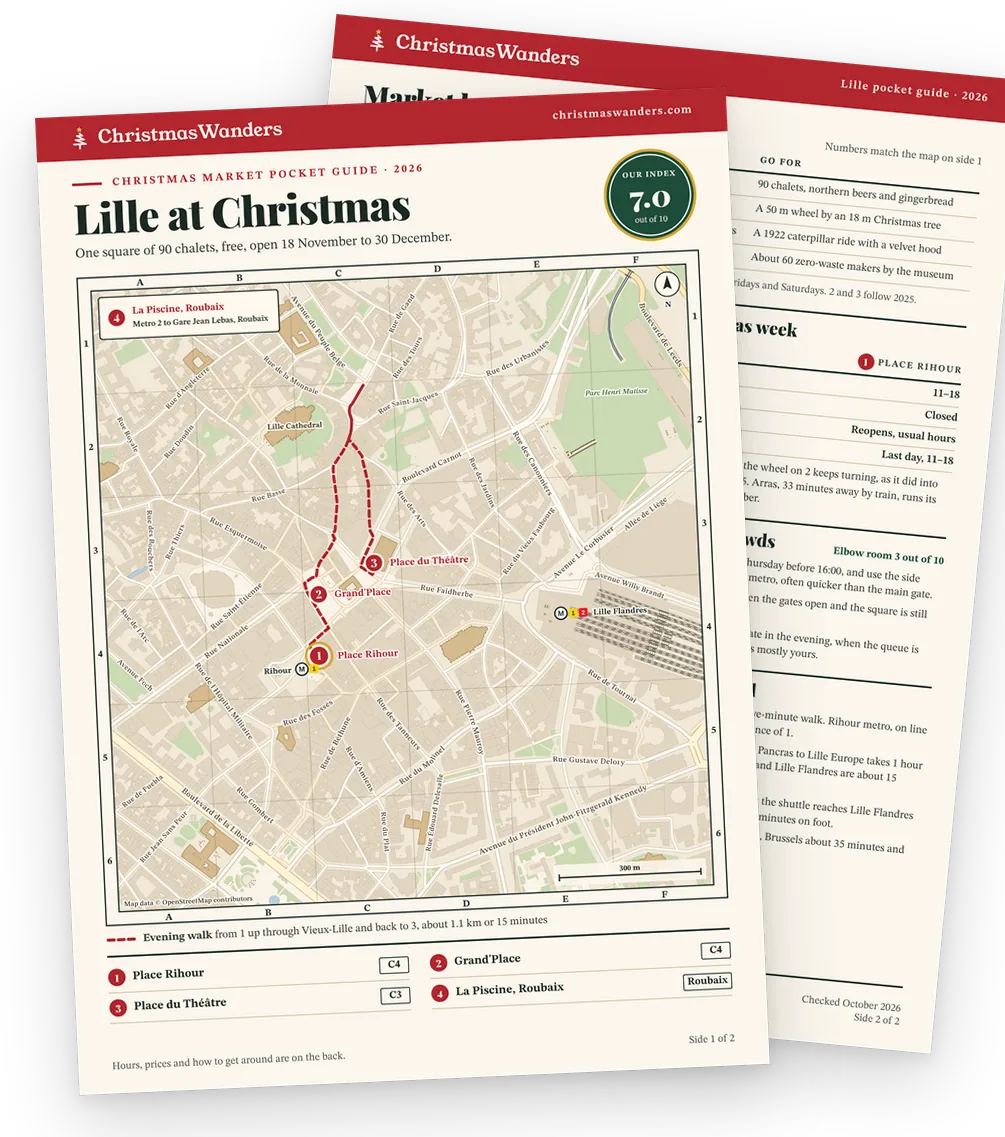
After dinner, walk it off in Vieux-Lille. Head north from Place Rihour along rue de la Monnaie to Place Louise de Bettignies, then rue de la Clef and rue Basse, where the shop windows go all out for Christmas.
Méert is on rue Esquermoise, so you can loop past it too, and if you carry on to rue Princesse you’ll find the house where de Gaulle was born, which is now a small museum.
Day Trip or a Night?
The Eurostar from London St Pancras to Lille Europe takes 1 hour 22 minutes, and the market is about a fifteen-minute walk from the station, so a day trip works fine.
If you do it in a day, get to Place Rihour for 11:00, when the gates open and the square is still calm, then have lunch in an estaminet and spend the afternoon in Vieux-Lille.
Be at the belfry for the 16:45 lift, walk back to the Grand’Place as the lights come on, ride the wheel, and grab your Méert box on the way to the station.
I’d still stay one night. Lille is at its best after dark, when the square lights up, the wheel runs late and the estaminets fill up, and a day trip means catching a train just when it gets good.
The next morning you can do the Palais des Beaux-Arts, one of France’s big art museums, with a famous pair of Goya paintings and a basement full of Vauban’s scale models of fortified towns.
Or take the metro out to Roubaix for La Piscine, an art museum built inside an Art Deco swimming pool.
On December weekends in 2025, a zero-waste Christmas market with about 60 local makers set up right outside it.
If your night lands on a Saturday, stay for Sunday morning and go to the market in Wazemmes, on Place de la Nouvelle Aventure.
It has nothing to do with Christmas, it’s just Lille’s big, loud, cheap Sunday market with food, flowers and everything else, and it’s the best look you’ll get at the city when it isn’t dressed up for visitors.
One practical note on trains, too. The Eurostar and most TGVs from Brussels stop at Lille Europe, while a lot of trains from Paris and the regional trains to Arras use Lille Flandres.
The two stations are a few minutes’ walk apart, and both are within about fifteen minutes on foot of Place Rihour.
Lille or Arras?
Arras is only 33 minutes away by train.
Its Ville de Noël spreads about 100 chalets across the Grand’Place and Place des Héros, two big Baroque squares under a 75-metre belfry, and in 2025 it also had an ice rink and a Ferris wheel. In 2026 it runs from 27 November to 27 December.
If the market itself is the main reason for your trip, Arras is the better market, and Lille is the better city.
I’d base myself in Lille and give Arras half a day. Amiens, further south, is the other big one in the region, with more than 100 chalets along about two kilometres of streets.
Brussels is only about 35 minutes from Lille by fast train, and Paris is about an hour, so Lille also works as a stop on a longer rail trip.
If what you’re really after is France’s big classic Christmas market, that’s Strasbourg, and it’s a different trip altogether.
So, Is the Lille Christmas Market Worth It?
The market alone is small, busy and a bit commercial, and pretty enough for an hour. Lille in December is worth it, and the market is part of what makes the city feel like Christmas.
Go midweek, hit Place Rihour before 16:00, ride the belfry lift at 16:45, have a Welsh in an estaminet for dinner and save the wheel for late at night. Pick up a box of Méert waffles before your train, and if you still want more chalets, Arras is half an hour away.
If you’re coming over Christmas itself, the market closes at 18:00 on 24 December and stays shut on the 25th, then reopens until the 30th, when it closes at 18:00.
After that it’s just the wheel, and the square is much quieter.