

Gothenburg at Christmas
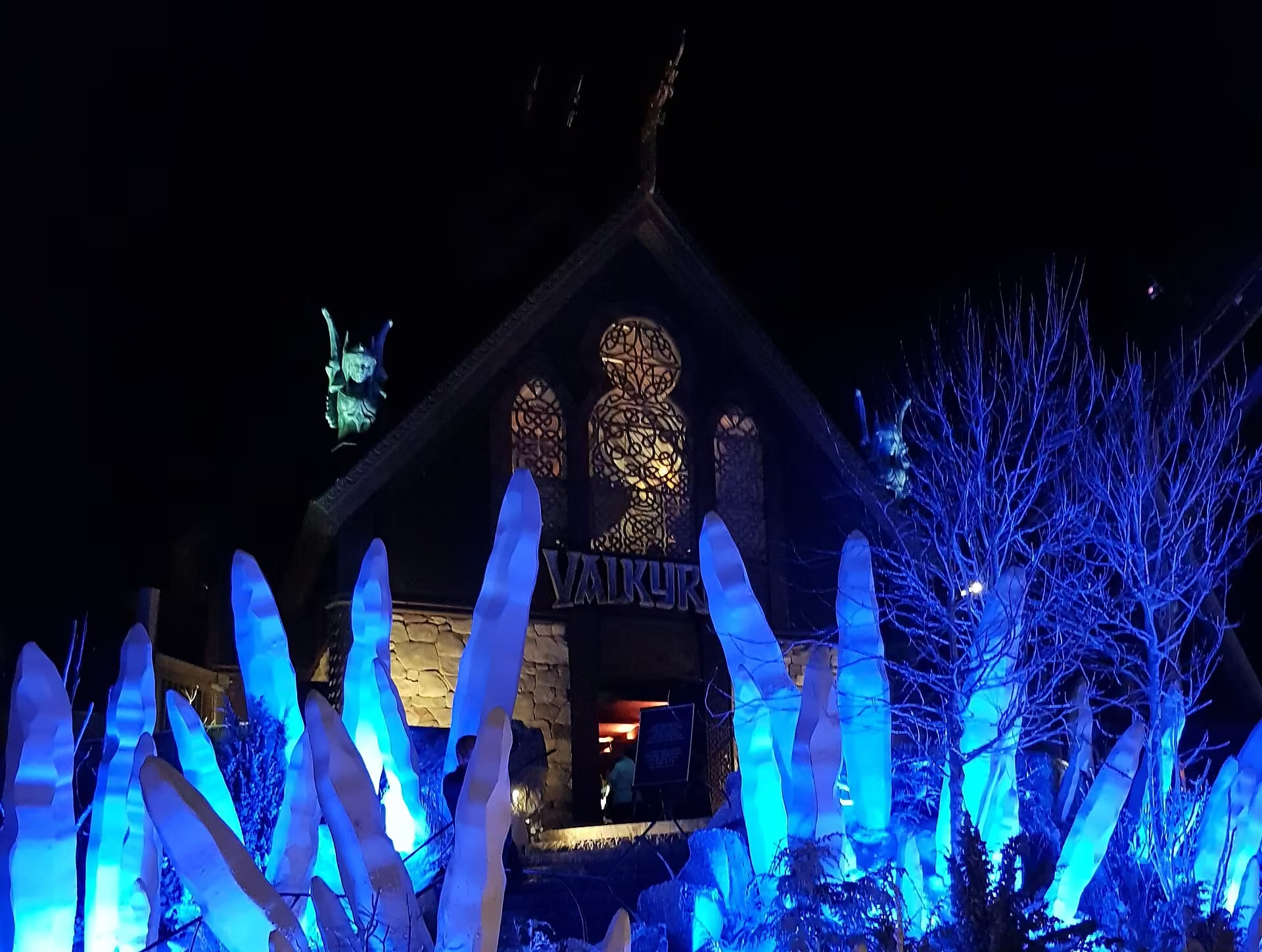
Gothenburg does Christmas inside an amusement park, and walking through Liseberg’s gates on a dark December afternoon still makes me grin like a kid. More than 2,100 fir trees stand dusted in fake snow, six million lights climb the hill and run along every path, and over all of it rises a 116-metre Christmas tree made of light, so tall you can see it from across the city.
This year the lights go further than they ever have, with Luma Celestia, a new kilometre-long trail that winds round the hill from Luna Park up to the gardens at the top. It’s the most Liseberg has ever spent on a single Christmas, and I can’t wait to walk it.
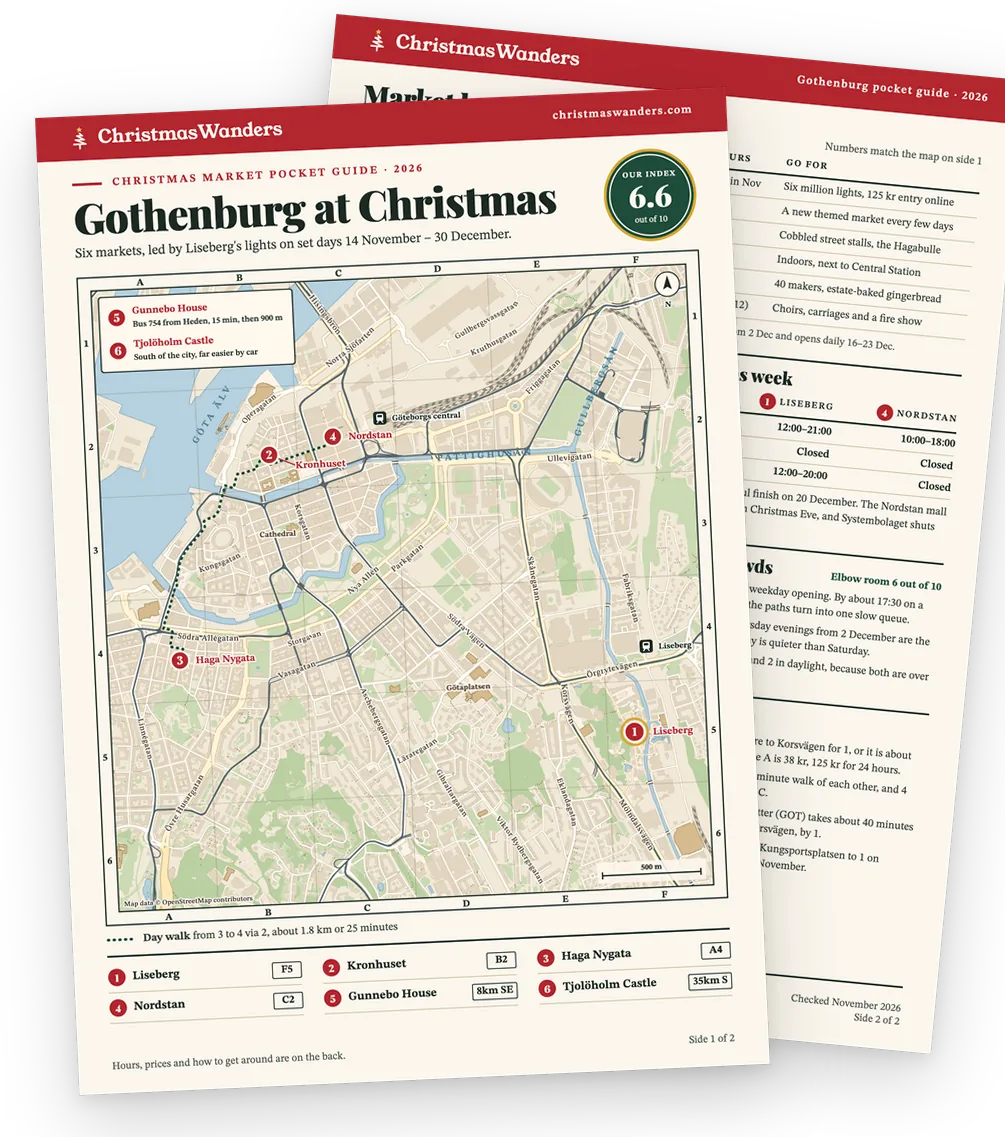
The Christmas market part of Liseberg is smaller than all that suggests, with 46 stalls spread across three little markets, so I come for the lights and the skating and do my shopping in town. Haga’s cobbled main street fills with stalls on the Advent weekends, Kronhuset’s craft halls change their market every few days, and out in the countryside two castles hold markets of their own.
When Is the Gothenburg Christmas Market 2026?
Jul på Liseberg, the Gothenburg Christmas market most people mean, runs from Saturday 14 November to Wednesday 30 December 2026, and you need a park ticket to get in.
It costs from 125 kronor online (about £9.50), 20 kronor less than at the gate, and children under 110 cm go free. That one ticket covers the markets, the lights and the ice rink, so you only pay extra for the rides, and although it’s tied to one day, you can move it for free right up to opening time, which I’d count as a real kindness in a city as rainy as this one.
The one thing to get right is the calendar, because Liseberg isn’t open every day. In November it opens Friday to Sunday only, and every season someone books a Tuesday and finds the gates locked, so check Liseberg’s calendar before you book flights.
From 2 December it adds Wednesday and Thursday evenings, and from 16 December it’s open every day until Christmas. Weekdays start at 15:00 and weekends at 12:00 until 20 December, then it opens at 12:00 every day, closing between 20:00 and 22:00 depending on the day.
Christmas Eve is the big day in Sweden, so Liseberg closes on 24 and 25 December, and then it reopens from 26 to 30 December, 12:00 to 20:00, long after Stockholm’s markets have packed up for the year.
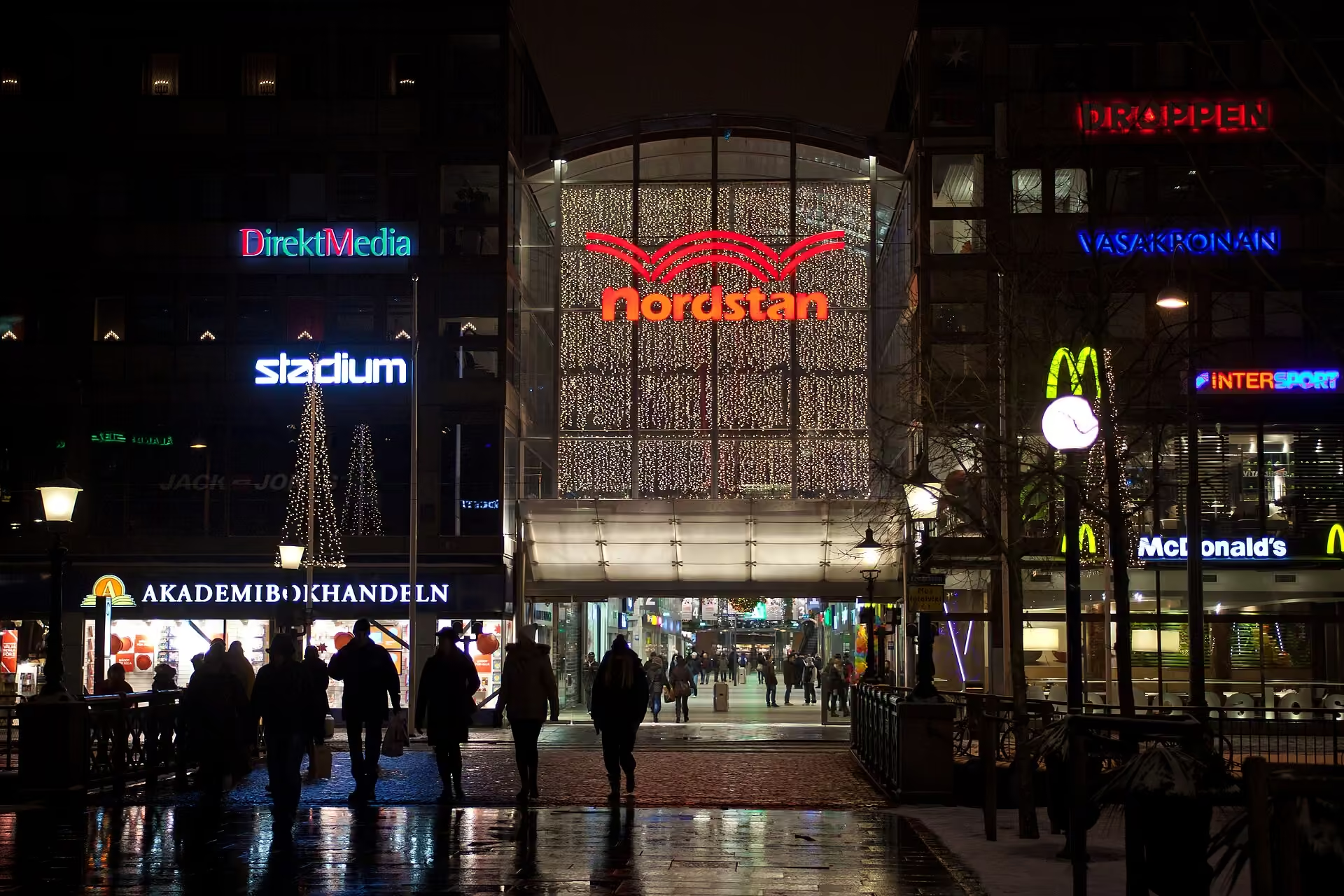
The city’s other markets keep shorter windows. Kronhusjul runs from 25 November to 20 December and closes on Mondays, Haga’s street market fills the four Advent weekends from 28 November, and Nordstan’s indoor market is open every day from 30 November to 23 December.
| Date | What’s on |
|---|---|
| Fri 13 to Sun 15 Nov | Opening weekend of the city’s Christmas season |
| Sat 14 Nov | Jul på Liseberg opens at 12:00, and Gunnebo’s first weekend |
| Fri 20 Nov | Tjolöholm castle market opens, Fridays to Sundays until 6 Dec |
| Wed 25 Nov | Kronhusjul opens at Kronhuset |
| Fri 27 Nov | Paddan Christmas boats to Liseberg start, Fridays to Sundays |
| Sat 28 Nov | Haga’s street market opens, Advent weekends only |
| Sun 29 Nov | Last day for Gunnebo |
| Mon 30 Nov | Nordstan’s indoor market opens |
| Wed 2 Dec | Liseberg adds Wednesday and Thursday evenings |
| Sun 6 Dec | Last day for Tjolöholm |
| Sun 13 Dec | Lucia parade on Avenyn |
| Wed 16 Dec | Liseberg opens every day until 23 Dec |
| Sun 20 Dec | Last day for Haga and Kronhusjul |
| Wed 23 Dec | Last day for Nordstan |
| Thu 24 and Fri 25 Dec | Liseberg closed for Christmas |
| Sat 26 to Wed 30 Dec | Liseberg reopens, 12:00 to 20:00 |
| From Thu 31 Dec | Closed until next season |
The Best Christmas Markets in Gothenburg
The city markets are daytime affairs and Liseberg comes into its own after dark, so a good Gothenburg day starts with presents in Haga or Kronhuset and ends under the lights on the hill.
Jul på Liseberg (The Big One)
The Paddan Christmas boats leave from Kungsportsplatsen, and they’re a lovely way to turn up. You’re handed a glögg and a ginger biscuit on the quay, then it’s 40 minutes in an open boat through the canals and an old lock to Liseberg’s own jetty, for 279 kronor (439 with park entry), on Fridays to Sundays from 27 November to 20 December.
Inside, the whole hill is lit from bottom to top with that tree of light standing over it, and it’s even better up close than from across the city. Fire pits glow by the ice rink, where people stand with hot chocolate between their gloves while little ones head off to meet Santa in Tomtebyn, his village in the park, and skating is in your ticket, so you can take a few laps between markets without paying a krona more.
The markets themselves are where I’d lower your expectations a notch. Last year there was a winter market by the rink, an old-fashioned Christmas corner and a Tyrolean market with après-ski music, and between them you’ll find knitted mittens, leather gloves, slippers, cheeses, liquorice and marzipan. It’s lovely for grazing and picking up a pair of mittens, but if you’ve done a big German market, 46 stalls will feel small.
Get there for the 15:00 opening on a weekday and you can walk straight up to those stalls by the rink while it’s only just getting dark. Leave it until about half past five on a December weekend and the paths between the markets turn into one slow queue, families lose each other in it, and browsing stops being an option.
November is a different place, with short queues even on weekends, and in December the Wednesday and Thursday evenings from 2 December are the calm ones. On a weekend trip I’d aim for the Sunday, which is usually quieter than the Saturday, and I’d steer clear of the last two weekends before Christmas and 21 to 23 December if I possibly could.
If you do get caught on a packed night, look at the Tyrolen restaurant, because a queue outside it means the park’s full, and that’s your cue to leave the stalls and walk the light trail round the hill instead.
Kronhusjul at Kronhuset
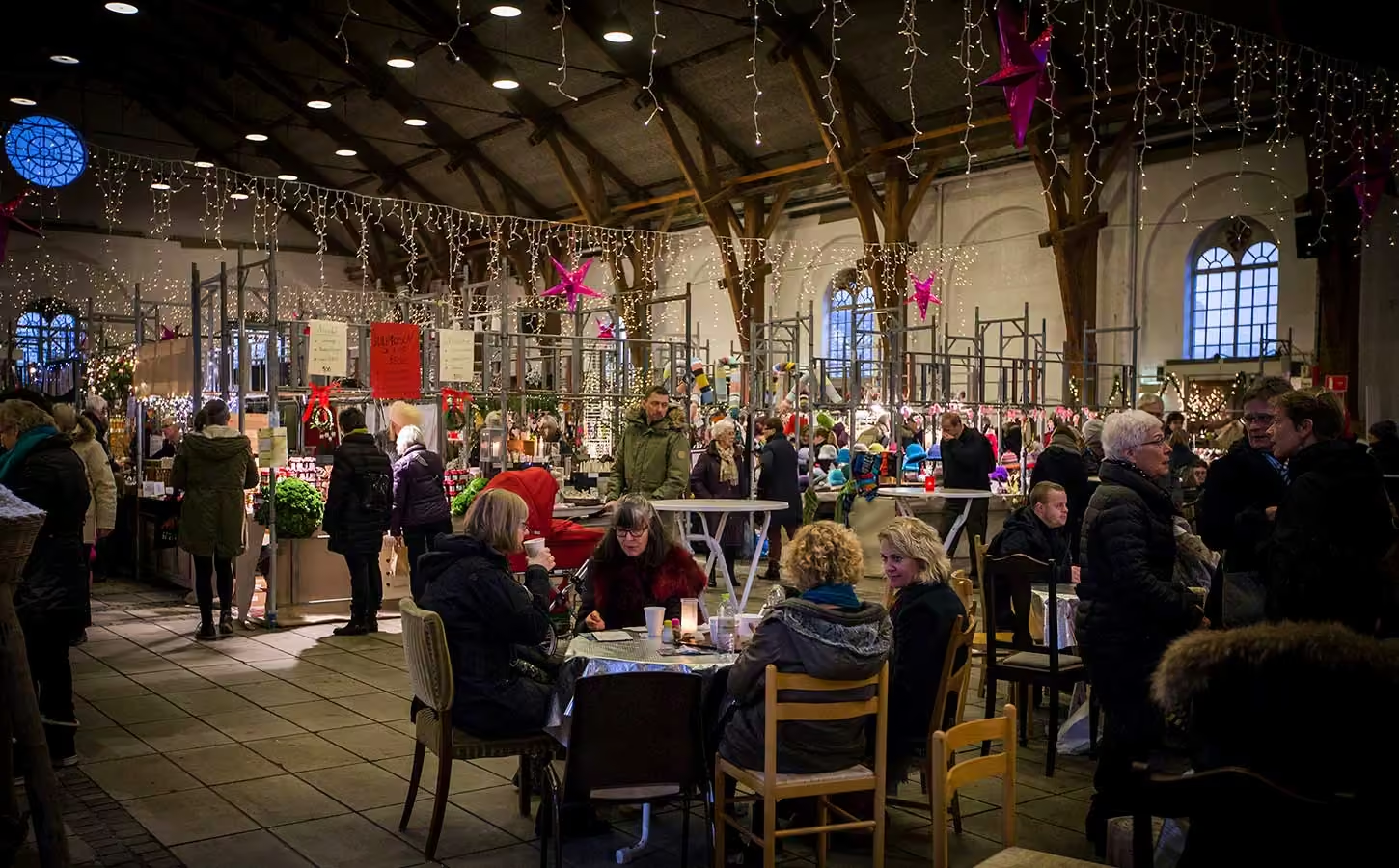
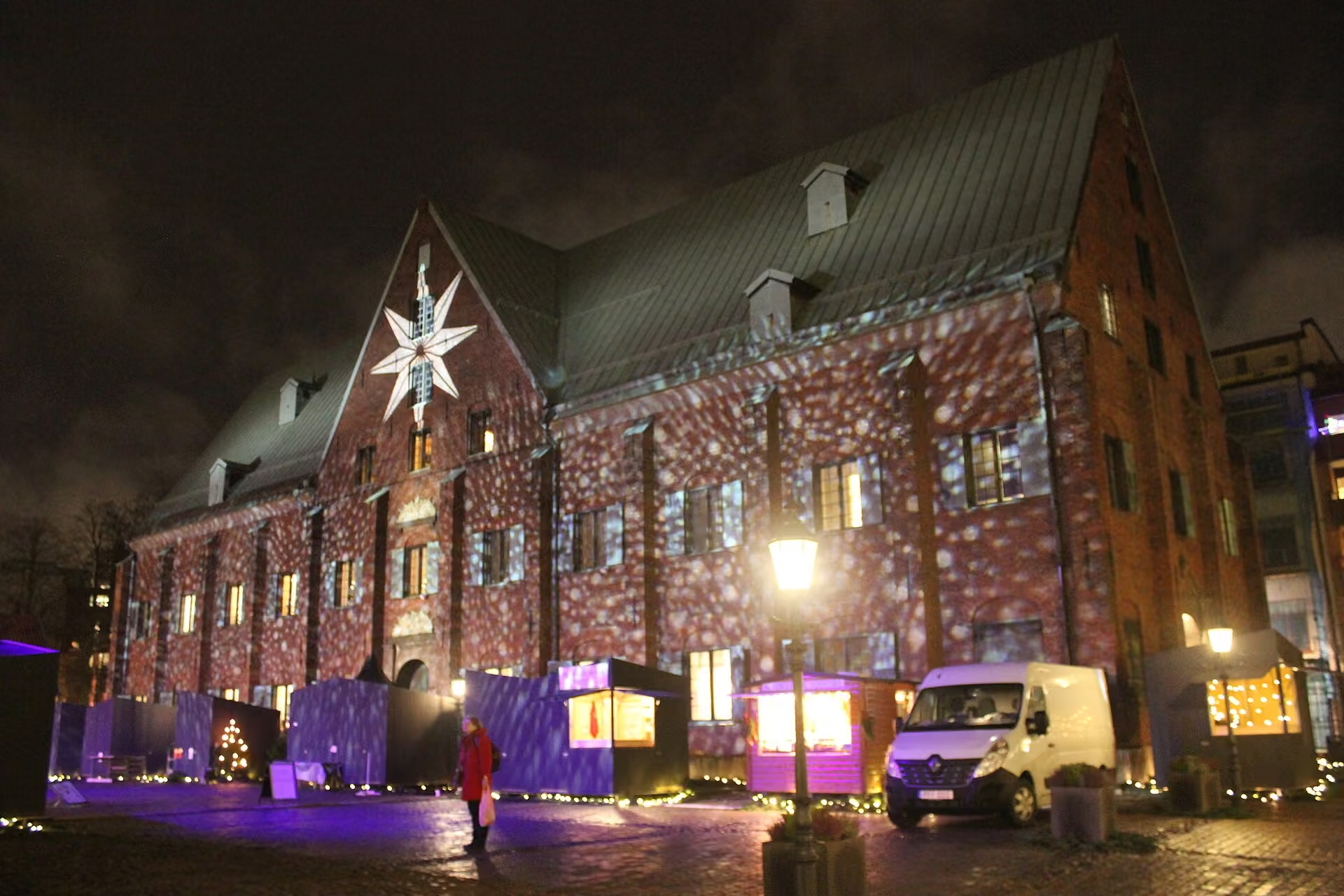
Kronhuset was finished in 1654, and from 25 November to 20 December it and the little 18th-century craft cottages round its yard host a different Christmas market every day or three. One week it’s local food, the next it’s vintage, a design market, a book fair or a lane full of children’s things.
That means the day you turn up decides what you get, so I’d look up Kronhusjul’s theme for your date before you go. For handmade presents I’d pick 26 to 28 November, the craft market, or 11 to 13 December, when the art students from HDK-Valand sell their own work, and it’s free whichever you choose.
Whichever date you pick, go in daylight. It’s closed on Mondays and shut by 19:00 at the latest, and people who turn up at quarter past seven find a dark, empty courtyard where those tiny, cosy booths were.
Jul i Haga
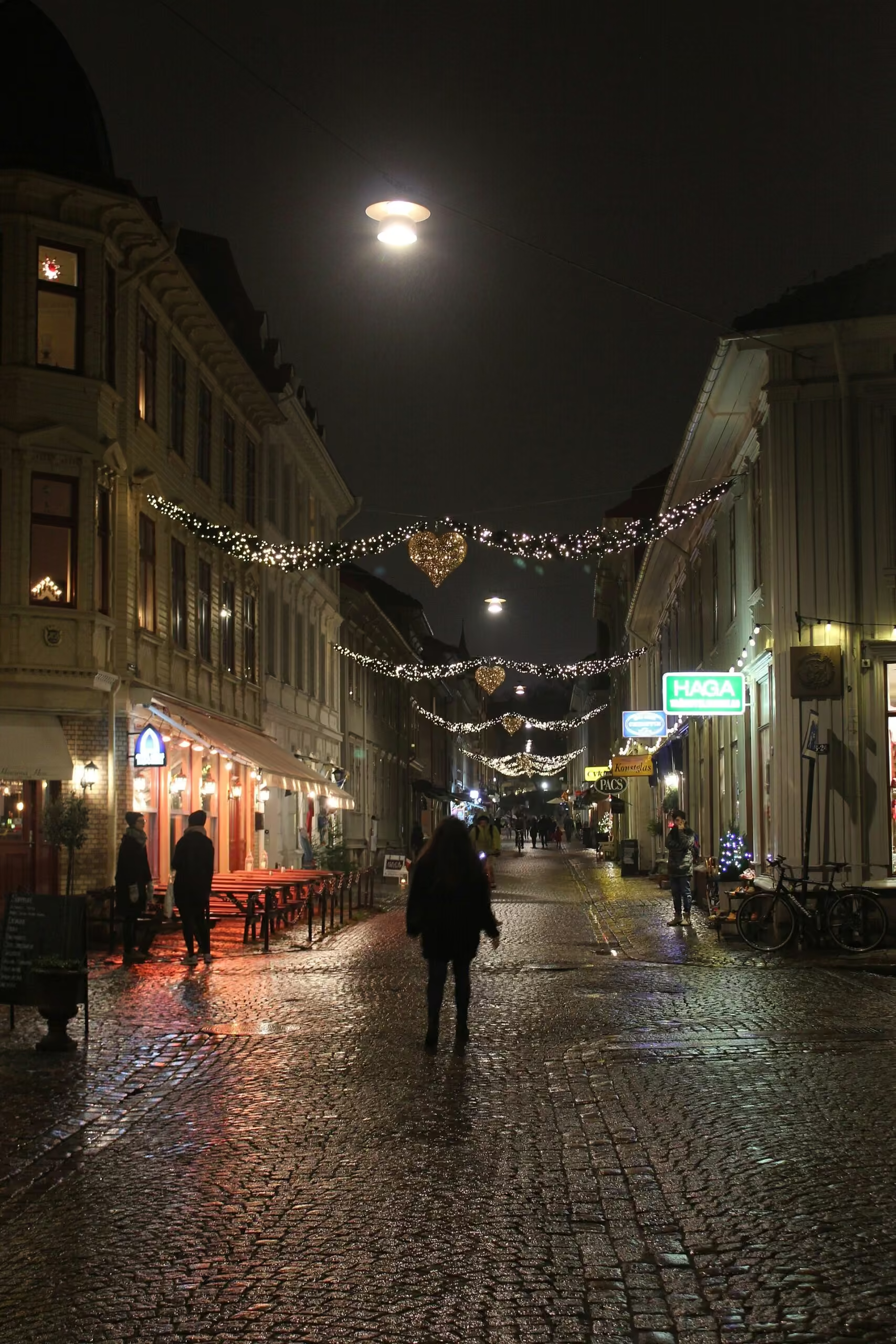
Haga is the corner of Gothenburg I’d walk even without a market, and on the four Advent weekends its cobbled main street, Haga Nygata, fills with stalls from 11:00 to 16:00. This year the market carries on round the corner along Tredje Långgatan, which makes it 660 metres long, and that new stretch is mostly food and drink and keeps going into the evening after the stalls close.
It’s free and it’s the most Swedish-feeling market in the city, which is exactly why it fills up. On a busy weekend afternoon you’re moving a metre at a time between steaming cups of glögg, so I’d be at Haga for the 11:00 start and leave the afternoon for the cafés, where people sit outside under blankets with hot chocolate piled with cream.
When Is the Best Time to Visit Gothenburg at Christmas?
Friday 27 to Sunday 29 November is the weekend I’d book without a second thought. Liseberg is still in its quiet month, the first Paddan boats are running, Kronhuset has its craft market, Haga has its opening weekend, Gunnebo has its last and Tjolöholm is in full swing, so it’s the only weekend when Liseberg, Haga, Kronhusjul and both castles are all open at once.
Early December comes a close second, because the Wednesday and Thursday evenings make a midweek city break possible, Tjolöholm has its final weekend on 4 to 6 December, and Lucia falls on Sunday 13 December.
The week before Christmas is when Gothenburg looks its brightest and Liseberg opens every day, and it’s also when the crowds are at their worst and the castle markets are long gone. Between Christmas and New Year you get Liseberg on its own, from 26 to 30 December, with every other market packed away.
What to Eat and Drink at the Gothenburg Christmas Markets
My favourite thing to eat in Gothenburg at Christmas comes from a café on Haga Nygata, so start with a Hagabulle from Café Husaren, a cinnamon bun so big it’s meant for two, though I wouldn’t blame you for not sharing, at 110 kronor in 2025. It sells out on market days, so get yours in the morning.
Round the stalls, these are what I’d reach for.
- Renskav is thin-sliced reindeer wrapped in flatbread with lingonberries, and it’s on plenty of Liseberg’s food stalls. On a cold night I’d have one.
- Brända mandlar are sugar-roasted almonds, and at Liseberg the smell of them drifts right across the paths.
- Pepparkakor are thin ginger biscuits, and Gunnebo’s estate bakery makes its own for the castle market.
- Lussebullar are the saffron buns of Lucia week, golden and soft and best eaten warm.
- Glögg is mulled wine, spiced and sweet, with raisins and almonds in the cup.
The glögg is cheap, at 37 kronor for a small cup at Liseberg last year (about €3.40), but stall glögg is often alcohol-free, so treat it as a hand-warmer, and for the boozy kind duck into a bar or restaurant.
Liseberg’s food on a busy night is where the evening can go wrong, with a queue at every counter and nowhere to sit, so for a proper dinner I’d book a julbord, Sweden’s Christmas buffet, where herring, salmon, meatballs and ham crowd one long table.
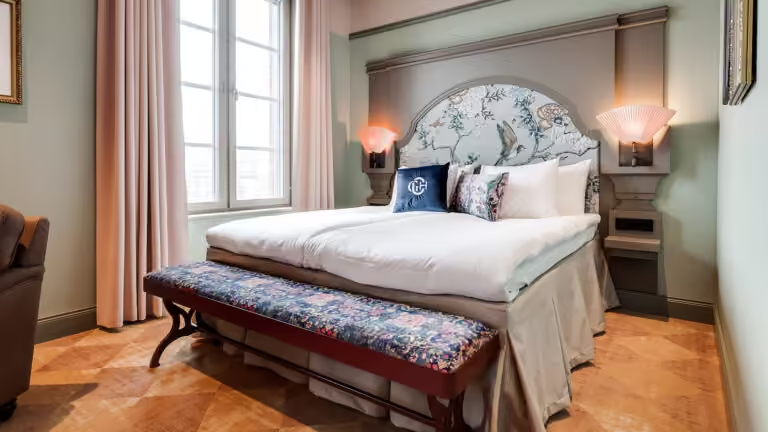
I’d book the one at the Grand Curiosa hotel by the park’s south entrance, where the food is fresh, there’s a real spread, and it’s calm enough to hear each other after the crowds outside. On selected days until 23 December its packages bundle the room, the julbord and your Liseberg entry.
What’s the Weather in Gothenburg in December?
Rain is the likelier weather here, on about half of December’s days. Real snow is a long shot, on the ground on 16% of Gothenburg’s market days in our snow odds study, a touch more than Hamburg‘s 11% and less than half of Stockholm’s, so most of the white at Liseberg is seven tonnes of paper snow, and it looks wonderful anyway.
Standing on the hill at dusk, it’s the wind that gets you. Gothenburg averages about 5°C by day in December and just above freezing at night, but once the wind gets going it feels nearer −3°C, and Liseberg always feels a few degrees colder than town, so I’d pack a proper hat and boots that keep the water out.
The sun sets at about 15:24 in mid-December, which is exactly why that 15:00 weekday opening at Liseberg is such a good one, because you walk in at dusk and watch the lights take over.
When the rain really sets in, I’d take the afternoon indoors at Nordstan’s market next to Central Station, open 10:00 to 18:00, with wool socks, jewellery, marzipan and chocolate, and the easiest last round of presents before a train home. Liseberg and the trams both run on a contactless card (Liseberg is cashless apart from its games, and a tram ride is 38 kronor a tap), while the Swish signs you’ll see on plenty of stalls need a Swedish bank account.
Day Trips to Christmas Markets Near Gothenburg
If your dates land in late November or the first days of December, add a castle, because both castle markets are over by 6 December, and anyone coming in mid-December misses them entirely.
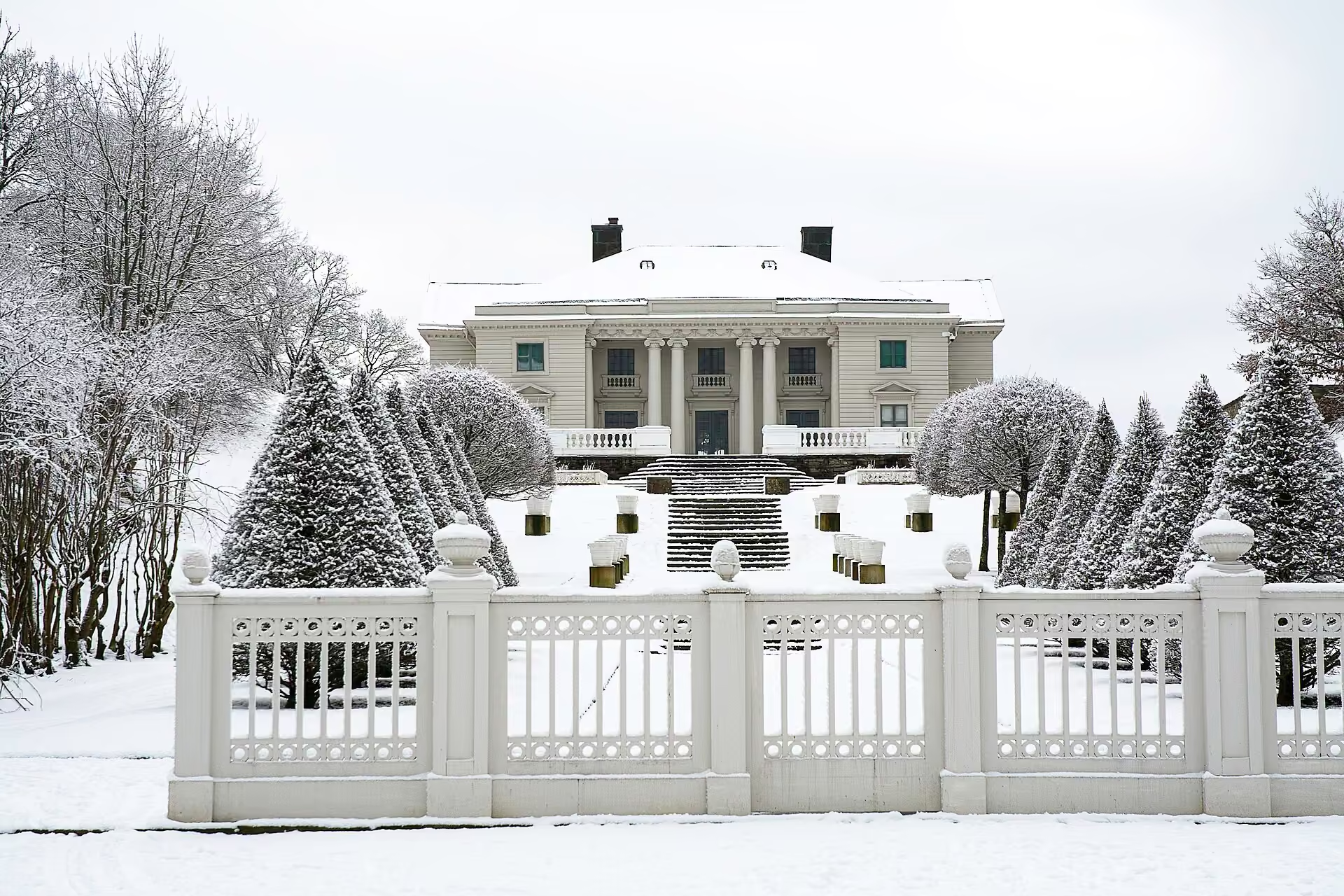
Gunnebo House
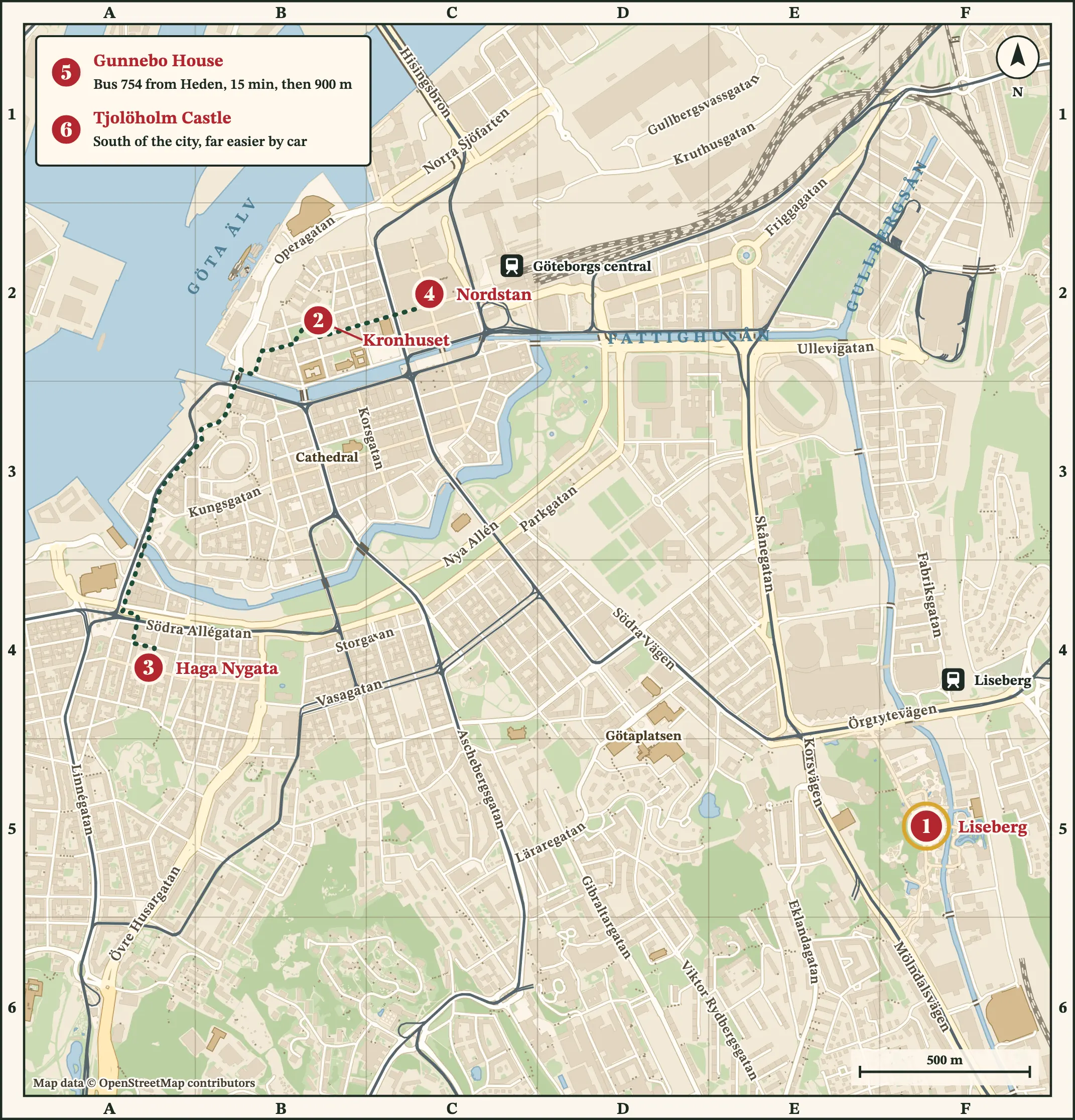
Gunnebo is an 18th-century country house in Mölndal, about 15 minutes on bus 754 from Heden and then a 900-metre walk up through the park. On three November weekends, 14 to 29 November, from 11:00 to 16:00, about 40 local makers fill its kitchen garden and outbuildings, and the estate’s own bakery pours the glögg and bakes the gingerbread. It’s free, it’s close, and it’s the easy one.
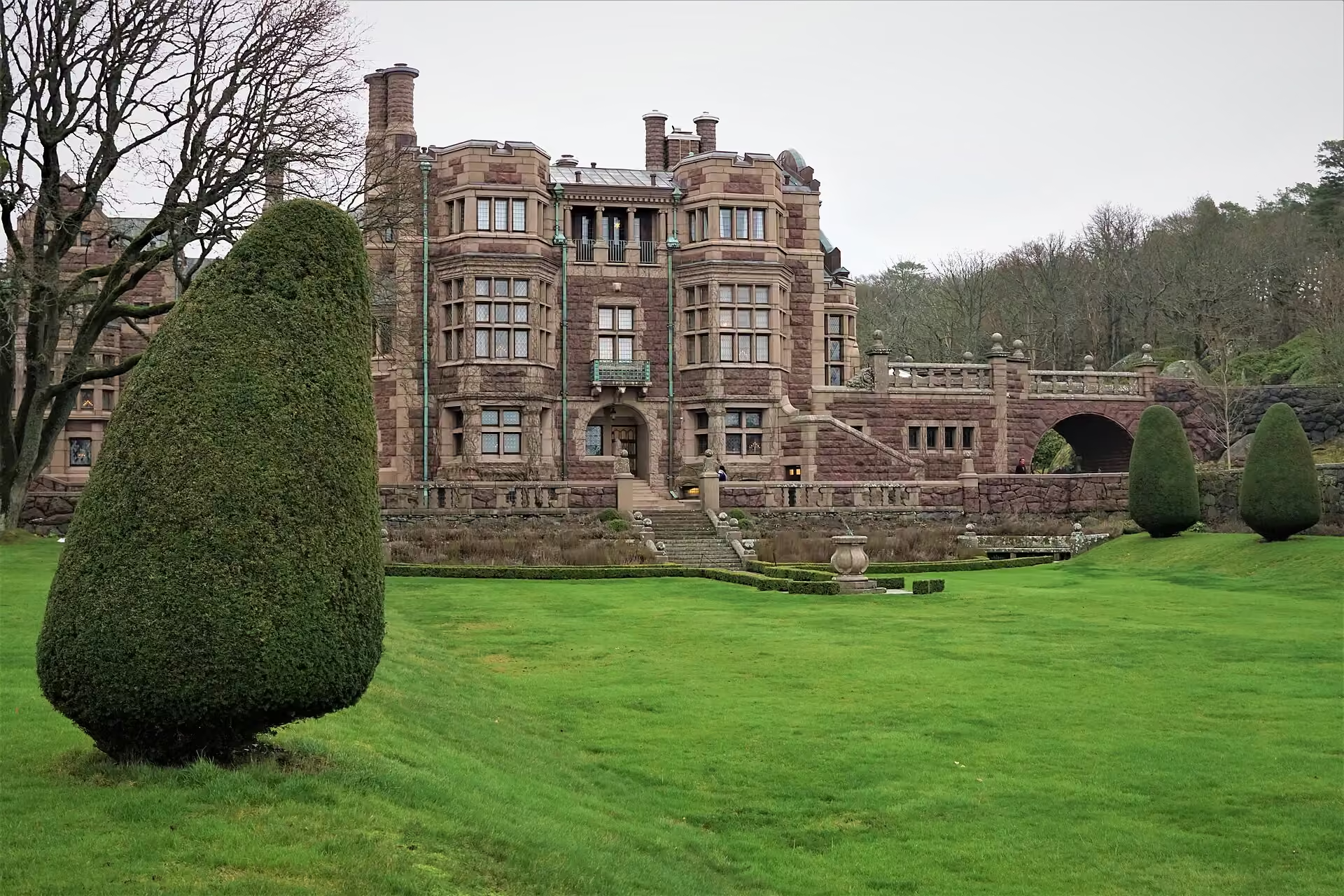
Tjolöholm Castle
Tjolöholm is a Tudor-style castle about 40 kilometres south of the city, and its market is the grand one, with choirs, horse-drawn carriages and a fire show every market day, which is a lot of Christmas for one afternoon and exactly why I’d make the trip.
It runs Friday to Sunday on 20 to 22 November, 27 to 29 November and 4 to 6 December, from 12:00 to 18:00 on Fridays and 10:00 to 18:00 at weekends, and last year entry was 100 kronor on Fridays and 120 at weekends, with under-15s free. It’s far easier with a car, since by public transport it’s a train to Kungsbacka, a bus and about 3.5 kilometres on foot.
Most of those hours are spent outdoors or in unheated stone buildings, on gravel paths that get muddy, so the boots you packed for Liseberg earn their place here too.
Lucia and Christmas in Gothenburg
Gothenburg takes Lucia out onto the street on Sunday 13 December, in the most Gothenburg way I can imagine, with Lucia riding up Avenyn to Götaplatsen in a parade of vintage vehicles from World of Volvo. Last year around 150 young singers gave a free concert at the top, and this year it’s expected at about 17:00, with the concert around 17:30, so check the time nearer the day.
Over Christmas itself the city goes quiet. Liseberg is shut on the 24th and 25th, the Nordstan shopping centre opens 10:00 to 14:00 on Christmas Eve for anything you forgot, and if you want a bottle for the holidays, get it by the 23rd, because Systembolaget, the state off-licence, is shut from 24 to 26 December.
Then Liseberg opens its gates again on the 26th, the same trick the Lübeck Christmas market pulls in Germany, which makes it the one big-city Christmas market in Sweden you can still visit between Christmas and New Year.
The 26th and 27th are busy, but many stalls cut their prices once Christmas is over, and from 31 December Kaninlandet, the children’s area, stays open until 10 January, with fireworks for New Year.
Is the Gothenburg Christmas Market Worth It?
Gothenburg is worth the trip for Liseberg’s lights alone, and I’d happily pay the 125 kronor just to walk the new trail round the hill after dark.
It’s at its best for families, with skating in the ticket, Santa in his village and under-110s free, and for anyone who loves lights more than shopping, and it’s about the easiest add-on to a Danish trip there is, three and a half hours from Copenhagen on a direct train you don’t even need to book. Craft-stall hunters will find more for free at any big German market.
A Hagabulle and a morning in Haga, then a quiet weekday evening on the hill as the lights come on, is my perfect Gothenburg day.