Prague gives its Christmas market forty days.
From 28 November 2026 to 6 January 2027 the squares of the old city fill with wooden huts, and they stay filled through Christmas Eve, through Christmas Day, through New Year’s morning, all the way to Epiphany.
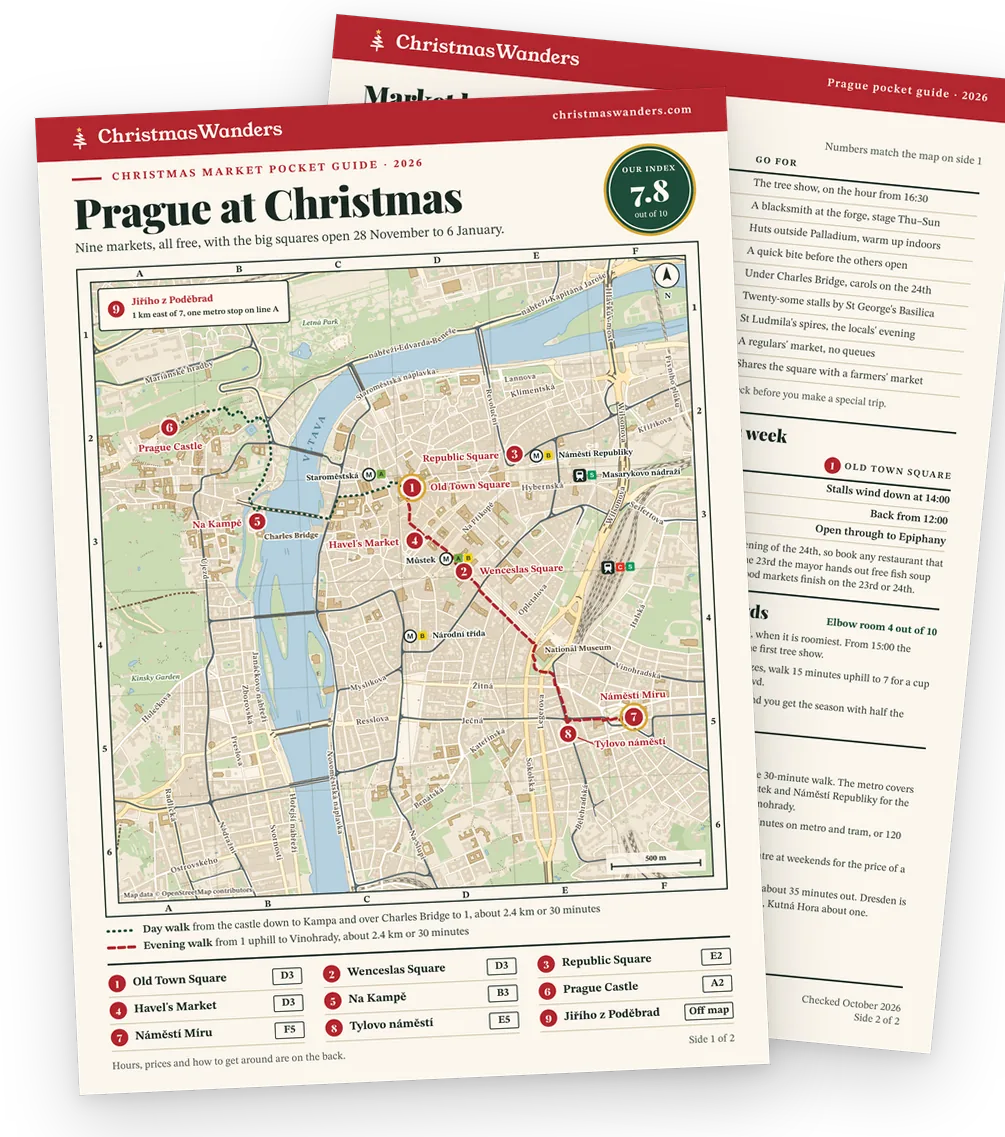
Entry is free at every market in Prague and 7 of them sit inside one thirty-minute walk, which means you can drift from market to market in a single afternoon (or morning, depending on the day you choose to go).
No other headline market city is this open-handed with the calendar, and the setting takes no prisoners either. Gothic towers, a medieval astronomical clock, lanes fogged with svařák steam… just absolutely breathtaking.
CNN put Prague on its 2025 list of the world’s best Christmas markets, and it is easy to understand why.
I’ve been to Prague’s Christmas market several times, and my honest summary is as simple as it can be: come, and come with a plan.
And the plan takes one sentence: the centre by day and at lighting time, the neighbourhood squares in the evening. Here’s everything you should do in as many details as possible.
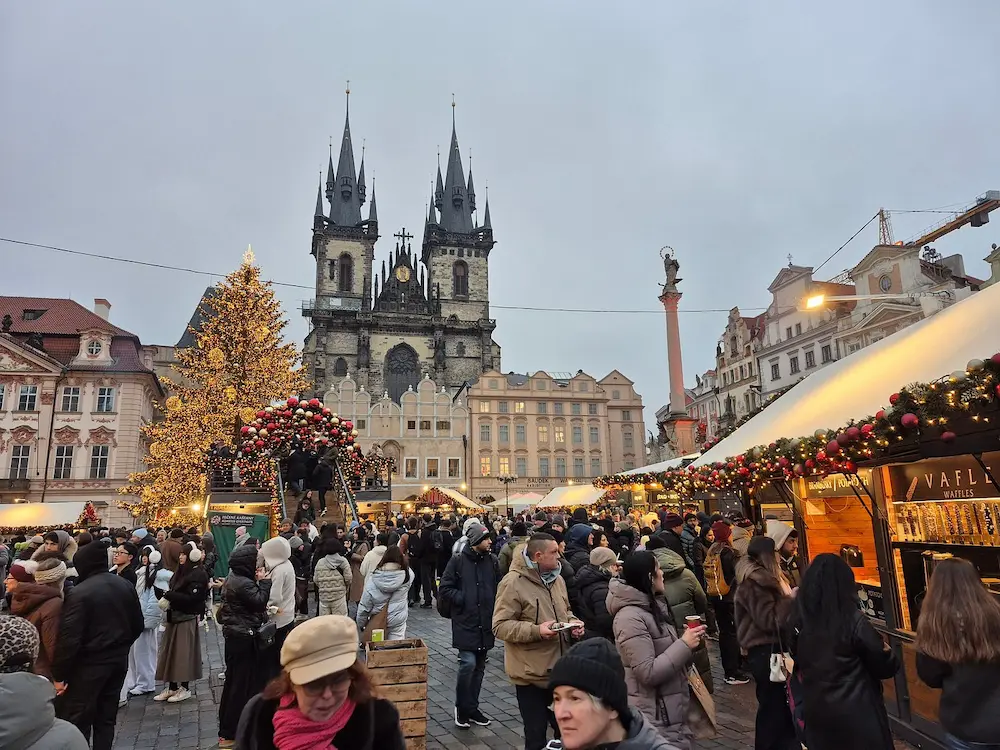
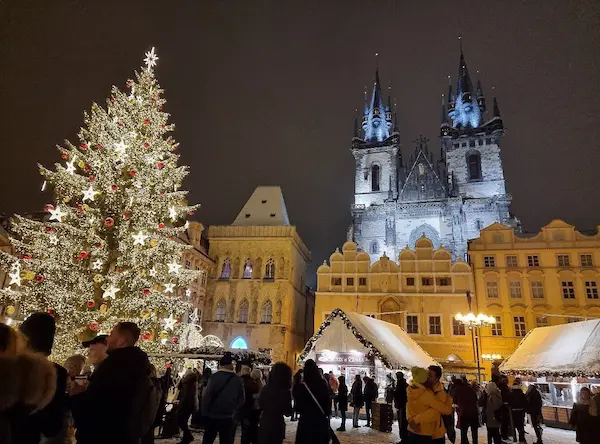
Old Town Square at lighting time
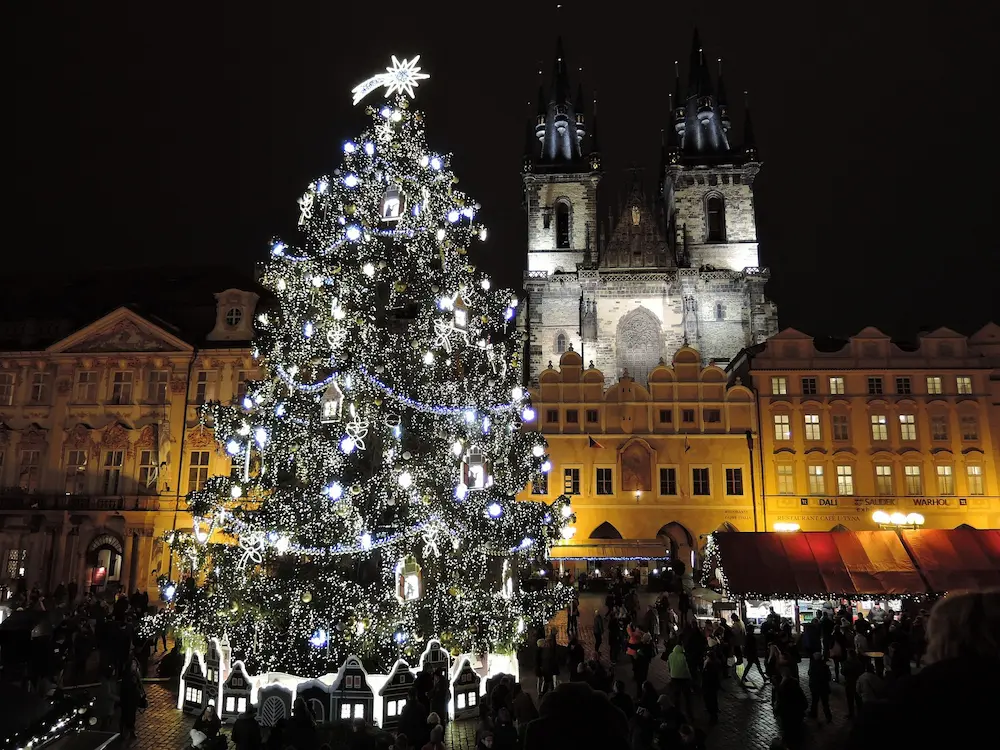
Every year a village somewhere in Czechia gives Prague a tree.
The 2025 spruce stood 26 metres, tall as an apartment block, travelled down from Jiřetín pod Jedlovou near the German border, and was dressed with 8.5 kilometres of light chains.
The tree plays its show every hour from 16:30 to 21:30, and because December daylight quits around four, the first one lands exactly at the blue hour, with the Týn church spires going black against the last of the sky.
You should absolutely stand mid-square for that one because it provides you the best view possible. It’s honestly the best free spectacle in Central Europe, in my opinion.
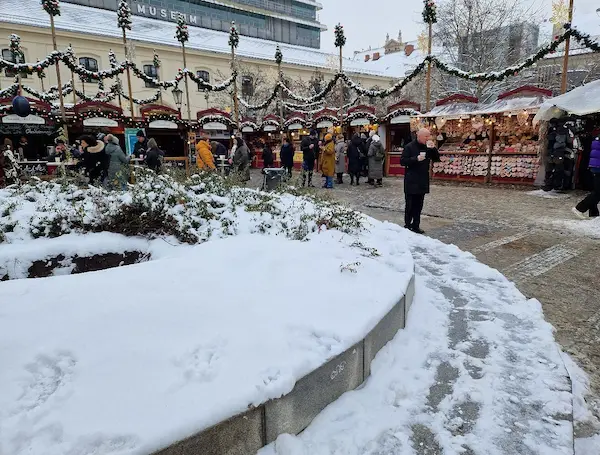
Around the tree you’ll see 80+ stalls (at least last season), a wood-and-straw nativity scene at walk-in scale, and a stage that runs folk ensembles and choirs daily through the entirely of the Christmas season.
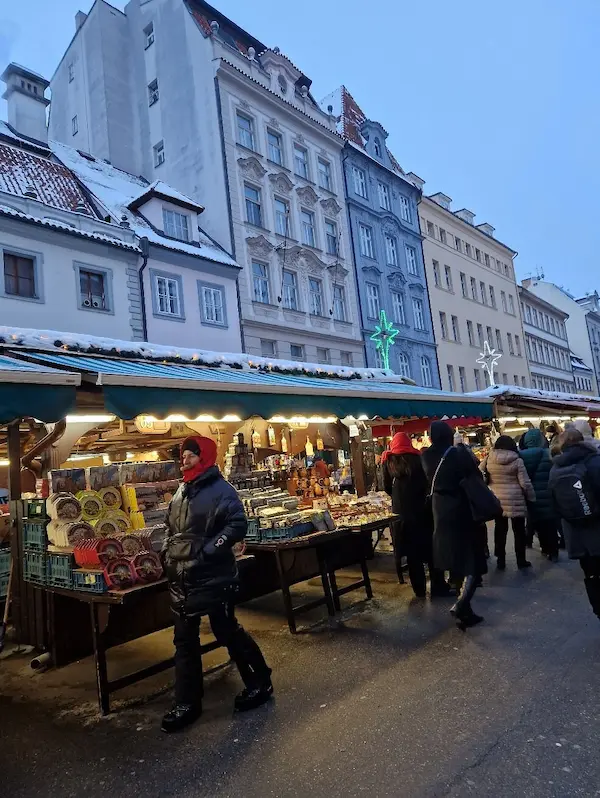
The shopping here is honestly better than its reputation. Czech hand-blown glass baubles are some of the finest made anywhere (this is a country that exports ornaments to half the world, if you didn’t know), and the straw decorations, carved nativity figures and beeswax candles are the real, local thing. The tins of hot-chocolate mix you can leave for someone else, though.
The square’s rhythm decides your visit. Mornings are unhurried, and that’s when you browse, in peace, giving each stall enough of your attention.
And if you are bringing kids, the weekend-morning craft workshops are theirs, and the square is at its roomiest. From three the crowd thickens toward the first lighting, and on a December Saturday evening you feel every one of the season’s 750,000 visitors at once, so keep that in mind.
So shop it in the morning, then come back at dusk for one show and let the square be pure spectacle.
You should also climb the Old Town Hall tower while you’re at it. The view straight down onto the lit market with tree, hut-rows, currents of people is the photograph everyone wants and not everyone ends up taking.
Wenceslas Square, Republic Square and the run between
The same Prague company has run the three central markets since 2004, and it shows in the good way because you’ll see matching timber huts, hours you can set a watch by, card readers on every counter, a cultural program that actually happens.
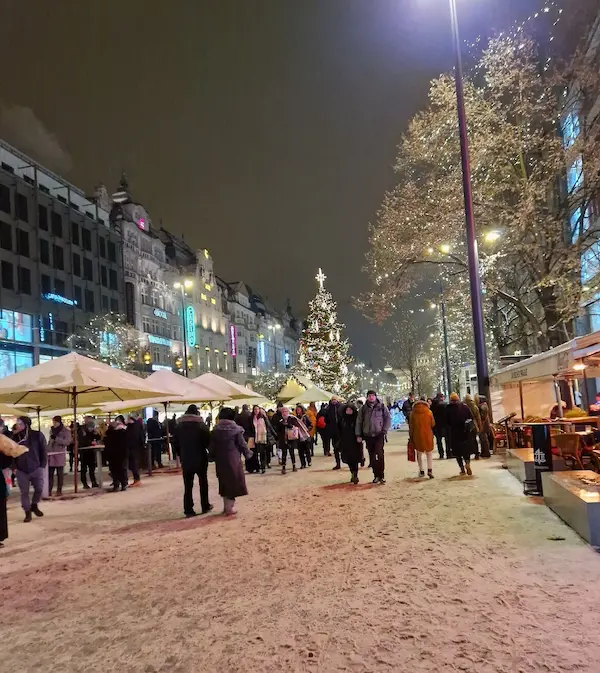
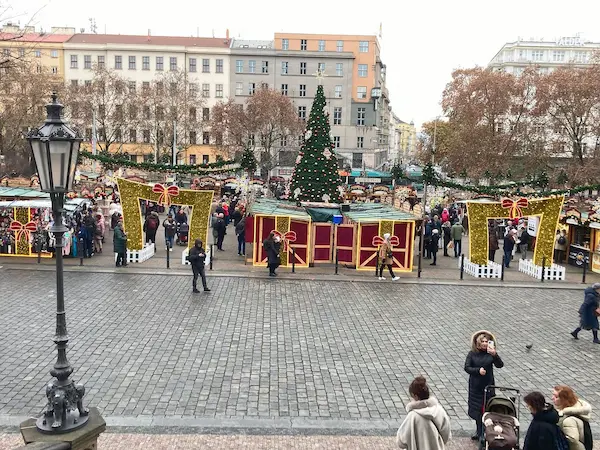
Wenceslas Square is the lively sibling. The market holds the lower end of the square this season (the upper stretch is being rebuilt to bring trams back up to the National Museum, work that runs into 2027), so it’s compact now, with a 15-metre tree, stage shows Thursday to Sunday, and the two things that make the five-minute stroll from Old Town Square worth it: a blacksmith hammering ornaments and blades at an open forge, and a free ice rink.
The rink deserves its own line. Thirty by twelve metres of ice in the middle of the square, free to enter, skates for hire on the spot, open 9:00 to 22:00 daily, and it outlasts the markets, running to mid-February.
Republic Square rounds out the triangle. A snug run of huts outside the Palladium shopping centre, handy for warming up indoors between squares, open to 20:00 and finishing on Christmas Eve. Cross it with a cup in hand and you’ve done it justice.
The neighbourhood squares
When the centre starts to squeeze, Prague’s best move is a 15-minute walk uphill into Vinohrady area.
Náměstí Míru opens the city’s season, around 20 November in recent years, a full week before the big squares switch on, and runs to Christmas Eve in front of St Ludmila’s neo-Gothic twin spires, which out-romance almost anything in the centre once the lights come up.
The stalls sell much of what the centre sells though, so keep that in mind if you plan shopping at Vinohrady. The square around the stalls is the difference, however and it includes neighbourhood families, school choirs, small trees decorated by local kids, room to hold your cup two-handed and actually stand still.
It’s the first place I send anyone.
Jiřího z Poděbrad, one metro stop deeper, doubles the trick. Its advent market shares the square with a working farmers’ market, so between the punch and the sausages you’re shopping the way the neighbourhood shops and you can buy bread, cheese, wreaths, Christmas carp, and it all happens under the great brick face of the Sacred Heart church.
Mikuláš appears on 5 December, the Bethlehem Light arrives in the last days before Christmas, and the whole thing wraps on the 23rd. Tylovo náměstí, between the two, adds two short rows of stalls with a regulars’ feel.
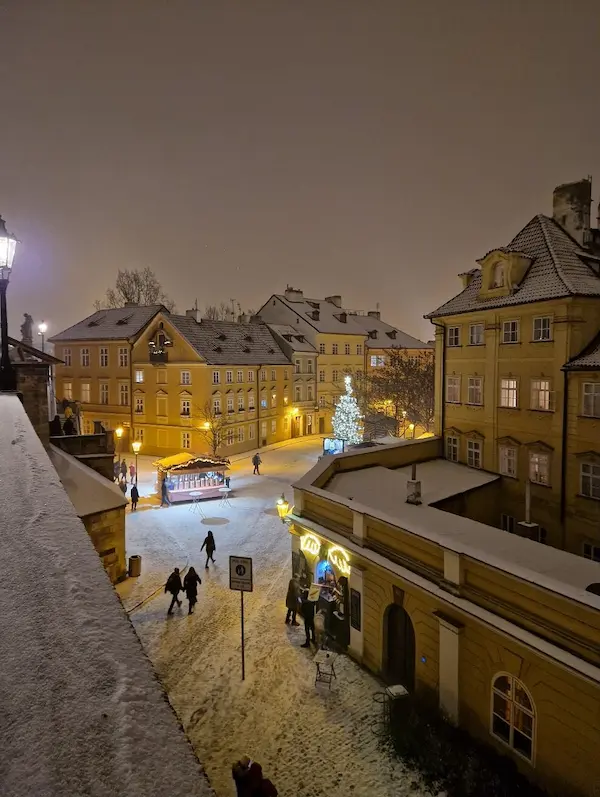
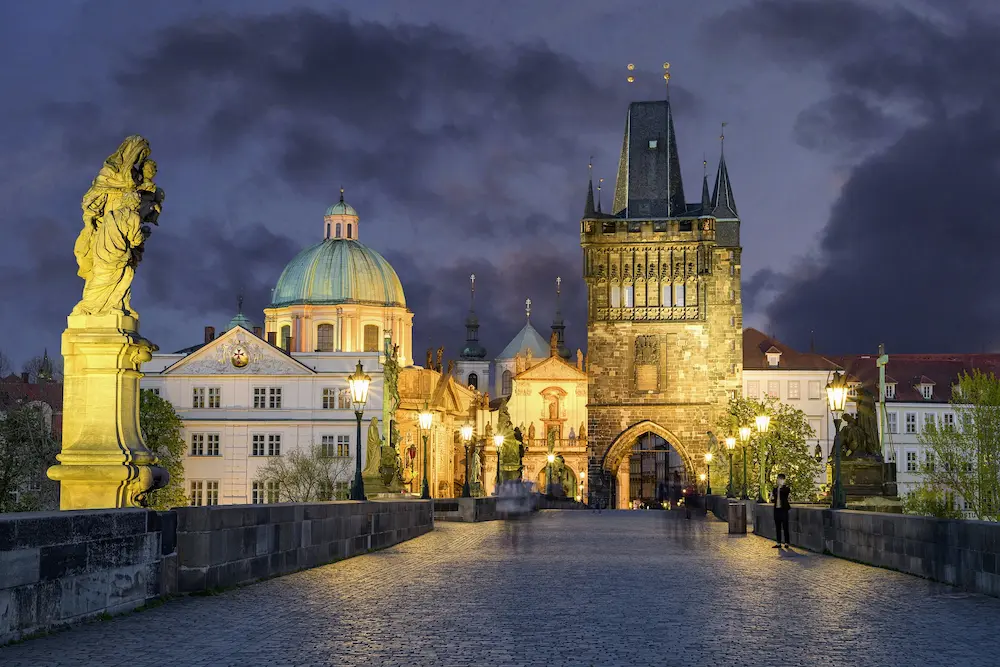
Down at river level, Na Kampě might be Prague’s prettiest few minutes of market, and it includes a small cluster of stalls on the square under Charles Bridge, water on two sides, carols sung right there on Christmas Eve. It opens a little later than the rest and runs into the new year. Treat it as the reward at the end of a Malá Strana wander.
Two more worth knowing. The castle courtyards host their own market beside St George’s Basilica with twenty-some stalls last season, a bit shorter hours, but as a bonus… you’re already inside Prague Castle when you’re done.
And the small charity market on Marianské náměstí by the City Hall sells handmade candles, jewellery and ornaments with the proceeds going to nonprofits, which makes it the most feel-good shopping in the old town.
What to eat and drink on Prague’s Christmas Market
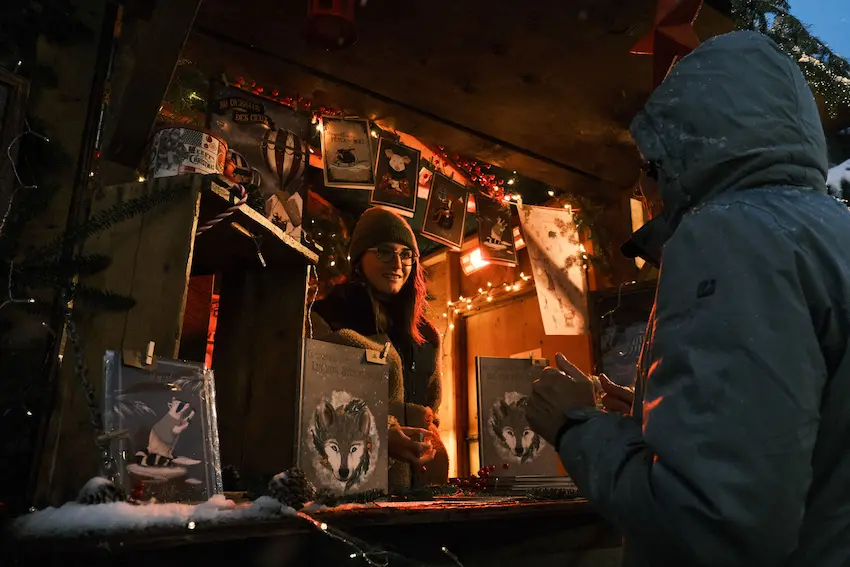
Czech markets feed you properly and I’d be surprised anyone ends up going home not getting an extra few pounds… The good thing is that Prague’s whole card costs less than you’d guess, where an ambitious evening of grazing runs 500 to 1,000 CZK a head.
When it comes to drinks, Svařák is the thing you have to try. Usually priced at around 100 CZK, you get a cup of hot Moravian red from the Valtice cellars, cinnamon and citrus riding on top.
Hot mead, medovina, drinks like liquid Christmas sit at around 130 CZK. Punch at 90 CZK comes sweeter and stronger, hot chocolate at 90 CZK keeps kids and drivers in the game, and a 0.4-litre Pilsner at the market costs 80, which makes Prague the rare market city where the beer undercuts the mulled wine, but this is Czech Republic, so you should absolutely expect that.
As for the food, my recommendation is to eat off the grills. Klobása at 140 to 160 CZK comes charred and snapping into a roll with mustard, and it’s always been amazing at every food stall that I visited in Prague.
Langoš at 180 to 220 is fried flatbread rubbed with garlic and buried in cheese, exactly what −2° asks for, but it is not traditional Czech thing, just so you know.
Roast ham turns on spits all day and is carved to order, and is an absolute delight to eat as well. It’s priced per 100 grams, so name the portion you want and the bill will stay as friendly as the smell. A cone of roasted chestnuts at 140 warms both pockets on the walk between squares.
As for the the trdelník…it is newer than it looks, and it is a chimney cake that arrived with tourism rather than tradition, but on a cold evening a tube of warm cinnamon sugar argues its own case, so spending 100 to 180 CZK is still a worthy thing to do.
For the genuinely Czech sweet, buy hand-iced perníčky, gingerbread cut into trees and bells at about 150 a pack. They double as ornaments and can absolutely survive the flight home.
And don’t forget about the fish soup. Carp, cream and root vegetables ladled from cauldrons represent the official taste of a Czech Christmas Eve. If you’re in town on 23 December, the mayor hands it out free on Old Town Square to whoever joins the queue.
Join the queue.
Trust me.
December runs on the Czech calendar
On 5 December, Mikuláš. After dark, trios of St Nicholas, an angel and a devil roam the squares quizzing children on the year’s behaviour.
A song earns sweets, and the devils take the role seriously enough that you’ll watch four-year-olds negotiating like diplomats. Best free theatre of the month in Prague.
In the last days before Christmas the carp barrels appear on street corners where around 200 stands citywide are selling the traditional centrepiece of the Czech Christmas Eve table, live from the tub.
It is Czech Christmas at its most unfiltered, and you’ll probably be describing that one to your friends the whole next year.
And if you are there on the Christmas Eve itself, that is is the one day to plan around. Czechs feast and open presents on the evening of the 24th, so the Old Town Square stalls wind down at 14:00 and the city goes incredibly quiet where you can only hear the Czech Christmas Mass that is being sung on the square, and any restaurant open that night will need a booking made well ahead.
Then the season restarts at noon on the 25th and 26th, and this is Prague’s ace.
While Vienna’s markets mostly pack up after the 24th, with a couple reopening on the 26th, Strasbourg’s close on 31 December. Prague keeps pouring through New Year’s Eve, New Year’s Day and on to 6 January, when the Three Kings see the season out on Epiphany.
Land here on 27 December and you get the full experience with half the crowd.
Between markets: ice, trams and day trips
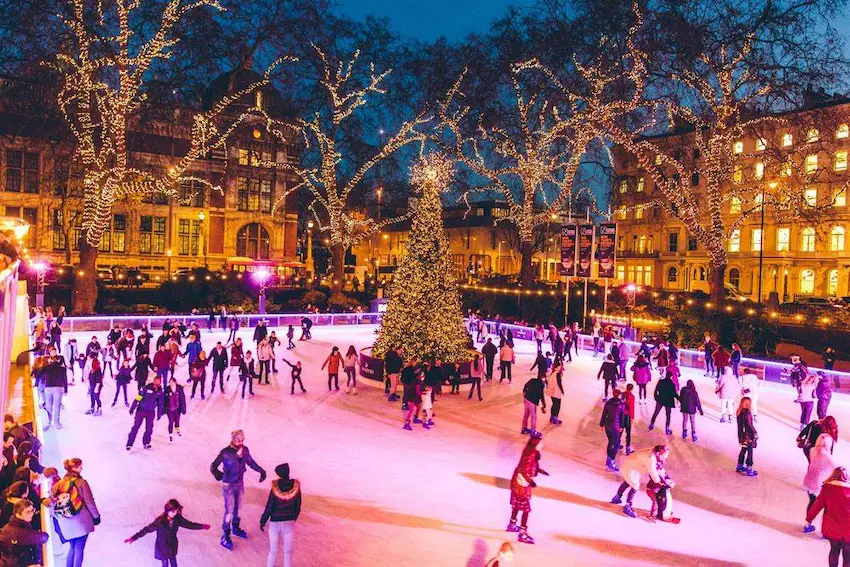
The extras are startlingly cheap, and most of them are free.
Prague runs free public ice rinks through the season and you have one on Wenceslas Square, and another on Ovocný trh beside the pale-green Estates Theatre and both are free to skate with rentals on site, and both lit into the evening. Na Františku by the river adds a third if you want ice without an audience and a crowd.
The vintage no. 42 tram, varnished wood and period livery, loops the centre on weekends and turns the whole lit-up city into a rolling viewpoint for the price of a ticket.
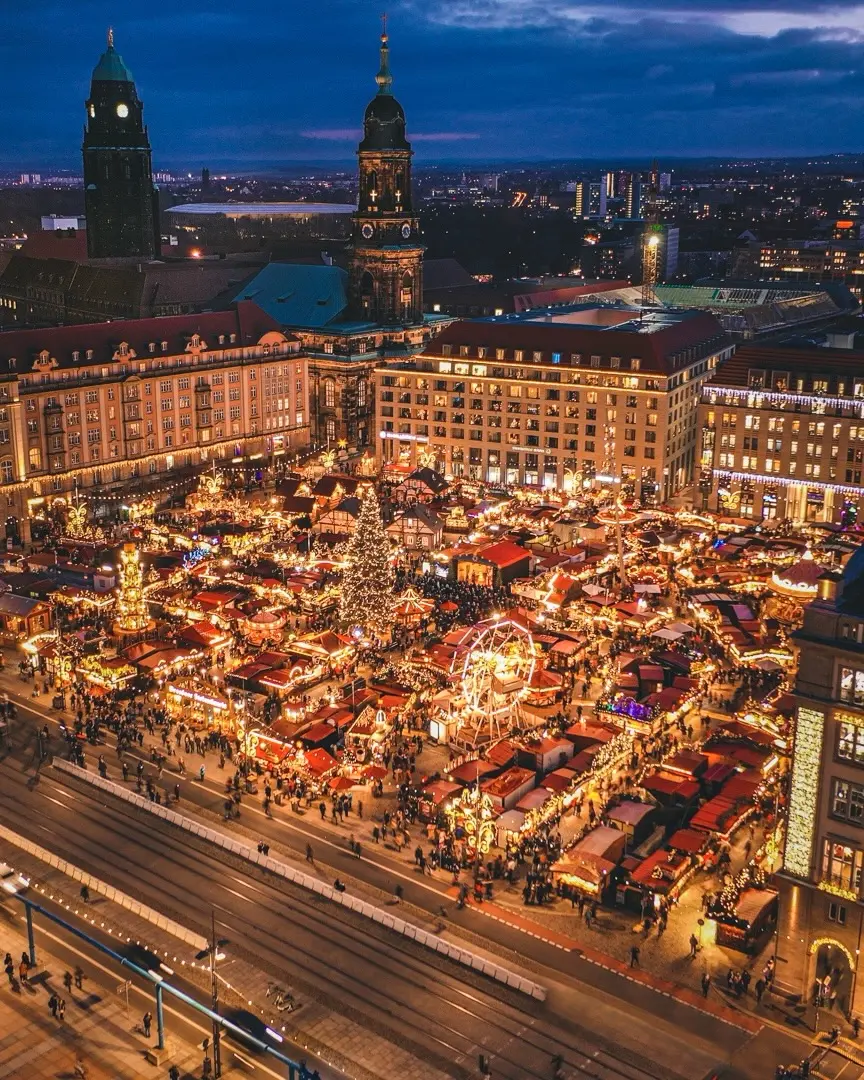
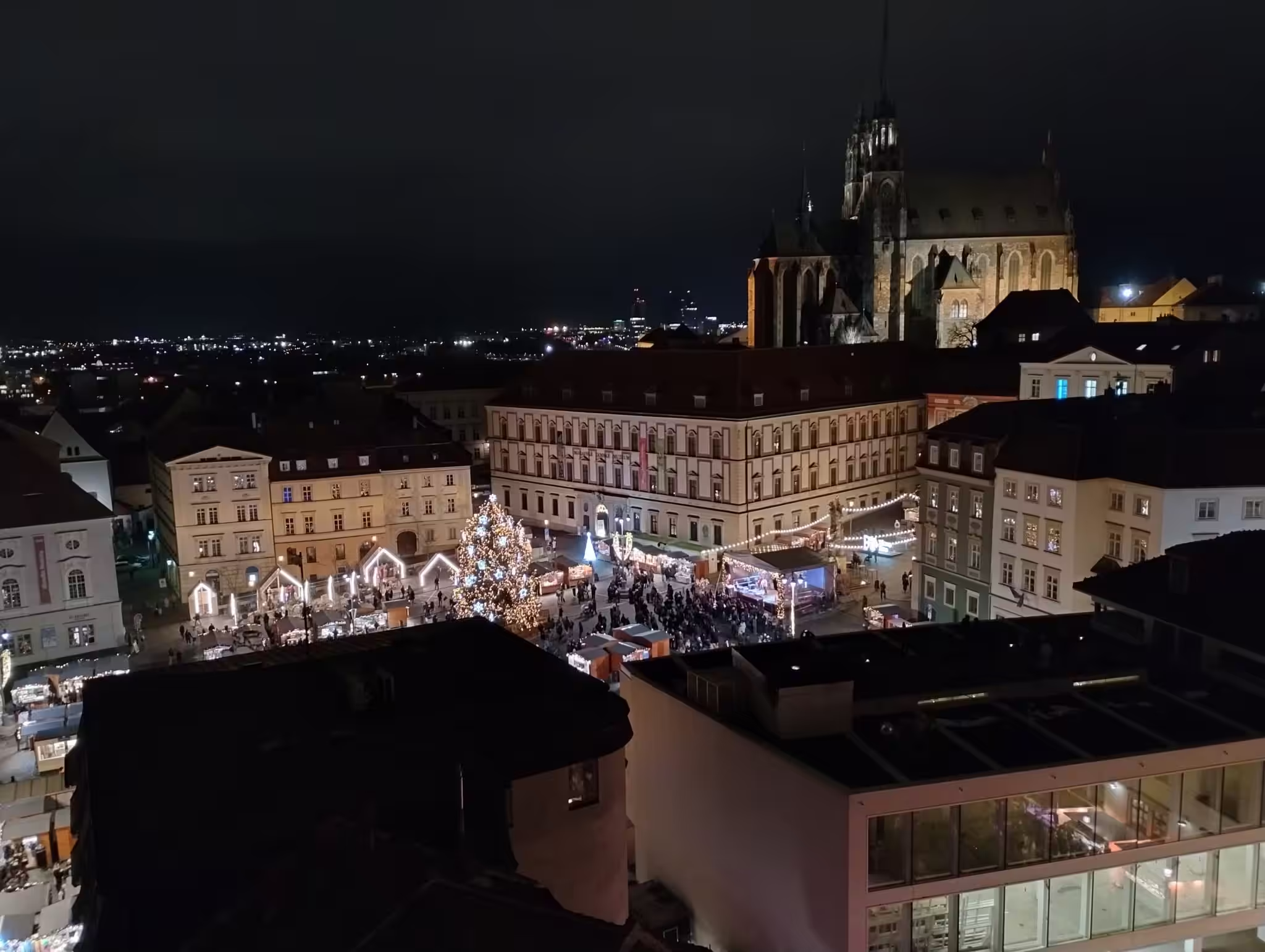
Midnight Mass fills the great churches on the 24th. And if the markets leave you wanting more markets, Prague is the best-placed base in Central Europe and you can be off to Dresden’s Striezelmarkt in about two hours by direct train, and a medieval Kutná Hora in about one hour.
Planning it
Weather first so you don’t complain about it later on. Plan around −1°C as the December average with honest swings both ways, with darkness from four, and cobbles that find every thin sole. Get some boots you can stand in for two hours, proper gloves, layers. It’s Central Europe in December – it’s cold.
If I visit Prague again, I’d give the big squares my weekday mornings and early afternoons, and my evenings to Vinohrady or the river. If I was in town only for a weekend, then I’d go to the Old Town Square at 10:00 on Saturday, Vinohrady that evening with one tree show squeezed between.
You’ll have had the best of both, if you follow that plan.
As for where to stay, I recommend Prague 1 for the two-minute commute to the lights, or in Vinohrady for calmer streets, better-value rooms and your pick of the local markets.
The metro stitches everything together (Staroměstská, Můstek and Náměstí Republiky for the centre, Náměstí Míru for Vinohrady), and trams run every day of the season with only minor holiday timetables, so it matters less where you stay, if I am being completely honest.
The day to copy
Morning coffee and browsing at Jiřího z Poděbrad while the farmers’ market is in full swing. Old Town Square before noon for ornaments and the tower view, lunch off the grills, a lap of the Wenceslas rink to earn the next svařák. Tram up to Míru as the light turns amber, a cup under St Ludmila with the after-work crowd, pub dinner in the neighbourhood.
And if the night still has legs, go back down for the 21:30 tree show, when the square has gone soft and the lights have it to themselves.
Forty days, free at every door, open when the rest of Europe has packed up. Prague has built the most visitable Christmas season on the continent, and all it asks is that you time it like a local. If you have a day to spare, the rest of the Czech Republic’s Christmas markets are a cheap train ride away.