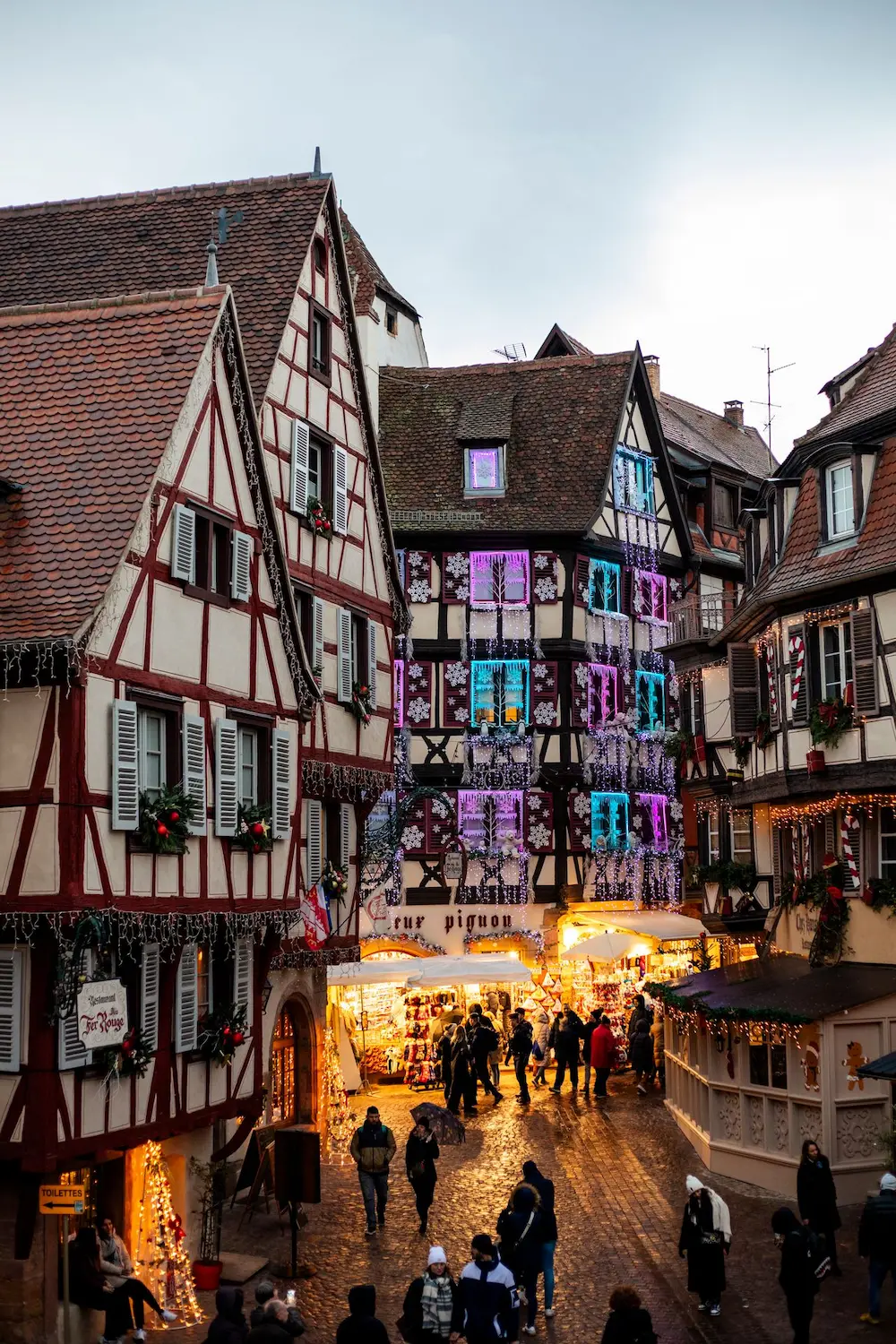
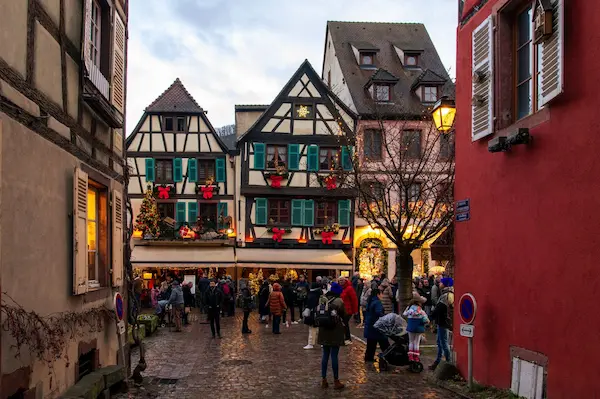
The town is the market
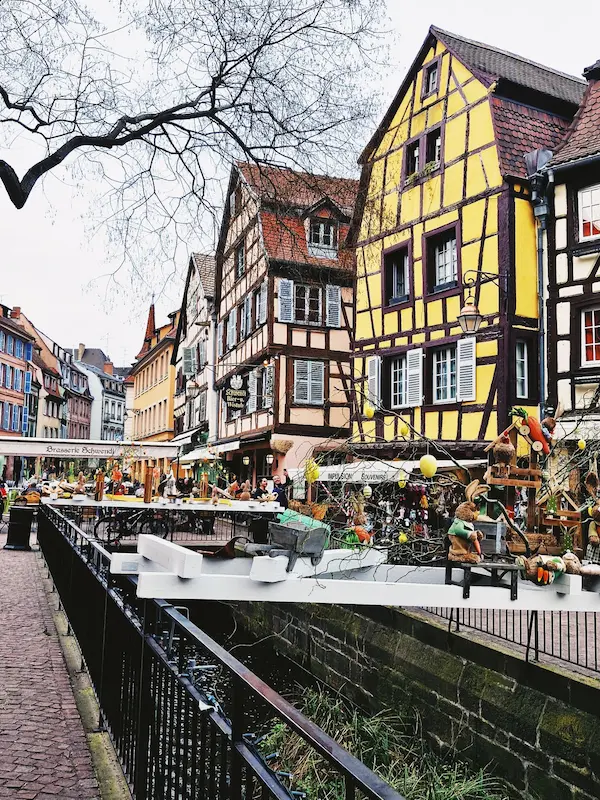
Colmar doesn’t set up a Christmas market in the old town. It turns the old town into one.
From 23 November to 29 December 2026, six themed markets thread through a centre of half-timbered houses and canal-side lanes, roughly 180 stalls in all, stitched together by 25 kilometres of garlands, 90 projectors and 800 lit baubles. Entry is free at every one of them. The whole circuit fits inside a twenty-minute walk.
Around 1.6 million people came last season, into a town of 68,000, and they don’t come by accident: this is the most beautiful market setting in Europe. Strasbourg, thirty minutes up the line, is the region’s giant with the 1570 pedigree. Colmar is the one that fits inside a single evening and looks better in every photograph.
The town takes its season seriously, too. December is worth some €150 million to the local economy, and the biggest foreign contingents are Germans and Swiss, border-crossers from the homeland of the Christmas market itself, which for a French market is its own kind of review.
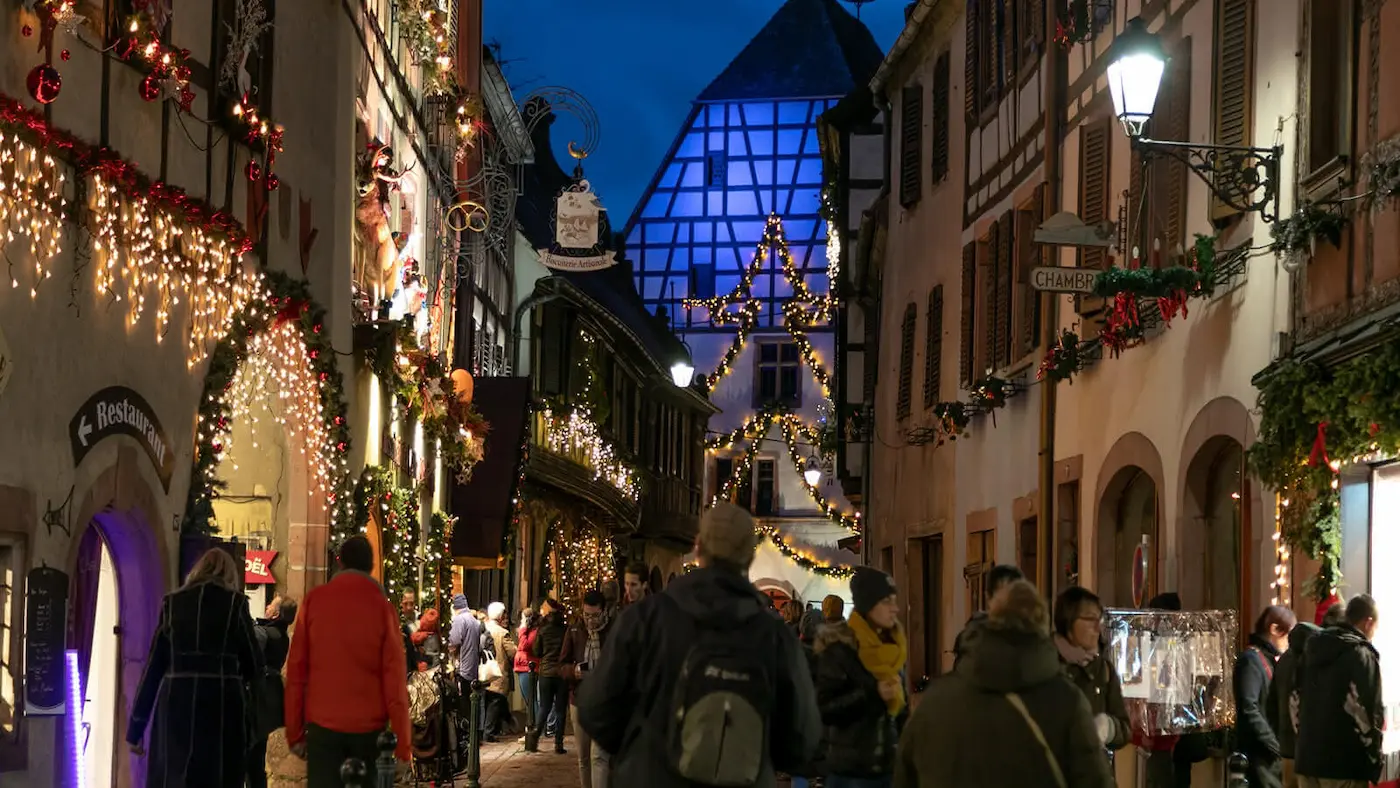
One number organises the whole visit: half past four. That’s when the lights go up, the timber facades turn amber, and the day-trippers with early trains home start missing the point. Plan around that half hour and Colmar delivers everything the pictures promised.
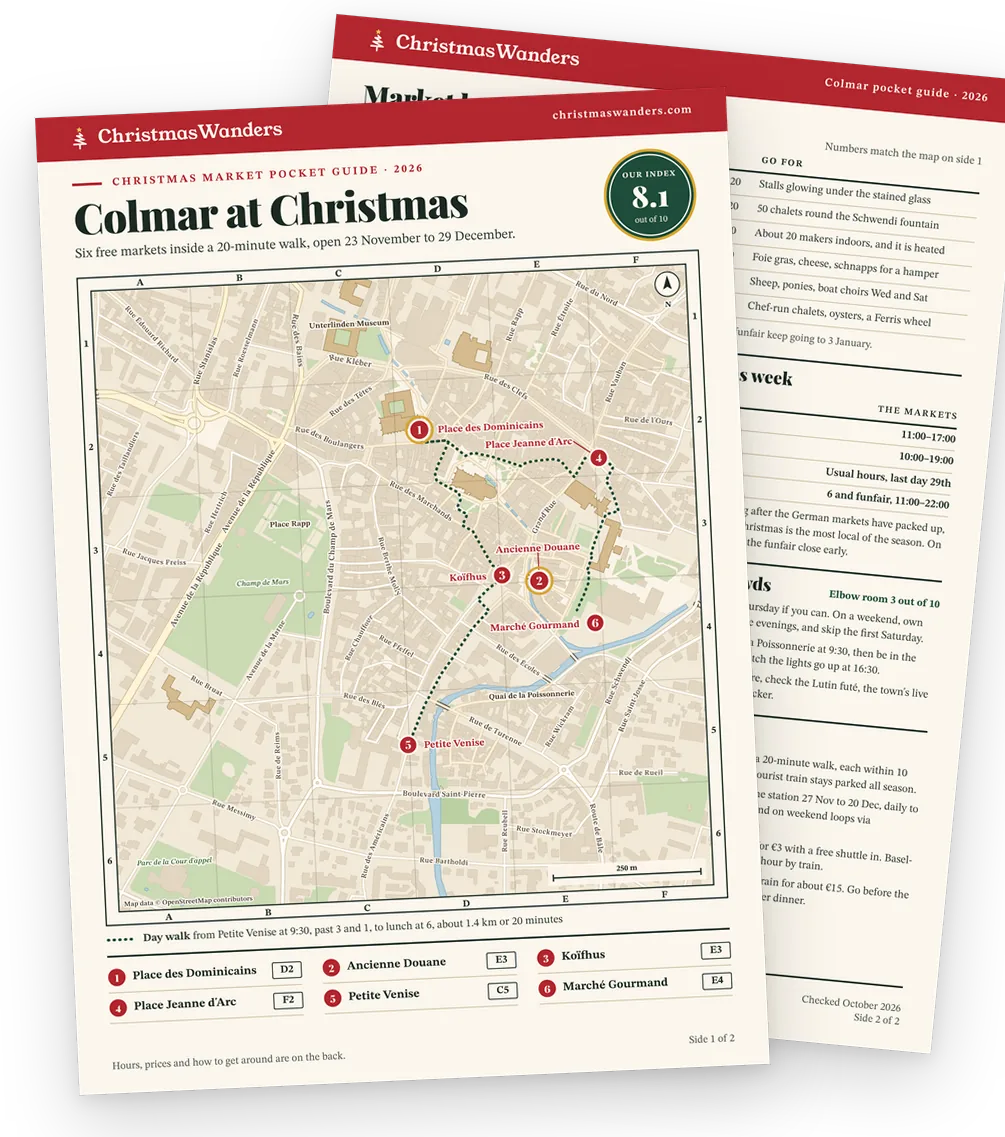
Six markets in a twenty-minute walk
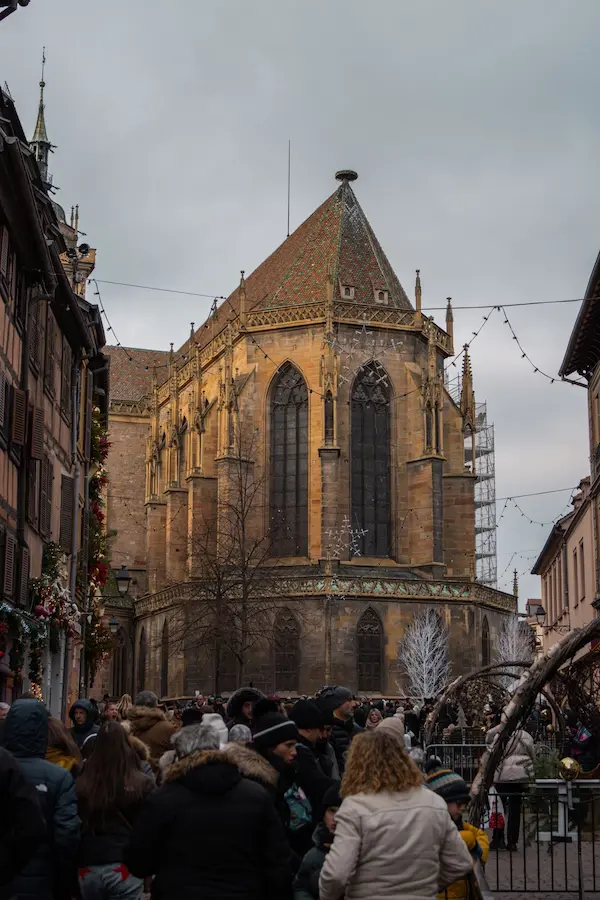
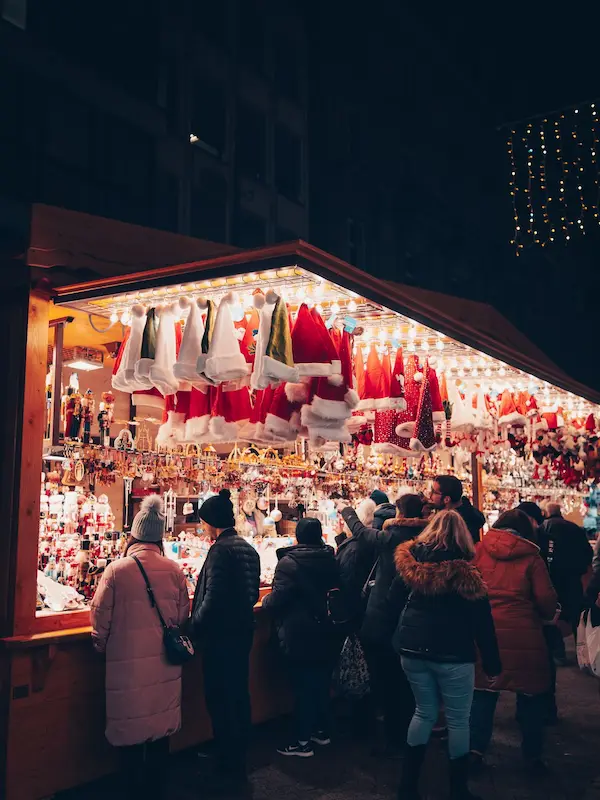
Place des Dominicains is the classic: about 60 chalets of ornaments and decorations pressed against the Dominican church, at its best after dark when the stained glass glows behind the stalls.
Place de l’Ancienne Douane wraps some 50 chalets around the Schwendi fountain and carries the biggest crowds. Gifts run traditional to contemporary, and it’s the square you’ll cross most often whether you mean to or not.
Place Jeanne d’Arc is the eating-and-carrying market, staged like an Alsatian village: foie gras, charcuterie, cheeses, schnapps, biscuits by the tin. This is where the Christmas hamper gets filled and where the producers will talk you through what you’re buying.
The children’s market on Place des Six Montagnes Noires, at the edge of Petite Venise, keeps live sheep and rabbits, a mechanical nativity, pony rides, hot spiced apple juice and a giant letterbox that forwards to Santa. A Christmas treasure hunt runs through the season for anyone whose children need a mission between squares.
On Wednesdays and Saturdays around 17:00, children’s choirs sing from flat-bottomed boats on the Lauch just below the square. Get to the bridge twenty minutes early. Everyone else has read the schedule too, and the singing carries better than you’d think across the water.
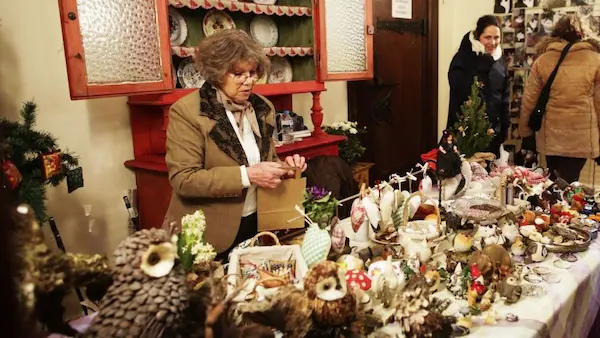
The Koïfhus, the town’s 15th-century customs house, holds the indoor market: twenty-odd local artisans working in ceramics, glass, wood and jewellery, with an elaborate gingerbread display and a toy museum upstairs. It’s the shopping with the highest maker-to-reseller ratio in town, and it’s also where you thaw out.
The gourmet market on rue de la Montagne Verte is the newest idea and the best one: nine chef-run chalets doing oysters, truffle risotto and proper Alsatian plates, live cooking demonstrations toward the end of the week, and a Ferris wheel turning next door for €9. An €18 set of tarte flambée, vin chaud and a glass of crémant is the smartest sit-down deal in the centre.
Sleep here, the coaches don’t
Colmar’s crowd has a rhythm, and it belongs to the day-trippers: in by late morning, out by the time the lights have properly settled. Stay the night and you get the two hours they never see.
Day-trip Colmar and you’ve seen the stalls. Sleep here and you’ve seen the town.
The first is 9:30 in the morning, when Quai de la Poissonnerie and the lanes of Petite Venise are empty enough to photograph and the bakers are pulling the first kouglof. By afternoon, the Maison au Pèlerin corner is a queue pretending to be a street.
The second is dusk. Arrive in the squares at 15:30, watch the lights climb the timbers over the next hour, and stay on: the illuminations run to 22:00 on weekdays and 23:00 at weekends, and the last two hours belong to people who are sleeping in town.
Book early, because five months out is normal for December and weekends go first. Hôtel Turenne at the edge of Petite Venise holds the budget end. Colombier Suites and the James put you mid-range inside the circuit. La Maison des Têtes, 21 rooms in a listed 1609 building with a Michelin-starred dining room, is the splurge that matches the town. Basing in Strasbourg sounds like the thrifty move until you learn its December hotel average has hit €276 a night. Colmar itself is often the value play now, and the wine villages need a car once the shuttles stop around eight.
What to eat where the French outnumber you
Here is the quiet reassurance inside the visitor numbers: the crowd stays overwhelmingly French, with a strong Alsatian core. This is a market region’s own population turning out for its own tradition, and the food is priced and made accordingly.
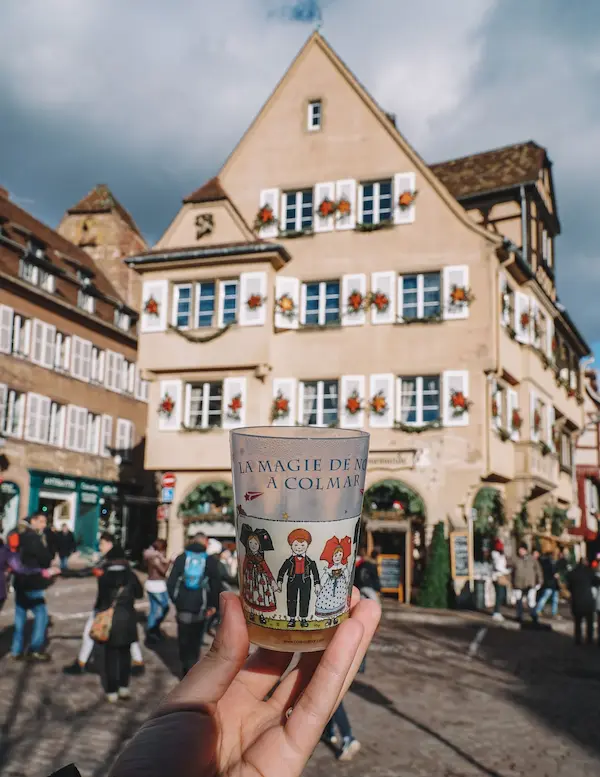
Vin chaud runs €3.50 to €5 a cup, and the one to order is the white. Hot Alsatian white wine with citrus and spice is the region’s signature pour, and it makes Vienna’s €4.50-to-5.50 glühwein look dear. Prague’s mulled wine lands around €4 as well, so Colmar drinking sits at the friendly end of the entire market circuit. The cups are plastic rather than keepsake, with €1–3 deposits where they’re charged at all, and a few stalls sell a boot-shaped souvenir mug for the collectors.
Tarte flambée at €9–10 is the proper market meal: cream, onions and lardons on dough thin enough to fold. A lardon-studded bretzel runs about €5, a raclette sandwich €12, a choucroute plate around €15, and €15–20 a head covers a serious market dinner anywhere in the circuit.
Sweet things are where Alsace shows off. Kouglof, best bought fresh from a bakery like L’Enfariné rather than shrink-wrapped from a stall. Pain d’épices in slabs and hearts. Bredele, the little Advent biscuits, sold loose by weight. Glance at the per-kilo figure before you fill the sachet, because the worst offenders push toward €69 a kilo and a generous scoop adds up fast.
Two upgrades worth planning. The winegrowers’ Caves de Noël see domaines around Colmar (Jean-Baptiste Adam and Emile Beyer among them) open their cellars for Advent tastings, which beats any souvenir bottle. And the gourmet market’s oyster-and-crémant run is there for the night you can’t face another sausage. Bring cash either way: the food stalls prefer it, cards get happier as purchases get bigger, and even the public toilets want their 50 cents.
Timing is the whole game
Monday to Thursday, Colmar is a delight. Friday to Sunday, up to 150,000 people can pass through in a day, and the lanes between stalls move at shuffle pace from late morning to early evening.
So play it like this. Come midweek if you possibly can, when hours run 11:00–19:00 and the squares breathe. If it must be a weekend (10:00–20:00), own the mornings and the late evenings, and spend the shuffle hours somewhere the coaches don’t go: the Unterlinden museum, whose cloister gets its own December light projections, or out in a wine village. Skip the season’s first Saturday entirely. It is the single densest day of the calendar.
Before you choose a square, check the Lutin futé, the town’s live colour-coded crowd tracker covering ten area markets. Colmar publishes its congestion in real time, which is the most useful thing any market town has done for its visitors in years, and almost nobody uses it.
The town is well looked after, too: visible and plainclothes patrols, drone cover on the peak days. Normal pocket-and-bag habits are all the caution the trip needs.
Open when the rest have gone home
Alsace’s German neighbours pack up on the 23rd or 24th. Colmar keeps going.
The markets run to 29 December, with Christmas Eve trading 11:00–17:00 and Christmas Day running from 10:00. Then the Ferris wheel, the Place Rapp funfair and the gourmet market carry on daily to 3 January, 11:00 to 22:00, closing early only on New Year’s Eve. Even Strasbourg’s giant winds down on the 31st, so a between-the-holidays Alsace trip quietly becomes a Colmar trip.
That last week is the softest, most local window of the season: lights still up, squares still pouring, coach traffic gone, hotel prices exhaling. If you can only come after the 25th, come anyway.
Two planning notes for that stretch. The ice rink hasn’t returned since 2022, its old Place Rapp slot now given to funfair rides and a toboggan, so skaters should aim their ambitions at Strasbourg. And the little tourist train stays parked through the season because the pedestrian zone is sealed for security. Colmar rewards feet, which is the best way to see it anyway.
The villages on the Christmas shuttle
Colmar sits in the middle of the Route des Vins, and in December the wine villages run markets of their own: smaller, older-feeling, and reachable without a car.
The Navettes de Noël leave from outside the station from 27 November to 20 December. One line runs daily to Eguisheim (€8 midweek, €17 at weekends). Weekend loops link Kaysersberg, Ribeauvillé and Riquewihr on a €17 hop-on day ticket with unlimited same-day boardings. Under-12s ride free with a reservation. Tickets go on sale online at noon on 12 November in limited daily numbers, and the good dates sell out. Set a reminder, because this is the one hard booking deadline of a Colmar trip.
Choosing between the Alsace villages: Eguisheim (27 November–30 December) is the easy daily add-on and the one still running after Christmas. Kaysersberg (weekends only) is the connoisseurs’ favourite. Riquewihr (27 November–20 December) has no rail station, so the shuttle is the way in. Ribeauvillé compresses everything into two medieval-market weekends, 5–6 and 12–13 December, of spit-roasts, minstrels and costumed noise. Turckheim and Munster cover the quieter end: Munster fills its valley through December, Turckheim has a regular TER train from Colmar if you miss the shuttle window. And fortress-town Neuf-Brisach gets its own shuttle line for a single weekend, 12–13 December.
Strasbourg is thirty minutes away for about €15, which makes the two-market day trivial on paper. In practice the market-season trains fill like ski lifts: ride before the stalls open and come home after dinner, not at the 18:00 crush.
Getting there and the small print
By rail, Colmar is easier than its storybook looks suggest: Strasbourg 30 minutes, Basel 50 minutes for around €17, Paris 2h20 by TGV from about €50. There’s a tourism welcome desk inside the station now, which says everything about how the town has professionalised its December.
Driving, skip the centre. The Parc Expo park-and-ride costs €3 with a free shuttle in, against €8.30 for five hours in a central garage, and Sunday city parking is priced on purpose to push you toward the trains.
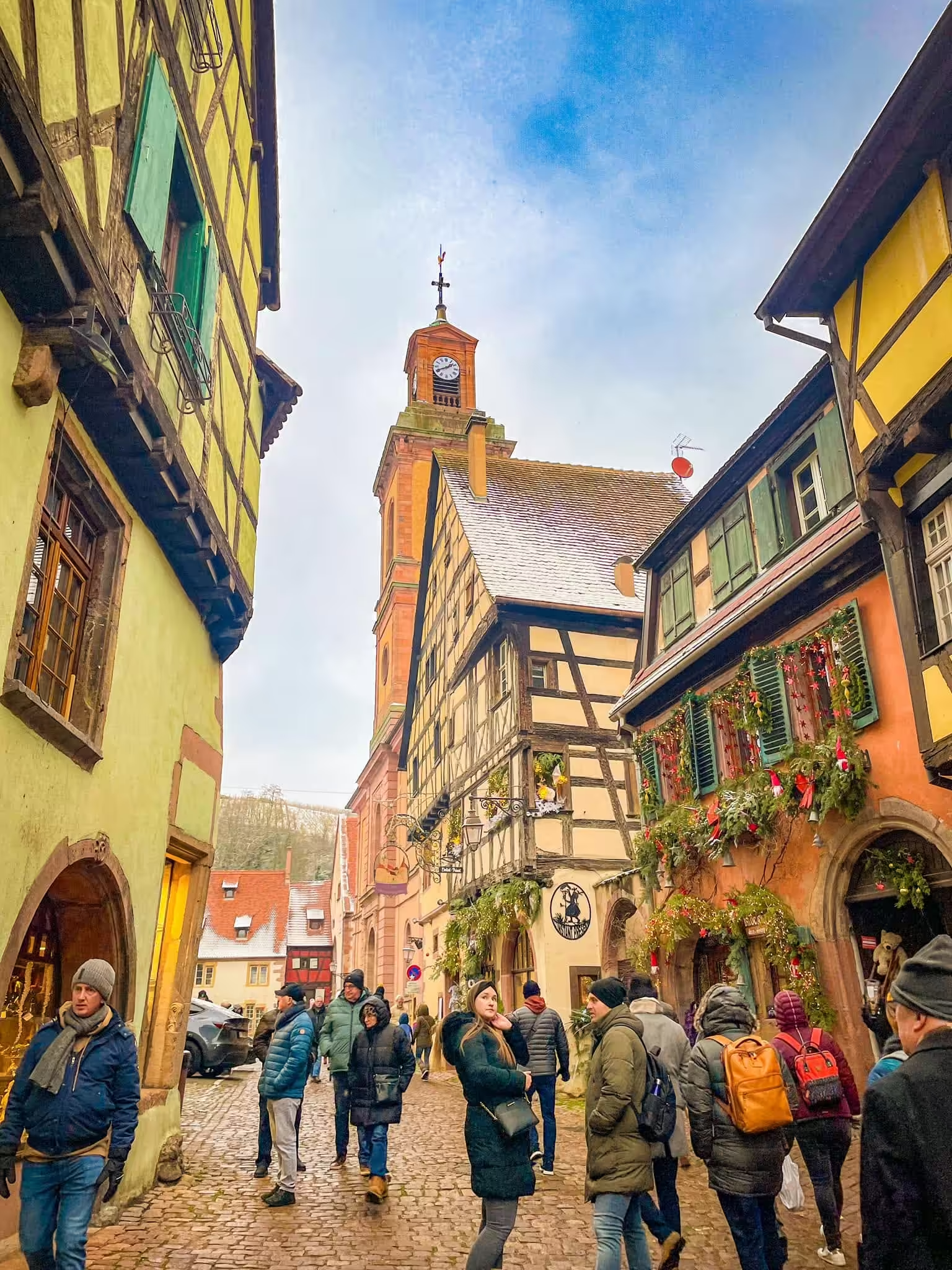
One piece of honest history, because the guides that skip it always ring false: Colmar’s market dates from 1988 in its modern form, four centuries after Strasbourg’s. What’s old here is the raw material: the bredele baking, the manele brioches for Saint Nicolas, the facades themselves, dressed each year for a residents’ decorating competition, which is why every window looks art-directed. Young market, old customs, and the town wears both well.
The day I’d copy
Morning train in, coffee and a fresh kouglof, Petite Venise photographed by 9:45 while the lanes still echo. Koïfhus and the Dominicains before noon, Place Jeanne d’Arc to load the hamper, the €18 gourmet-market lunch. Shuttle to Eguisheim for the early afternoon, back by 15:30, and into position on Place de l’Ancienne Douane as the lights climb the timbers.
Boat choirs at five if it’s a Wednesday or Saturday. White vin chaud in hand either way. Dinner late, and the squares nearly to yourself at 21:30 under a town still fully lit, the hour the coaches never see, which is the hour Colmar was dressed for.
This is the market Europe’s other markets have on their mood boards. Give it a night and time it by the half-hours, and it hands you the whole postcard with room to stand in it.