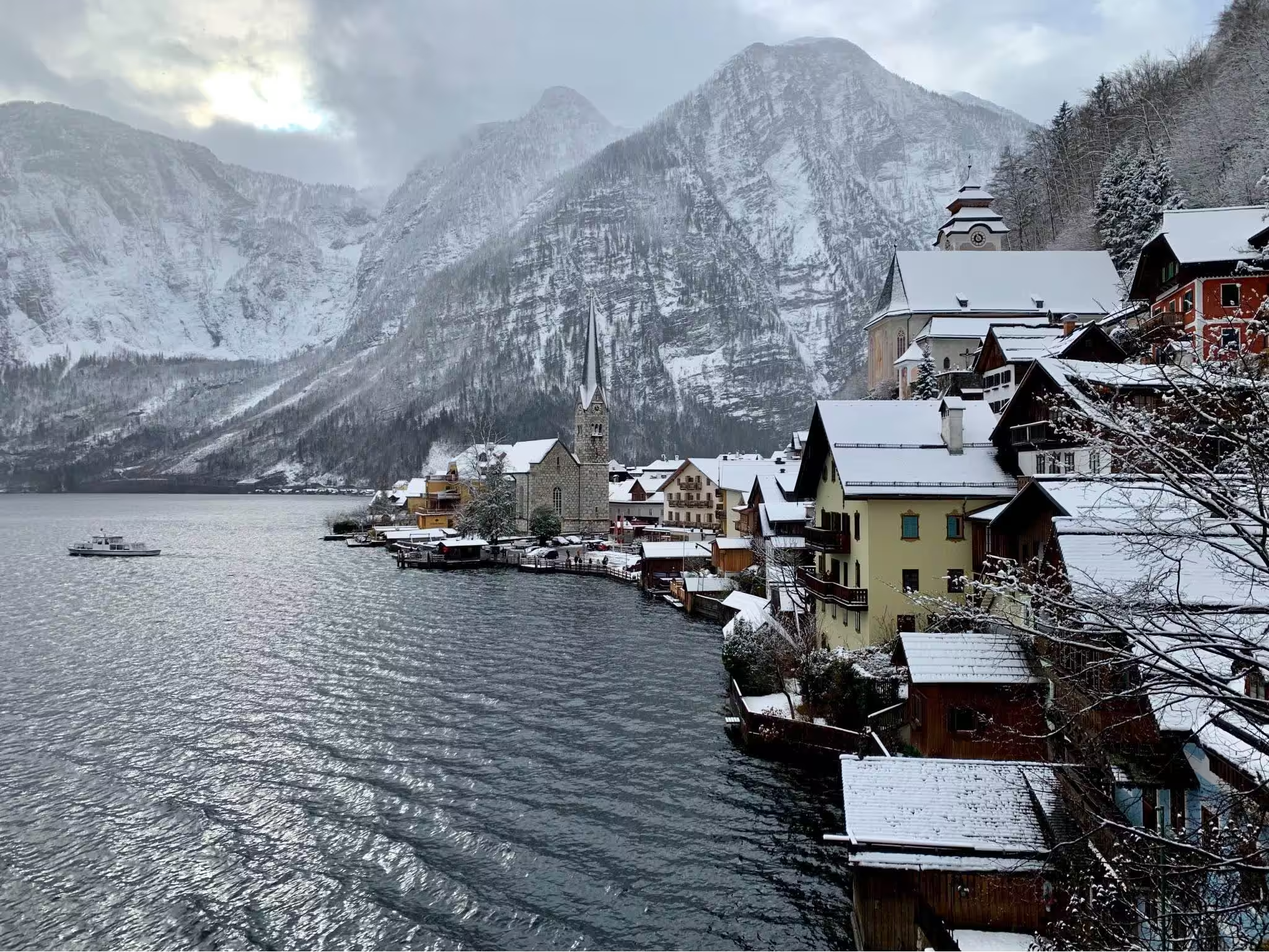
Hallstatt has a Christmas market for one day a year. In 2026 that day is Tuesday 8 December, and if you turn up on the 7th or the 9th you get the lake, the church spires and the wooden houses stacked up the mountain, but no market.
That catches a lot of people out. Hallstatt sits on a lot of “most magical Christmas markets in Europe” lists, so people plan a December trip around it, ride the train and the little ferry across the lake, and walk onto a square with no stalls on it. The lists just forget to mention the date.
The market itself is small and run by locals, and you can see all of it in about an hour. On its own it isn’t worth crossing an ocean for. But the same week has two Krampus nights on that very square, a third and much bigger one in Bad Goisern on the Monday, and a few tiny Advent markets around the lake that most visitors never hear about. Put it all together and Friday 4 to Tuesday 8 December is the best stretch of the year to be in Hallstatt.
Whatever dates you pick, sleep in the village for at least one night. Hallstatt turns into a different place once the day buses leave, and on market day the last ferry to the train station goes before the market even closes.
Hallstatt Christmas Market 2026 Dates, Hours and What’s There
| What | Details |
| Date | Tuesday 8 December 2026, one day only |
| Hours | 10:00–18:00 |
| Where | Marktplatz, the main square just up from the lake |
| Entry | Free |
| Payment | Bring cash |
| Run by | The Hallstatt municipality, with locals from Hallstatt and Obertraun |
| Tourist office | Closed that day |
The hours need one quick note. The municipality’s own listing says 10:00 to 18:00, and a couple of regional tourism sites say 18:30. I’d go with 18:00, because that’s what the organiser publishes, and treat anything after it as a bonus.
The 8th is Maria Empfängnis, the Feast of the Immaculate Conception, and it’s a public holiday in Austria. Since 1995 shops have been allowed to open on the 8th when it falls on a weekday, so a big chunk of the country spends the day off doing its Christmas shopping.
For a village market you couldn’t pick a better day. It hasn’t always been just the one day, either. In 2013 the market ran on the 7th and 8th, in 2018 on the 8th and 9th, and for the last few years it has been the 8th and nothing else.
The nativity scene is the thing to look at. It’s a three-dimensional crib made by HTBLA Hallstatt, the village’s technical school for woodwork, and that school is no hobby club. It opened in 1873 as an imperial trade school for woodwork and marble, and today about 450 students train there in instrument making, wooden boat building, sculpture and restoration. A crib from that place beats anything from a catalogue by a mile.
Around it you’ll find a big lit Christmas tree, local musicians, and stalls with handmade decorations, small gifts, Christmas cookies, bratwurst, mulled wine, punch and hot tea. Nobody publishes a stall count, and you won’t need one, because the whole thing fits on one small square with room left for the crowd. My pick is the smoked fish, which comes out of the same lake you’re standing next to.
You might also find old mentions of a Christmas market up on the Salzberg by the Rudolfsturm, the tower above the village. That was a one-off in 2019. Nothing is listed up there for 2026.
Because it’s a national holiday, the 8th gets busy. Austrians are off work, the day-trip coaches still come, and by late morning the lanes around the square are tight. The best times are right at 10:00, while the stalls are still opening, and after 16:00, when the daylight’s gone and the tree does the work. The tourist office is shut for the holiday, so ask your questions the day before.
Krampus Nights in Hallstatt and Bad Goisern
Krampus is the horned demon who walks with St. Nicholas. St. Nicholas rewards the good kids, and Krampus is there for everyone else. In practice that means young men in huge hand-carved wooden masks, full fur suits and heavy bells, coming through the streets with fire and smoke and a lot of noise. It’s loud, it’s a bit scary, and in this corner of Austria people take it very seriously.
Hallstatt has its own group, D’Hirlatzer Teufel, founded in 2012. In their legend the Krampus comes down from the Hirlatz cave, a big cave system in the mountain above the lake. There are about 25 runners, the masks come from a carver in St. Johann called Wolfgang Gangl, the furs from a tanner in Styria, and every runner pays for his own kit, which comes to over €1,000 each. Nobody spends that on a costume unless they really mean it.
They do two nights on the Marktplatz. The children’s Krampus run is on Friday 4 December, 17:00 to 20:00, with about 20 of the younger devils, aged 5 to 15, doing their own run and fire show before St. Nicholas hands out sweets. It’s free (they take donations), it happens in any weather, and it’s the gentler one if you’ve got kids with you.
Saturday 5 December is the main event. The bar opens at 17:00, the show starts at 19:00 and St. Nicholas turns up at 20:00. Another listing gives the whole evening as 18:00 to 23:00, so just be on the square by 19:00. They serve hot drinks and Holzknechtnocken, an old woodcutters’ dish that’s exactly as filling as it sounds.
Then on Monday 7 December there’s the Salzkammergut Krampuslauf in Bad Goisern, run by the town’s volunteer fire brigade, and it’s a different scale altogether. More than 800 Krampusse and Perchten from about 90 groups come in from five Austrian states. The huts open at 16:00, the kids’ run is at 18:00, and the main run starts at 19:00 along Marktstraße and takes around two hours to pass. Sci-fi and latex masks are banned, so it’s all carved wood and fur. Christoph Waltz once talked it up on Jimmy Fallon’s show, which is probably the strangest bit of PR a fire brigade has ever had.
Bad Goisern is only about half an hour from Hallstatt by bus, but there’s no public transport back after the run. Either drive, book the Salzkammergut shuttle ahead (+43 50 422 422), or sleep in Bad Goisern and come over for the market in the morning.
The Krampusse are meant to be scary and they’ll come right up to the crowd, so keep small kids a step back from the front. At the organised runs the real ones wear numbers.
Advent Around Lake Hallstatt
The region sells all of this as “World Heritage Advent” across the four villages on the lake, Hallstatt, Obertraun, Gosau and Bad Goisern. Almost everything is small, local and on for a day or a weekend, so your dates decide what you see.
| Date (2026) | What | Where | Worth knowing |
| Sat 21 – Sun 22 Nov | Mühlenadvent | Anzenaumühle mill museum, Bad Goisern | Small, quiet market at a mill documented back to 1584, 10:00–18:00 |
| Sat 28 – Sun 29 Nov | Gosauer Bergweihnacht | Heimatmuseum, Gosau | Sat 13:00–19:00, Sun 11:00–18:00 |
| Sun 29 Nov | St. Nicholas crosses the lake | Strandbad (lido), Obertraun | 14:30 (one listing says 15:30), small market beforehand |
| Fri 4 Dec | Children’s Krampus run | Marktplatz, Hallstatt | 17:00–20:00 |
| Sat 5 Dec | Krampus run | Marktplatz, Hallstatt | Show at 19:00 |
| Sat 5 – Sun 6 Dec | Gosauer Bergweihnacht | Heimatmuseum, Gosau | Second and last weekend |
| Mon 7 Dec | Salzkammergut Krampuslauf | Marktplatz, Bad Goisern | Main run at 19:00 |
| Tue 8 Dec | Christmas market | Marktplatz, Hallstatt | 10:00–18:00 |
| Sat 12 – Sun 13 Dec | Meisteradvent | Hand.Werk.Haus, Bad Goisern | Craft market in a castle, 10:00–18:00 |
| Mon 28 Dec | Altjahrverbrennen (“burning the old year”) | Obertraun | Torch walk and bonfire at 18:00, €13 |
| Tue 5 Jan 2027 | Glöckler runs | Obertraun, Bad Ischl, Bad Goisern | 16:45, 17:00 and 20:00 |
Gosau is the one I’d go out of my way for. It calls itself “far away from kitsch and commercialism”, and for once the tagline holds up. The stalls are spread between the square outside, the inside of the local museum and a barn, and there’s a horse-drawn sleigh out to a little farm, donkey rides, soup served in a bread bowl and fried pastries they call “baked mice”. It only runs on the first two Advent weekends. One tourism site has the Saturday and Sunday hours swapped, so go by the organiser’s times in the table. From Hallstatt it’s half an hour to an hour by bus, depending on the connection.
If you’re around on the first Sunday of Advent, go and watch St. Nicholas cross the lake. He comes over the water at dusk in a Fuhr, one of the traditional flat wooden boats of the lake, with his helper Knecht Ruprecht and the Obertraun brass band, and the kids recite little poems to earn their presents. Some blogs put this in Hallstatt. It’s actually in Obertraun, the village at the other end of the lake, about ten minutes away by bus, and it pairs nicely with Gosau the day before.
The Meisteradvent is at the Hand.Werk.Haus, a crafts centre inside Bad Goisern’s old Neuwildenstein castle that has been on UNESCO’s register of good practices for safeguarding intangible heritage since 2016. Think paper-star workshops for kids, hand-brewed beer and the town band.
On 5 January the Glöckler come out, groups dressed in white with bells on their belts and huge lit caps made of cut paper, running through the villages to chase the winter spirits away. Hallstatt doesn’t have its own run, so Obertraun is the closest. The best-known one is in Ebensee, about 40 minutes up the line by train, where the caps can weigh up to 20 kg.
Can’t Make the 8th? The Markets Within Reach
If your dates miss the 8th, you’re not stuck. These markets are a train or bus ride away, and they run for weeks instead of hours.
| Market | 2026 dates | From Hallstatt | Getting back |
| Bad Ischl (Trinkhalle crafts market) | 20 Nov – 20 Dec, Wed–Sun, plus 7 and 8 Dec | 20 min by train, plus the ferry | Last bus to Hallstatt around 18:15 |
| Wolfgangsee Advent (St. Wolfgang, St. Gilgen, Strobl) | 20 Nov – 20 Dec, Wed–Sun, plus 7 and 8 Dec | About 1 h 35 to St. Wolfgang by bus | Last bus back around 17:15 |
| Salzburg Christkindlmarkt | 19 Nov 2026 – 1 Jan 2027, daily | About 2 hours | Leave Salzburg by about 16:25 |
| Gmunden Advent market | 27 Nov – 20 Dec, Fri–Sun, plus 8 Dec | About 1 hour by direct train | Last ferry from Hallstatt station is 18:30 |
Bad Ischl is the easy answer. Emperor Franz Joseph spent his summers in this old spa town, it was European Capital of Culture in 2024, and it’s 20 minutes away by train. The craftspeople’s Christkindlmarkt at the Trinkhalle is run by local makers, with music every day from 15:30, and it’s open on the 7th and 8th too, so you can do both markets on one trip. Next door, the Schmankerldorf food village keeps going until 6 January with raclette bread, Kaiserschmarrn and mulled wine into the evening. On 28 and 29 November there’s also an Advent market in the stables of the Kaiservilla, with about 20 makers picked by Christine Habsburg-Lothringen. A Habsburg choosing the stalls in the Habsburg stables is about as Austrian as it gets.
Wolfgangsee is the prettiest of the lot, with a 16-metre lantern floating in the lake in front of St. Wolfgang and Advent boats between the three villages. From Hallstatt, though, it’s over an hour and a half each way, and the last bus back goes around 17:15, right when the lantern starts to glow. I’d give it its own night or do it from Salzburg.
Salzburg is the big one, and as a day trip from Hallstatt it’s hard work because you have to leave by about 16:25. It works much better the other way round, with Salzburg as your base and Hallstatt as one or two nights. My Salzburg Christmas market guide has everything you need for that side of the trip.
Hallstatt in December Without a Market
On most December days there’s no market in Hallstatt, but a lot more is open than older guides suggest. Some still say the salt mine is closed all winter. In 2026 it isn’t.
| What | December 2026 |
| Salt mine (Salzwelten) | Open until 6 January, last tour starts 15:00 |
| Salzberg funicular and Skywalk | Open until 6 January, 09:00 to last ride down at 16:30, €29 return |
| Beinhaus (bone house) | Short winter hours around 11:30–14:30, closed Mondays and possibly Tuesdays, €2 cash |
| Museum Hallstatt | 11:00–16:00, €12 |
| Catholic parish church | Daily 09:00–17:00, free |
| Lutheran church | Daily 10:00–18:00, free |
| Krippenstein cable car (Obertraun) | Closed until 19 December |
| Dachstein ice caves | Closed until May |
| Lake boat tours | Pre-booked groups only (the ferry runs daily) |
The big news is up the mountain. The funicular up the Salzberg was completely rebuilt and reopened on 29 August 2026 after almost a year of work, and it now runs two glass cars for 60 people each, taking under three minutes to the top. The combined ticket with the salt mine is €49, or €29 if you just want the ride and the view. Up top, the Welterbeblick Skywalk sticks out 12 metres over the drop, about 360 metres above the rooftops, and on a clear winter day I’d rank it the best view on the whole lake. Don’t plan on walking up instead, because the path isn’t passable in snow.
The Beinhaus is the one people remember. It’s the bone house in St. Michael’s chapel next to the Catholic church, and it exists because the graveyard is so small that bones used to be dug up after some years to make room. About 1,200 skulls ended up stacked inside, 610 of them painted with names and little wreaths, starting around 1720. The last skull went in as recently as 1995. Winter hours are short and the listings can’t agree on them. Some say it’s closed on Mondays, some say Mondays and Tuesdays, and market day is a Tuesday, so if it matters to you, go on the Wednesday.
The Museum Hallstatt tells the village’s biggest story. A whole era of European prehistory, the Hallstatt culture, is named after the ancient graves found up on the Salzberg. And the churches are the quiet win. The Catholic parish church, finished in 1505, sells paper angels for its Christmas tree in Advent. Last year about 2,750 of them raised just over €4,500, and the parish says most were bought by tourists. The Lutheran church by the ferry landing is the spire in every postcard shot, and it holds a Christmas Eve vespers at 17:00 (in German).
For mountains, the Krippenstein cable car in Obertraun doesn’t open for winter until 19 December. After that you can snowshoe the easy 1.1 km trail from the top station out to the 5fingers viewing platform in about half an hour, with snowshoes to rent at the bottom.
Christmas Eve afternoon goes very quiet. The days after it don’t. Last December the mayor said Christmas and New Year in Hallstatt are like high summer, so don’t expect an empty village between the 26th and the 1st.
Crowds, Light and Snow
The crowds are real, even in winter. Hallstatt has 741 residents. In 2025 it was heading for a record of about 1.2 million day visitors, against only around 132,000 overnight stays. So the village fills up by day and half-empties at night, which is the best argument for paying for a room here.
The town has tried a lot to cope. Tour coaches are capped at 54 a day, with booked slots and a €126 fee per day-trip coach since May 2026. In 2023 the council put up a wooden screen at the famous photo spot to block the selfie crowds and took it down again after a backlash, and that same summer residents blocked the road tunnel for 15 minutes in protest. The tourist board also warns that pickpocketing has become “a business model” here, so keep your phone and wallet zipped.
And two myths, quickly. Hallstatt did not inspire Arendelle in Frozen, whatever you’ve read online, because the film’s makers pointed to Norway. China, on the other hand, really did build a copy of Hallstatt’s centre in Guangdong, and it opened in 2012.
The light goes early. Hallstatt sits on a narrow strip of shore under a steep mountain, so in December the sun drops behind it well before the official sunset of about 16:16. The weather station in Bad Goisern next door averages 1.8 hours of sunshine a day in December, and some houses in the Lahn district get no direct sun for months. One local went without it from 2 November to 8 February. Take your photos from late morning to early afternoon, and save the evening for the lamps.
Snow is a gamble. Every Hallstatt in winter photo you’ve seen has snow on the roofs, but the village sits at only 511 metres. December averages around −1°C, and you might get a white village or grey drizzle. Austria’s weather service says a white Christmas is only reasonably reliable above about 800 metres. If snow is the point, go up the Krippenstein after 19 December, where the odds are far better at around 2,000 metres, and count any snow down in the village as a gift.
Getting In and Out (the Ferry Sets the Clock)
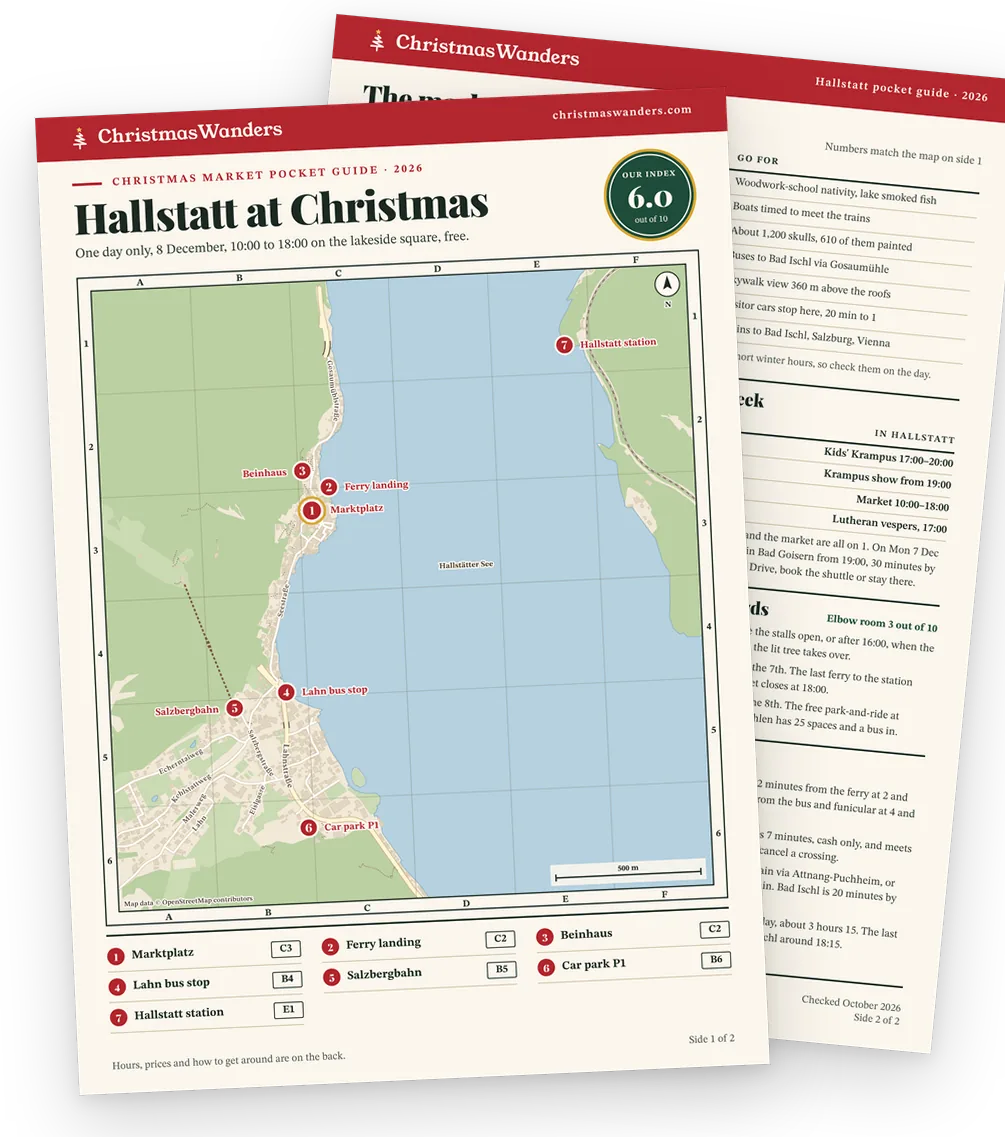
Hallstatt’s train station is on the other side of the lake. A little ferry, the MS Stefanie, has been doing the crossing since 1881, and it’s the only lake boat line in Austria that keeps running through winter. It takes 7 minutes, costs €4 one way or €8 return, it’s cash only, and it’s timed to meet the trains. In bad weather a crossing can be cancelled.
| Ferry | First daily boat | Last boat |
| Village (Hallstatt Markt) to the station | 08:10 | 17:45 |
| Station to the village | 08:35 | 18:30 |
The current timetable runs until 13 December 2026, so it covers the Krampus nights and the market day.
The 17:45 boat is the one that matters. On 8 December the market closes at 18:00 and the last ferry leaves at 17:45, so a day-tripper on the train walks away just as the square looks its best.
From Salzburg it’s between 2 and 3 hours, by train via Attnang-Puchheim or by the 150 bus to Bad Ischl and a train from there, and there are extra 150 buses on Advent weekends. From Vienna there’s one direct train a day at about 3 h 15, or 3 to 4 hours with a change, and the last connection back leaves just after 18:00.
The 543 bus stops at Hallstatt Lahn, at the south end of the village near the funicular, about ten minutes’ walk from the square. From Bad Ischl you change at Gosaumühle, and the last bus into Hallstatt leaves Bad Ischl around 18:15.
Driving is fine, but the car stays outside. The centre is closed to visitor cars, and even hotel guests can’t drive through. Car park P1 by the petrol station is open all year and about 20 minutes’ walk from the square. P2 at the funicular is closer, but some listings say it’s summer-only, so check before you count on it.
Both give you 15 minutes free, then €5 for an hour, €9 for two and around €18 to €20 for the day. Winter tyres are compulsory in wintry conditions from November to mid-April.
On the 8th the car parks fill early, and the fallback is the free park-and-ride at Obertraun Dachsteinhöhlen station, which has 25 spaces and a bus into Hallstatt.
Is Hallstatt Worth It at Christmas?
For the market alone, no. For the week around it, absolutely. Hallstatt is worth its salt at Christmas, just not because of the stalls.
The market is a village affair on a single Tuesday. The week around it gives you two Krampus nights on the same little square, the biggest Krampus run in the region on the Monday, a proper mountain Advent market in Gosau at the weekend, a brand-new funicular up to the salt mine, and a village that goes quiet and lamp-lit once the last coach pulls out. That’s a trip worth making.
People often ask whether Salzburg or Hallstatt is nicer, and they’re really two different trips. Salzburg is the Christmas market trip, with weeks of stalls and a whole city around them. Hallstatt is the village trip. With a week in Austria, I’d base myself in Salzburg for the markets and give Hallstatt one or two nights, ideally the 7th and 8th, or the 4th and 5th if you want the Krampus runs. There are plenty of other Austrian Christmas markets to fill the rest.
Just don’t come on a random Wednesday in December expecting stalls. And if you do make it on the 8th, tell me in the comments what the smoked fish stall had that year.