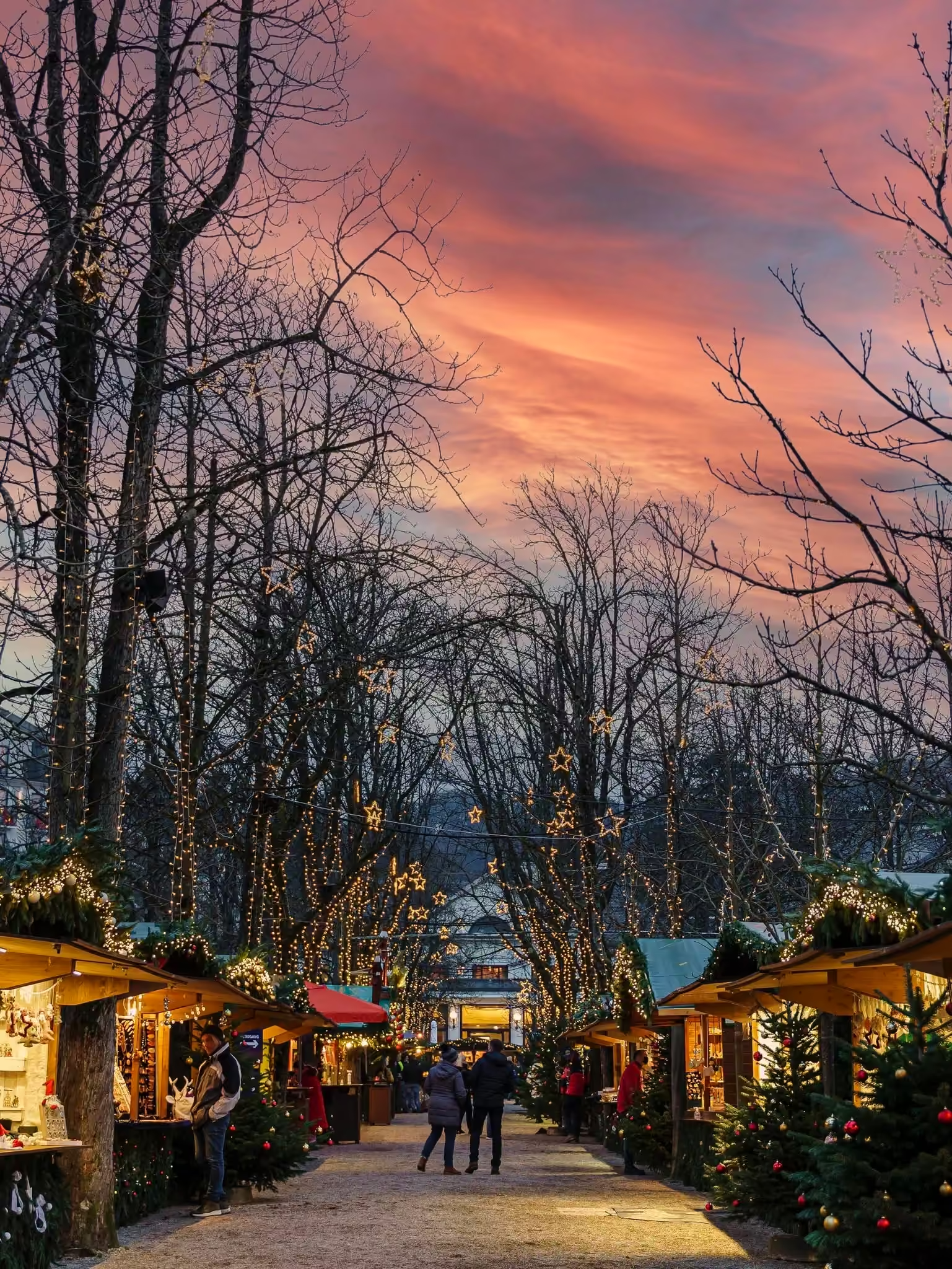
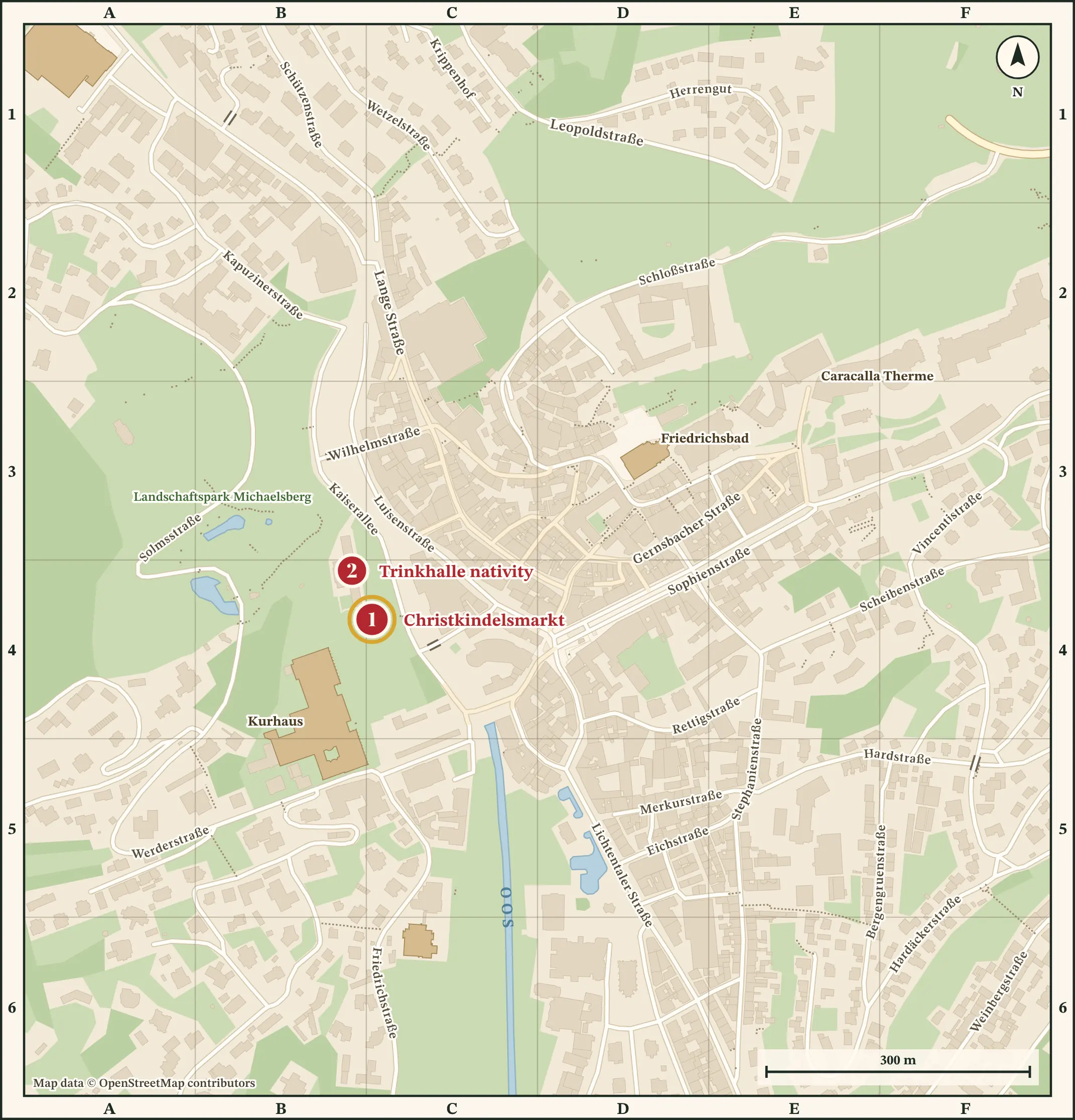
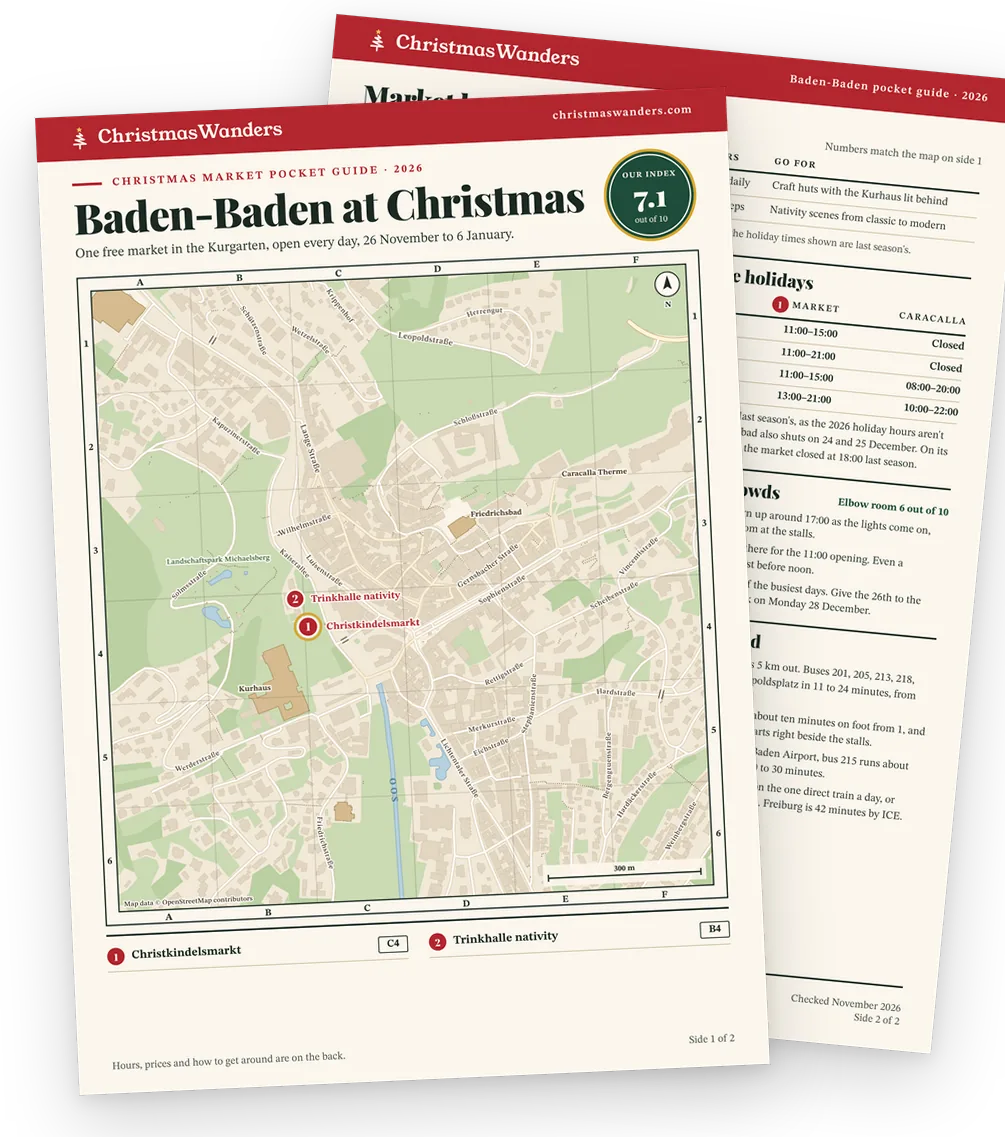
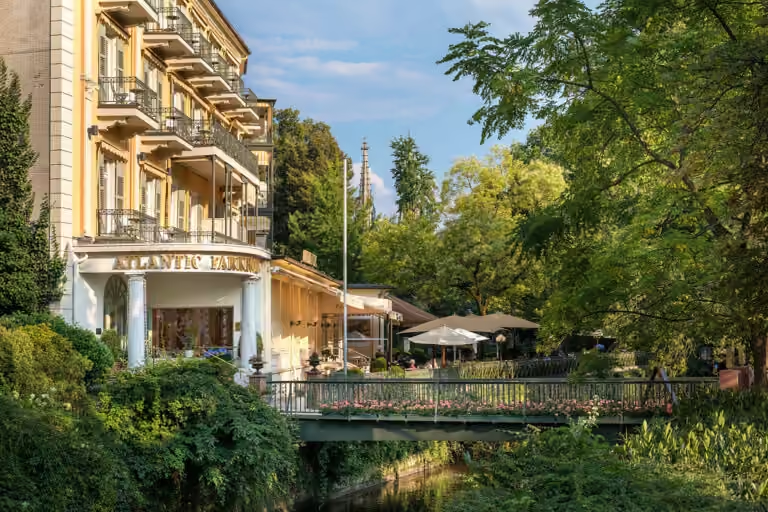
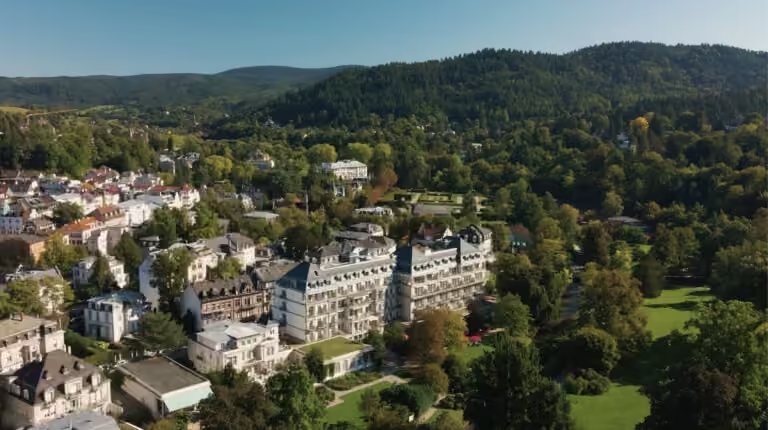
The Baden-Baden Christmas market is a single market, the Christkindelsmarkt, and it fills the spa gardens right in front of the Kurhaus.
So unlike major German Christmas markets that live in a square squeezed in between old houses, in Baden-Baden, you get wooden huts strung through a park.
It’s also the most grown-up Christmas market in this corner of Germany. The organiser allowed three children’s rides at most in 2024, so it feels like an evening out rather than a fair.
And a lot of it honestly comes from the town around it. Baden-Baden is a spa town before it’s anything else, in my experience, so the best version of the evening starts in the afternoon, in hot thermal water and it ends with a short walk over to the stalls just as the lights come on.
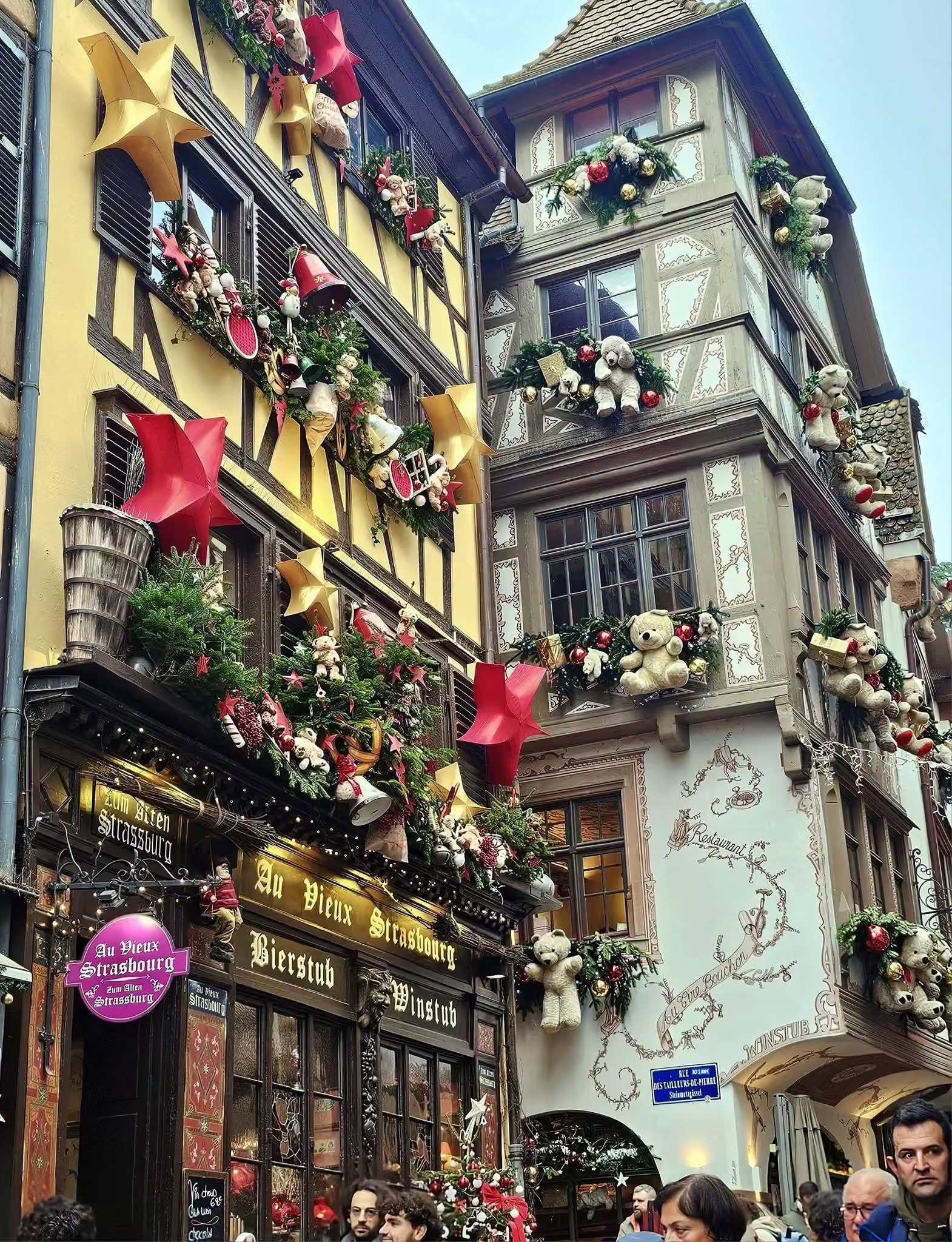
And I advise you to have that evening right through the holidays, because many Christmas markets like Strasbourg shut its markets on Christmas Eve or even before, while Baden-Baden is open on Christmas Day and keeps going until 6 January.
Baden-Baden Christmas Market 2026–2027 Dates and Hours
The Baden-Baden Christmas market runs from Thursday 26 November 2026 to Wednesday 6 January 2027, and entry is completely free.
It’s open 11:00 to 21:00 every day, weekends included, and there isn’t a single closed day in those six weeks.
The day I’d plan a trip around is Saturday 5 December, the Berlin Phil in the Kurhaus. Players from the orchestra give three chamber concerts that day, at 11:00, 14:00 and 17:00, staged by the Festspielhaus.
Chamber music in the Kurhaus and then straight out into the market on its doorstep is about as Baden-Baden as December gets.
It’s St Nicholas weekend as well, though, so I’d do the stalls at 11:00 and take the 14:00 or 17:00 concert.
Later in the season, the holidays are the only days the hours change, and the 2026 ones aren’t out yet. Last season it closed at 15:00 on Christmas Eve and New Year’s Eve, and it was open on Christmas Day with its normal 11:00 to 21:00.
| Date | What’s on |
|---|---|
| Thu 26 Nov | Opening day, stalls open 11:00–21:00 |
| Thu 3 and Fri 4 Dec | Berliner Philharmoniker and Kirill Petrenko at the Festspielhaus, 19:00 |
| Sat 5 Dec | Berlin Phil chamber concerts in the Kurhaus at 11:00, 14:00 and 17:00 |
| Fri 11 to Sun 20 Dec | Winterfestspiele at the Festspielhaus, with Swan Lake, The Magic Flute and the Christmas Oratorio on the 19th |
| Thu 24 Dec | Christmas Eve, 11:00–15:00 last season, both thermal baths closed |
| Fri 25 Dec | Christmas Day, open (11:00–21:00 last season), both thermal baths closed |
| Sat 26 Dec | Open, and one of the busiest days of the season |
| Thu 31 Dec | New Year’s Eve, 11:00–15:00 last season, Festspielhaus New Year’s Eve concert at 16:00 |
| Fri 1 Jan | New Year’s Day, 13:00–21:00 last season |
| Wed 6 Jan | Last day, 11:00–18:00 last season |
| From Thu 7 Jan | Closed until next season |
When to Go (and Why to Leave the Car at Home)
If you can choose, go on a weekday, or be there for 11:00 on a weekend. Even a Saturday can be quiet just before noon. On a weekday you can turn up around 17:00, as the lights come on, and still find room at the stalls.
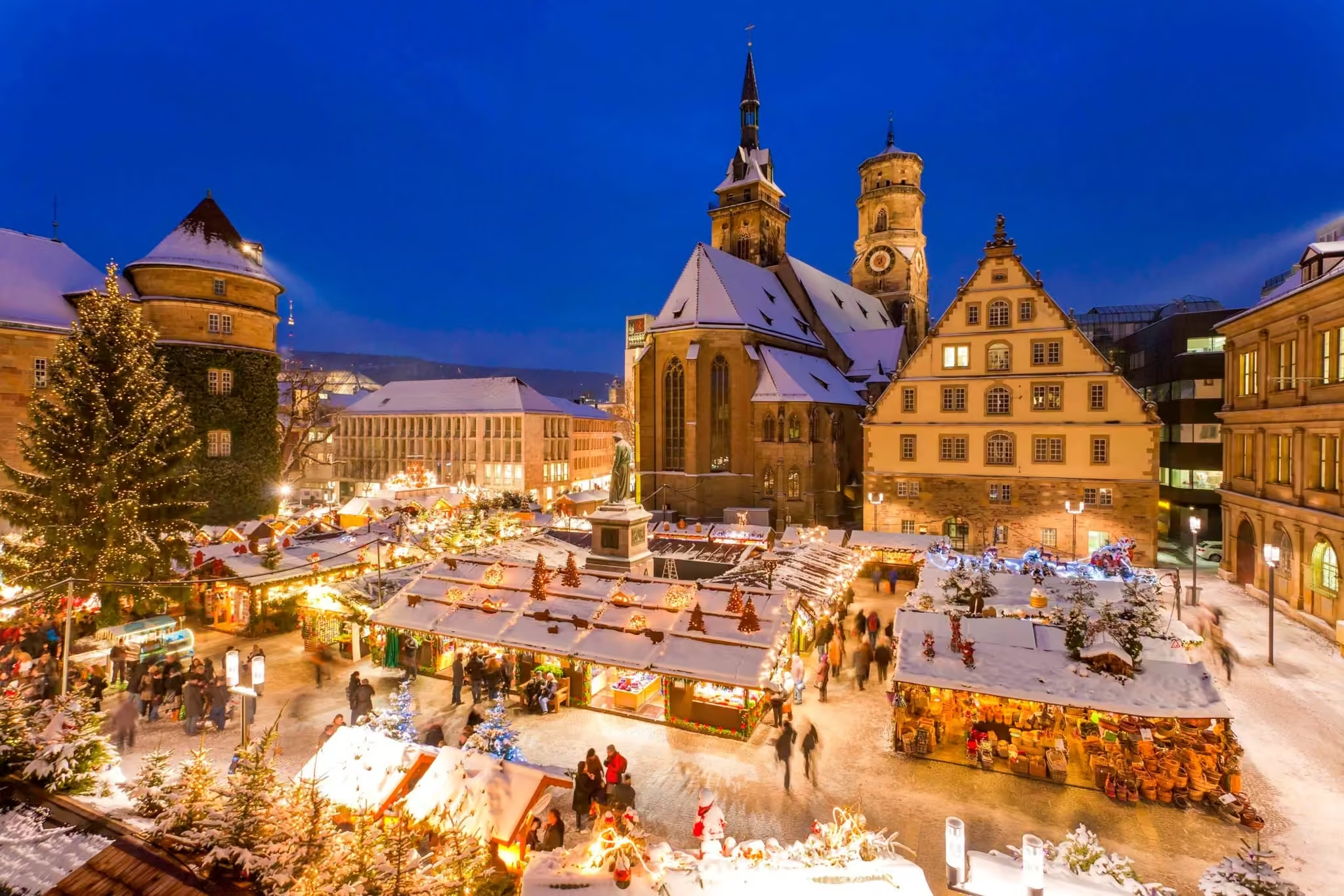
Having that elbow room is the thing Baden-Baden does better than big Christmas markets like Colmar or Stuttgart.
The paths through the Kurgarten are wide and the huts aren’t jammed together, so even a busy evening rarely turns into a shove. Our Elbow room score gives it 6 out of 10, level with Strasbourg and well ahead of Colmar at 3 and Stuttgart at 4.
Now, weekends are a different story (like with every Christmas market out there), and you will feel it most in the car parks. The garages near the Kurhaus fill up at weekends, and on Boxing Day last season even the multi-storeys a few kilometres out were full.
So my advice to you is to leave the car at home at weekends and come by train and bus. If you’re driving in anyway, make sure you use the park and ride on the edge of town.
Spend the Afternoon in the Baths, the Evening at the Market
If you get into the baths around 14:00 and give it three hours, you come out just after sunset, which is 16:31 in mid-December.
Both baths are within about ten minutes’ walk of the stalls, so you arrive with the Kurhaus lit up and still warm from the water. You’ll be glad of it, because December highs here are only about 7.5 °C, and after dark it can feel like a degree or so below freezing.
Which bath depends on how brave you’re feeling. Caracalla is the easy one, a modern thermal bath with a round outdoor pool that steams away in the cold air. It’s where I’d send anyone who just wants to float and thaw out.
Friedrichsbad is the one to do at least once. It’s a Roman-Irish bathhouse from 1877 with no time limit, so you work through it at your own pace, about three hours if you do it properly.
That slow, steamy afternoon is exactly what this trip is for.
It’s traditionally done without a swimsuit, though. If that’s a step too far, Friedrichsbad asks for swimsuits on Wednesdays and Saturdays.
And keep in mind that neither works with small children, as you might’ve guessed yourself already. Caracalla only lets children in from 7 and Friedrichsbad from 14, so families are better off giving the afternoon to the market and saving the hot water for a grown-ups’ day.
Walking the Christkindelsmarkt
Whenever you come, stay until it’s dark, because that’s when the Christmas market in Baden-Baden comes into its own. The Kurhaus and its colonnades light up behind the huts, the avenue of backlit church windows glows, and the whole Kurgarten turns warm and bright.
It’s the reason to build the whole day around sunset.
The market itself is a loop of around a hundred stalls, from the Fieser bridge past the Himmelsbühne stage to the Trinkhalle at the far end.
The live music on the stage is a nice extra rather than a reason to come, and if you only walk the loop, you’re round in under an hour.
With children it all takes a lot longer. Last winter there was an ice rink a short walk away on Augustaplatz. On the market itself there’s a fairy-tale trail, a historic carousel, a little train, a mini Ferris wheel and a Christmas bakery where children roll out, cut and decorate butter biscuits.
For grown-ups the stalls are the reason to slow down. The organiser keeps food to a minority of the huts and gives crafts and gifts most of the space, and that makes the shopping better than at most markets I know, so do your present shopping here.
And make sure you look for carved, hand-painted nativity figures from South Tyrol, wood from the Erzgebirge, blown glass from Lauscha, and all the other handmade ceramics and wooden toys.
The best nativity scenes on the market aren’t for sale, though. They’re at the Trinkhalle end, up a few steps in its long arcade, where the nativity exhibition lines up scenes from classic to modern. One winter there were even scenes built into a barrel and a vase.
The nativity exhibition is the bit I’d definitely go back for, and it’s a calm few minutes away from the crowd.
What to Eat and Drink (and What It Costs)
My recommendation is to get your first Glühwein at stall 6. Last season it belonged to Spindler, and its winemaker’s Glühwein, made with wine from the Laub winery in Breisach, came first out of 24 in the market’s tasting.
The judge was the sommelier Natalie Lumpp.
Real Baden wine, mulled and properly balanced, beats whatever the first stall you pass is pouring.
It won’t be cheap, mind. In January 2025 a rosé Glühwein cost €6, and the mug deposit was €5 in 2024.
That’s Baden-Baden for you. It’s a town of grand hotels and a casino, and the stalls price themselves to match, which is why our Index gives it a 6 for value against Strasbourg’s 9.
So I’d make sure to spend the money on the food that earns its price, and bring cash, because plenty of the stalls still prefer it. All the prices here are from last season.
- Dinnele comes straight out of its own little oven, thin and hot, with onion and speck or cheese and potato on top, for €7. It’s the first thing I’d eat.
- Reibekuchen are crisp potato pancakes, three for €7 with apple sauce. The stall dresses them up all the way to €17 with Parma ham, but the €7.50 ones with cranberries are plenty.
- Flammkuchen is the Alsatian original, and with the French border this close it’s a fixture here as well.
- Lángos is the Hungarian fried flatbread, and it’s the thing to queue for when the cold really bites.
- The Allgäu cheese stall is worth a stop for something to take home, from the cheese itself to salami made with venison, wild boar and roe deer.
- Wild boar turns up in sausages and burgers, and Black Forest ham is about as local as the menu gets.
- Alsatian Christmas biscuits from the Biscuiterie du Col de Saales are the sweet stop, with French nougat and candied nuts close behind.
- Mulled gin is there for when you’ve had enough Glühwein, and there’s non-alcoholic punch for anyone not drinking.
- A glass igloo is the sit-down option, one of eleven that seat up to eight for a fondue and raclette menu with regional wines. Groups of four or more can book online, and I’d do that before you travel if you want a weekend night.
- Bratwurst cost €6, about what you’d pay at any big market.
Not every stall is that fair, though. A €9 Kaiserschmarrn in 2024 and €7 for a little tray of tinned mushrooms last season are the prices that give Baden-Baden its reputation, and neither was worth it. Stick to the regional stalls and walk past the generic filler.
Day Trips from Baden-Baden
Baden-Baden makes a better base than you’d expect, because its evenings are calm and the big names are close. I’d day-trip by daylight and come back for the market at night.
- Strasbourg is the obvious one before Christmas. It’s the bigger, busier set of markets, and on a weekend evening it’s shoulder to shoulder. That’s exactly why I’d see it by day and sleep in Baden-Baden.
- Colmar and the rest of Alsace are the next step out if you’ve got the time.
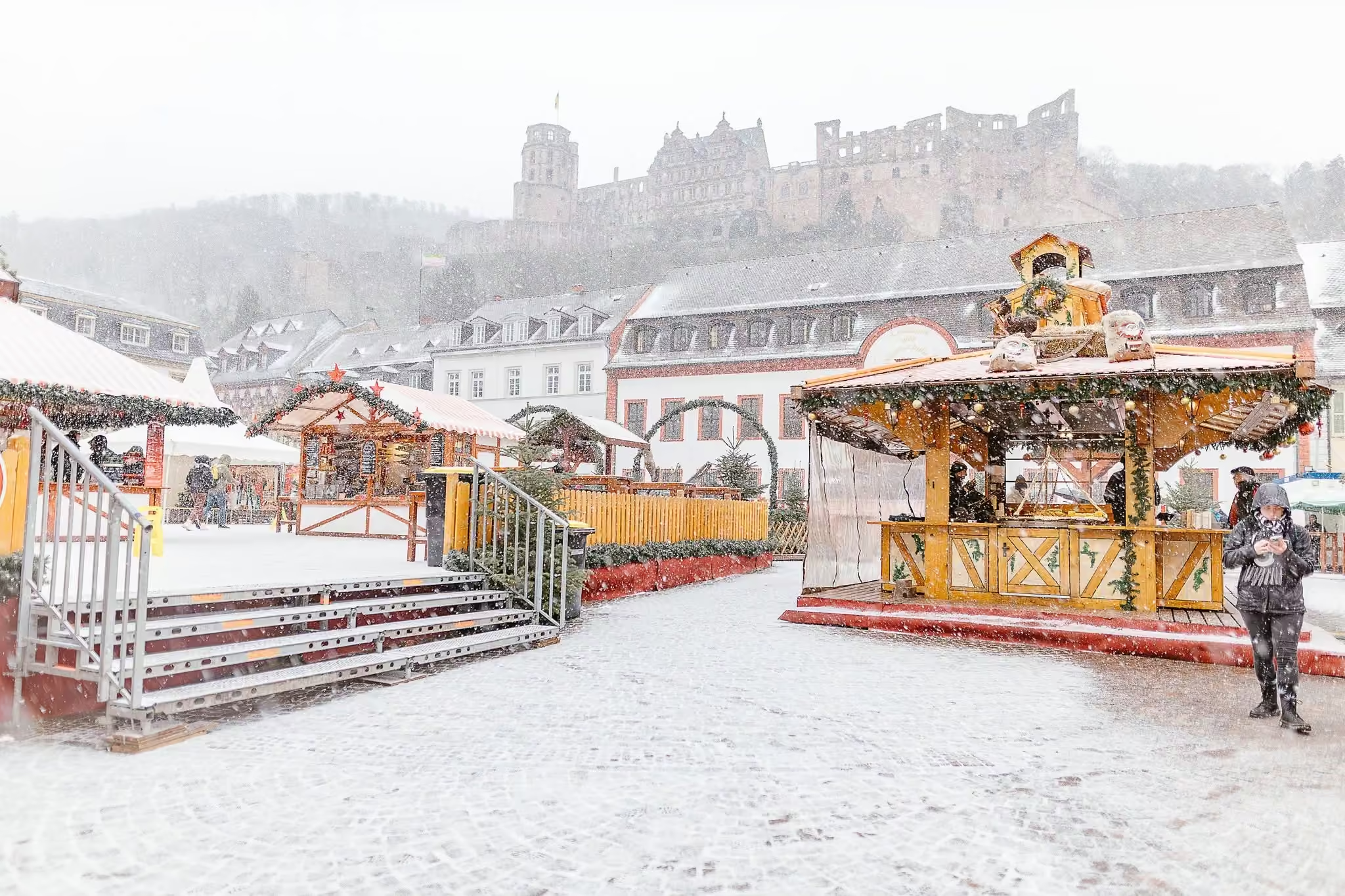
- Heidelberg is about an hour away with a change at Karlsruhe or Mannheim.
- Freiburg is 42 minutes on the direct ICE. Its market is good rather than great, but the old town is lovely, and it sits right at the foot of the Black Forest.
Up in those hills is where the snow is. Our snow odds put snow on the ground on 11% of market days in Baden-Baden, against 60% at the Ravenna Gorge market under its viaduct.
Baden-Baden Over Christmas and New Year
Being here on Christmas Day works well, as long as you plan around the baths, because both baths close on 24 and 25 December.
That makes the 23rd the day for a long soak, and Christmas Day the one for the market and a walk down the Lichtentaler Allee, the park avenue that starts right beside the stalls.
Boxing Day is one of the busiest days of the season at the market, in my experience, and this year it falls on a Saturday. The baths are open again by then, so I’d give the 26th to the baths and come back to the stalls on Monday the 28th.
After that, the week up to Epiphany is when I like Baden-Baden best. Colmar’s main markets close on 29 December, and only its gourmet market and funfair hang on to 3 January. Baden-Baden carries on to 6 January. That’s a treat if, like me, you’re never quite ready for the markets to end.
That week does have one short day. On New Year’s Eve the stalls closed mid-afternoon last season, but the Festspielhaus New Year’s Eve concert starts at 16:00, so you can go straight from one to the other.
New Year’s Day started late at the market last season, which leaves the morning for the baths. Caracalla opens at 10:00 that day.
Is the Baden-Baden Christmas Market Worth It?
Yes, it’s worth it, and the later in the season you go, the better it looks next to its neighbours. Baden-Baden isn’t the biggest or the cheapest German Christmas market, and if you want big-market buzz on a budget, Strasbourg does that louder and for less.
What it gives you instead is an evening done properly, with a winemaker’s Glühwein in your hand as the colonnades light up. And it’s still there on 5 January, after the markets around it have packed up.
It’s what I’d pick for a couple’s weekend, for anyone in the region between Christmas and Epiphany, and as the calm half of a Strasbourg trip.
Just come midweek if you can, and do it the right way round, with the baths first and the market after dark.