The Reiterlesmarkt opens on Friday 20 November 2026 and runs until Wednesday 23 December. It’s open from 11:00 to 19:00 Sunday to Thursday and from 11:00 to 20:00 on Fridays and Saturdays, and entry is free.
The whole market shuts on Sunday 22 November, two days after it opens, because that’s Totensonntag, the Sunday when Protestant Germany remembers its dead.
For years the market opened on the Friday before the first Sunday of Advent, and plenty of people still tell you that. Since 2025 the stalls open a week earlier, so in 2026 trading starts on 20 November, and the old Friday-before-Advent slot is now just the ceremony.
That’s Friday 27 November at 17:00, when the Reiterle rides into the Marktplatz on horseback and the big tree gets switched on.
If you want the show, come that weekend. If you just want the market, the first week has the same stalls and fewer people.
There’s also nothing after the 23rd.
The stalls are gone by Christmas Eve, so think of Rothenburg as an Advent trip.
| Date | What’s on |
| Fri 20 Nov | Stalls open at 11:00, plus the Long Night of Museums and Churches from 18:00 to 22:00 (€10) and late shopping in the old town |
| Sun 22 Nov | Market closed for Totensonntag |
| Fri 27 Nov | The Reiterle opens the market on the Marktplatz at 17:00 and the tree is lit |
| Sun 29 Nov | Shops in the old town open from 13:00 to 18:00 |
| 1 to 23 Dec | A new Advent window lights up on the Rathaus every day at 17:00 |
| Wed 2 Dec | Schoolchildren’s lantern parade at 16:30 |
| Sun 6 Dec | The Nikolaus heritage train runs in from Nuremberg and Fürth (times still provisional) |
| 11 to 23 Dec | Winterglühen, the alternative market in the Burggarten |
| Sat 19 Dec | Bach’s Magnificat in St. Jakob at 17:00 (€18) |
| Every day | The Pelzmärtel does his round at 16:30, and the English Night Watchman tour starts at 20:00 |
| Wed 23 Dec | Last day, stalls close at 19:00 |
| Thu 31 Dec | New Year’s Eve organ concert in St. Jakob at 22:00 (€12) |
December in Rothenburg is cold and mostly grey. The German Weather Service has a station in Rothenburg, and over 1991 to 2020 the average December day reached about 4°C and dropped to around -1°C at night.
The odds of snow are a coin toss, as well. Seven of the last ten Decembers had at least some snow on the ground between late November and the 23rd, four of them for more than a week, but 2024 and 2025 had none at all.
Whatever the sky does, the old town is all cobbles and slopes, so bring boots with a decent grip.
The Ghost Who Opens the Market
The market is named after its mascot, and its mascot started out as a ghost. The Reiterle, the “little rider”, comes from the old stories about the Rauhnächte, the long dark nights around midwinter.
In those stories it was a messenger from another world that flew through the winter sky with the souls of the dead, and people were scared of it.
Somewhere along the way it changed jobs. Today the Reiterle is a friendly figure in a red coat on a real horse, and instead of collecting souls it opens the Christmas market.
Some people link it to the Wild Hunt and the old Germanic god Wotan, who rode across the midwinter sky with an army of the dead.
It’s a nice theory and it fits, but the town itself doesn’t make that claim. The same goes for the market’s age.
Rothenburg says its Christmas market goes back to the 15th century, which would put it among the oldest in Germany, but I couldn’t find a single document that backs it up, so take the “over 500 years” line as the town’s story rather than proven history.
What’s definitely real is the ceremony. On Friday 27 November at 17:00 the Reiterle rides onto the Marktplatz and speaks a greeting to the crowd, the mayor says a few words, and then the big tree in the middle of the square lights up.
It’s short, it’s free and it’s packed, so get there early if you want to see the horse and not the back of someone’s hat.
The Reiterle comes out again on Wednesday 2 December for the schoolchildren’s lantern parade at 16:30, which is the one I’d pick if you’ve got kids with you.
The other local character to look out for is the Pelzmärtel, Franconia’s own gift-bringer, a gruff figure wrapped in fur whose name is usually explained as “Fur Martin”.
He does a round of the market every day at 16:30. The English programme just calls him Santa Claus, which is selling him short.
What the Market Is Really Like
The Reiterlesmarkt is small, and it’s better to know that before you go. There are 61 stalls, spread over the Marktplatz in front of the Rathaus, the short slope of the Grüner Markt and the Kirchplatz in front of St. Jakob, plus a few inside the Lichthof, the inner courtyard of the town hall. You can walk from one end to the other in about three minutes, and you can see every stall, eat a sausage and finish a Glühwein in under an hour.
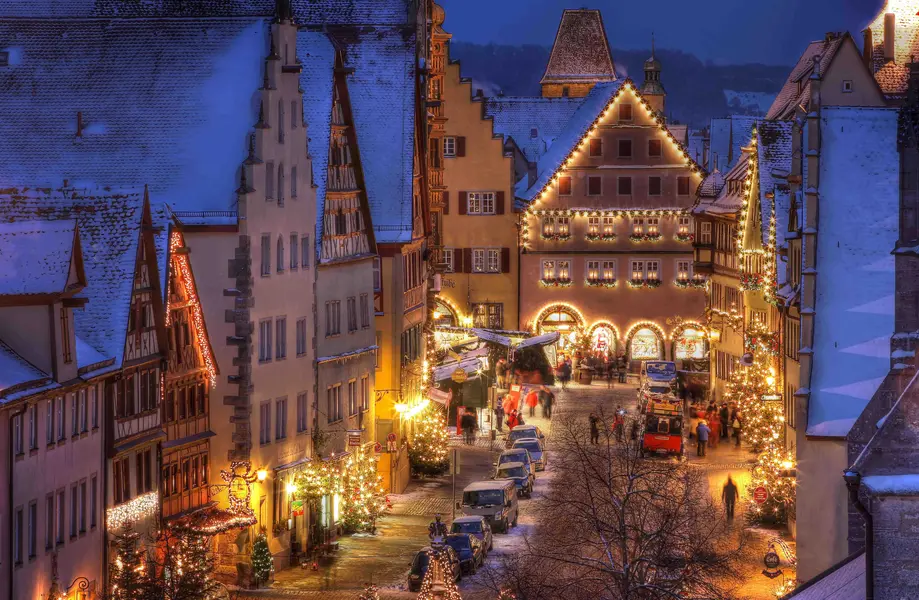
That isn’t really a complaint, it’s just the size of the place, and the setting more than makes up for it. The stalls sit under the Rathaus, which is half Gothic and half Renaissance, with the two spires of St. Jakob at the top end and a carousel for small kids on the Kirchplatz. There’s a nativity scene by the Rathaus, and in 2025 there were more on show in the Lichthof. The stalls lean towards decorations and crafts, with carved wood, nutcrackers, Bunzlau pottery from Poland and glass, and Käthe Wohlfahrt has a stall here as well as its big shop round the corner.
Look up at the Rathaus at 17:00. From 1 December a new window on the second floor lights up every day as a giant Advent calendar, and each one is made by a local school class or youth group. The full 2026 music programme isn’t out yet, but in 2025 a brass band played on the square every day at 17:30 from the first Advent weekend, with an extra set at 14:00 on weekends, and there were Christmas concerts from the town hall balcony on a couple of Sunday mornings. Expect something very similar.
Now the crowds. Rothenburg has about 11,300 residents and gets an estimated 1.9 million day visitors a year, and in December a lot of them arrive by coach. Tour groups roll in from mid-morning, river cruises on the Main send day trips over from Würzburg, and by lunchtime a market this size feels full. The coaches start leaving in the late afternoon, but don’t expect an empty square right away, because that’s exactly when the lights come on and people from the area drive in for an after-work Glühwein. So 16:30 to 19:00 is still busy, then at 19:00 the stalls shut and the town empties out fast.
Saturdays are the worst, and I’d avoid sunny Sundays too. The calmest time is a weekday in the first week, before the Reiterle ceremony, or a wet Tuesday in early December. One more honest note. The cobbles, the slopes and the steps into most shops make this a hard market with a wheelchair or a pushchair, especially when the lanes are packed, so if that’s you, aim for the quiet hours.
Rothenburg by the Clock
This is the order I’d follow for a day and a night.
| Time | What to do |
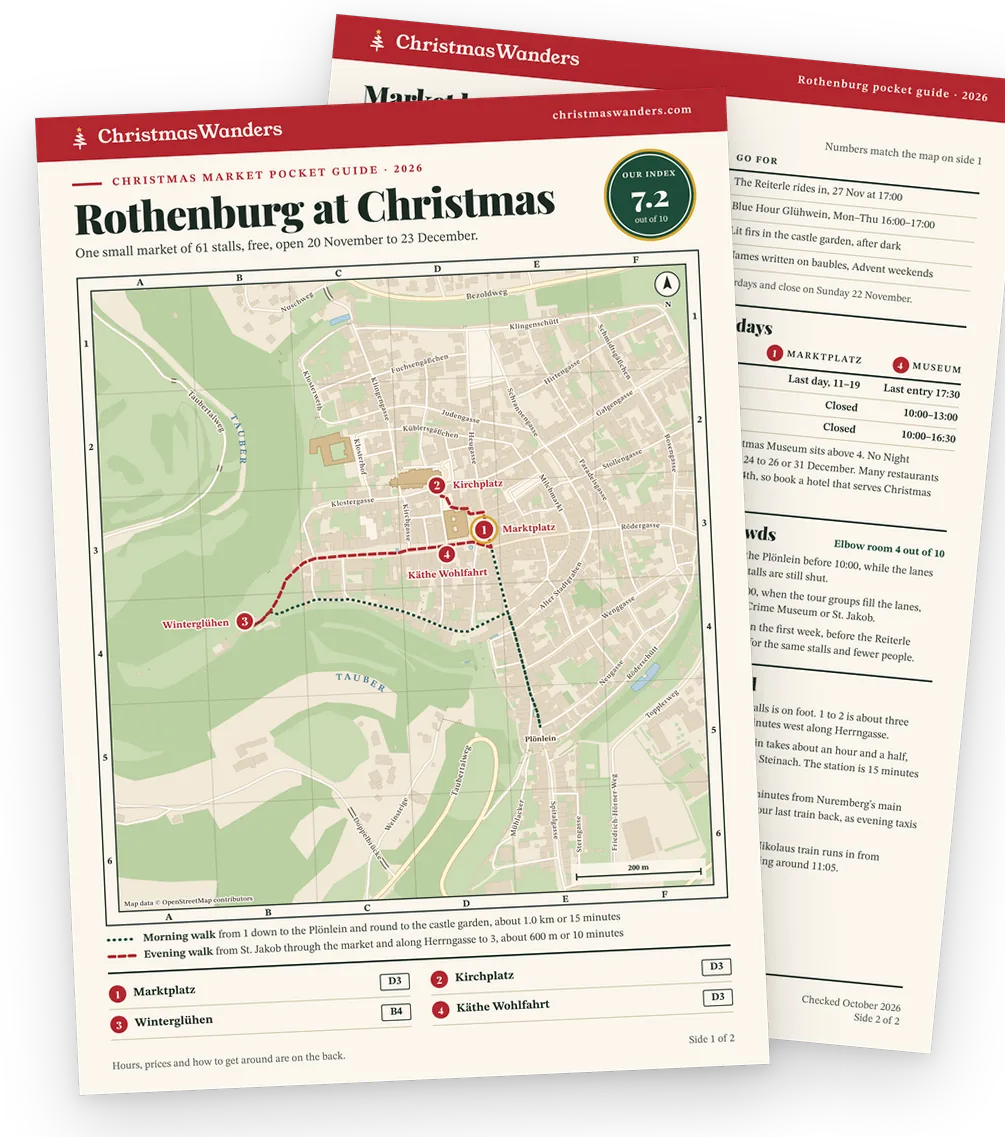
| Before 10:00 | Walk a stretch of the town wall, then the Plönlein and the Burggarten while they’re empty |
| Morning | Käthe Wohlfahrt’s Christmas Village, as soon as it opens |
| 11:00 | The stalls open, so have a first look before the tour groups arrive |
| Midday to 16:00 | Museums and churches while the lanes are at their busiest |
| 16:00 to 17:00 | The coaches start leaving and the lights come on. Climb the Rathaus tower for the view |
| 16:30 | The Pelzmärtel does his round of the market |
| 17:00 | A new Advent window lights up on the Rathaus (from 1 December) |
| 19:00 | Stalls close (20:00 on Fridays and Saturdays), so go to dinner |
| 20:00 | English Night Watchman tour from the Marktplatz |
| After 21:00 | Winterglühen in the Burggarten (11 to 23 December) or a walk through the empty lanes |
The wall is open around the clock and runs for about 4 km around the old town, much of it as a covered walkway with views over the rooftops.
In the early morning you’ll have it nearly to yourself, which is also the best time for the Plönlein, the little fork in the road with the yellow house that’s on every Rothenburg postcard.
The stalls don’t open until 11:00, so the first couple of hours belong to the town.
When the coaches pile in, get indoors.
The Medieval Crime Museum is the one everyone remembers, two buildings full of shame masks, torture devices and old law books, open daily from 11:00 to 16:00 in winter (17:00 on Advent Saturdays) for €10.50.
St. Jakob is open from 10:00 to 17:00 in December (11:00 to 14:00 in November) and costs €5, and the reason to pay is Tilman Riemenschneider’s Holy Blood Altar, a carved limewood masterpiece from around 1500.
Time the Rathaus tower for late afternoon.
It’s 220 steps and a ladder at the top, €4 in cash, and during the market it’s open from 10:30 to 14:00 and 14:30 to 18:00, until 19:00 Friday to Sunday.
Go up around 16:00 and you get the last of the daylight over the red roofs, then the market lighting up below you.
If you’re there Monday to Thursday, the Christmas garden at the Hotel Reichsküchenmeister on the Kirchplatz runs a happy hour on Glühwein and kids’ punch from 16:00 to 17:00, which it calls the Blue Hour.
The early close is the thing to plan around.
At 19:00 the shutters come down and most visitors head for the car or the station, so book dinner for 19:00 and you’ll be done in time for the Night Watchman at 20:00.
After that, Winterglühen is the late option. It’s a small alternative Christmas market in the castle garden, and in recent years it has stayed open until 22:00.
Or just walk. The lanes are lit, nearly empty and very quiet, and that’s when Rothenburg looks its best.
The Night Watchman Changes Hands
If you’ve read anything about Rothenburg, you’ve read about the Night Watchman tour, and most of what you’ve read is really about one man.
Hans Georg Baumgartner, the original Rothenburg Night Watchman with his black cape, lantern and halberd, led the English tour for decades, and his deadpan humour is a big part of why this hour tops so many lists.
He’s retiring, and his last tour is on 31 October 2026, so this is the first Christmas market without him.
The tour carries on. The city says colleagues from the night watchman team are covering the rest of the year, and it’s looking for a new Original Rothenburg Night Watchman to start in April 2027.
So if a blog promises you Baumgartner this December, it’s out of date.
You’ll still get a costumed watchman, a lantern and the town’s history told with plenty of dark jokes, and I’d still go.
The tour works because of where it happens as much as who leads it. You’re walking the dark lanes after the crowds have gone, with someone explaining what life inside these walls was like when the gates shut at night.
The English tour starts at 20:00 every day in front of the Rathaus on the Marktplatz and lasts about an hour.
There’s no booking, you just turn up, and it costs €9 for adults, €4.50 for 12 to 17-year-olds and nothing for under-12s, cash only.
The German tour follows at 21:30 for €8. There’s no tour on 24, 25, 26 or 31 December, but it does run from 27 to 30 December and on 1 to 3 January. Groups can get big, so stand near the front if you want to hear the punchlines.
If your German is good, there are a couple of other evening walks. A ghost and crime tour led by the town’s “executioner” leaves from the arcades on the Marktplatz at 18:00 every day until 19 December (€12, cash), and a Christmas walk called Von Reiterle und Christbaam runs Friday to Sunday on the four Advent weekends.
White Glühwein and the Half-Metre Sausage
The drink to order here is white Glühwein.
Franconia is white wine country, so the regional mulled wine is made with white, and it comes out lighter and fruitier than the red you get everywhere else.
For the most local cup on the square, look for the winemaker’s Glühwein from Weingut Glocke, a Rothenburg winery whose An der Eich vineyard sits right below the town wall and is the southernmost point of the whole Franconian wine region.
For a market this size, the hot drinks list is long. There’s quince Glühwein, hot mead, hot champagne, hot gin and a Feuerzangenbowle, the one where a rum-soaked sugar cone is set on fire over a pot of mulled wine, poured by a local club that calls itself the Franken Knights.
The mug is worth keeping this year. The 2026 design is a watercolour by local painter Alfons Berse of the Marktplatz during the market, with the tree, the outlines of the stalls and the Rathaus behind, and they’ve made 38,000 of them.
If you don’t want it, hand it back at a stall and you get your deposit back.
The food is where Rothenburg feels small. You won’t find the endless rows of food stalls you get in Nuremberg, but what’s here is good, and the half-metre bratwurst is the thing people remember.
]One stall does it alongside Käsespätzle, the local Lutheran deanery runs a stall with Franconian bratwurst and a vegan version, and the town’s shooting club, the Schützengilde 1374, grills steaks and bratwurst.
Around those you’ll find Obatzter, a soft Bavarian cheese spread with butter and paprika, plus Leberkäse, lángos, chimney cakes, roasted chestnuts, candied almonds, and Lebkuchen and Stollen from a bakery stall.
For a proper sit-down meal, order Schäufele, the Franconian Sunday roast.
It’s a pork shoulder roasted until the skin turns to crackling, named after the shovel-shaped bone, and served with a potato dumpling and red cabbage or sauerkraut.
Have it with a beer from Landwehr-Bräu, which has been brewing in the village of Reichelshofen just outside town since 1755.
Should You Eat a Schneeball?
You’ll see Schneeballen, snowballs, in every bakery window in town.
They’re strips of shortcrust pastry gathered into a ball about the size of a fist, fried, then dusted with icing sugar or dipped in chocolate.
People in this corner of Franconia have been making them for centuries, originally as a treat for weddings and village fairs, and they look fantastic in a window display.
The reality, however, is that a lot of people find them dry. They’re crunchy and not very sweet, they shatter when you bite in so you end up wearing the sugar, and a stale one is basically sugared cardboard.
The way to enjoy one is to buy it fresh from a proper bakery, stick to the plain icing-sugar original or try a filled one, and share it, because one is plenty for two.
Break it into pieces inside the bag rather than biting it, and have it in the afternoon, which is when the town’s own tourist site says they’re best.
Diller’s Schneeballen café on Obere Schmiedgasse is the specialist, open every day from 9:00 to 20:00 with more than 20 flavours, and its plain original costs €2.50 in the online shop.
Diller has a stall at the market as well, and there’s a second Schneeballen stall too. They keep for around eight weeks, so even if you don’t fall for them, a box makes a good present for someone back home who’s never heard of them.
Käthe Wohlfahrt and the Christmas Museum
Rothenburg’s other Christmas market is open all year.
Käthe Wohlfahrt’s Christmas Village on Herrngasse, a couple of minutes from the Marktplatz, opened in 1981 and packs more than 1,000 square metres with glass baubles, nutcrackers, smoking men, music boxes and wooden pyramids, with a 5.7-metre white tree hung with 1,900 ornaments in the middle.
The company says it gets more than a million visitors a year, and in December it can feel like they’re all inside at once.
Go as early in the day as you can, because the queues build by midday, especially at weekends.
Photos inside are usually not allowed, so check the signs and get your picture with the red Käthe Wohlfahrt truck parked outside, which has been a favourite photo spot since 1994.
The hand-painted glass and the big carved pieces are expensive, but the smaller ornaments are fair for the quality. If you’re flying home with glass, keep it in your hand luggage wrapped in a jumper.
On Advent weekends (27 to 29 November, 4 to 6, 11 to 13 and 18 to 20 December) the calligrapher Gosbert Stark sits in the shop from 11:00 writing names onto ornaments, and a personalised bauble makes a better souvenir than anything off the shelf.
Don’t panic-buy the rest, though. Much of the range is sold in Käthe Wohlfahrt’s other shops, including one on Stonegate in York.
What you won’t find anywhere else is the German Christmas Museum upstairs.
It’s a proper small museum on how Germany decorated for Christmas, from early tree ornaments and Advent calendars to old Father Christmas figures, and it costs €5 for adults, €2 for children aged 6 to 11 and €11 for a family.
During Advent you can get in until 17:30 Monday to Thursday, 18:00 on Fridays and Saturdays and 17:00 on Sundays, and it shuts half an hour after last entry.
It’s also open on Christmas Eve from 10:00 to 13:00 and on 25 and 26 December from 10:00 to 16:30, which makes it one of the few Christmas things left to do once the market has gone. It isn’t accessible for wheelchairs.
Is Rothenburg Real?
You’ll hear Rothenburg called a theme park, a Bavarian Disneyland or an open-air museum.
Germans especially love saying it, and with the tour groups and a Christmas shop round every corner, I understand why. But the town is real, and the story of how it got through the war is one of the better reasons to visit.
On 31 March 1945 an air raid hit the eastern part of the old town, killed nearly 40 people and destroyed around 300 houses, along with several hundred metres of the wall.
A few weeks later, with American troops closing in, the US Assistant Secretary of War John McCloy, who knew how important the town was, told the army not to use artillery on it, and the German commander agreed to pull out without a fight.
Donations from around the world helped pay for the rebuilding, and if you walk the wall you’ll see stone plaques carved with donors’ names along the walkway.
Some go back to the years after the war, and people still sponsor new ones today.
So yes, part of what you’re looking at is a rebuild, but it’s a rebuild of a real place by the people who live there, and that’s not the same as a theme park.
The Disney connection is real too, just backwards. When Disney made Pinocchio in 1940, the artist Gustaf Tenggren based Geppetto’s village on photos of Rothenburg, and the town says the Plönlein in particular has been copied ever since. So the town didn’t copy Disney, Disney copied the town.
And Harry Potter? Sort of. A film crew shot aerial footage over Rothenburg for Harry Potter and the Deathly Hallows, but none of it made the final cut. You won’t find the town in the films.
Day Trip or a Night?
Rothenburg isn’t on a main line.
The station sits at the end of a short branch line, so from Nuremberg you change twice, at Ansbach and then Steinach, and the trip takes roughly an hour and a half.
Some of the Steinach connections are only a few minutes, so a late first train can cost you an hour. From Munich or Frankfurt it’s around three hours, and the station is a 15-minute walk from the Marktplatz.
There’s an extra catch this year.
In October 2026 the local paper reported that trains on the last stretch from Steinach were running far slower than normal because of heat damage to the track, and the mayor wants talks with Deutsche Bahn.
Check your journey in the DB app close to the date. If you like trains, there’s a nicer way in on Sunday 6 December, when a heritage Nikolaus train runs from Fürth and Nuremberg, arriving around 11:05 and heading back around 15:25.
The steam engine is being overhauled, so this year it’s pulled by an old diesel.
A day trip from Nuremberg works, but it pushes you into the busiest hours and pulls you out just as the town gets good.
If you stay for the lights, check your last train before you order another Glühwein, because evening taxis are hard to find.
That’s why I’d stay the night. You get the empty lanes after 19:00, the Night Watchman at 20:00 and the wall to yourself the next morning before the first coach arrives.
Rooms inside the walls go fast for December weekends, so book early, or come midweek when it’s easier to find a bed and the market is calmer anyway.
If you’re planning to spend Christmas itself here, know what you’re getting.
The market is gone by the 24th, a lot of restaurants close or shut early on Christmas Eve, and much of the town is quiet until the 27th, so book a hotel that serves a Christmas Eve dinner.
The Christmas Museum opens on the morning of the 24th and for most of the day on the 25th and 26th, the Crime Museum opens on Christmas Eve morning, and the Night Watchman is back out on 27 December.
On New Year’s Eve there’s an organ concert in St. Jakob at 22:00, and in 2025 the town also threw a party on the Marktplatz from 20:00.
Rothenburg or Nuremberg?
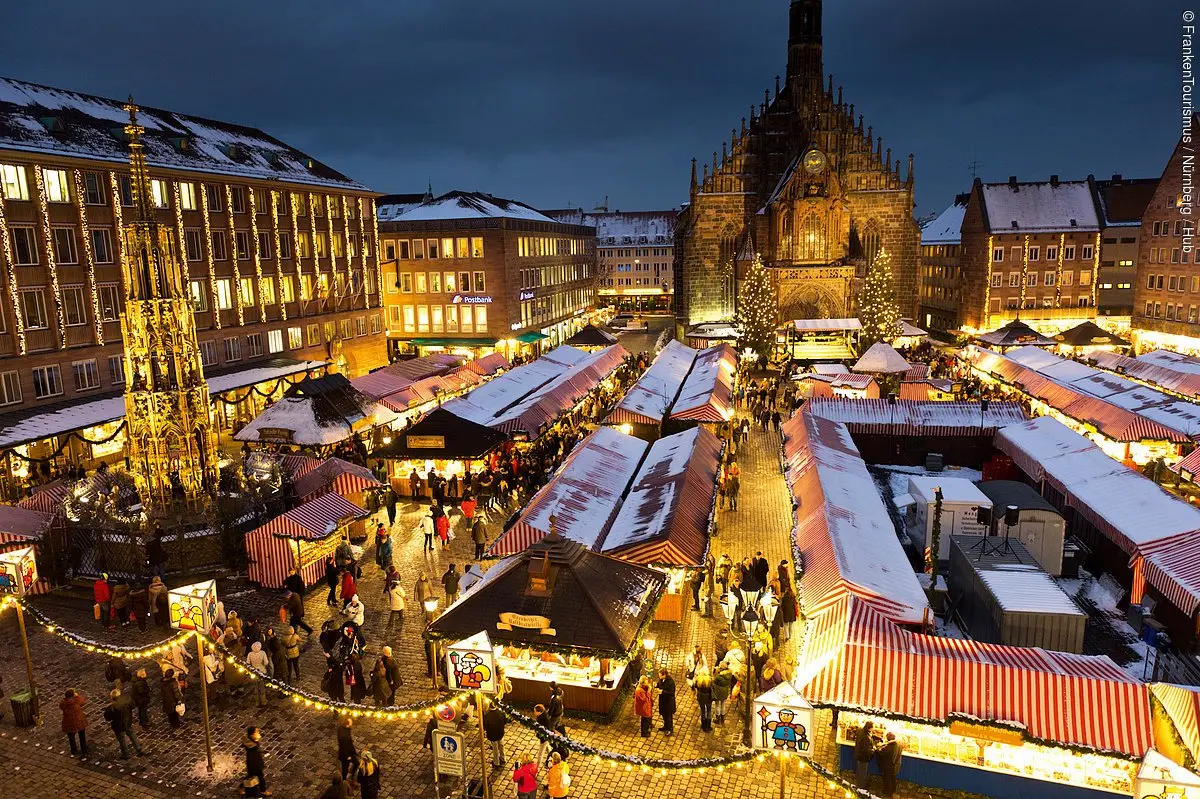
If the market itself is the main reason for your trip, Rothenburg isn’t the strongest one in the area. The Nuremberg Christmas market is the big Franconian classic, with around 170 stalls, most of them on the Hauptmarkt under the Frauenkirche, and it’s an hour and a half away.
Regensburg gives you several markets in a real medieval city on a main rail line, including a romantic one in the grounds of the Thurn und Taxis palace.
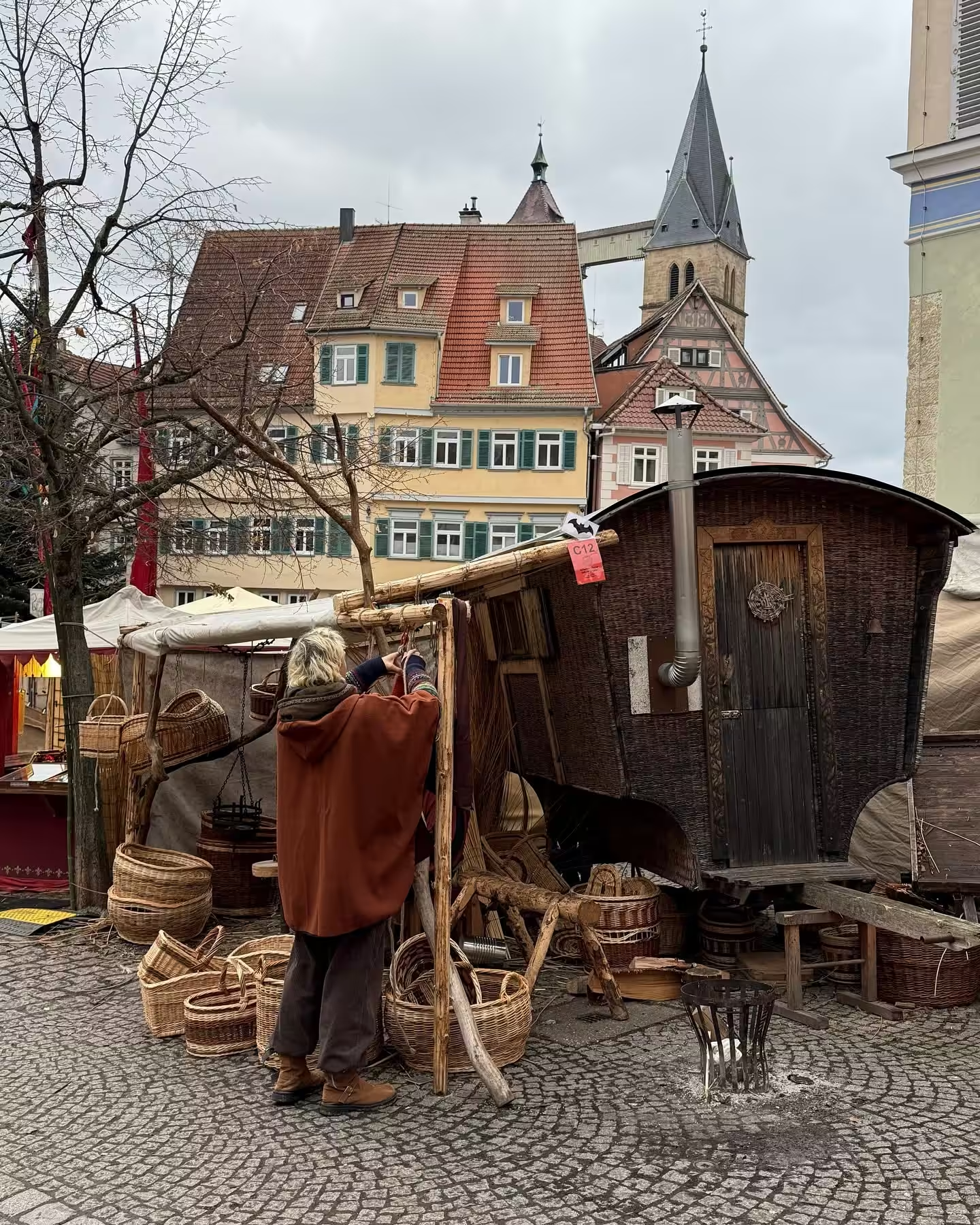
And if it’s the medieval look you’re after, the market in Esslingen near Stuttgart has costumed craftspeople working in front of you.
Where Rothenburg wins is the setting.
Nowhere else around here gives you a complete walled town where every lane feels like part of the market, and nowhere is better after dark once the crowds have gone.
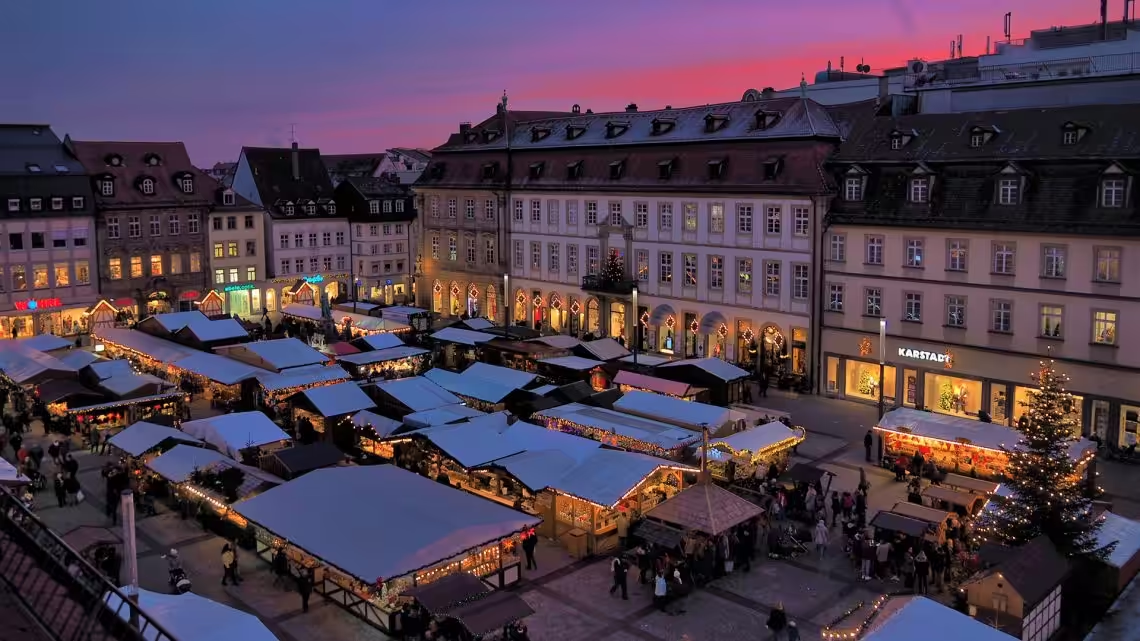
Bamberg is the closest match, a modest market in a beautiful old town, but Bamberg is a lively university city with smoked beer and students, while Rothenburg is a tiny place that goes silent at night. Pick Bamberg for the pubs and Rothenburg for the walls.
The Bavaria trip I’d plan is to base yourself in Nuremberg for the big market, then take the train out and give Rothenburg one night. If you’re driving the Romantic Road, Dinkelsbühl, about 40 minutes south, is a quieter walled town with its own small Christmas market, but it has no regular train service.
So, Is the Rothenburg Christmas Market Worth It?
The market on its own is small, a little samey and closed by 19:00, and if you’ve only got one day for German Christmas markets, spend it in Nuremberg. Rothenburg at Christmas is a different kind of trip.
It’s a whole walled town lit up for Advent, and the market is just the part of it that sells Glühwein.
It’s worth it if you’ve always wanted to see the Christmas-card version of Germany, if you love decorations, or if you can stay the night.
It’s not worth a long day trip just for the stalls, and it’s not for you if a Saturday crowd ruins your day.
Go midweek, walk the wall before 10:00, hide in the Crime Museum at lunch and climb the Rathaus tower at 16:00. Drink a white Glühwein when the lights come on, eat at 19:00 and follow the Night Watchman at 20:00.
And if you pick up a box of Schneeballen on the way out, give them to someone else.