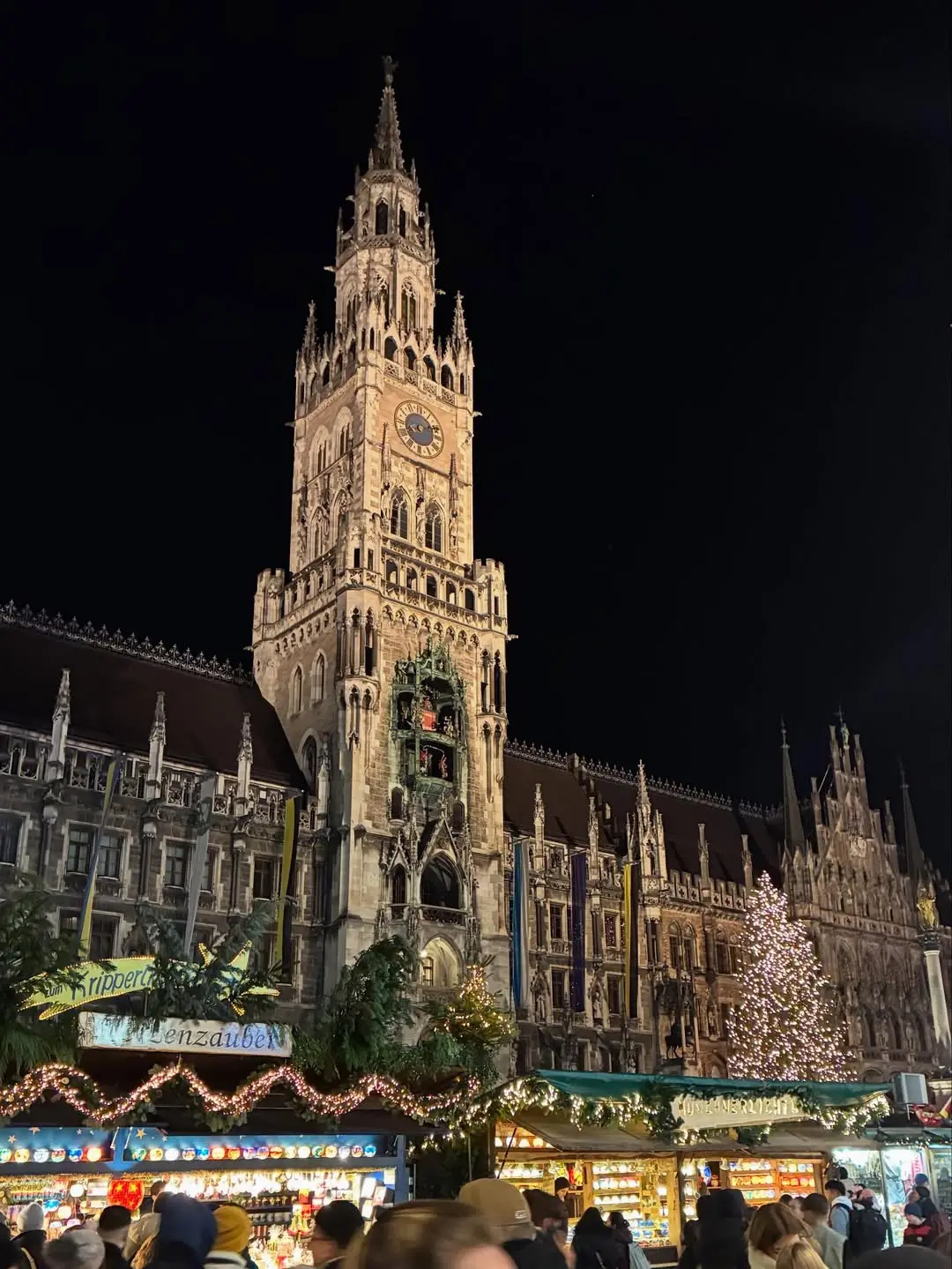
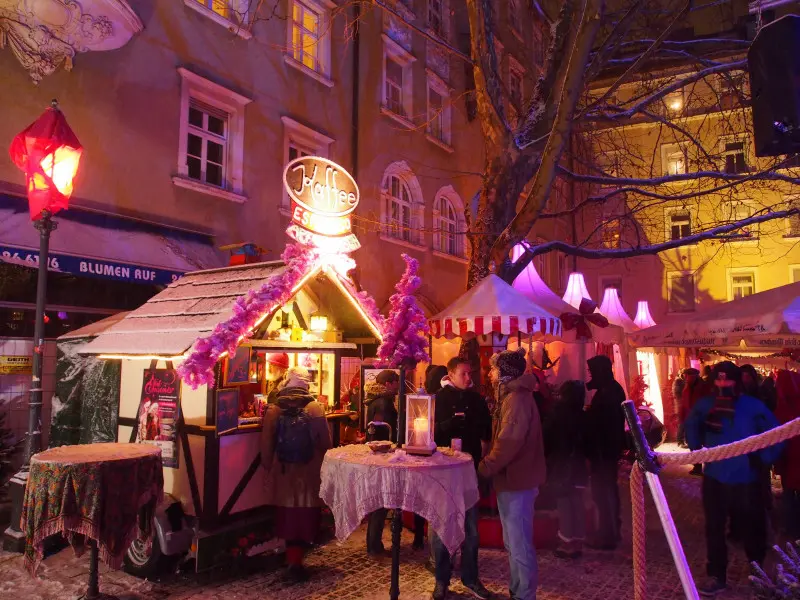
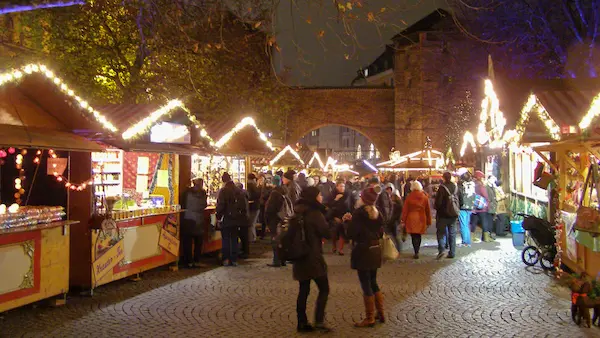
The Munich Christkindlmarkt (German: Münchner Christkindlmarkt) is the Christmas market that fills Marienplatz and the streets around the Neues Rathaus.
And the first thing to understand about Munich is that it has more than 20 Christmas markets, but most visitors only happens to see one or two, which is a huge shame (and something I am setting out to correct with this guide).
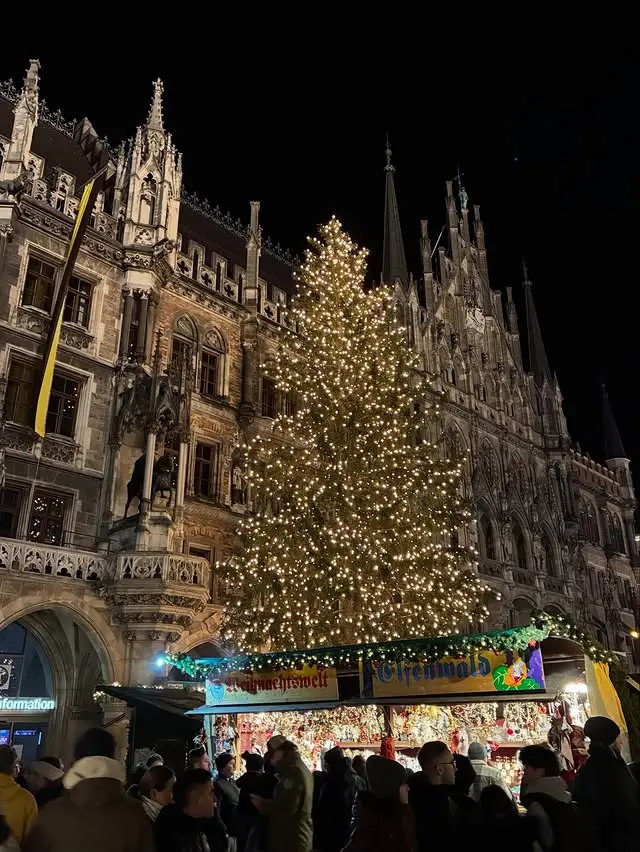
The Marienplatz Christkindlmarkt is the obvious postcard market you shouldn’t miss, with the 25-metre tree, the golden angels of the Himmelswerkstatt, the brass from the town hall balcony at 17:15… and it’s worth your time, for sure.
But the Munich that locals actually visit is in a different set of squares entirely, and the best thing you can do here is to try and split your day, by visiting the centre for the spectacle during the earlier parts of the day and leave all the neighbourhoods for the evening (and I’ll explain why this way).
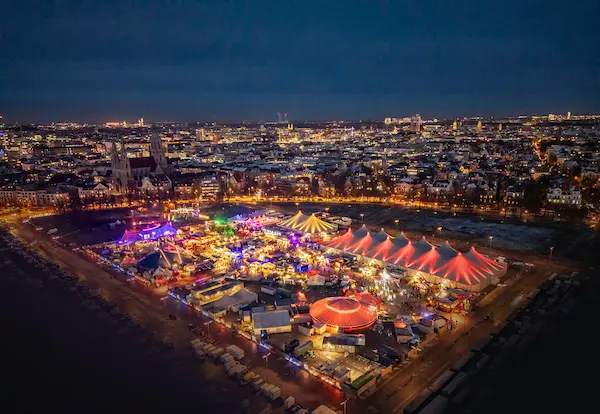
And If I had to place Munich against its German rivals in one line: Nuremberg is the template Christmas market, Cologne things really well at scale, Dresden is the oldest and with the richest history… and Munich is the one where the centre is the whole show, but all the satellites are the ones holding the reward. Roughly 3.2 million people visit Munich Christmas market each season, so that should tell you a whole lot of how good Munich is as a Christmas destination.
A quick history of the Christkindlmarkt
Munich’s Christmas market traces to the Nikolausmärkte of the 14th century, but the first hard document is a Nikolaidult in 1642, held on Kaufingerstraße by the Schöner Turm and open only to Munich merchants.
It moved to Promenadeplatz in 1803, was renamed from Nikolaimarkt to Christmarkt in 1806 (the Enlightenment shift from St. Nicholas to the Christkind as gift-bringer), and finally settled at Marienplatz in 1972, where it has stayed.
The detail I love the most is the Christmas tree. Since 1977, the Marienplatz Christmas tree has been donated every year by a different town, from Bavaria, Austria, or South Tyrol, and the donor town runs a glühwein stand in the Rathaus courtyard (the Prunkhof) as reciprocal promotion.
There’s also a multi-year waiting list of towns wanting to donate the Christmas tree and the 2025 tree came from Ellmau in the Tirol, a 75-year-old spruce pulled from near the Wochenbrunner Alm at 1,085 metres, dressed in 3,975 LEDs across 265 light chains (absolutely magical).
If you can swing opening night at 20 November 2026, when the Oberbürgermeister and the donor-town mayor count down and the tree lights at around 17:00, you certainly won’t regret it.
The Marienplatz spectacle (and why it’s worth doing once)
The main market is the one with the tree, the brass, and the kids in angel costumes.
It runs 137 stalls across Marienplatz and the lanes around it, including Weinstraße, Rosenstraße, Sendlinger Straße, Rindermarkt, and it’s the part every other Christmas market Munich guide will send you to. Fair enough. You should do it.
But you should know that two things make this more than a generic German square of stalls.
The first is the Adventsmusik which is live brass and choirs from the Rathausbalkon, Sunday to Thursday at 17:15, free, with the closing note sounded by the Grünwalder Turmbläser at noon on Christmas Eve.
The second is the Himmelswerkstatt (Heavenly Workshop), running since 1994 with kids 6–12 dressed as angels with golden wings that make Christmas crafts upstairs in the Ratstrinkstube. It’s completely free, it serves more than 1,000 kids a season, and you register at kindermuseum-muenchen.de, if you want to go. If you’re travelling with children, this is the Munich market memory I’d definitely recommend.
The Christkindltram is the third. Since 1994, a festively decorated MVG tram has run a 30-minute glühwein-and-lebkuchen circuit from Sendlinger Tor through the centre: €5 for adults, €3 for kids 6–14, free under 6, weekends from 28 November to 21 December. It’s the only market in Munich that is also a tour, and if your feet are giving out, it’s the laziest possible way to see the lights.
The medieval market (and the themed-market tax)
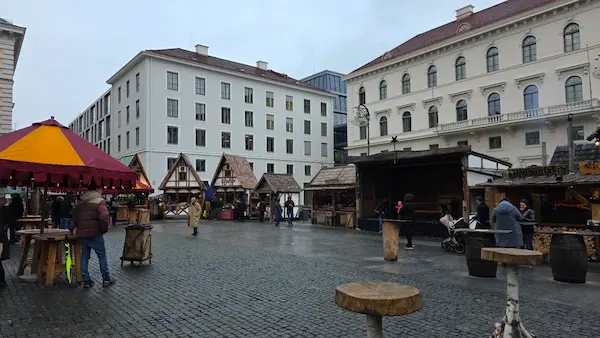
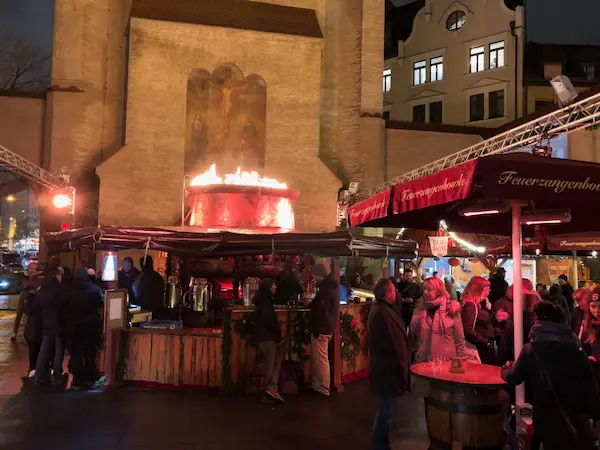
Three minutes’ walk north of Marienplatz, Wittelsbacherplatz turns into the Mittelaltermarkt, the medieval market, with costumed vendors, mead, and the Feuerzangenbowle. If Marienplatz is the family-friendly postcard, this is the one that earns its Instagram title.
The Feuerzangenbowle is the draw: a rum-soaked sugar cone set alight and dripped, caramel and all, into the mulled wine below. It’s the most theatrical drink at any German market I’ve come across, and Wittelsbacherplatz is where Munich serves it best.
But the medieval market also carries what I’d call the themed-market tax. In 2022 the Bratwurstsemmel here was €7.50 against €5 for an organic sausage at Marienplatz, the glühwein was €6 plus a €5 Pfand, the candied almonds were priced per 100g. The themed atmosphere is real and worth paying for sure… but only once. Don’t make this the market you eat at all evening, if you are on a budget.
When to go (and how to beat the crowds)
3.2 million visitors in roughly 31 days is a lot of people in a small Altstadt. Here’s how I’d play it.
- Go on a weekday. Tuesday through Thursday is noticeably calmer than the weekend. The difference is the single biggest lever on how much you enjoy the centre.
- Go early or go late. The market opens at 10:00 and runs to 21:00 (20:00 Sundays). The sweet spots are right after opening because stalls are quiet and you can actually see the ornaments, and after 20:00 on a weeknight, when the dinner rush thins and the lights are at their best.
- Avoid Saturday afternoon like the plague. This is when the tour buses unload. If Saturday is your only option, go at 10:00 or after 20:30.
- The two Shopping Nights (28 November and 13 December 2026) keep stalls open to 22:00.
- Opening night (20 November) is busy but worth it for the tree-lighting countdown. The Krampuslauf (13 December, 15:00–17:00) is the busiest afternoon of the season. 25 groups, 400 participants, 70,000 onlookers, on the route Augustinerstraße → Färbergraben → Rosental → past Viktualienmarkt → Altes Rathaus. Go if you want it but avoid the centre entirely if you don’t.
- The last two days (23–24 December) are definitely quieter. By Christmas Eve, most tourist traffic has moved on.
My pick is a Thursday in early-to-mid December where you arrive mid-afternoon and stay through the evening switch-on. That’s the Marienplatz Christkindlmarkt at its best.
The neighbourhood markets (the actual play, in my opinion)
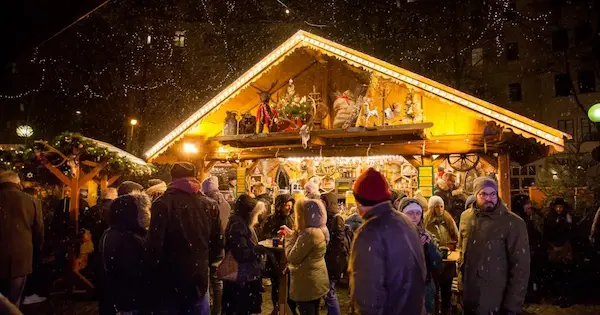
Munich locals don’t drink glühwein at Marienplatz. They pre-game at home with supermarket glühwein (Netto, for the record) and then go to the markets for the atmosphere, standing in the cold with friends and not buying the €6 cup. And when they do buy, they go to the neighbourhood squares, where the same glühwein is half the price.
The named ones, repeatedly recommended by people who live there:
- Weißenburger Platz (Haidhausen, near Ostbahnhof) – not too crowded, nice and cozy, with a special beer for the non-glühwein drinkers.
- Kaiser-Ludwig-Platz (Au-Haidhausen) – cozy, less crowded, the local evening.
- Sendling: Harras and Luise-Kiesselbach-Platz – nothing particularly special, except close by and not nearly as crowded as the central ones. Very friendly feel. Perfect for a mug of glühwein and a bratwurst after work.
- Glühwein-Festival at Cosimabad, Bogenhausen – small, accessible (no cobblestones, lots of seating), huge drink variety, runs later than the main markets (to ~30 December in most years).
The suburb-to-centre glühwein gap is roughly 100%. €3.90 at an S-Bahn-suburb market against €6–7 at the central squares.
A 15-minute S-Bahn ride roughly halves the drink price.
The one cheap outpost in the centre I found is the glühwein stall right next to the Schrannenhalle (the old grain hall by Viktualienmarkt, steps from Marienplatz) that sold glühwein for €4 in 2022, run by a friendly rocker type.
What to eat & drink (beyond the obvious)
This is the part I’d build your visit around. Munich takes its market food seriously, and the variety is wider than the central stalls make it look.
- Flammlachs at Rindermarkt. Flame-grilled salmon with potatoes. The Rindermarkt specialty, and the thing to eat when you’ve had enough bratwurst.
- Feuerzangenbowle at Wittelsbacherplatz. The burning sugar cone, dripped caramel and all into the mulled wine below. The medieval market’s signature.
- Spätzlekäse mit Rotweiblen at Marienplatz. Spaetzle with melted cheese and red onions, €6, at the stall in front of Rischart’s. The carb-and-cheese reward for a cold evening.
- Drei im Weckla. Three Nürnberger sausages in a bun. Yes, the same legally-protected Nuremberg sausage you’ll find at the source an hour down the train. Cheaper in Nuremberg, but perfectly good here.
- Gebrannte Mandeln. Candied almonds, the market’s default snack. Priced per 100g at the central markets. You need to name the portion you want before the vendor bags a double. This is Munich’s version of the per-100g pricing trap, and it catches people every time.
- White glühwein (Weißer Glühwein). Made from white wine rather than red. Look for it around the Frauenkirche area and at Schwabing. A genuine alternative if you’re sick of the red version.
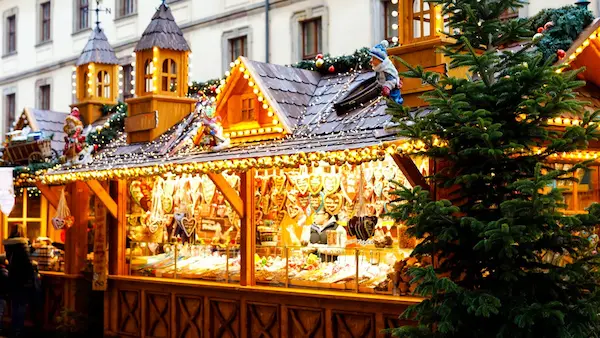
- Lebkuchenherzen. Gingerbread hearts with written icing. Munich isn’t Nuremberg so no protected-origin gingerbread here, but the hearts make the cheap, photographable souvenir.
What to buy (and what to skip)
The Kripperlmarkt at Alter Peter is the one genuinely craft corner of the Munich markets.
First documented in 1757, ten stalls selling exclusively nativity figures with wood carvings from Oberammergau and South Tyrol, and Marolin papier-mâché from Thuringia, Erzgebirge miniatures. If you want a real German-made ornament, this is where you get it. The main Marienplatz stalls have a higher share of imported goods than the brochures imply.
Plauen lace, wool socks, fur hats, pottery, oil paintings with Munich motifs, baking forms are all good options as well.
The craft is definitely real at the proper stalls and tourist tat at the others, and you have to be aware of that.
How to get to Munich
Munich is the easiest German city to fly into and the easiest to rail into.
- By air: Munich Airport (MUC) is 28.5 km north-east of the city, second-busiest in Germany. S-Bahn S1 and S8 run to Marienplatz every 20 minutes.
- By train: Munich Hauptbahnhof is a major ICE hub. Direct ICE from Nuremberg (~1 hr), Frankfurt (~3.5 hr), Berlin (~4.5 hr), and Vienna (~4 hr). Salzburg is ~1.5–2 hr by ICE. The Hauptbahnhof is two U-Bahn stops from Marienplatz (U3/U6).
- By car: possible but not recommended for the centre. No parking at Marienplatz. Use a Park + Ride on the city edge.
Getting around Munich
- U-Bahn and S-Bahn cover everything. U3 and U6 stop at Marienplatz. S1–S8 all stop at Marienplatz or Karlsplatz.
- Tram 19 runs to Theatinerstraße, near Odeonsplatz and the medieval market.
- The Christkindltram doubles as a tour if you want to see the lights without walking.
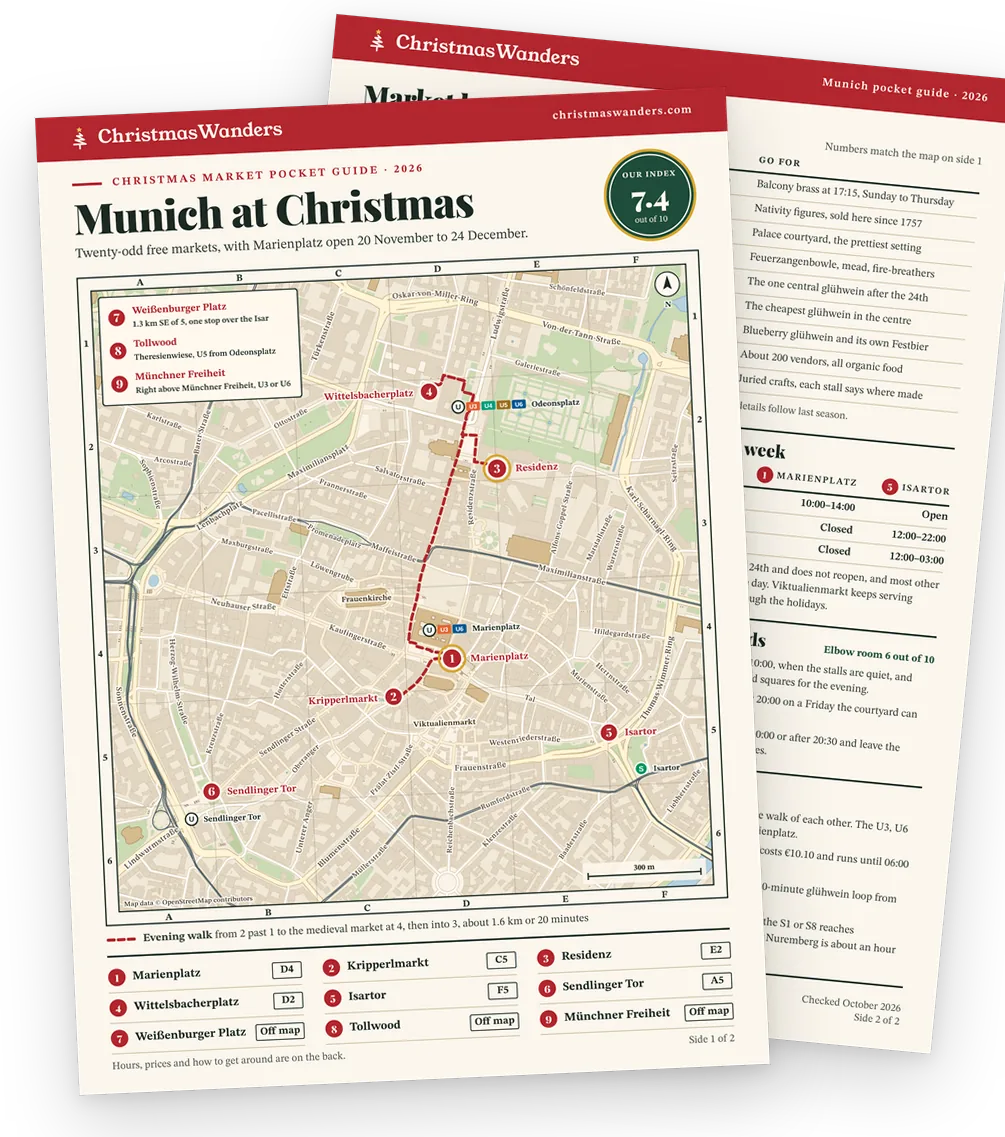
- Walking is how you’ll experience the centre with Marienplatz, Wittelsbacherplatz, the Residenz market, Rindermarkt, and Alter Peter being all within a 10-minute walk of each other. The neighbourhood squares need transit.
Where to stay for the Christmas market
Location matters more than luxury here because you want to walk home after the market without a long cold transit ride.
- Altstadt-Lehel: the most central, walking distance to Marienplatz and every central market. The most expensive option in December, but the one that lets you walk home.
- Schwabing: the historic bohemian quarter, a short U-Bahn ride from the centre. More atmosphere per euro than the old town, and Münchner Freiheit has its own small market.
- Near Hauptbahnhof: convenient for train arrivals and better value. A 10-minute walk to Marienplatz. Skip the very cheapest blocks immediately south of the station.
Keep in mind that you should book early. December weekends sell out, and the good-value places go first. Compare Munich hotels on Booking.com, and check flights on KAYAK to lock in the whole trip before prices climb.
A perfect evening at the Munich markets
If you only have one evening, here’s the flow I’d build your night around:
- Arrive around 16:00, before it’s fully dark, to actually see the stalls and ornaments while the crowds are still manageable.
- Walk the Marienplatz loop. See the tree. Hear the brass from the balcony at 17:15.
- Walk up to Wittelsbacherplatz for the medieval market and a Feuerzangenbowle. Budget for it.
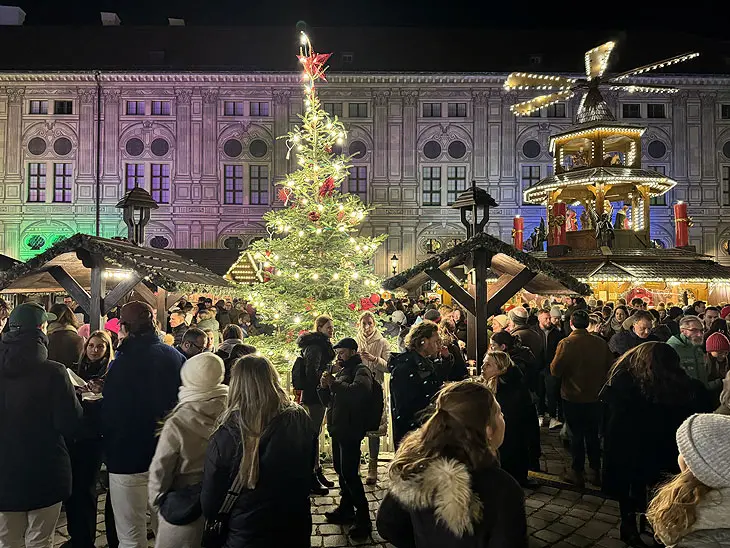
- Drop into the Residenz market on the way back, the cozy one, less crowded.
- Eat Flammlachs at Rindermarkt.
- End with the Christkindltram if your feet are giving out.
That’s a complete Munich evening in about four hours, and it’s the centre-and-satellite split compressed into one night.
If you have a second evening, take the S-Bahn to Weißenburger Platz or Kaiser-Ludwig-Platz. Half the glühwein price, the actual local evening, and the part of Munich most visitors never see.
Day trips from Munich
Munich is the best rail base in Bavaria, and the markets you can pair it with are the reason to build a longer trip.
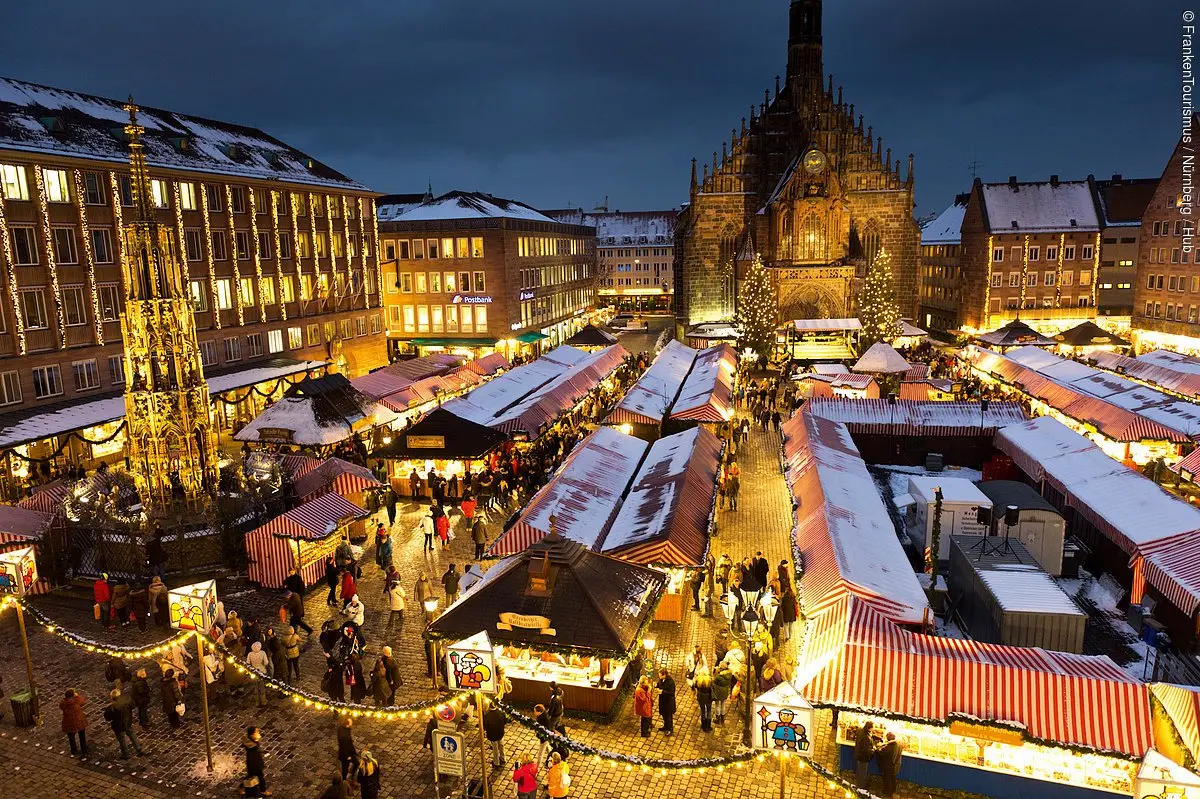
- Nuremberg (~1 hr by ICE). The template German market with red-and-white striped stalls, the Christkind’s balcony prologue, the 9,000-litre Feuerzangenbowle. The natural pairing and the one I’d do first.
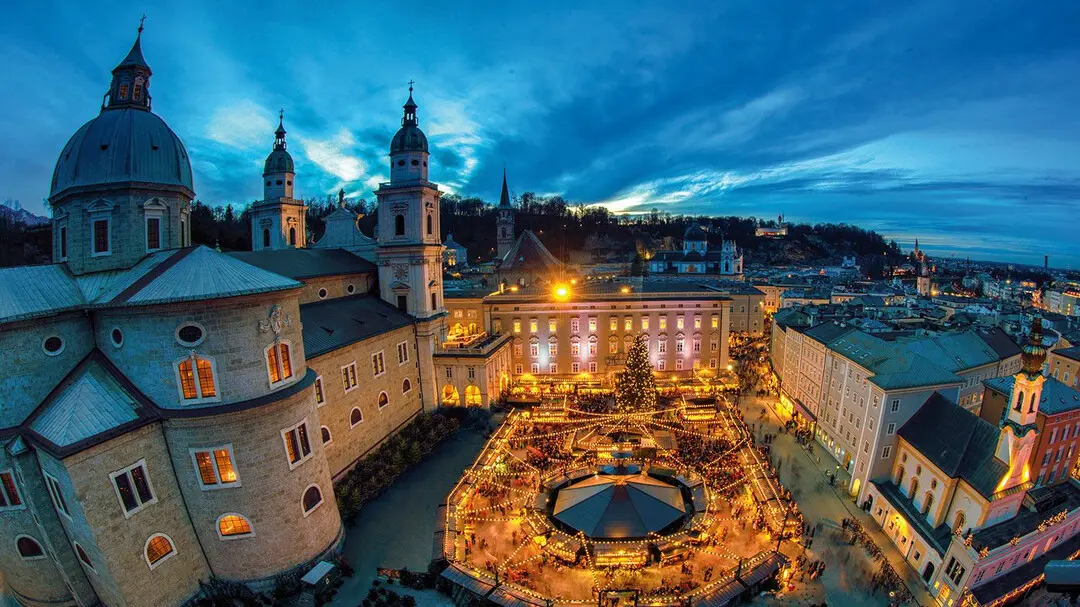
- Salzburg (~1.5–2 hr by ICE). Across the Austrian border. Cathedral choirs, fortress stars, Mozart’s birthplace.
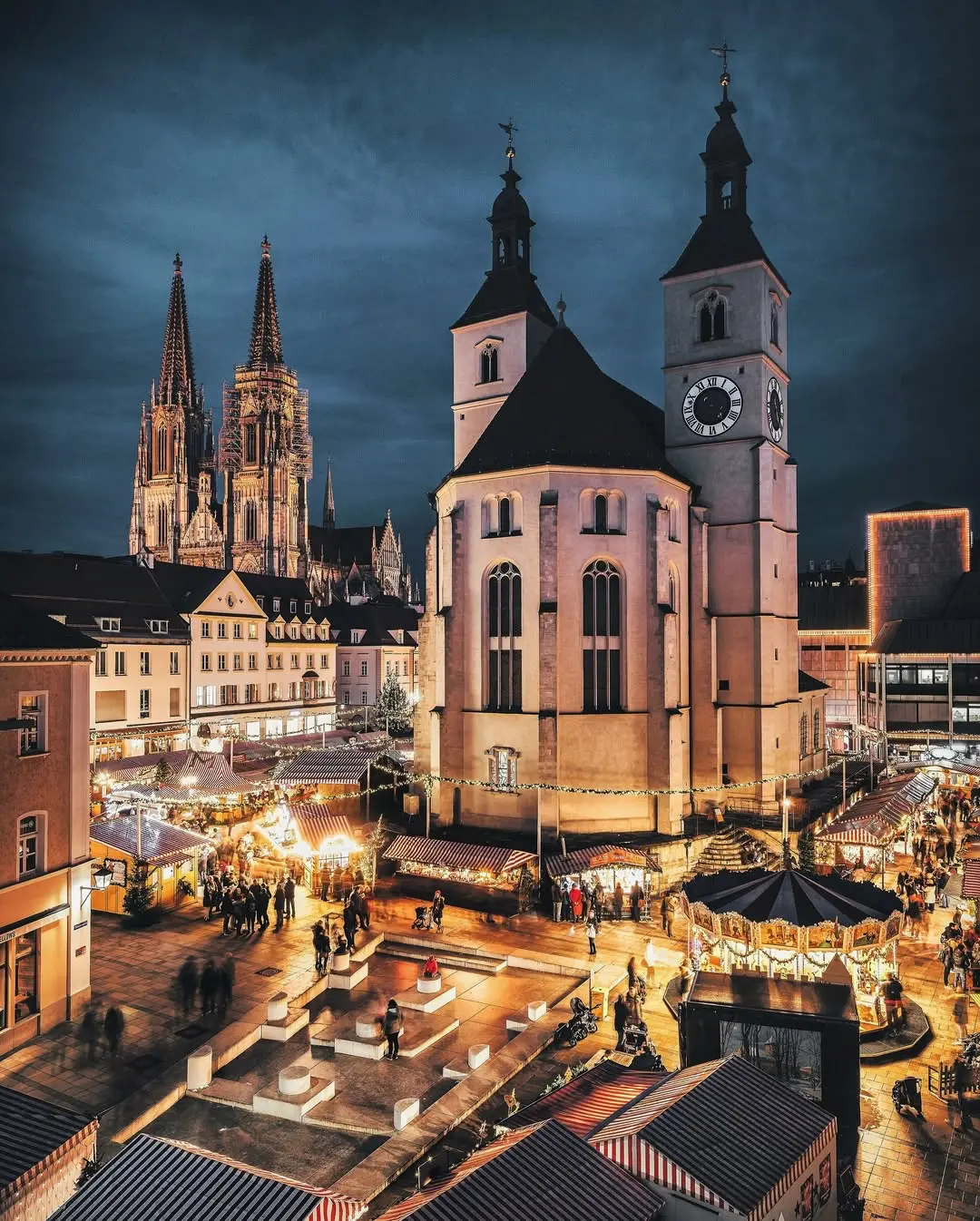
- Regensburg. A smaller, older Bavarian alternative that locals rate over Nuremberg for charm.
- Garmisch-Partenkirchen. The alpine play. Take the train south for mountain markets.
- Chiemsee island market. A market on an island in a lake.
What’s open after Christmas (the post-24 December workaround)
Most Munich markets close on 24 December (the main Christkindlmarkt shuts at 14:00 on the 24th and doesn’t reopen). If you arrive 26 December–5 January, the city is effectively market-dark. Almost.
The exceptions:
- Feuerzangenbowle stand at Isartor – open until 6 January. The single surviving glühwein outpost in the centre after the main markets close. If you want a central glühwein between Christmas and New Year, Isartor is the only address.
- Tollwood Winter Festival (Olympiapark) – through 31 December in most years.
- Glühweinfestival at Cosimabad, Bogenhausen – through ~30 December.
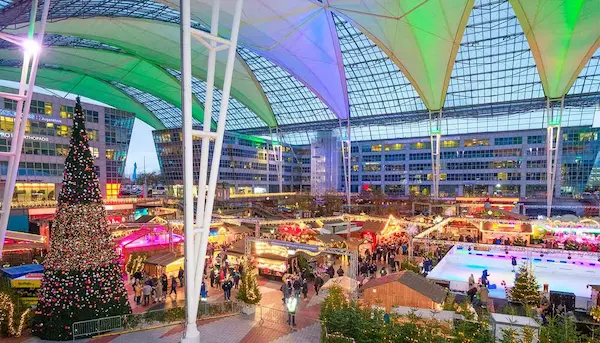
- Munich Airport Wintermarkt – through 1 January or 6 January. Surprisingly good. The post-Christmas option for stranded travellers.
- Viktualienmarkt (not a Christmas market as such) continues through the holiday with glühwein and food.
If you want an actual market after New Year, Salzburg runs to 1 January and is the day-trip option.
Tips for visiting + being a responsible visitor
A few practical notes, plus the bit I’d stress most:
- Bring cash. 80% of vendors take cards (no Amex), but the mug deposit comes back in coins, and the smaller craft and food stalls still prefer cash. You don’t want to miss a Kripperlmarkt figure because the card reader’s down.
- Dress for the cold. You’re standing still outdoors for hours. Layers, a real coat, gloves, a hat. December in Munich hovers around freezing at night, and the wind funnels through the Altstadt lanes.
- Book accommodation and trains early. December weekends sell out. Four to six weeks ahead is the sweet spot.
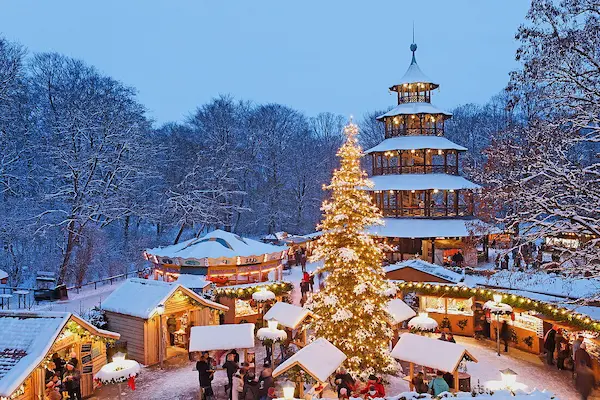
- Verify markets are running, and check the 2026 opening dates, before you build an itinerary around them. The Chinesischer Turm market in the Englischer Garten was cancelled in 2022 with little warning. Even long-running markets disappear year to year.
- Go on a weekday. I know I said it already, but it’s the single biggest lever on how much you enjoy the centre.
- Take the Krampuslauf seriously. 13 December 2026, 15:00–17:00, 400 participants, 70,000 onlookers. It’s a 500-year Alpine tradition and it’s wild.
Independent Christmas journaling. All of the opinions on this website are mine and written from my personal perspective, with my love for Christmas behind it.
Some links here are affiliate links. If you book a hotel, tour or rail ticket through one I may earn a commission at no extra cost to you. It never changes what I recommend, but it does allow me to run this website, invest time in it and provide accurate and useful information.