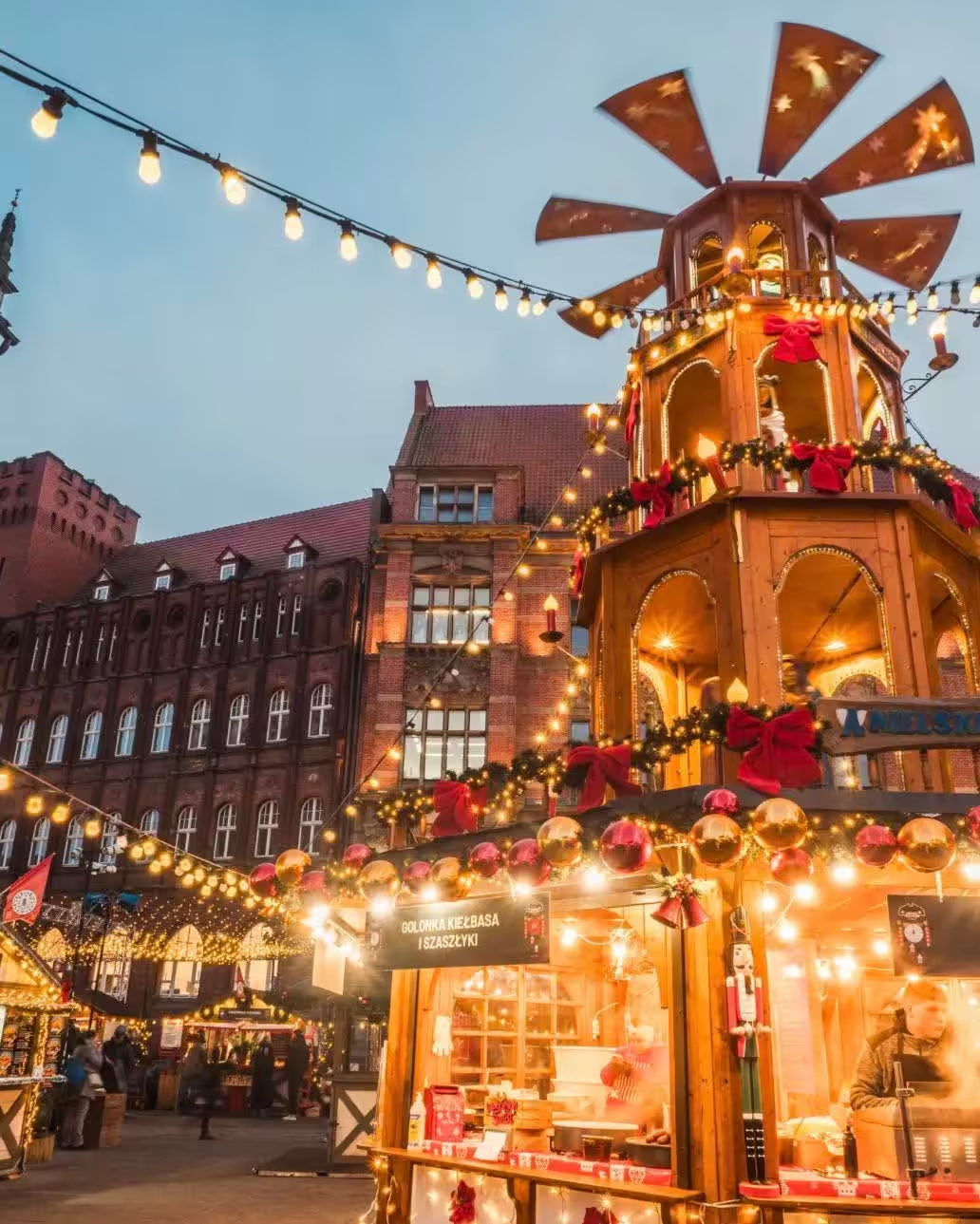
Gdańsk might be one of the best Christmas markets in Europe that you have never heard of.
And I don’t mean that as travel-blogger fluff. Those big reader polls, the European Best Destinations votes, the ones where hundreds of thousands of people actually vote… they keep putting Gdańsk at or near the top.
And that’s often ahead of Vienna, ahead of Prague, ahead of Strasbourg (which literally calls itself the Capital of Christmas) so you can imagine why these people feel like this.
And yet, if you ask a room full of people to name a Polish Christmas market, they’ll say Krakow, maybe Wrocław if they’re sophisticated, and then will completely forget about Gdansk.
Gdańsk is the band that’s topping charts in Europe while your local friends still haven’t streamed the album. Which means right now, this exact moment, is the sweet spot because Gdansk is famous enough to be world-class and unknown enough that you get to be the person who discovered it.
Now, why does it win? Well, the thing about Gdańsk is that it doesn’t look like Poland, at least not the Poland in people’s heads.
It’s a Hanseatic port city (kinda like Hamburg), an old member of the same medieval trading league as Bruges and Lübeck and Bergen, and it looks the part with tall, skinny, gabled merchant houses in every color, cranes and ship masts on the river, cobbles, gold trim everywhere.
I’ll bet that, on your trip, you will say “this looks like Amsterdam” within the first hour… Guaranteed! It happens all the time.
So the Christmas market doesn’t need to manufacture magic. You put a few hundred lights and a carousel into a street canyon that already looks like a snow globe, and the work is almost done.
But, there’s a catch, and it’s a big one… The Gdańsk market traditionally wraps up around December 23rd. While Krakow keeps going into January, Gdańsk packs up its stalls and goes home before Christmas even arrives.
So this is strictly an early-to-mid-December play.
Anyway, Gdańsk isn’t the biggest market, and it’s not the longest-running. It’s genuinely beautiful in the most unexpectedly gorgeous city.
And underneath all of it, there’s a story that makes this city hit differently. Because Gdańsk isn’t just a pretty face. It’s the city where the worst thing in modern history started, and also where the thing that ended it began. But that’s the next section, and trust me, it’s a good one.
What do you need to know about the city and the market?
Gdańsk has been doing markets for over 750 years.
In 1260, when London was still arguing about whether parliament should be a thing, the Pope himself signed off on the St. Dominic’s Fair, and it became one of the biggest and oldest market traditions in Europe.
It’s still running today, every summer. So when your friends are standing at the Christmas market with their grzaniec, they’re not at some festive pop-up invented for tourists in 2015.
They’re at the winter edition of a trading habit this city has had for three-quarters of a millennium.
And those markets made the city stupidly rich. Gdańsk was the trading hub of the Hanseatic League, the medieval union of merchant cities that basically ran northern European commerce, and its money came from grain, ships, and amber (mostly grain because Polish wheat flowed down the Vistula, into Gdańsk’s warehouses, and out to feed half of Europe).
That’s where those outrageous houses come from. This wasn’t a cute little port and in its golden age, it was one of the wealthiest cities on the continent, with the confidence to stick a giant bronze Neptune, the Roman god of the sea, in the middle of town as if to say “yes, the Baltic. Ours. Any questions?”
Because the city was Danzig then, a German-speaking free city between the wars, and on September 1st, 1939, at 4:45 in the morning, a German battleship opened fire on a tiny Polish military depot on a peninsula called Westerplatte.
Those were the first shots of the Second World War. The small Polish garrison there was supposed to hold for twelve hours. Instead, they held for seven days, and became a national legend while doing it. The worst six years in human history started right there, on that scrap of land in Gdańsk harbor.
And the city paid for it. By 1945, the historic center was rubble. 90% percent gone, those beautiful merchant streets flattened.
But here’s where Gdańsk’s rebuild story gets its own twist, different from Warsaw’s. Warsaw rebuilt exactly what was there.
Gdańsk made a different choice and it rebuilt itself in the image of its Hanseatic golden age with the Flemish-looking, gabled, merchant-prince version of itself, and de-emphasized the German-era city it had just been.
Okay, let’s talk about the actual Christmas market
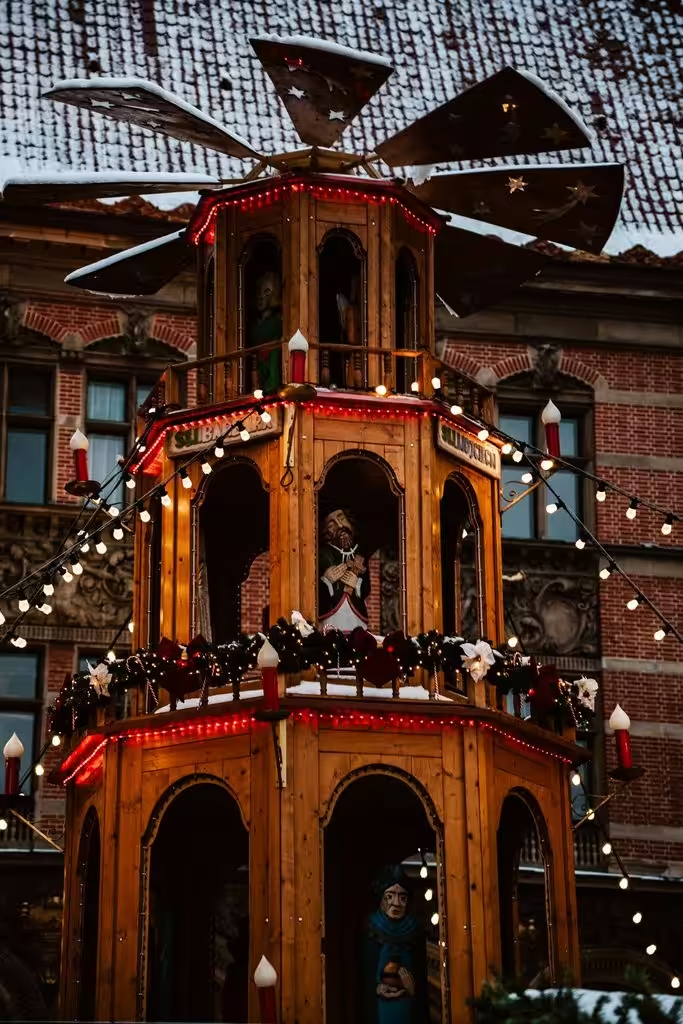
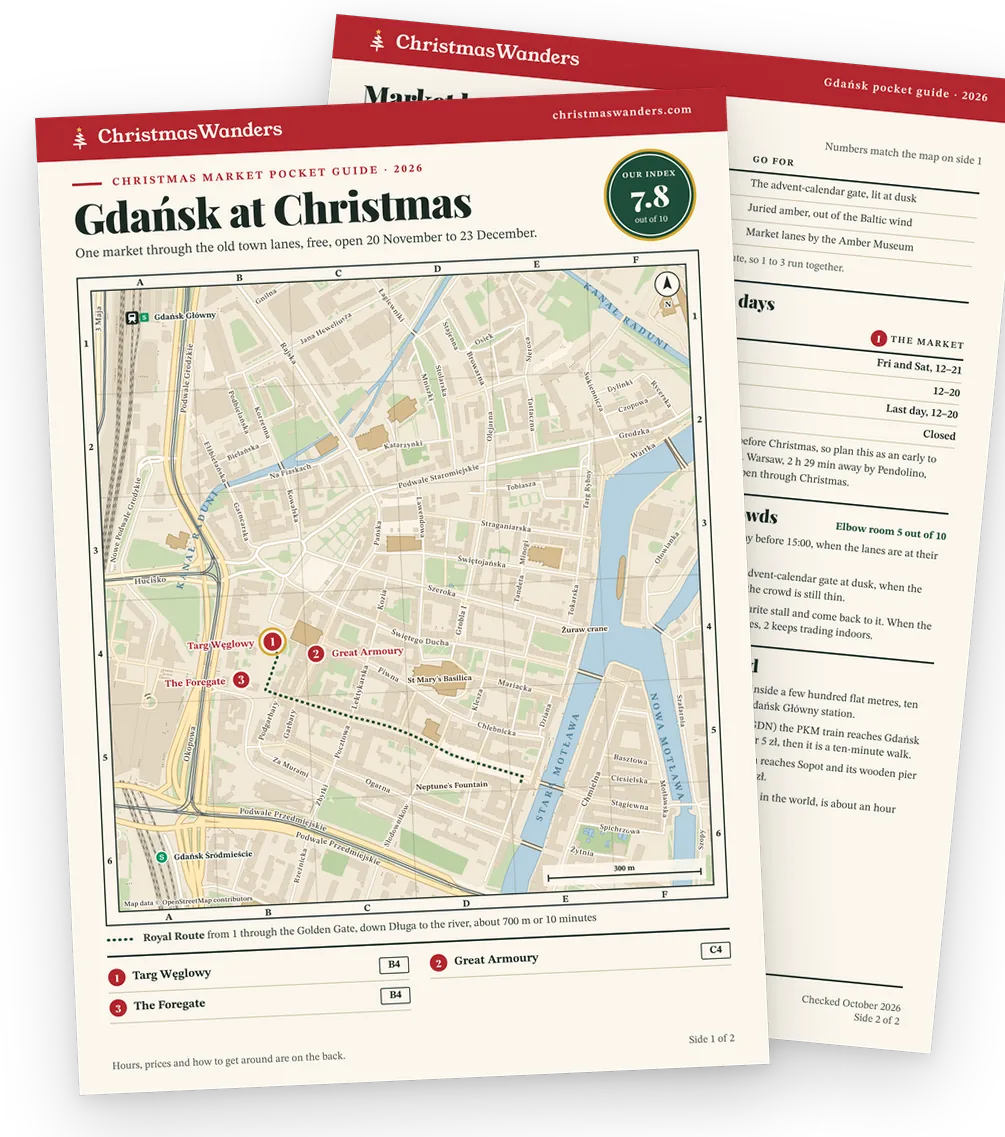
The Christmas market fills Targ Węglowy, the old Coal Market square, which sits at the top end of the Long Market, basically the prettiest street in Poland, with the Golden Gate at one end and Neptune’s Fountain around the corner.
Everything’s in one compact pocket, which is the first thing it does well. Now the good stuff.
I’ve said it before but it bears repeating; this is the one of the most photogenic market settings in the country and I’ll fight anyone on that.
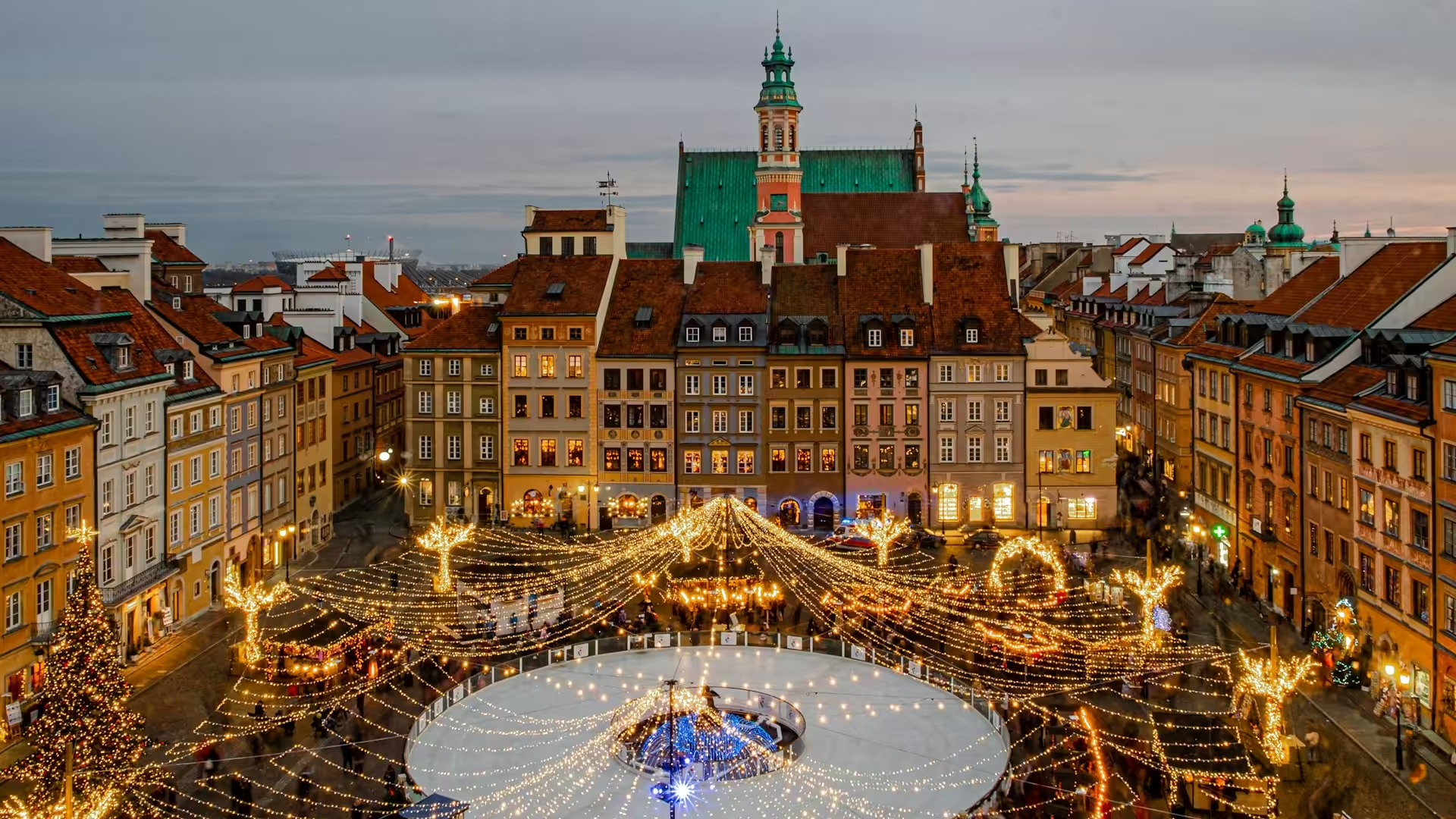
Those tall, skinny, gabled merchant houses crowd in around the square, every facade a different color with gold trim and ornate gables, and when the lights come on and the carousel’s spinning and there’s a giant Christmas tree doing its thing, it really looks like someone rendered a Christmas card and forgot to turn it off.
Your phone will run out of storage before the market runs out of angles.
Secondly, it understands the assignment on scale.
This is the anti-Vienna, and I mean that as a compliment. There’s no exhausting twenty-market sprawl, no three-million-visitor shuffle. It’s one atmospheric pocket you can actually do, in an evening, without a spreadsheet and a support team. It’s intimate. You do a lap, you find your favorite stall, you go back to it, you become a regular over the course of two hours.
That feeling of “our little market” is something the big famous ones lost years ago.
Third, the moose.
The market has these enormous illuminated moose sculptures… wait, but why moose?
Because Poland, that’s why, don’t question the moose! They’ve become the unofficial mascots and the designated selfie spot. Every visitor has the same photo. You will mock the moose, then queue for the moose, then post the moose. This is the moose lifecycle, nobody is immune, trust me.
Fourth, and this is where Gdańsk separates itself from every other market we’ve talked about on this website, the shopping is actually world-class.
This is the amber capital of the world. Baltic gold washes up on the beaches here, has been traded from this port for literally thousands of years, and the market stalls are full of it with jewelry, ornaments, little raw stones with forty-million-year-old gnats frozen inside, which is objectively the coolest stocking filler in existence.
By the way, real amber is light and warm to the touch, and the good stalls will show you certificates.
Fifth, and my personal favorite is the Goldwasser. This is Gdańsk’s own liqueur, a spiced, herbal vodka with actual flakes of 22-karat gold floating in the bottle, invented right here in the 1500s.
As for the food, well… it’s full Polish arsenal, obviously, with pierogi, bigos, the squeaky oscypek, hot Krupnik etc. Gdańsk does add its port-city bonus track – herring.
Herring in cream, herring in oil, herring in ways you didn’t know herring could be, plus smoked fish straight off the Baltic. Tell your friends to be brave once. The herring people are always right in the end.
What Gdansk has to offer beyond a Christmas market?
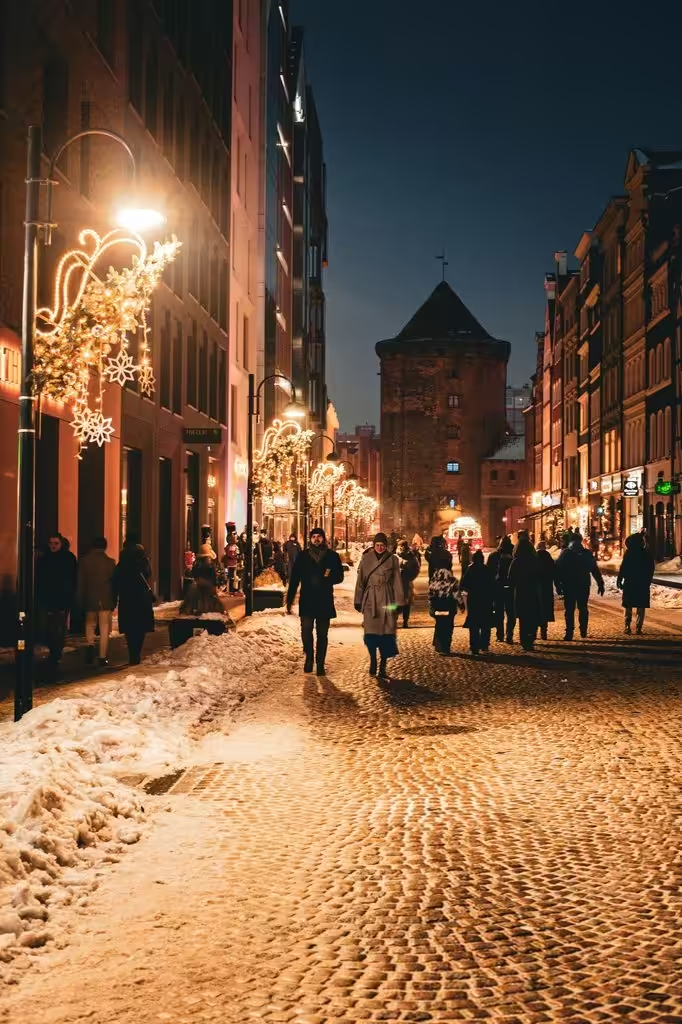
I recommend everyone to start with a simple stroll. The Royal Route from Golden Gate to the waterfront, down Długa Street and across the Long Market is the single most beautiful walk in Gdansk.
In December the whole route is lit up and it feels like walking through a jewelry box. Do it slowly and enjoy every moment of it.
Then duck into Ulica Mariacka, the street everyone falls for. It’s the amber street, very narrow, cobbled, lined with amber shops and little galleries. The real charm is the architecture though.
Every house has this raised stone terrace out front with carved balustrades and gargoyle-ish drainpipes, a feature you basically don’t see anywhere else.
In the evening, with the lights on and amber glowing in every window, it’s the prettiest street in a city full of pretty streets. Fair warning, you might take 40 photos here and use zero of the ones from anywhere else.
After that, go to St. Mary’s Basilica. It’s one of the two or three largest brick churches on Earth and it holds twenty-five thousand people, which means this medieval parish church could seat a Premier League stadium’s worth of worshippers.
It’s so big it doesn’t look real from up close, like a graphics glitch. You should also climb the tower… I know, I know, it’s a few hundred steps, but you’ll survive, because the view is definitely worth it.
Down on the waterfront, you have two stops. First the Żuraw, the big black wooden crane over the Motława river that’s on every Gdańsk postcard.
It’s five hundred years old, it’s the largest medieval port crane in Europe, and it was human-powered. Workers walked inside giant treadmill wheels, like hamsters, to lift four-ton loads off the ships.
Also it doubled as a city gate, because medieval people were efficient like that. And right nearby, the Amber Museum, housed in a medieval prison tower, so you learn about fifty-million-year-old tree resin in a former torture chamber.
Gdańsk does layers like nowhere else, believe me.
You should also do the European Solidarity Centre, that sits right in the old shipyard, in a building clad in rusted steel that looks like a ship’s hull, and it’s one of the best modern museums in Europe, with the story of the strikes, the movement, the wall coming down, told with actual drama.
As for the day trips, both are stupidly easy. Sopot is fifteen minutes away on the commuter train. This is the beach resort town, with the longest wooden pier in Europe stretching half a kilometer into the Baltic.
In December the beach is empty, the wind is biblical, and walking the pier feels like an expedition, but then you retreat to a warm café and feel incredible about yourself.
The other one is Malbork, an hour away. Malbork is the largest castle in the world, a Teutonic Knights’ mega-fortress the size of a small town, all red brick and towers.
Who should go and who should skip it?
This is not a city for everyone, and that’s exactly its charm. Let’s go.
In my experience, people who love this city belong to the group of beauty-first travelers. They are the ones choosing Bruges over Brussels, they plan walking routes around “the light,” their camera roll is 80% facades.
For that person, Gdańsk is the jackpot. The most photogenic market setting in Poland, in a city that looks like Amsterdam’s wealthier cousin, all lit up in December. They will produce content for months. Months.
Second, and this might be the strongest category, the Christmas market veteran. The person who’s done Vienna, done Prague, maybe did Krakow, and is now making that face that says “sure, but what else you got?”
Gdańsk is what else you got.
It’s the market for people who are bored of markets, because everything about it still feels like a discovery, because the polls say world-class, the streets say undiscovered, and that combination has an expiration date.
Third is the history person, and I know I said the same about Warsaw, but hear me out… Gdańsk might be an even stronger pitch per square meter. Warsaw has the whole 20th century, yes, but Gdańsk has the bookends. The first shots of the worst war in history, and the shipyard where the movement that ended communism began, within a fifteen-minute tram ride of each other.
You can stand at Westerplatte in the morning and in the Solidarity Centre after lunch, and that’s the entire arc of Europe’s worst century, start to finish, in one day.
Fourth… the gift-bringer. The one whose entire family expects “something nice” from every trip.
Amber jewelry from the world capital of amber, bottles of Goldwasser with actual gold flakes in them, little stones with prehistoric insects frozen inside… Gdańsk lets you do ALL your Christmas shopping at a Christmas market, with gifts that have actual stories attached.
Fifth is the purely geographic one. Anyone based in the UK, Ireland, Germany, or Scandinavia is a good fit because the flights are short, frequent, and frequently cost less than the taxi to your own airport.
Gdańsk is practically a weekend commute from Copenhagen or London.
As for the skips, that’s harder to define, but I guess one non-negotiable is anyone whose only window is late December, because Gdansk Christmas market packs up around the 23rd.
Another type of person who should skip Gdansk is the cold-averse. And I don’t mean normal cold like Vienna cold, Krakow cold… that’s amateur hour.
Gdańsk has Baltic cold, wind that comes off the sea with an agenda, wind that goes through your coat like your coat owes it money.
If you are the type of person to turn dramatic at minus two, this city in December will end you.
And last I guess, if you are the first-timer with one Polish city and three days to spare, I’d say Krakow still wins the debut because it’s the bigger market with a longer season and it’s a more complete package.
I think it’s pretty clear
This is the part where I usually sum it up with a clear question: Is Gdansk Christmas market worth your time?
Well, if you paid attention, you know how redundant it is for me to even attempt to answer that.
You’re getting the most beautiful market setting in the country, a Hanseatic street canyon that looks like Amsterdam dressed for Christmas, at the exact moment it’s topping European polls but hasn’t yet been overrun.
That window, right now, is the cheapest discovery premium in travel with a world-class product, undiscovered-crowd prices, and the smugness dividend of being the person in your group who went before.