Why Visit Vienna’s Christmas Markets
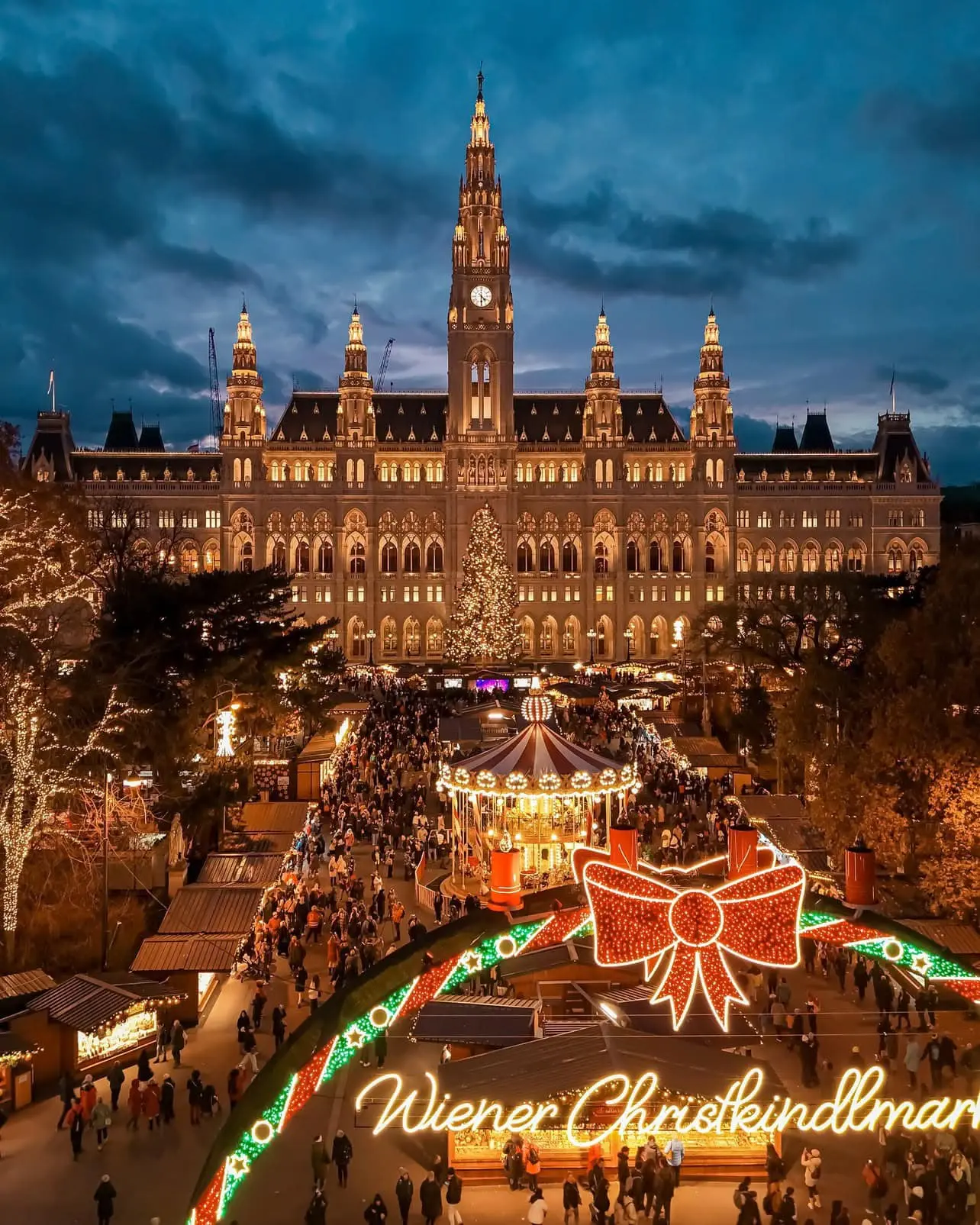
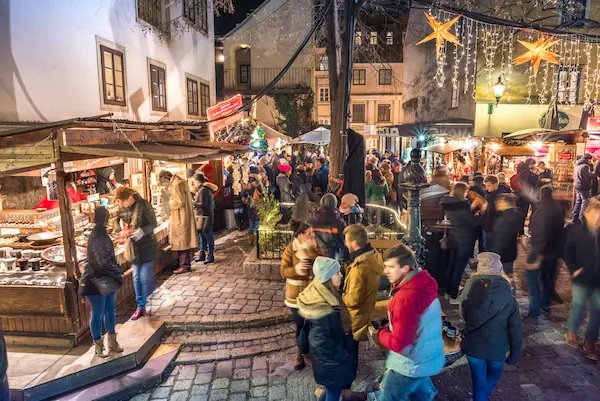
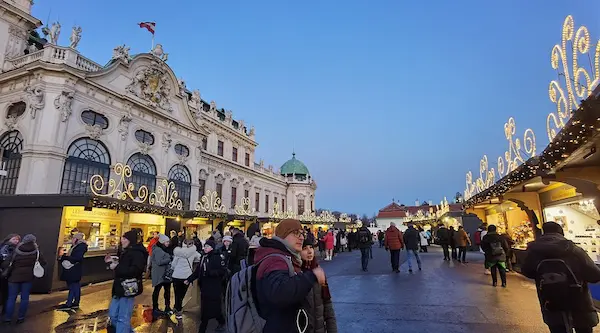
Other cities have a Christmas market. Vienna has a Christmas market system. Close to 20 of them pop up from mid-November on imperial squares, in palace forecourts, down cobblestoned backstreets, literally everywhere. And the remarkable thing is how different they are from each other.
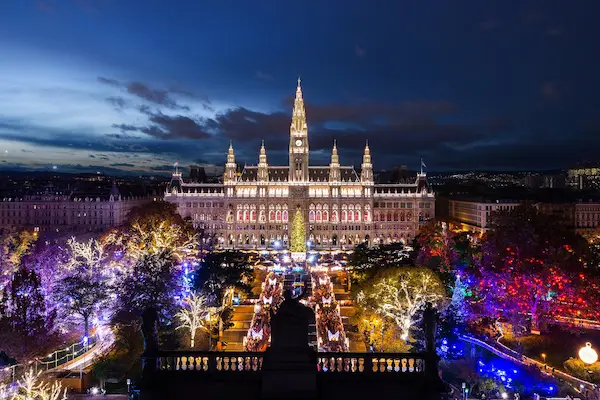
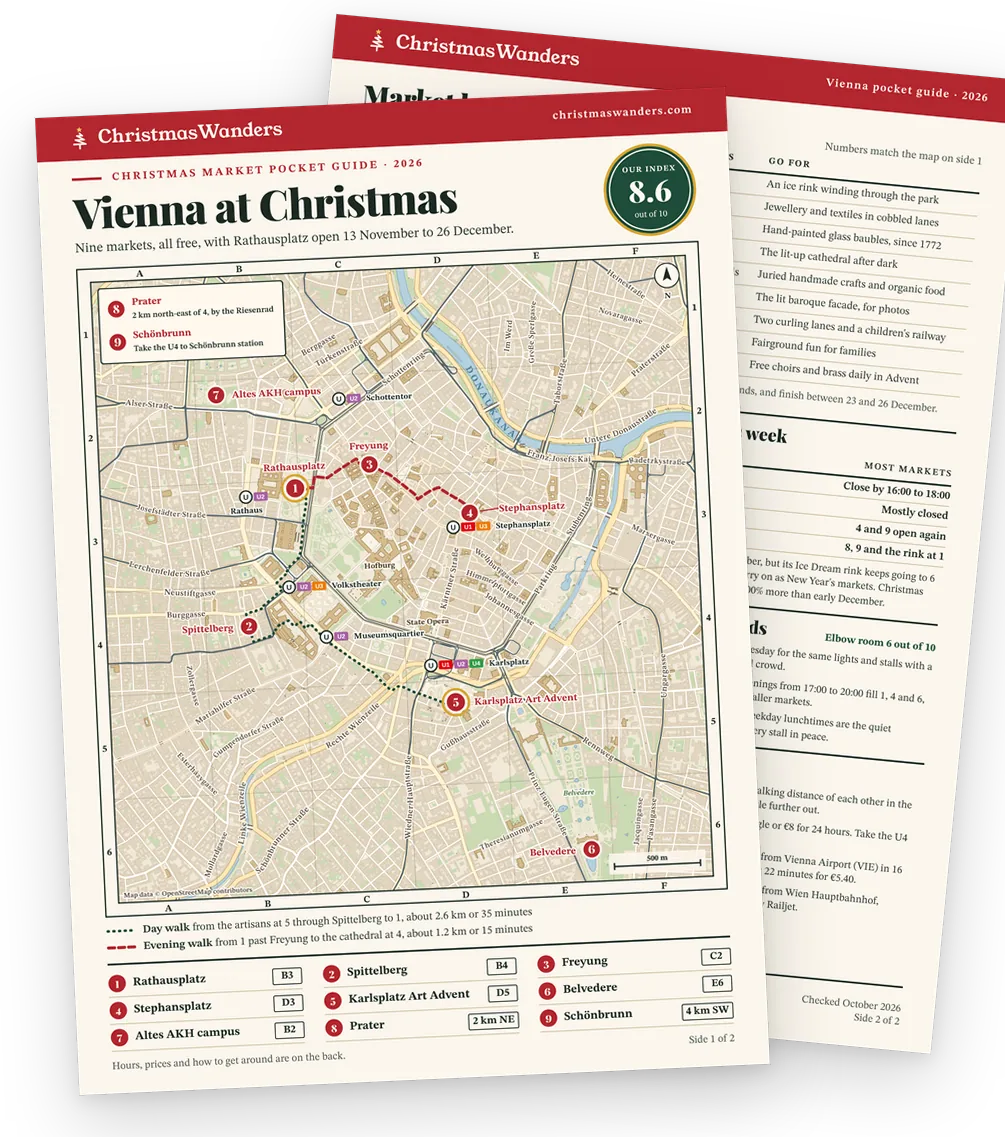
You can go from a juried artisan market at Karlsplatz where every piece is handmade, to a 150-stall behemoth at Rathausplatz with an ice rink snaking through the park, to a candlelit lane in Spittelberg that feels like it hasn’t changed in a century, and all of that in one afternoon.
Going to Vienna Christmas market is a destination trip, not a day trip, and you absolutely need to know that. I think 2 days is minimum to hit all the highlights but 3 or 4 if you want to go deeper and combine markets with palace visits, concerts, and Vienna’s ridiculous café culture (which are all more than worth visiting).
Couples, food lovers, and architecture nerds will get the most out of Vienna at Christmas. Families with kids under 10 should prioritise Rathausplatz and the Prater Winter Market as they have most activities that would interest kids.
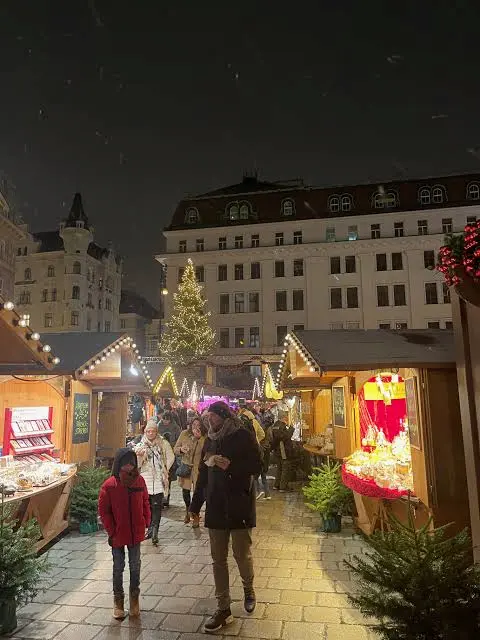
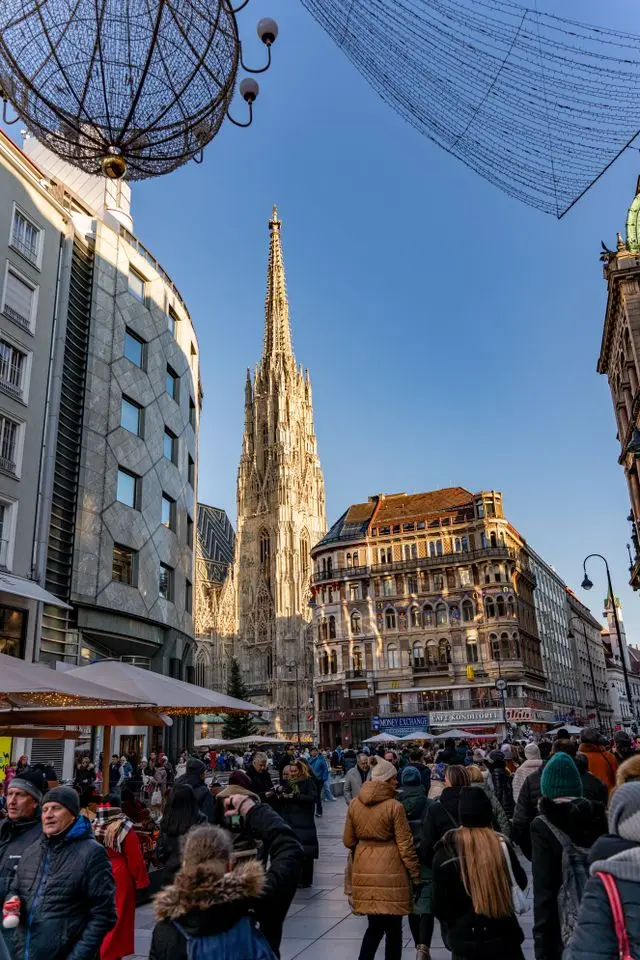
What I need to mention though is that the main markets, especially Rathausplatz and Stephansplatz, get crushingly busy on weekends.
Friday and Saturday evenings between 5 and 8 PM are the worst and tough to enjoy, if you are not a fan of large crowds (who is though?).
And while the stall quality across Vienna is noticeably higher than many German or Czech Christmas markets (very little plastic tat), some of the bigger markets have started to feel a bit samey in their food offerings.
You’ll see the same bratwurst-and-punch lineup at five different locations. The standout markets are the ones with curatorial standards: Karlsplatz, Spittelberg, and Freyung.
What to Expect
Food & Drink
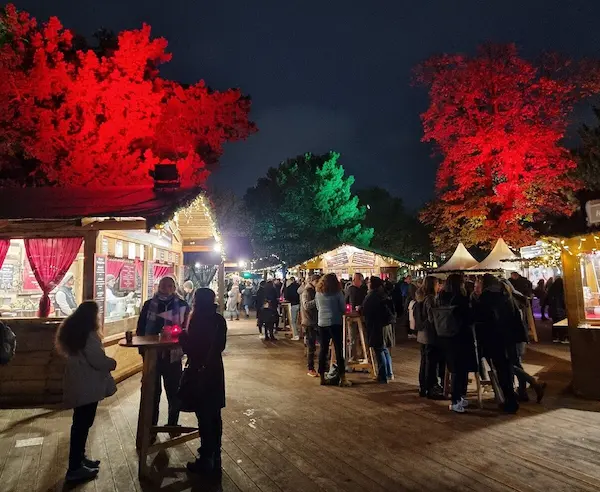
Forget the bratwurst for a second. The sausage you actually want at a Viennese market is called a Käsekrainer. It’s a pork sausage stuffed with melted cheese that oozes when you bite into it.
You’ll find it at almost every market for around €5-6 in a roll with mustard.
Another worthy find is Kaiserschmarrn, shredded pancake with powdered sugar and plum compote. It runs about €6-8 and is best eaten standing at one of the tall tables while it’s still hot.
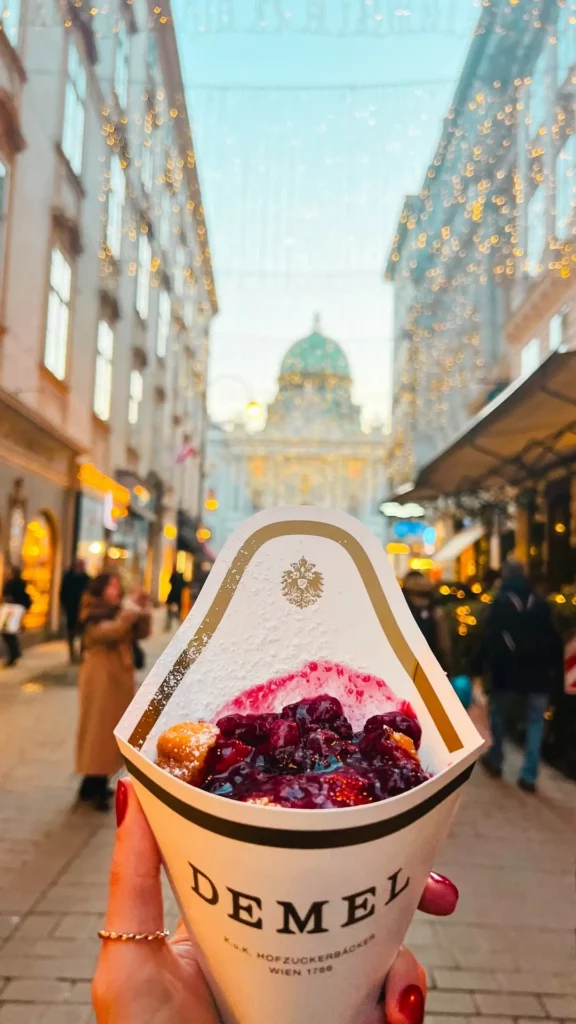
Other hits you might want to try include Kartoffelpuffer (crispy potato pancakes, around €4-5), Langos (Hungarian deep-fried flatbread with toppings, €5-7), and Bällchen, little dough balls served with vanilla or pistachio sauce that show up at almost every market.
For sweets, look for Lebkuchen (gingerbread), Bauernkrapfen (jam-filled doughnuts), and warm Apfelstrudel served with vanilla sauce. Expect €4-6 for a generous portion.
Drinks are where the Viennese system takes some getting used to. Glühwein costs around €4-5 for the drink itself, but you’ll pay a deposit (Häferlpfand) of €4-5 on top for the ceramic mug.
That means your first cup might cost €9-10 at the register. Return the mug, get the deposit back. Or keep it. Each market designs its own mug every year, and collecting them is a Viennese tradition.
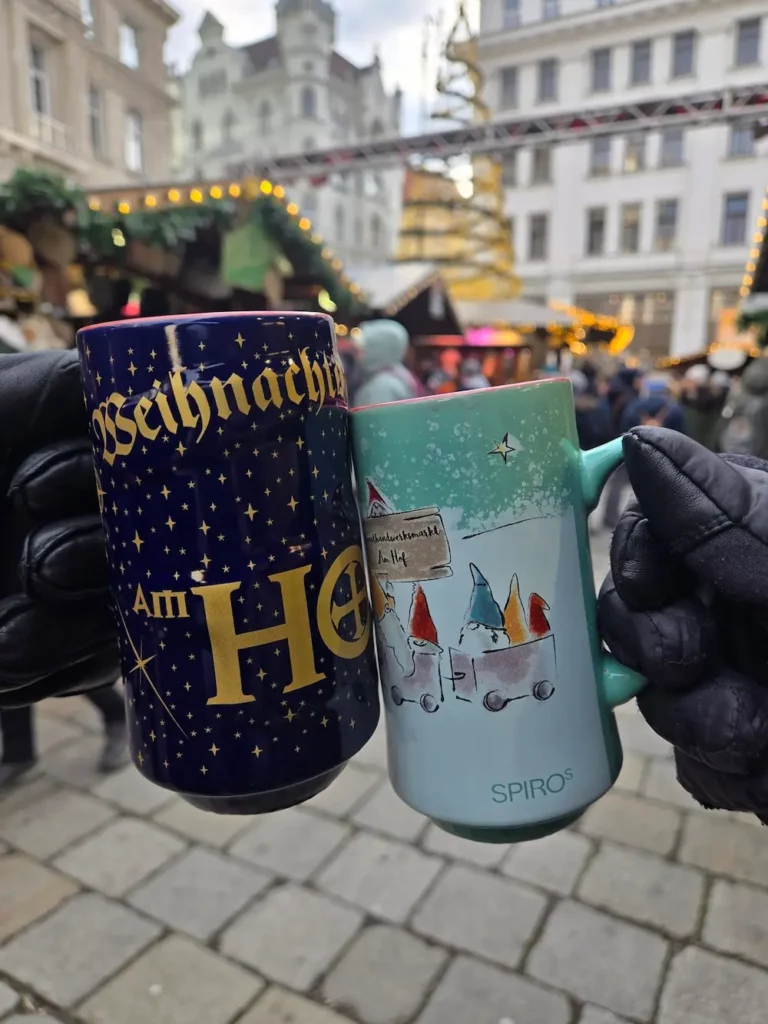
Beyond standard Glühwein, try the Punsch varieties: orange, white wine, or the theatrical Feuerzangenbowle where they set a rum-soaked sugar cone on fire over the bowl.
Shopping
The quality floor in Vienna is noticeably higher than in many other European Christmas market cities.
Plastic is rare. You’ll see a lot of wood, glass, ceramic, straw, and metal across the boards. For genuinely handcrafted pieces, not mass-produced “artisan-style” goods, head to Karlsplatz (Art Advent), where every vendor must be personally approved and each stall has a QR code linking to the artist’s background.
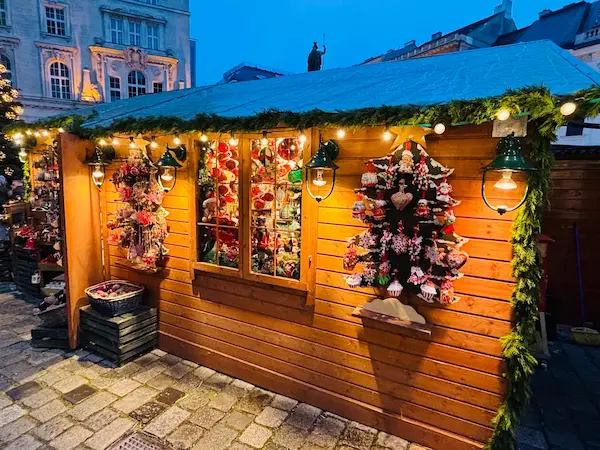
Freyung is the best spot for traditional Christmas decorations with hand-painted glass baubles, carved wooden nativity figures and beeswax candles.
Spittelberg rewards browsing with unusual jewelry and textile pieces you won’t find elsewhere.
What you should skip are the mass-produced Mozart chocolate boxes at Rathausplatz (cheaper in any supermarket), and anything that looks identical across multiple different markets.
Entertainment
The Rathausplatz market anchors its entertainment around the Vienna Ice Dream, a 3,000 m² skating rink that winds through the illuminated Rathauspark.
Skate rental is available, of course.
At the university campus market (Altes AKH), you’ll have curling lanes which are a quirky alternative to skating.
Karlsplatz will run fire shows and street theatre performances on weekends.
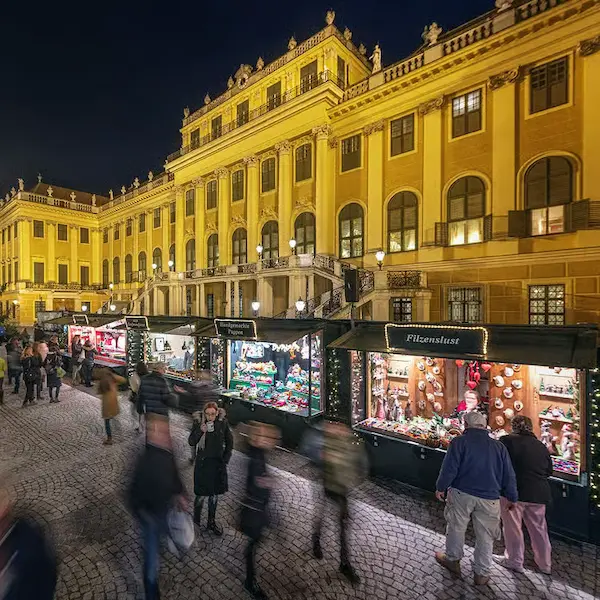
Schönbrunn has daily free performances such as choirs, a cappella groups, and brass ensembles throughout Advent.
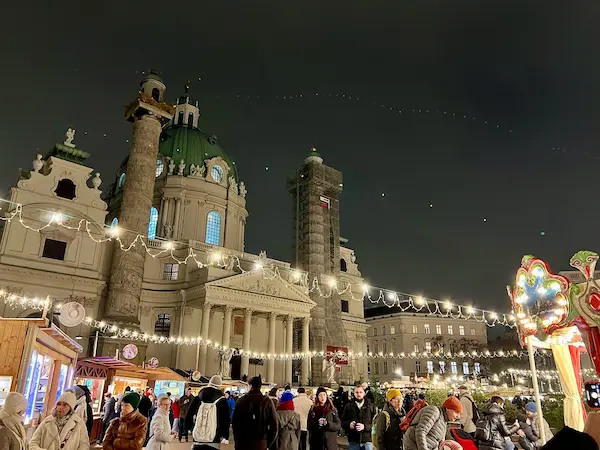
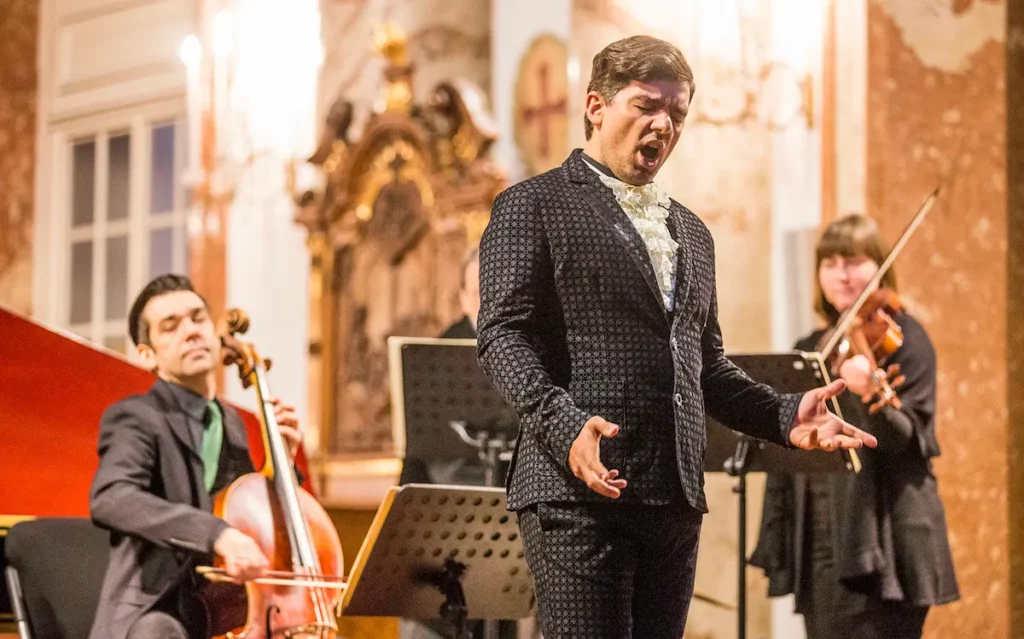
For something beyond the markets, keep in mind this is Vienna. Concert tickets are almost mandatory. Karlskirche hosts Vivaldi’s Four Seasons during the season every year, and both Schönbrunn and Mozarthaus run classical concert programmes.
Book ahead though!
For Kids
Rathausplatz has the most kid-friendly setup which include a Ferris wheel, a classic carousel, and the skating trail.
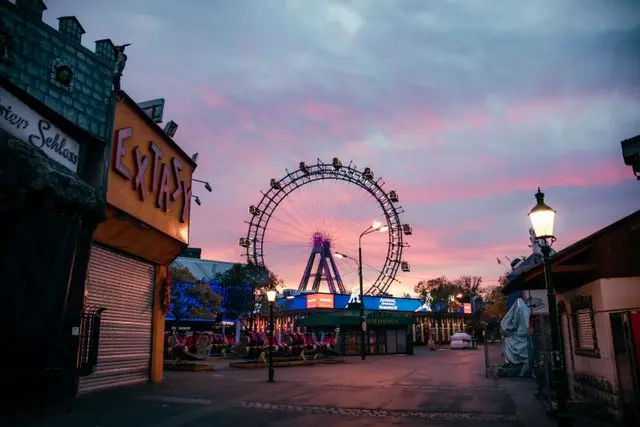
The Prater Winter Market is also good for families who need the amusement park energy to complement the market stalls.
The university campus market has a children’s railway and an old-fashioned carousel.
Kinderpunsch, the non-alcoholic fruit punch version, is available everywhere though and comes in the same collectible mugs as the adult drinks.
Practical Information
Most Vienna markets open between November 8 and November 16, with the majority running until December 23–26. Schönbrunn and the Prater Winter Market extend into early January as New Year’s markets.
Hours are typically 10 AM to 9 PM daily, with some markets staying open until 10 PM on weekends.
Christmas Eve hours are sharply reduced (most close by 4-6 PM), and December 25-26 runs shorter schedules where markets are open at all.
Admission to every market is free. No exceptions.
The crowd pattern is sort of predictable and same as for any other European Christmas market.
Weekday lunchtimes are quiet and you’ll be able to see what every stall has to offer in peace. Weekday evenings from 5-7 PM are also pleasant. And of course, Friday and Saturday evenings from 5-8 PM are wall-to-wall people at the major markets. Rathausplatz, Stephansplatz, and Belvedere will be the most packed so that might be the time to visit some of the smaller markets.
Sunday mornings are my sweet spot. The first two weeks of December are busier than late November, so keep that in mind as well.
Budget guide for two people spending an evening at the markets: two Glühwein (€10 for drinks, plus €8-10 in deposits you’ll get back), one Käsekrainer each (€10-12), a shared Kaiserschmarrn (€7), and one small handmade gift (€10-20). Expect to spend €40-50 for a solid evening, excluding any mugs you keep as souvenirs.
December weather in Vienna: daytime highs around 4°C, dropping to 0°C or below after dark. Snow is possible but not guaranteed. Vienna’s winters have been getting milder. Layer up. Waterproof boots, thermal socks, and gloves aren’t optional for an evening of outdoor market wandering.
How to Get There
Take the train. Vienna sits at the centre of Central Europe’s rail network and the connections are fast, frequent, and cheap if you book ahead.
- By train: ÖBB Railjet services connect Vienna Hauptbahnhof (main station) directly to Salzburg (2h 20m, from ~€25), Munich (4h, from ~€30), Budapest (2h 30m, from ~€19), and Prague (4h, from ~€15 if booked early). From Bratislava, it’s just one hour. Book on oebb.at. Prices are significantly cheaper 2-3 weeks out than at the station.
- By air: Vienna International Airport (VIE) sits about 20 km southeast of the city centre. The CAT (City Airport Train) does the run to Wien Mitte station in 16 minutes non-stop. The cheaper option is the S7 suburban train, which takes about 22 minutes to Wien Mitte for just €5.40. Railjet trains also connect the airport directly to Wien Hauptbahnhof in 15 minutes.
- By car: Don’t. Central Vienna is a restricted traffic zone and parking near the markets is either unavailable or absurdly expensive. If you’re driving in from another Austrian city, park at a Park & Ride lot on the outskirts and take the U-Bahn in. The P+R facilities at Hütteldorf, Erdberg, and Leopoldau all connect directly to the subway.
- Getting between markets: Vienna’s public transport system of U-Bahn, trams, and buses is excellent, cheap, and runs frequently. A 24-hour ticket costs €8, and most markets in the inner city are within walking distance of each other. The Schönbrunn market is the main exception. Take the U4 to Schönbrunn station.
Where to Stay
The best area for Christmas market access is the Josefstadt district (8th district) or the western edge of Innere Stadt (1st district), both within a 5-10 minute walk of Rathausplatz, Spittelberg, and Freyung.
The Neubau (7th district) around the MuseumsQuartier is another strong option, close to Spittelberg and Karlsplatz, with a younger, more local feel.
You should budget around €70-110/night at a minimum. JO&JOE Vienna offers shared and private rooms and is well-connected by tram. Motel One Wien-Staatsoper, near Karlsplatz station, consistently delivers the best value-for-money of any hotel in Vienna: clean, comfortable, great breakfast, under €100 most nights.
Some mid-range (€120-200/night) options include Max Brown Hotel 7th District that sits right near Rathausplatz with a design-forward interior. Hotel Josefshof am Rathaus in Josefstadt is a quieter pick in a charming side street.
Both put you within walking distance of 4-5 markets.
If you want to splurge (€250+/night), you can opt for places like Hotel am Stephansplatz for the cathedral views and unbeatable location. Hotel Imperial on the Ringstraße if you want the full Habsburg experience. The Ritz-Carlton Vienna for top-tier luxury near the opera house.
Also, make sure you book at least 6-8 weeks ahead for December stays, especially the first three weekends. Christmas week (Dec 20-26) commands 50-100% premiums over early December. Late November offers the same markets, the same atmosphere, and significantly lower hotel prices.
Tours & Experiences
Vienna is walkable enough that you don’t strictly need a guided market tour. The markets are free, well-signed, and clustered closely together.
But if it’s your first time and you want a local’s insight into what to eat and where to go beyond the obvious, a food-focused tour is worthwhile.
The top-rated option is the Christmas Market Food and Drinks Tour (~€70-80 per person), which takes you to four lesser-known markets, skipping Rathausplatz entirely, with food and drink included at each stop.
Guides like James and Rita get consistently excellent reviews for their depth of knowledge.
The walking Christmas Market Tour (~€25-35) covers more markets in a shorter time without the food component.
If you’re heading to Schönbrunn anyway, the Schönbrunn Palace & Christmas Market Walking Tour (~€40-50) bundles a skip-the-line palace tour with market time, a time-saver during the busy December period.
For something beyond the markets, book a classical concert. The Vivaldi Four Seasons performance at Karlskirche is a standout experience. The baroque church interior paired with a candlelit concert makes for a memorable evening. Tickets sell out, so book well ahead.
Insider Tips
- Try the Käsekrainer before the bratwurst. It’s the sausage the Viennese actually eat: cheese-stuffed, messy, and better than a standard bratwurst in every way. Available at almost every market for €5-6.
- Don’t buy at the first market you visit. The stalls rotate between markets, but each one has its own curated selection. Walk two or three markets before spending. The exception is if you see something truly unique at Karlsplatz or Freyung, grab it. Those artisan vendors aren’t at other locations.
- Visit Rathausplatz at 10 AM on a Tuesday. Same lights, same stalls, a fraction of the weekend crowd. The skating rink is also emptier in the mornings.
- Bring a small backpack, not a handbag. You’ll be holding mugs, food, shopping bags, and your phone for photos. Free hands matter. Also: waterproof boots with actual grip. Cobblestones get slippery when wet.
- The mug deposit system works in your favour. If you keep a mug from your first market as a souvenir, you can then use mugs from other markets and return them for the deposit. You end up with one collectible mug and no wasted deposits.
- Pack hand warmers. Standing at outdoor markets for 2-3 hours in near-freezing temperatures is more tiring than it sounds. Disposable hand warmers in your coat pockets make a genuine difference.
Nearby Markets & Day Trips
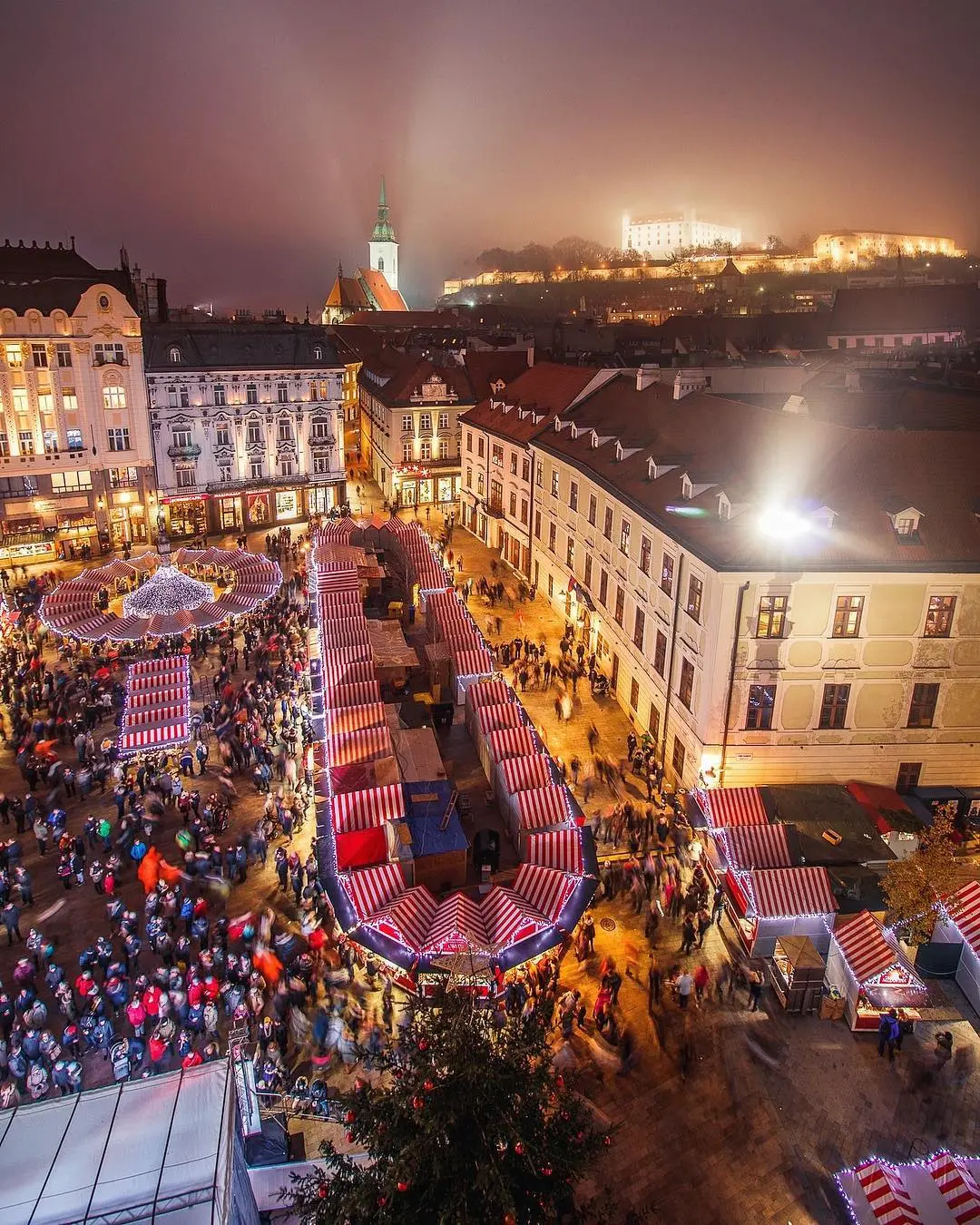
Bratislava, Slovakia: One hour by train from Wien Hauptbahnhof. The ÖBB Bratislava Ticket costs €16-18 return and includes local public transport. Bratislava’s Christmas market on the Main Square is small but charming, with cheaper food and far fewer crowds than Vienna. A proper half-day trip if you’ve already done Vienna’s main markets.
Salzburg, Austria: 2 hours 20 minutes by Railjet. Salzburg’s markets, especially the one in front of the Cathedral, offer an Alpine Christmas atmosphere that Vienna, as a big city, simply can’t replicate. Doable as a long day trip (8 AM train out, 6:30 PM return) but better as an overnight.
Budapest, Hungary: 2 hours 30 minutes by train. Budapest’s Vörösmarty Square market has its own distinct character: more rustic, heavier on Hungarian food (chimney cake, goulash), and generally cheaper than Vienna. Better as an overnight than a day trip given the travel time.
Baden bei Wien, Austria: 30 minutes by regional train. A small-town market in a thermal spa town south of Vienna, with fewer than 20 stalls but zero tourist pressure. Worth an afternoon if you want to see how Austrians outside the capital do Christmas.
History & Tradition
The first documented market here wasn’t really a Christmas market at all.
In 1298, the Viennese got a licensed “December Market”, essentially permission to sell goods through winter. Nothing festive about it. But that’s the seed.
The Freyung square market has been running since 1772, making it the city’s oldest continuous Advent market.
The modern Christkindlmarkt at Rathausplatz, despite being the most famous, is actually a relatively recent addition.
The tradition of the Christkind, the Christ Child as gift-bringer rather than Santa Claus, is alive in Austria.
You’ll see golden-haired Christkind figures at the markets, especially at Rathausplatz, where a Christkind procession opens the season each year.
It’s one of those customs that’s become partly performative but still connects to something real in how Austrians mark the season.
Our Verdict
The most complete Christmas market city in Europe: not the cosiest, not the cheapest, but the one with the most range and the highest average quality. Definitely worth visiting!